Sign In
Upcoming Event
 Free Newsletter

Proposals would ban cities from raising utility taxes for 4 years
Jakob Thorington, Arizona Capitol Times//March 6, 2026//
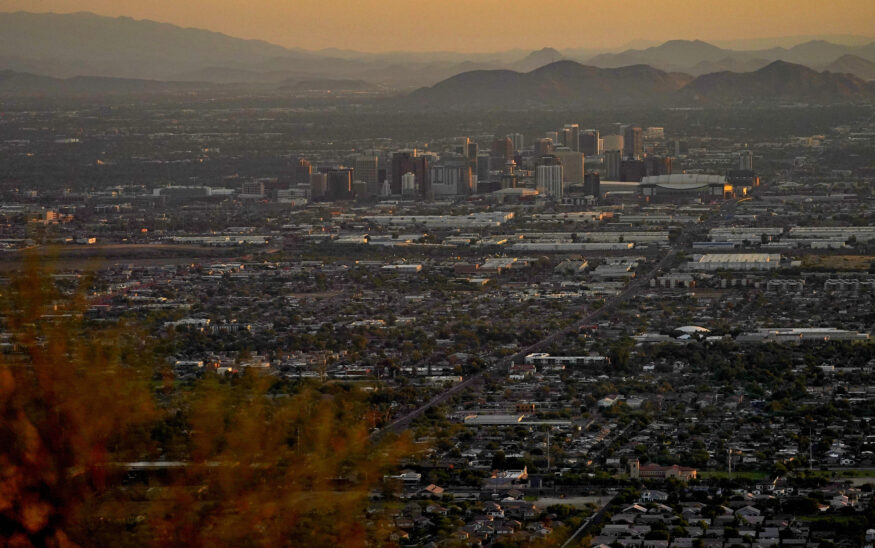
Day breaks over downtown Phoenix, Monday, July 17, 2023. (AP Photo/Matt York)
Proposals would ban cities from raising utility taxes for 4 years
Jakob Thorington, Arizona Capitol Times//March 6, 2026//


Key Points:
-
GOP bill would pause the ability for cities and towns to raise taxes or utility fees until June 30, 2030
-
The measure could go to voters on the November ballot
-
If passed, bill would allow increases with a 60% marginal approval in a local election
House Republicans are trying to enact a statewide four-year moratorium on tax rate increases at the municipal and county levels.
Rep. Justin Olson, R-Mesa, is sponsoring two measures that would prohibit cities and counties from raising taxes or increasing utility rates from July 1, 2026 through June 30, 2030. Local voters could approve a tax or utility fee increase with 60% of the vote.
Neither measure, House Bill 4030 nor House Concurrent Resolution 2052, has received a vote in the House yet. If Gov. Katie Hobbs were to veto the bill, then voters could decide whether the measure should pass in the form of a resolution this November — if the measure passes the House and Senate.
“What we’re trying to accomplish with this moratorium on tax and fee increases is to make it easier for hardworking Arizonans to deal with the high cost of living,” Olson said during a Feb. 11 House Ways and Means Committee hearing. “We’re not going to add to that burden by increasing tax rates and fees at the municipal level.”
City and county leaders are heavily opposing both measures, saying lawmakers are intruding on local budgetary decisions and that local infrastructure projects could be delayed if either measure becomes law.
Robyn Prud’homme-Bauer, the mayor of Clarkdale, called both measures “catastrophic” in a March 4 interview with the Arizona Capitol Times.
“We don’t even know how we would cover these costs,” Prud’homme-Bauer said. “If we can’t raise rates or assessments to cover those costs, then we have to get it from someplace else.”
For Clarkdale, that likely means cutting into the town’s $6 million general fund, which covers police, parks and other general services for the town.
But many conservative policy advocates argue Arizona cities and towns have more money than ever. The Arizona Free Enterprise Club referenced a 2025 report from the Common Sense Institute Arizona that concluded cities have had a $7 billion “surplus” in local and state shared revenue since 2020.
“I sure wish it was true,” said the League of Arizona Cities and Towns Executive Director René Guillen. “I would love for our cities to have $7 billion in excess cash. I don’t know what couch cushions they’re looking under.”
The Legislature did increase the general fund distribution that cities get from urban revenue sharing to 18% from 15%, but Guillen said that was done after former Gov. Doug Ducey signed the state’s flat tax law as a way to help keep cities afloat with the reduced revenue. The Covid pandemic also caused a surge in revenue for cities because tax filings were delayed in 2020.
Olson said in the Ways and Means Committee hearing that his measures don’t cut any city revenue but cap tax and utility rates to what they’re currently at. The Arizona Tax Research Association has also concluded general fund budgets for cities are up 67% within the past five years.
“If a city can’t live within its means with the existing rates, then it needs to find ways to be more efficient with the tax dollars,” Olson said.
Rep. Neal Carter, R-San Tan Valley, said he doesn’t believe cities will cut essential services.
“They’re not going to be cutting police and fire. They’re going to be cutting the lighting to the water tower,” Carter said.
Rep. Quanta Crews, D-Phoenix, noted that more than half a million people have also entered the state since 2020, and the revenue growth also considers the increased population in many areas of the state.
“Budgets are not linear, especially when you’re dealing with people,” Crews said.
Several Republicans lawmakers have grown uncomfortable with the size of city budgets and their revenue totals in recent years. In 2015, shared revenue among cities was about $1.5 billion and this fiscal year, it rose to $2.9 billion, according to House Appropriations Committee Chairman David Livingston, R-Peoria.
City leaders have also pointed to higher costs from the state as reasons why their budgets have increased in the 2020s. Prud’homme-Bauer said wastewater treatment costs in Clarkdale have shot up drastically in the 2020s because permits from the Arizona Department of Environmental Quality have increased by 1,400% in the last five years.
In 2025, the Maricopa City Council approved a half-cent sales tax increase to support the widening of State Route 347, which had become notorious for being one of most dangerous highways in the western U.S.
The league’s legislative liaison Tom Savage told the Arizona Capitol Times that had Olson’s proposal been law last year, Maricopa would have had to wait until this fall to put the tax increase question on the ballot, delaying work on that highway and potentially risking more fatalities and injuries.
“We would not have been able to strike while the iron was hot to make this important decision,” said Maricopa Mayor Nancy Smith. “Nobody likes taxes, right? But I haven’t talked to one person who is so angry about this tax that they vehemently oppose it.”
And if residents don’t like their local leaders’ taxing and budgetary decisions, Smith said they do have a choice at the ballot with elections. Should HCR2052 make it to the ballot this fall, it would allow a statewide vote to impact local budgetary decisions for each municipality and county.
“Let us do our work. That’s what we’ve been duly elected by our residents to do,” Prud’homme-Bauer said. “Nobody wants to raise taxes, fees or assessments. But to have a healthy community that can sustain itself, sometimes we have no choices, and we try to be as prudent and as least impactful as we can when we do have to raise them.”