Sign In




 Free Newsletter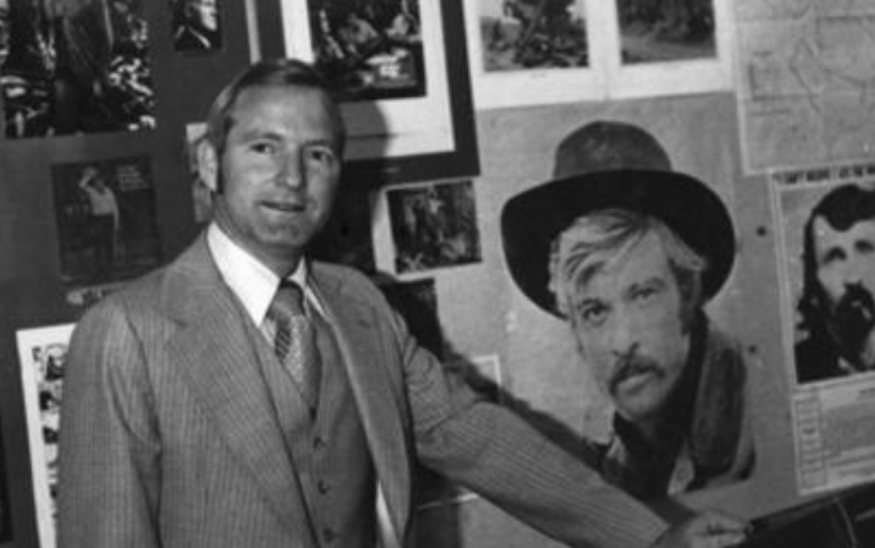
A photo of Marshall Trimble in his youth posing next to historical photographs. (Courtesy of marshalltrimble.com/)
Marshall Trimble: A piece of Arizona history
Kiera Riley, Arizona Capitol Times//July 3, 2026//


State Historian Marshall Trimble was born and raised in Arizona. He taught Arizona history to school children and college students. He travelled around the state and struck up conversations at every stop. He recounted the stories he heard in writing.
Now, on America’s 250th anniversary, he reflects on the many tales of opportunity in Arizona’s history and reflects on his own ascent to a nationally published historian writing on the state and country he calls home.
Questions and answers have been lightly edited for style and clarity.
What led you to immerse yourself in Arizona history?
I was born here, and my story is kind of interesting in that we lived in a trailer house. Five of us lived in a little two room trailer house when I was a kid. My dad had been a farmer, but he never owned his own land. He never even graduated from high school. And he used to say to me, Marshall, he said, ‘Go to college if you can. Just know it. If you can, go to college. It’s possible for you to go to college.’
I went to Phoenix College. I came from a high school of about 30 students in a little railroad town, and my dad didn’t make enough money for us all to have anything. My mother had to work as a waitress.
I could go to Phoenix College for $17 a semester, and that was in the 1950s, so that wasn’t that long ago. It sure wasn’t to me, but I was the first in my family to go to college, and I did it working at Encanto Park for $1 an hour and paid my way through the first two years of college. Then I was able to go on to ASU. It had just become ASU in about 1958. I got a master’s degree, and I started out as a school teacher, teaching Arizona history at a local high school here in Scottsdale. It was starvation wages.
Then, I just fell into a job teaching Arizona history at Scottsdale Community College, and next thing you know, my students said, Marshall, you should write a book, and I said, I can’t even write a good term paper, just barely graduated from college, and they said, but “Tell your stories, just tell the stories. Your students love to hear the stories about Arizona.”
I thought about that for a couple of days, and I sat down one night and wrote a whole chapter on a topic. I submitted a manuscript to Doubleday in New York, and doggone it, they published it. I couldn’t believe it when I got word they bought it. They offered me $10,000. That was more than I was making a whole year as a teacher. I thought maybe I hit on something here, and next thing, oh, I’m autographing books, and publishers are asking me to write something else.
I know that was unusual, probably, but the opportunity was there to do that. Only in America could that have happened.
What did you try to imbue in your students as an educator?
I appreciate – today – an education. The opportunity is there, and why throw your life away? Do something, and do something for the people, do something for your community, do something worthwhile, something we can be proud of. And I always had that philosophy. I never preached it that much, I just mentioned it to my students, but over the years I had thousands of students, and I still hear from them today, and I just keep falling back on that. Only in America could you have done something like that.
With your own story in mind, how are you thinking about America’s 250th?
America has lasted just 250 years, which is not very long when you think about it. But we very quickly rose to a world power. It sounds boastful, but it was true. We saved the free world twice in one century, referring to World War I and World War II.
You’ve always got dictators and people who seize power, and the people in America always were making their own laws. They may have been fighting each other at the same time, but, we’re in America. We always said we can do this.
We should be proud of our history, because we’ve given so much and contributed so much. We love to beat up ourselves, but I say I think we should look at the good because of what we’ve accomplished, and we should be proud of it. So, after 250 years, we’ve done some great things, and things to be proud of. We should be proud to be Americans.
How would you describe Arizona in reflecting on the 250th?
We’re the baby state. Well, not anymore, but we were for a long time, and we had a hard time getting statehood. At the time of statehood they wanted to put us together with New Mexico.
We thought, wait a minute, we’re different. We came out here for the gold rush, and we came out here for mining and land. We came here for land. Cattlemen came here for ranches, as big as the state of Rhode Island. It was a land of opportunity, and people could come here and start over again in Phoenix, Tucson, even Flagstaff, Prescott, places like that. We were new. We didn’t want to be part of New Mexico. We wanted to be our own state.
What American values did you see in Arizona history, both before and after statehood?
This was a land of opportunity. You could reinvent yourself out here. Back East things are pretty much set with old families that have been there a long time. It was settled back there, it was older and settled, and these people came out here, having lived there, they saw the opportunities to get a whole new start out here. We’ve seen that a lot here in Arizona, where people came out here with nothing.
What examples of rags to riches stick out to you?
I look at Arizona’s big businesses in territorial days – mining and ranching. People could come out here hardly, barely owning the shirts on their back, but they could start a ranch, and it took a lot of hard work. Even harder work was mining. Look at Ed Schiefflin. He was a poor man, everybody laughed at him when he came to town. There’s old Ed Schiefflin. He’s still looking for the lost mine. They’re still looking to get rich, poor old fellow.
The Apaches were pretty much controlling southern Arizona, and they said all you’re going to find out there is your tombstone, and he kept searching, and one day he found a spot that he thought looked promising, and he started working on it. and his brother came out, and an assayer, a man who knew metals. And he said, Ed, you are a lucky fella. He said yes, I found my tombstone, it turned out to be one of the richest mines in Arizona.
It was one of the richest mines in Arizona, and this was a guy who was in rags. That story played out many times in mining, you’re broke one day and rich the next.
Why is studying and documenting Arizona history important?
You should always look back to where you came from, what it was and what it can become.
It’s a chance for people who hadn’t had that chance. It was a land of opportunity, and it was accepting of new people, it was accepting of all kinds of people. Even here today, you hear people say I wasn’t born here but I sure love this place.
It’s a place to start over again. A lot of people don’t have a chance, they need a chance. That’s what the West provided in Arizona especially.
How would you recommend people get involved in Arizona history?
Get in your car and take your, take your spouse and your friends, and get out and get to know it. Travel it. When I first fell in love with Arizona history, I had no idea what was going to happen to me, what it was going to be, what kind of a career it was going to be, what it has been, and all the awards and the ways you’ve been honored.
I used to just get in the car on the weekend in my pickup truck and drive around to get to know the towns. For about 15 years I ran an institute at Scottsdale Community College, where we went out for two weeks. It was a summer school class, so we took two weeks, and we would choose a section of Arizona, and I would lecture on the history there. This is where the battle of Apache Pass was. These are the ruins of Canyon de Chelly. Here’s the Grand Canyon. Let them get to know the state, and they take more of a pride in their state. Go to Springerville, Arizona, and on a Saturday night, or on any night, just stop by the local places, stop at the barbershop, ask questions. Stop at the restaurants, and talk to the waitresses. Most of them grew up there, and tell stories.
I found that’s how to fit in, that’s how that’s how to get something going in one of these towns when you’re an outsider. I never had any trouble when I was writing my books on Arizona history.