Sign In
Upcoming Event
 Free Newsletter

How divided government shaped Arizona’s 2026 session
Jordan Gerard and Reagan Priest//July 9, 2026//
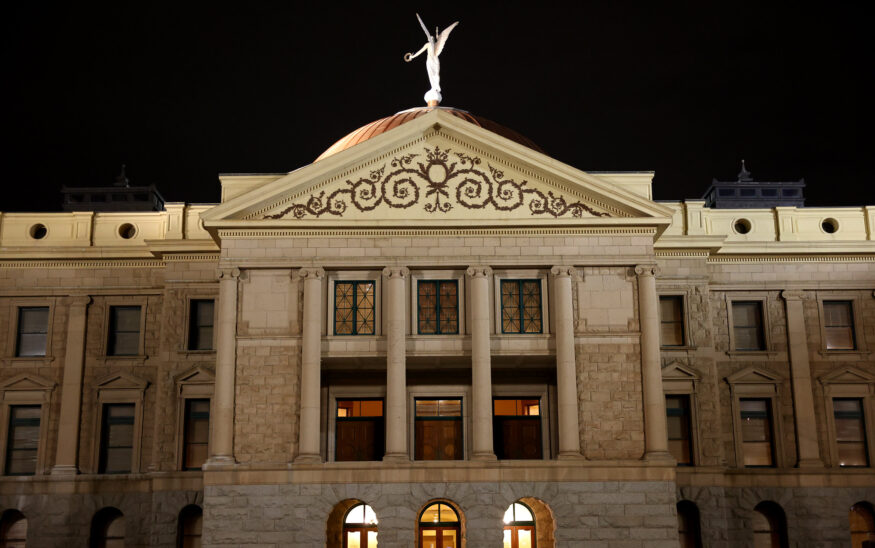
The Arizona Capitol building lights up as lawmakers debate bills late into the night on the last day of the legislative session. (Gage Skidmore / Flickr)
How divided government shaped Arizona’s 2026 session
Jordan Gerard and Reagan Priest//July 9, 2026//


Key Points:
-
Lawmakers introduced a record-breaking number of bills in the 2026 legislative session
-
Gov. Katie Hobbs did not break her veto record this year
-
Rep. Selina Bliss took home the title of most effective lawmaker with 15 bills signed
Gov. Katie Hobbs didn’t set a new veto record in 2026 – but lawmakers still produced a high-friction session defined by record bill volume, a lower success rate and a steady stream of vetoes.
Lawmakers filed 2,116 measures this year, including at least 87 that Hobbs had already vetoed in prior sessions. About 21% of those bills reached her desk, down from roughly 25% a year earlier, according to an Arizona Capitol Times analysis.
Of the bills that did advance, Hobbs signed 264 and vetoed 151. Together, those numbers underscore a familiar dynamic at the Capitol: prolific introductions paired with limited conversion and persistent partisan mismatch between a Republican-led Legislature and a Democratic governor.
The Arizona Capitol Times analyzed every bill that reached Hobbs’ desk to see which lawmakers were most effective – and which sent the most veto bait her way. The analysis excludes the 16 budget bills to avoid skewing the results toward the House and Senate appropriations chairs, whose names appear on much of the spending package.
She leaves her fourth legislative session with an all-time tally of 541 vetoes and 993 bills signed.
“I said from day one, I’ll be a backstop, but I didn’t come here to veto bills, I came here to work across the aisle and get things done,” Hobbs told the Arizona Capitol Times on June 30. She said Arizonans expect lawmakers and the governor to “put the politics aside” and argued that when they do, “we can do that” – even in sessions dominated by partisan clashes and bill moratoriums.
This session, most of the bills Hobbs approved were related to state government operations, healthcare and public safety, according to bill data.
Republican Rep. Selina Bliss topped the effectiveness rankings this year with 15 bills signed into law. Bliss represents Legislative District 1, which encompasses most of Yavapai County around Prescott.
Bliss said her proudest accomplishment was House Bill 2720, a bipartisan effort with Sen. Flavio Bravo that targets people who pay for sex. The new law makes paying for sex under a fee arrangement a class 6 felony and adds a mandatory $200 fine that will go to the state’s Anti-Human Trafficking Grant Fund, which provides services to victims of sex trafficking.
“This bill was very important to me, looking uniquely at reducing the demand (for prostitution) by increasing the penalty on those that traffic other humans (and) are part of fueling the sex trafficking trade,” Bliss said during a bill signing ceremony.
The law also strengthens protections for victims by requiring courts to seal records tied to prostitution convictions when those convictions are vacated because the person was a trafficking victim, according to a news release.
Beyond HB 2720, Bliss said this was a particularly good session for everyone and credited her work ethic to her grandfather, who served 17 years in the South Dakota Legislature and set the expectation that everyone should work hard.
She added that while lawmakers still face plenty of challenges, “We’re all a little more satisfied with the work we did this year” and argued that what matters most is “really the quality, not so much the quantity” of bills.
Sen. Carine Werner, R-Scottsdale, finished close behind Bliss, with 14 bills signed into law. Werner and Bliss chair the Senate and House Health and Human Services committees, and their portfolios helped drive the 31 new healthcare laws enacted this session.
At a recent healthcare roundtable at Valle Del Sol Community Health, Hobbs urged legislators to focus on ensuring Arizonans can actually access healthcare, not just pass health-related bills, she told the Arizona Capitol Times. She pointed to revisions in the federal H.R. 1 package that critics say make coverage harder to maintain and warned that when people lose insurance, “it doesn’t mean they’re not going to get healthcare – it’s just going to cost more because they’re going to go to the emergency room,” driving up costs for everyone.
Sen. Shawnna Bolick, R-Phoenix, and Rep. Jeff Weninger, R-Chandler, tied for third place with 13 bills signed each.
Democrats got 10 bills signed, all from the House. Reps. Consuelo Hernandez, D-Tucson, Sarah Liguori, D-Phoenix, and Stacey Travers, D-Phoenix, each saw two bills make it through, creating a three-way tie for the most bills passed by a Democratic lawmaker this session. Those measures largely focused on public safety, veterans issues and criminal justice, underscoring how few Democratic bills make it through a Republican‑controlled Legislature.
It was a repeat performance from last year, where Democrats also had 10 bills signed; in 2024, they got 12 bills signed. Democrats have repeatedly highlighted how difficult it is to get their bills heard in a Republican-controlled Legislature.
On the veto side, Sen. Wendy Rogers recorded 14 vetoed bills – the most of any lawmaker this session. Almost half of those bills had already been vetoed in prior sessions. She did have three standalone bills signed plus a striker amendment signed. Sen. Mark Finchem had 12 vetoes, and Reps. Lisa Fink and Gail Griffin had 11.
Rogers said her rural constituents voted for her to fight for them down at the Capitol.
“Fourteen vetoes means fourteen times I represented my people and thus refused to write policy just to please a governor who forgot she works for Arizonans,” Rogers said via email. “We need real leadership at Arizona’s Capitol. Until we get it, I’ll keep fighting for my rural district and the entire state, one veto at a time.”
But of her bills that she got signed, Rogers said she’s most proud of Senate Bill 1426, which will make it easier and faster for property owners to evict squatters.
The law does not change any of the rights and remedies available to landlords and tenants under the Arizona Residential Landlord Tenant Act. It specifically does not apply to current or former tenants, immediate family members or people who had a verbal or written agreement to live on the property with the owner, narrowing it to people occupying homes without a legal or agreed-on right to be there.