Sign In


 Free Newsletter

Mayes won’t charge Hobbs over pay-to-play allegations, but urges reforms
Howard Fischer, Capitol Media Services//August 21, 2026//

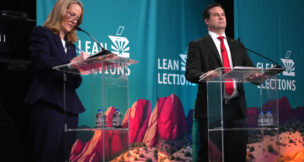
Gov. Katie Hobbs and Attorney General Kris Mayes at a 2023 press conference discussing fraud in the state's Medicaid program. (Capitol Media Services file photo by Howard Fischer)
Mayes won’t charge Hobbs over pay-to-play allegations, but urges reforms
Howard Fischer, Capitol Media Services//August 21, 2026//


PHOENIX — Attorney General Kris Mayes will not bring criminal charges against Gov. Katie Hobbs in connection with an alleged pay-to-play scheme involving a state contractor.
In a report released Friday, Mayes acknowledged that the state awarded two substantial increases in payments to Sunshine Residential, a company that provides beds for children in foster care.
The investigation also found that Sunshine had contributed significant sums to Hobbs’ inaugural fund and the Arizona Democratic Party, and that Hobbs had a personal friendship with company owner Simon Kottoor.
But Mayes, a Democrat like Hobbs, said her investigation found no evidence of a bribe or that the Department of Child Safety increased Sunshine’s payments because of the company’s political connections to the governor.
“After two years of investigation, consisting of multiple interviews, reviews of campaign-finance records, procurement records, bank documents, and state emails and chats, totaling over one terabyte of data, including more than 100,000 documents, the investigation has not uncovered any evidence of the necessary quid pro quo to support a bribery charge,” Mayes said.
The findings are supported by a report by Nick Klingerman, chief of the attorney general’s criminal division.
“Sunshine’s political contributions and Kottoor’s close relationship with Gov. Hobbs, as discussed in various news articles, is insufficient to support charging an offense without a quid pro quo,” Klingerman wrote.
So why did Sunshine receive such favorable treatment?
Klingerman said the company’s rate increases appear to have resulted not from a bribe, but from its “outsized leverage” over DCS’ congregate care program.
Sunshine provided services the state needed, including finding additional space when DCS was short on beds and housing siblings together, he said.
The company also told DCS that, without a significant increase in the rates it was paid, it would reduce the number of beds available to the agency and instead contract with the U.S. Department of Homeland Security, which was willing to pay more.
Mayes said the episode exposes problems with the state’s contracting system.
“Declining prosecution is a conclusion about the legal standard for charging a case, but this case shows there is a need for legislative reform,” she said.
“The Legislature and the governor have the power to ensure greater transparency with regard to political donations made by state contractors,” Mayes said. “I am urging them to work together and try again to pass legislation that does so.”
Mayes did not mention that Hobbs twice vetoed legislation that would have required anyone bidding on a state contract to disclose all the donations made in the prior five years to the governor, anyone running for office, and all of their political committees.
Hobbs said the measure crafted by Sen. T.J. Shope, a Coolidge Republican, fell short because it did not include other reforms she sought, such as new restrictions on state legislators.
Shope, however, said that was just an excuse, particularly since the governor’s office –- and agencies under her control –- decide whether to award contracts.
The investigation took longer to complete, in part, because Hobbs would not submit to an interview about her role in the matter. Instead, the governor agreed only to provide two written statements, denying any involvement in the decision to give Sunshine more money.
Friday’s findings do not end the investigation.
The state Auditor General’s Office has its own probe, assisted by Maricopa County Attorney Rachel Mitchell, who is a Republican. There is no word on when that will be completed.