Arizona election officials may face conflict of interest concerns
Secretary Adrian Fontes endorses candidate who filed campaign finance complaint
Arizona law does not bar election officials from endorsing candidates
A campaign finance complaint filed with the Arizona Secretary of State has unwittingly provoked a perennial election question in Arizona: Can state officials carry out their election duties while also exercising their free speech rights?
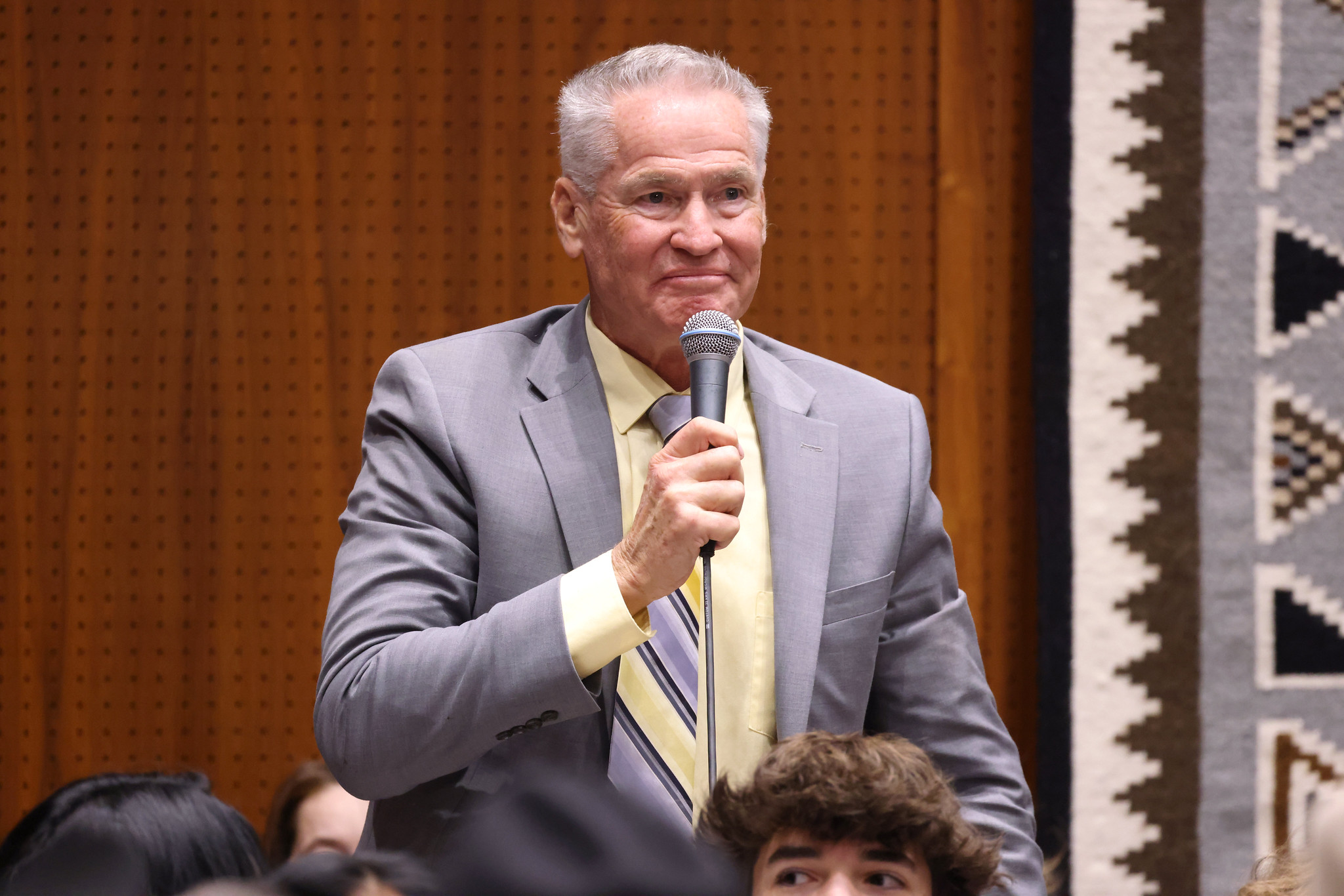
To Secretary of State Adrian Fontes, who has endorsed the candidate making the complaint, the answer is simple.
“I can chew gum and walk at the same time,” said Fontes, a Democrat who is backing fellow veteran Dan Toporek in a contested legislative district in north Phoenix. “I’m a voter, too, and I have a First Amendment right to express myself.”
There is no clear answer to the possible conflict of interest. Arizona law doesn’t bar endorsements or block an election official’s management and oversight of elections when they themselves are on the ballot.
The National Association of Secretaries of State had a similar assessment when looking at conflict of interest policies nationwide.
However, a recent Utah state law requires election officials to take steps to avoid potential conflicts, said John Milhofer, research director for the association. And, he noted, Michigan Secretary of State Jocelyn Benson, who is now running for governor, has said she would formally recuse herself from actions that would affect the gubernatorial race.
While there are guidelines and codes of conduct, in Arizona and elsewhere, it often comes down to the official’s own discretion, said Tammy Patrick, chief executive officer for programs with the Election Center, which is run by the National Association of Election Officials.
“These types of questions arise and surface when we start to talk about our election infrastructure,” Patrick said.
The questions are not new.
In 2000, the issue became a national hotpoint when then-Florida Secretary of State Katherine Harris oversaw the contentious recount of Florida’s presidential election results, and certified George W. Bush as the winner of that state’s votes. Harris also was co-chair of Bush’s campaign in Florida.
Four years ago, then-Arizona Secretary of State Katie Hobbs also faced questions about her ability to oversee the 2022 election, given she was running for governor. Hobbs did not recuse herself and said she would follow ethical guidelines to keep her political ambitions separate from her formal duties.
She followed in the footsteps of her predecessors in the secretary’s office, who continued their work as secretary of state even while their name was on the ballot. They include Jan Brewer, who was re-elected to the state’s top election office in 2006; Ken Bennett in 2010 and Michele Reagan in 2018, who lost in the primary election that year.
Fontes said he is tending to his secretary duties in the upcoming primary and general elections as he seeks a second term.
“No secretary has ever recused for that purpose and that won’t start now,” he said.
It’s similar to what he did in 2020, when he served as Maricopa County recorder.
He was on the 2020 ballot as a candidate, seeking re-election. He lost that race and stepped down, a point Fontes’ supporters say indicates he did not use his post for his own political benefit.
Gina Swoboda, who is running for the Republican nomination for secretary of state this year, said the public doesn’t grasp the fairly limited role the secretary of state plays in elections. The secretary does not run elections; that is done by each of the 15 county recorders. The secretary has an oversight role and is required to certify election results.
“I think there’s a perception these leadership roles have more power than they do,” she said.
That said, if elected, Swoboda said she would refrain from participating in the logic and accuracy tests that are done on ballot-counting machines, arguing it’s not a good look. And she would seek legislative scrutiny of any other “significant” changes to the state’s Elections Procedures Manual that could affect the secretary of state race.
Her Republican challenger, state Rep. Alexander Kolodin, R-Scottsdale, did not return requests for comment.
The focus on the secretary’s office often obscures scrutiny of conflict issues at the county and local levels, where the elected officials actually run elections.
“That can be a particular issue in rural counties, where there aren’t big staffs,” said Patrick, of the Election Center.
If the elected official running the office has a conflict, who handles the work, she asked. She cited a 2022 report from Reed College in Portland that found 34% of election offices nationwide have no full-time staff dedicated to elections.
The Election Center has suggested standards for dealing with conflict issues, encouraging election officials to create guardrails to guide situations where they are on the ballot. Recusal from decisions that directly impact their own race should be one of those guardrails, “to the extent feasible,” according to the center’s report.
Another organization that is working to reduce partisanship in elections has suggested that election officials take a cue from the judiciary when it comes to dealing with potential conflicts.
Federal law, as well as many state and local laws, require judges to recuse themselves in potential conflict situations.
“Election officials are enough like judges that recusal guidelines should at least exist for elections,” the Election Reformers Network stated in a 2024 report.
Patrick said the issue of endorsements is less clear cut than oversight of elections. Elected officials have a First Amendment right to support the candidates of their choosing, but it can create the perception of a conflict.
Fontes said his office is set up so that issues such as the campaign-finance complaint filed by the candidate he endorsed won’t even get to his desk. He had not even seen it, he said on May 15, as his staff is still reviewing it to determine if there is reasonable cause to forward it to the state attorney general for investigation.
“We’re operating under this basic understanding that if there is a political matter, I’m not involved,” Fontes said in an interview. Any decision, if needed, would fall to the assistant secretary of state, he said.
Republicans face divisive primaries amid shifting political dynamics, voter makeup
Turning Point influence tested against independent voters’ growing electoral hold
Conservative incumbents battle fellow Republicans across multiple statewide races
Thirteen Republicans are vying for statewide office this year, but before they can take on their Democratic opponents, they’ll have to navigate increasingly contentious and fragmented primary challenges.
There isn’t a single Republican running unopposed in a statewide primary this year, while most of the Democrats hoping to keep or flip those same seats will not face any meaningful competition within their own party. Even Republican incumbents have not been spared; three officeholders with proven conservative chops are facing challenges from the right.
“That’s a Turning Point thing,” said Chuck Coughlin, a Republican-turned-independent consultant. “Are they going to be able to marshal Republican voters in opposition to fairly conservative candidates?”
Hanging over it all is diminished public support for President Donald Trump, his policies and the Republican Party as a whole. Each candidate is walking a delicate tight rope between supporting the president enough to win over an engaged GOP primary voter and keeping enough distance so as to not alienate Arizona’s growing bloc of independent voters.
Some Republicans argue even Turning Point, the conservative youth organization founded in Arizona, might be losing its influence in the state after less than resounding results for TP-backed candidates in April’s Salt River Project Board elections.
“Turning Point puts their money behind people, and that machine rolls, but it turns off the independent voters,” said Lisa Everett, the former chair of Legislative District 29 Republicans. “Since they are the ones that decide the elections in Arizona, we need to figure out how to court them.”
With the exception of the Republican primary for governor, GOP voters seem largely undecided about primary candidates in down-ballot statewide contests. Polling suggests that some of those candidates are unknown to the Republican electorate, even though most have held some form of elected office in Arizona.
Governor
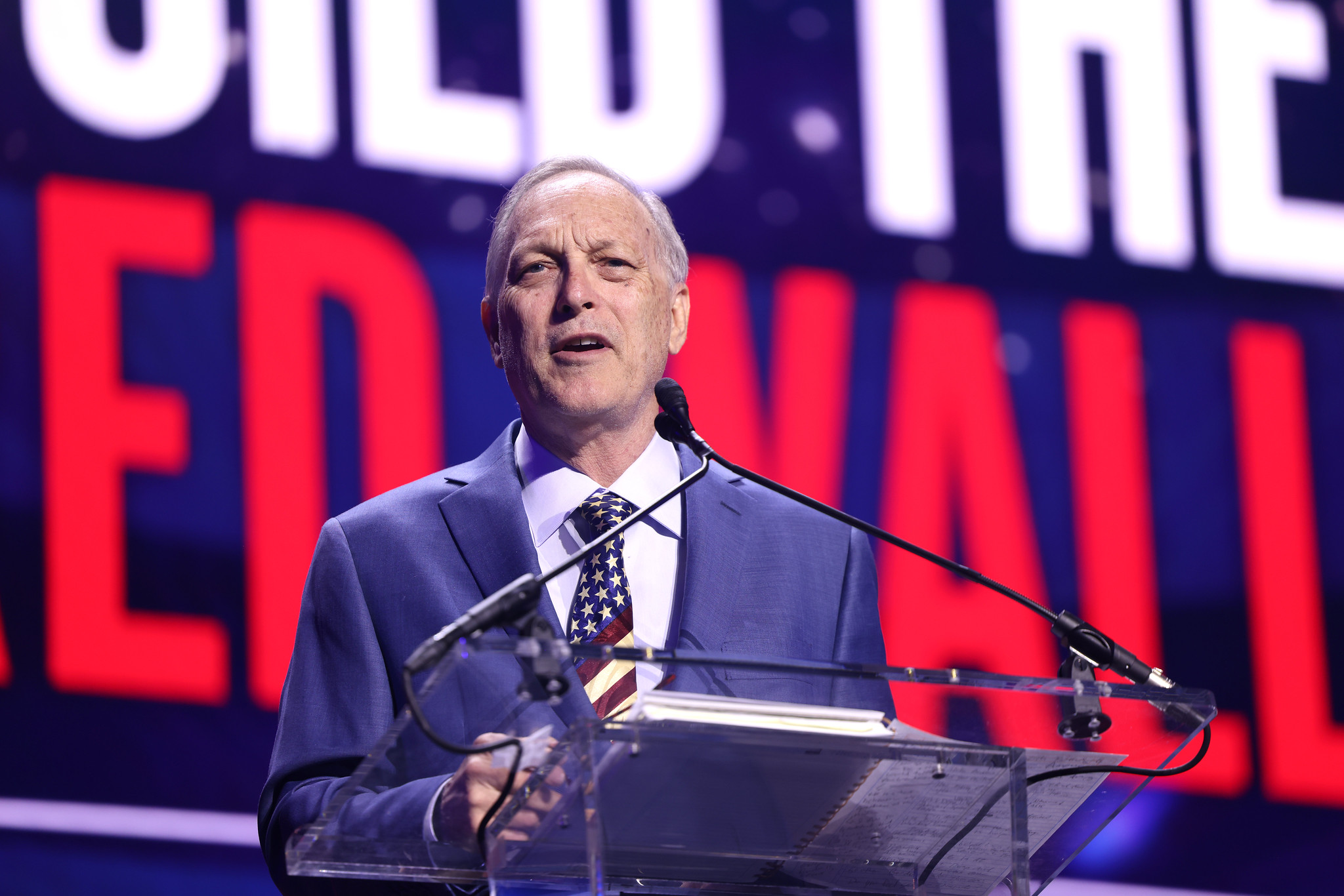
U.S. Congressman Andy Biggs speaking with attendees at the April 2026 “Build the Red Wall” rally at Dream City Church in Phoenix. (Gage Skidmore / Flickr)
Congressman Andy Biggs is widely viewed as the frontrunner in the GOP gubernatorial primary. His closest rival — fellow Congressman David Schweikert — is still behind by double-digits according to most polls and by several hundreds of thousands of dollars in fundraising.
“I’m trying to unify the Republican Party right now to win this governor’s race,” Biggs told reporters when asked about Schweikert on May 5. “I don’t talk about my primary opponent, because the reality is, I’m staying focused on Governor (Katie) Hobbs, what she’s not doing and what she is doing, and I’m trying to bring that message out.”
Schweikert has maintained since he entered the race in October 2025 that Biggs cannot defeat Hobbs in the general election.
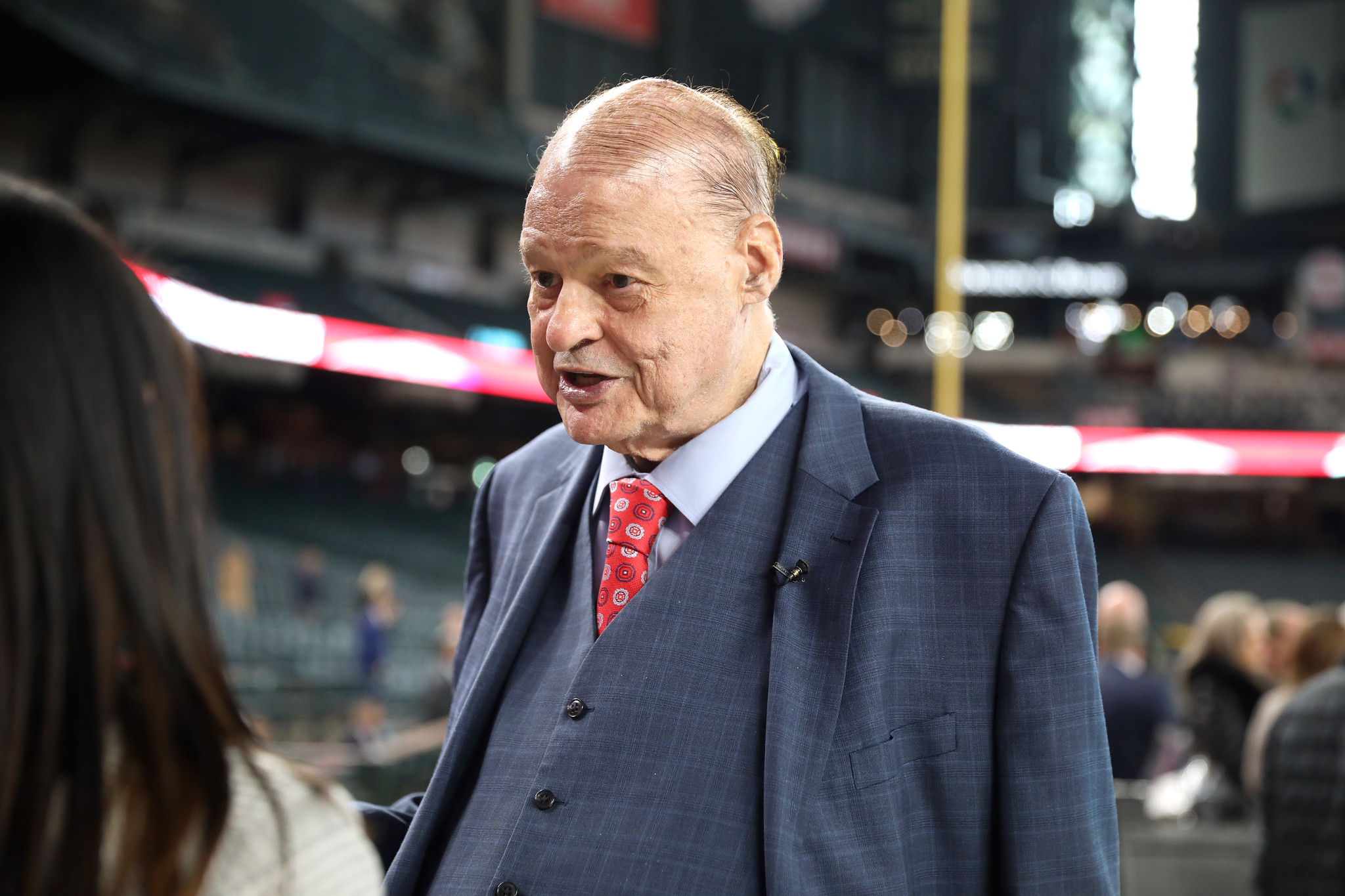
U.S. Congressman David Schweikert speaking with attendees at the 2022 Legislative Forecast Luncheon hosted by the Arizona Chamber of Commerce & Industry at Chase Field in Phoenix. (Gage Skidmore / Flickr)
“The left is so giddy (and) wanting him to be the nominee because you see the polling, he can’t come within 10, 11 points of Katie Hobbs,” Schweikert told KTAR on May 7.
Everett endorsed Schweikert on social media for precisely that reason, though she knows her opinion is not widely shared among the conservative grassroots.
“I attend lots of meetings, LD meetings, club meetings, council board meetings, etc. and what I am seeing is Republicans are coming up to me, and they’re whispering, ‘I’m supporting David Schweikert,’” Everett said. “They’re afraid to say it out loud, because the other candidates that are supported by these larger organizations are taking up all the oxygen in the room.”
One slight wrinkle in Schweikert’s election theory is that polling numbers actually show he’s doing worse than Biggs in the matchup against Hobbs. According to a February survey from local pollster Noble Predictive Insights, Biggs trailed Hobbs by five points among registered voters, while Schweikert trailed the governor by nine points.
Biggs, the only candidate in the race with a Trump endorsement after Karrin Taylor Robson dropped out in February, doesn’t see the president’s support as a deterrent for voters.
“If I had an issue, I would just call (Trump) up and say, ‘Hey, what’s going on here?,’” Biggs told reporters on May 5. “… I think you need to have somebody in office as the governor here who can actually call up the president … I think those relationships are important, and I think they benefit the state.”
Secretary of State
State Rep. Alexander Kolodin, R-Scottsdale, speaking with attendees at a campaign rally for Andy Biggs for Governor at the Arizona Biltmore in Phoenix. (Gage Skidmore / Flickr)
Rep. Alex Kolodin, a state lawmaker and election attorney, was the first candidate to cut into the secretary of state’s race. But, he did so as rumors of a run by Gina Swoboda, chair of the Republican Party of Arizona and the Legislature’s election policy lead, started to swirl around the political sphere.
Swoboda initially launched a campaign for the 1st Congressional District, but, in early February, she filed her statement of interest for the Secretary of State’s Office and pivoted her run.
“I love the office so much, and I love the people in it, and I love the work,” Swoboda said. “And I’m sad by how politicized it’s become, and I’m sad at where I think it will go if this continues for another four years.”
Kolodin, with the endorsement of Turning Point Action, is angling his campaign at some election nerves frayed among his base. Along the campaign trail, Kolodin has focused on alleged noncitizen voting, championed the SAVE Act and pledged to cooperate with the federal government in granting access to state voter rolls.
“When I’m elected the very first thing that we need to do is partner up with our friends in the federal government who have graciously offered to allow us to use their SAVE Act database to ensure that we don’t have noncitizens on our voter rolls,” Kolodin said in an interview with former U.S. Congressman Matt Gaetz.
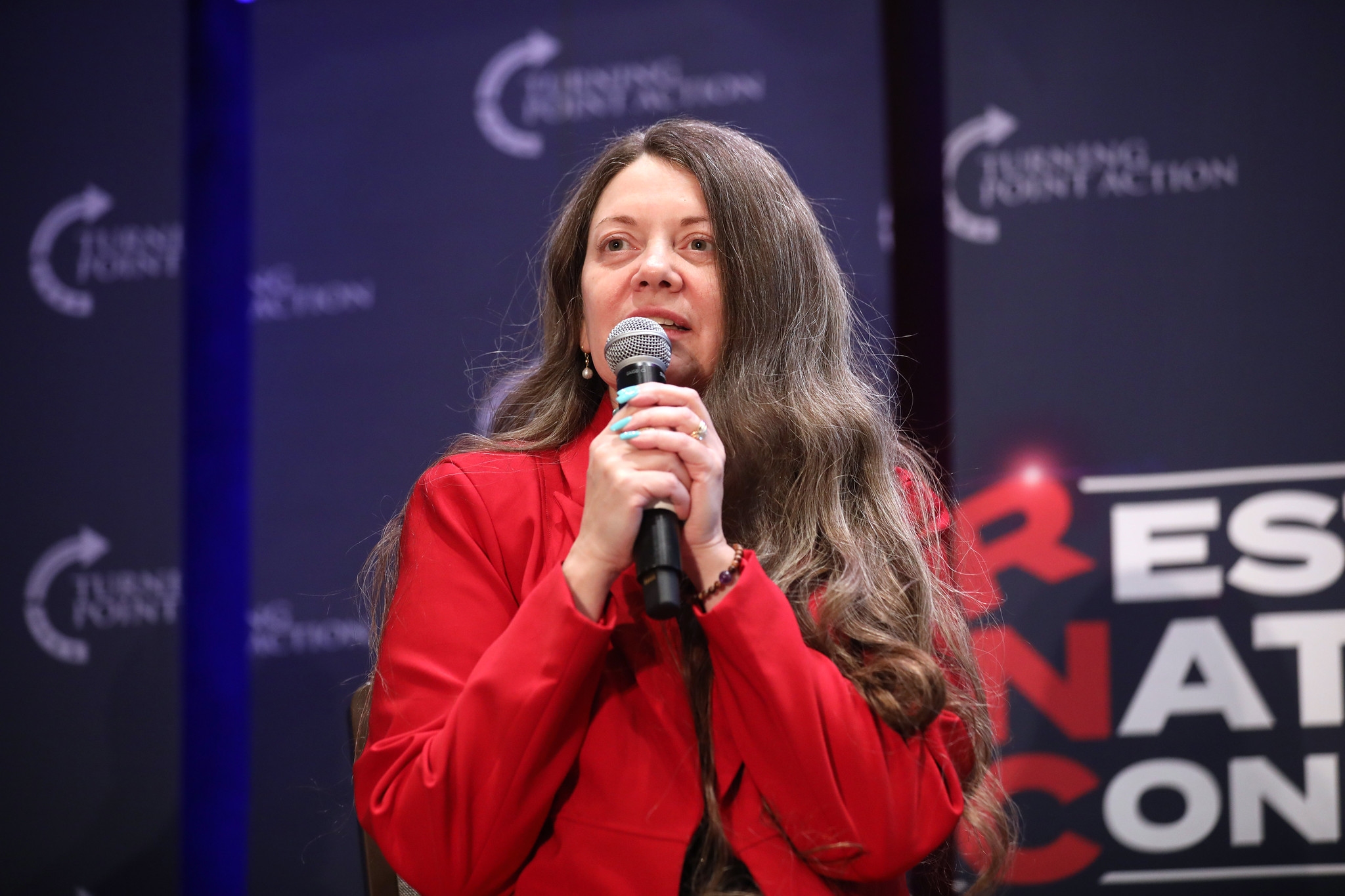
Gina Swoboda speaking with attendees at the Restoring National Confidence Summit at Planet Hollywood in Las Vegas, Nevada. (Gage Skidmore / Flickr)
Swoboda, meanwhile, aims to capture the growing sect of Arizona’s independent voters through a focus on policy and operations.
“What I want to run on is transparency, accountability and competence. That’s all I want. And that’s what I think the voters want. I think that they are exhausted,” Swoboda said. “The last thing (people) need to worry about is what did the secretary of state do today? Why do people have to think about that?”
She expressed some doubt that Kolodin could win over the third of the state’s voters who have no declared party affiliation. And Swoboda stressed the need to work well across the state with officials in every corner on election administration, a skill she claimed her opponent lacked.
Swoboda referenced the ongoing legal dispute between the Maricopa County Recorder and the Board of Supervisors as one example.
“It’s a disaster. I got into the race because I don’t want that to happen on a statewide level,” Swoboda said. “It will dissolve into dysfunction and infighting, and the voters will not have confidence in the process. Nobody needs that.”
Attorney General
Senate President Warren Petersen and Rodney Glassman framed campaigns for the Attorney General’s Office as a matter of legal experience.
Rodney Glassman speaking with attendees at a campaign rally for Andy Biggs for Governor at the Arizona Biltmore in Phoenix. (Gage Skidmore / Flickr)
Glassman, a lieutenant colonel in the U.S. JAG Corps Reserve, former Tucson City Councilmember and longtime candidate for office — with past runs for the Arizona Corporation Commission, Maricopa County assessor and the U.S. Senate, as a Democrat — claims he is the only candidate who has ever practiced law, taken on a client or prosecuted someone in court.
“My primary opponent is a termed-out career politician, a part time Realtor, and received his law license less than 28 months ago,” Glassman said. “He’s never had a client. He’s never prosecuted a criminal, and he doesn’t even carry professional liability insurance, aka, he doesn’t practice law. He’s never practiced law.”
Petersen was licensed to practice law in 2023, though he passed the bar in 2020. And he corrected Glassman, noting he is not yet termed out from the Senate.
State Senate President Warren Petersen speaking with attendees at a campaign rally for Andy Biggs for Governor at the Arizona Biltmore in Phoenix. (Gage Skidmore / Flickr)
Petersen claimed he is the most experienced person in the race, pointing to his part in a swell of litigation from the Legislature to defend public laws Attorney General Kris Mayes left by the wayside.
“We basically set up a mini Solicitor General’s Office here at the Senate,” Petersen said.
More significantly, Petersen pointed to Glassman’s past history of switching parties and continuing to pursue election as a downside.
“The people, they’re tired of him running for office. If you run twice and lose twice, normal people quit,” Petersen said. “If you run more than twice and you keep running, I think you’re achieving sociopath level.”
Support and endorsement is currently split among both candidates.
Glassman has courted support from Congressman Paul Gosar, Superintendent of Public Instruction Tom Horne, Maricopa County Sheriff Jerry Sheridan, and former Senate President Karen Fann.
Petersen meanwhile has shored up support withCongressman Biggs, a slate of Republican state lawmakers and Idaho and West Virginia’s attorneys general.
During Trump’s recent visit to the state, he declined to dole out any formal endorsement, but he did give Petersen a shoutout from the stage. And when Gosar voiced his support for Glassman, it drew a mixed reaction from the crowd.
Superintendent of Public Instruction
The Arizona Freedom Caucus and Turning Point Action placed veteran incumbent Superintendent of Public Instruction Tom Horne in its crosshairs early on, recruiting outgoing Treasurer Kimberly Yee to oust him from office.
Arizona Superintendent of Public Instruction Tom Horne speaking with attendees at the 2024 Legislative Forecast Luncheon hosted by the Arizona Chamber of Commerce & Industry at Chase Field in Phoenix. (Gage Skidmore / Flickr)
Horne is keeping his messaging on improving academics across education and is hoping voters will keep him around for another four years to finish what he set out to do at the start of his term.
He pointed to the department’s Project Momentum, which lifted 80% of schools in the bottom 5% for academic performance to a higher bar.
“That’s an eight-year job, not a four-year job,” Horne said. “I want to finish the job. If the voters were to switch horses after four years, somebody else would start all over again and it would never get done.”
Horne is continuing his crusade against critical race theory, diversity, equity and inclusion and “woke ideology” as well. And in that vein, he did not have much to say about his opponent, other than claiming she had served on a Diversity, Equity and Inclusion Committee for the National Association of State Treasurers.
Yee denies serving on any DEI committee and went so far as to send a cease and desist letter.
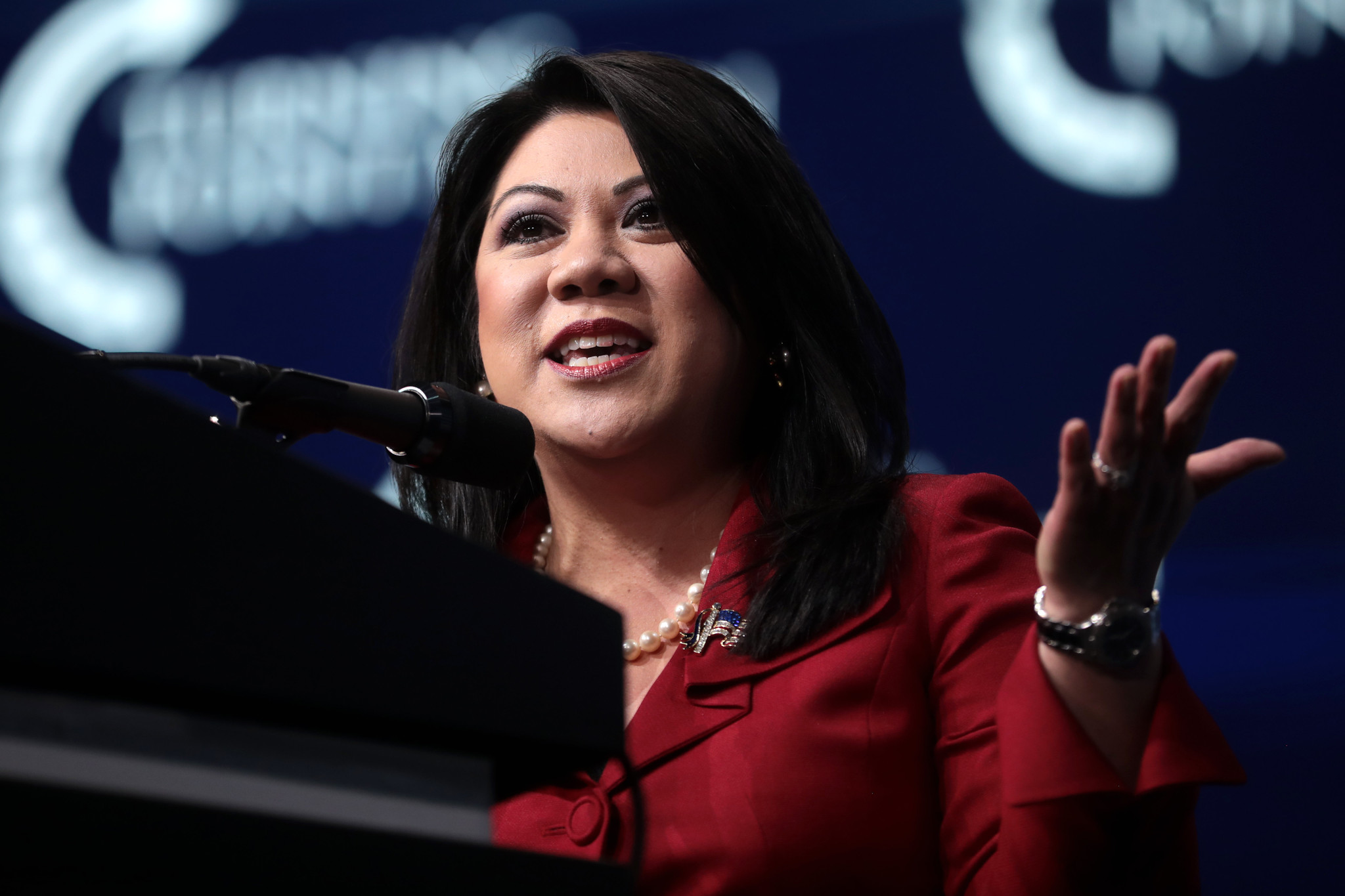
State Treasurer Kimberly Yee speaking with attendees at the “Rally to Protect Our Elections” hosted by Turning Point Action at Arizona Federal Theatre in Phoenix. (Gage Skidmore / The Star News Network)
In her own campaign, Yee claims academic performance has not improved significantly under Horne.
“He’s had four years, and those numbers have not changed,” Yee said. “I see complete chaos in the Department of Education when it comes to management. I also see a real non-presence of this current superintendent with respect to his role as a statewide official.”
The two must also contend with the Empowerment Scholarship Account program, a live wire for Republicans staunch on supporting school choice, which has formed significant party lines surrounding the issue of ensuring there’s no misspending, fraud or abuse in the program.
Horne maintains the department is continuing to finetune its oversight of the program.
Meanwhile, Yee, in her role as state treasurer, recently put out a request for information to assess the field of financial vendors. She stopped short of wading into any policy questions for the program, though, claiming the specifics are better left to the Legislature.
“We have a superintendent of public instruction who has exceeded that authority and has gone beyond what an administrator is required to do by the law,” Yee said. “And if there ever is a question of administration or properties of educational definitions, those really need to be brought back to the Legislature.”
Corporation Commission
Corporation Commissioners Nick Myers and Kevin Thompson are not exactly known as moderate Republicans. But that did not stop the Arizona Free Enterprise Club and the state’s Freedom Caucus from recruiting two state lawmakers to run against them in the Republican primary.
That challenge lost a bit of steam recently, with former Rep. David Marshall ending his bid for the commission to accept a new role as Navajo County recorder. Marshall’s exit leaves Rep. Ralph Heap, R-Mesa, to fend for himself against the two incumbents.
State Rep. Ralph Heap, R-Mesa, speaking with attendees on the floor of the Arizona House of Representatives on opening day of the 57th legislature in Phoenix. (Gage Skidmore / Flickr)
“If you have two people on the commission that have similar ideas in terms of how to produce energy and what we need to do, that’s a stronger position,” Heap said. “So that does weaken the message I have and that’s frustrating.”
Heap’s main message is that Myers and Thompson have not done enough to end “Green New Deal” policies at the state’s utility companies, nor have they done enough to support Trump’s coal-centric energy priorities.
“We need to immediately adopt the principles that are in the Trump energy agenda, which are continuing with reliable, affordable fossil fuels, and then move towards nuclear energy as fast as we possibly can.” Heap said.
This combination photo features Arizona Corporation Commissioners Kevin Thompson (left) and Nick Myers. (Photos by Gage Skidmore)
Myers and Thompson say they have done exactly what they set out to do, pointing to their votes to repeal the energy efficiency and renewable energy requirements past commissions imposed on utilities.
“We’ve delivered the promises that we campaigned on the first time, which was to eliminate the Green New Deal, eliminate mandates and subsidies,” Thompson said.
Myers noted that the pair is in favor of an “all of the above” approach to energy generation, though they believe natural gas is far more affordable and reliable than solar or wind. The two also said they have done everything in their power to cut the fat out of utility budgets in rate cases, though they know customers are still struggling with high bills.
“We’ve been saving as much money as we possibly can and trying to keep those rate increases as low as we can, but we’re fighting an uphill battle when it comes to the weather and the things that we don’t have control over,” Myers said.
The duo said they are more focused on the general election than defeating Heap in the primary.
“We’re just going to continue focusing on things that got us here, and talk about the great things the commission has done over the last three years and hope that the people of Arizona see that and decide they want to keep us in place,” Thompson said. Treasurer
Katherine Haley, president of the State Board of Education, lodged her challenge against Elijah Norton, former treasurer for the AZGOP, late in the game, with an endorsement from sitting Treasurer Kimberly Yee in tow.
Norton has painted himself as the candidate with the most relevant experience. Besides guarding the AZGOP coffers, he founded and currently serves as president of Veritas Global Protection Services, an international vehicle insurance company.
“I don’t just have business experience. I also have experience investing money,” Norton said. “And that’s literally the treasurer’s job, the chief Banking and Investment Officer of Arizona.”
He said Haley was a “nice person” but doubted her ability to manage the state’s $32 billion in assets.
“I always use the example of the Treasurer’s Office being like an airplane. Do you want someone flying a $32 billion airplane from Phoenix to Australia who’s never set foot in a cockpit before?” Norton said. “Or do you want a veteran person that has proven experience piloting that flight?”
Haley is leaning on her background in public service to make her case to voters and pointed to her experience on the State Board of Education overseeing district budgets and the Empowerment Scholarship Account program.
“It’s about the mentality of service. It’s focused on Arizona taxpayers and what they need, rather than personal interest,” Haley said. “My opponent has a life career in sales, and I think that is just a different skillset than one that is focused on Arizona taxpayers.”
Norton noted, though, as the two have convened at legislative district meetings that straw polls have swung in his favor.
At the Legislative District 27 meeting on May 12, Norton said a straw poll yielded 68 votes for him and four votes for Haley.
“When people actually get into the weeds, and they listen to us talk about policy. There’s an obvious dichotomy, that she does not have the experience,” Norton said.
President Donald Trump gave shout outs, not endorsements, to down ballot Republicans
Elected Republicans coalesced around gubernatorial candidate U.S. Rep. Andy Biggs
Remarks targeted Democrats, emphasized governor’s race and control of U.S. House
President Donald Trump rallied Arizona’s conservatives in Phoenix on Friday with less than 100 days to go before several Republican hopefuls battle it out in the state’s primary election.
A host of state candidates attended the “Build the Red Wall” rally hosted by Turning Point in pursuit of an endorsement from the president. Many left without any official stamp of approval.
Meanwhile, the Republican members of the state’s congressional delegation hammered home the importance of maintaining control of Arizona’s U.S. House seats to keep the conservative trifecta in Washington, D.C and further Trump’s political agenda.
But the governor’s race and other down ballot contests seemed top of mind for all of Friday’s speakers. Some argued that unseating incumbent Democratic Gov. Katie Hobbs should be the top priority for Arizona Republicans.
“Arizona can’t trust Katie Hobbs, you cannot afford Katie Hobbs, and we cannot and must not re-elect Katie Hobbs,” Congressman Andy Biggs, a candidate for governor, told the crowd.
The Friday visit marks the president’s first appearance in the state this year ahead of the midterm elections.
While Biggs, widely viewed as the frontrunner in the Republican primary for governor, secured his endorsement from the president in 2025, Trump hasn’t yet handed down endorsements in the Republican primaries for attorney general and secretary of state, and declined to do so today.
Some candidates are still working to build a coalition among Arizona Republicans, but Biggs is not one of them. Speakers and attendees offered stalwart support for his candidacy, praising his conservative bona fides and sporting “Biggs for Governor” merch.
Senate President Warren Petersen hoped to get the nod over Rodney Glassman for the attorney general’s race, while secretary of state hopeful Rep. Alex Kolodin sought a boost over Trump’s past pick for chair of the Republican Party of Arizona, Gina Swoboda.
Trump gave Petersen, Kolodin and Treasurer Kimberly Yee — who is hoping to unseat Superintendent Tom Horne — a shoutout during his remarks, but stopped short of throwing his full weight behind their campaigns. He spent roughly the same amount of time calling out professional athletes who were in attendance as he did local politicians.
Petersen acknowledged the lack of formal endorsement but said he was still honored to get a mention.
“It’s a shout out,” Petersen said. “It’s amazing to have the president of the United States give you a shout out like that and say nice things.”
Congressman Paul Gosar, meanwhile, vouched for Glassman over Petersen for attorney general, producing some simultaneous groans and scattered claps from the crowd.
Every member of the state’s Republican congressional delegation spoke, with the exception of Biggs’ primary challenger, U.S. Rep. David Schweikert. Biggs even took a jab at Schweikert, joking that the president would hang up the phone if the congressman attempted to call him.
U.S. Reps. Juan Ciscomani, Abe Hamadeh, Eli Crane and Gosar all voiced ongoing support for Trump’s agenda but courted the most applause, or boos, when mentioning elected Democrats in statewide and federal offices.
Hobbs, Attorney General Kris Mayes, Secretary of State Adrian Fontes and Sen. Ruben Gallego were frequent targets of the speakers.
“Arizona has been captured by the radical left,” Hamadeh told the crowd. “Look, we have a cartel lawyer as secretary of state, we have an illegitimate climate activist parading around as an attorney general, and we’ve got a crooked disaster holding us back, Katie Hobbs.”
Hamadeh hit on election integrity in his remarks and took the opportunity to once again claim the 2022 election, in which he lost his bid for attorney general to Mayes, was “stolen.”
Crane called the current political climate “a spiritual war” and again pushed for control of the House and the governor’s office.
“Republicans aren’t the solution to all of your problems,” Crane said. “But Democrats are pretty much the cause of all of your problems.”
Ciscomani centered his speech around the American dream and shared his story of immigrating to the U.S., becoming a citizen in 2006 and running for Congress, and winning, 16 years later.
At the same time, his colleagues spoke about controlling Arizona’s “open border” and slammed Hobbs and other Democrats for eliminating the state’s Border Coordination Task Force and voting to shut down the U.S. Department of Homeland Security.
Crane deemed the governor’s office the most important race this cycle and called out the cavalry to vote for Biggs.
“I’m going to talk about the most important race coming up here in this state,” Crane said. “You guys have an opportunity to represent, in my opinion, the best candidate for governor in the entire country.”
Ex- Republican Party chair files to run for Arizona secretary of state
Gina Swoboda may face state Rep. Alexander Kolodin in GOP primary
Swoboda’s congressional bid for CD 1 has drawn multiple Republican challengers
A potentially heated race is shaping up among Republicans who want to take on incumbent Democratic Secretary of State Adrian Fontes.
Gina Swoboda, who just stepped down as chair of the Arizona Republican Party, filed a “statement of interest” on Feb. 3 to be the GOP nominee to become the state’s chief elections officer. That filing allows Swoboda to begin gathering signatures to have her name on the Aug. 4 primary ballot.
But whether Swoboda intends to take on state Rep. Alexander Kolodin, R-Scottsdale, remains in question.
“Exploring my options,” she said in a statement to Capitol Media Services.
“Elections have always been a passion for me,” Swoboda said. “I love that office.”
Swoboda actually worked in the Secretary of State’s Office under both Republican Michele Reagan and Democrat Katie Hobbs.
Aside from running the state party for two years before quitting last month, Swoboda was also a policy adviser for the state House.
In October, she announced plans to run for the U.S. House after Republican Congressman David Schweikert said he was vacating that seat in a bid to run for governor. That district includes parts of north Phoenix, Scottsdale and Fountain Hills.
Swoboda also got the backing of President Trump in that bid.
Kolodin, for his part, dismissed the possibility of having to wage a primary race. He even said that Swoboda, before her latest move, endorsed his bid for secretary of state.
“I’m the most qualified candidate in the race and the voters know it,” Kolodin told Capitol Media Services. And he said there’s a good reason for her not to abandon her congressional bid.
“Gina should focus on her CD 1 primary so that she isn’t the reason Republicans lose the (U.S.) House majority,” Kolodin said.
The move also drew the ire of Sen. Jake Hoffman. The Queen Creek Republican is chair of the Arizona Freedom Caucus, of which Kolodin is a member.
“Gina Swoboda is a Democrat,” he said.
Hoffman also accused her of attacking “school choice.”
That stems from the fact that Swoboda, as chair of the Arizona Republic Party, said there need to be more “guardrails” around the voucher program which provides tax dollars for parents to send their children to private and parochial schools and to home school their children. Swoboda cited reports of parents buying items like lingerie, jewelry and home appliances and said there need to be protections against abuse.
More recently, Swoboda drew ire from Republicans after saying that Trump had lost the political argument about immigration enforcement, not because of the deportations, which she said remain popular, but because of the increased reports of tactics being used.
With Schweikert not seeking reelection, that race for CD 1 has become crowded.
Also in the hunt is former Arizona Cardinals kicker Jay Feely. He, too, was endorsed by Trump.
So is state Rep. Joseph Chaplik of Scottsdale.
Other Republicans who have filed statements of interest include Jason Duey, Dusko Jovicic, Kaitlin Purrington, Paul Reeves, Brandon Sowers, Brandon Sproles and John Trobough.
Sergio Arellano elected chair of Republican Party of Arizona
Sitting chair Gina Swoboda left seat to pursue congressional run
Eligibility questions and hand count prolonged meeting
Sergio Arellano was elected as the next chair of the Republican Party of Arizona at the annual mandatory meeting on Jan. 24, following a run-off with Pam Kirby.
Despite rumors that sitting chair Gina Swoboda would secure a nomination from the floor and stay at the helm, the meeting went by without any major upsets.
“Enough of the division, enough of the fighting, let’s focus on winning and kicking butt in November,” Arellano said.
Nominations started with four candidates – Arellano, Kirby, Kathleen Winn and Robert Branch.
The initial round of voting put Arellano and Kirby in a runoff, with Arellano taking 655 votes and Kirby taking 603, and dropped Branch, with 200 votes, and Winn, with 196 votes.
A brief last-ditch effort to keep Swoboda resulted in drawn-out procedural tension and a run-off vote between Sergio Arellano and Pam Kirby, stretching the meeting until late evening.
Sergio Arellano, newly elected chair of the Republican Party of Arizona, celebrates his swearing in alongside first vice chair Shiry Sapir (left), secretary Sherra Kissee and sergeant-at-arms Carie Hughes (right) at a meeting on Jan. 24 in Prescott. Arellano won in a runoff election by 140 votes. (Kiera Riley / Arizona Capitol Times)
In the final round, Arellano prevailed, with 761 votes to Kirby’s 621.
Before any votes were cast, Saturday’s meeting kicked off with a debate over whether to allow a “fractional” appointed state committeemen to vote, and for Arellano, to run for a leadership position.
Under state law and bylaws, the party elects one state committeeman for every three precinct committeemen, ensuring a proportionate share for each legislative district.
But the math required rarely yields a clean round number and often leaves decimals, or “fractional” appointments, in an awkward gray area. In past chair practice, remaining fractions were typically rounded up, giving way to the appointment of additional committeemen.
Swoboda said under her leadership that, instead of rounding up each decimal to a state committeeman, the party would add all the remaining decimals, creating a total of 16 “fractional” state committeemen.
Ahead of the meeting, legal threats challenged the practice altogether.
The party maintained fractional reserve appointments as a reasonable interpretation of the law, but decided to vacate state committeemen status for the 16 “fractional” members, Arellano among them, citing potential damage to party unity and finances.
The decision made Arellano, a fractional member, no longer eligible for the chair or the committee. But after a back-and-forth on points of order and information, and ultimately a motion, the party voted to allow the 16 members to vote, clearing the way for Arellano.
The field stuck to the four candidates despite ultimately unsuccessful motions to first request Swoboda reconsider her resignation and then to throw her name in the chair race.
Amid a run for Congressional District 1, Swoboda said she would resign upon election of a new chair. Though there was some speculation that Swoboda would try to stay, she told the party today it was time for her to step aside and thus shut down a motion to nominate her.
“Don’t try to keep me, let’s just go. It’s been an honor,” Swoboda said. “Just continue to work together.”
Swoboda’s time at the helm oversaw the return of big-dollar donors, increased voter contact spending, and coordinated campaigns, reaping wins for the Republican party up and down the ballot in 2024.
Her work inspired the ire of Turning Point, though, culminating in an ultimately unsuccessful effort to oust Swoboda at the 2025 organizational meeting.
Criticism of Swoboda continued, but in a departure, Turning Point did not charge into the chair race at the same tenor this year, offering no single endorsement.
Arellano now takes the mantle, bringing with him his experience as a son of immigrants, a veteran, president and CEO of Tipping Point, LLC, a political consulting firm, and as a founding member of the AZGOP Latino Coalition.
He attributed his success to his work to expand party membership and donors during his campaign.
“We can address and expand the umbrella a little bit more to welcome individuals who are tired of one side or the other as far as rhetoric goes,” Arellano said. “We lead with conservatism and family values.”
As for day one business, Arellano hopes to start dialing for dollars, a task won with a plan, an outline of what it takes to win the state.
And as for party unity, Arellano wants to lead with communication.
“People are in this party because they believe in what we have to offer,” Arellano said. “But also, they deserve recognition, they deserve a shout out for running for office, they deserve data, they deserve support.”
Arellano prevailed over Kirby, former first vice chair and executive director of the AZGOP.
Her time in party leadership, though featured in her run for chair, was marked with controversy, as pointed out in attack ad played at the top of the meeting.
Kirby, as second in command to then-chair Kelli Ward, spent big on a campaign bus and an election party rather than on voter contact in the lead-up to 2022, leaving the party in difficult financial straits in the aftermath.
She now works as the founder and president of the Arizona Coalition of School Board members. In her campaign video, Kirby championed her efforts to elect conservative school board members and noted her efforts with Latinos for Trump and Women for Trump.
And in her remarks to the party, she hit hard on election integrity, going so far as to call for a “one day, one vote, required ID, no machines” approach to elections.
Branch, former candidate for Maricopa County Supervisor District 4 and Superintendent of Public Instruction, called for a steadier fundraising mechanism, with increased reliance on the precinct committeemen to keep party momentum going down the ballot.
Winn, chair of the Pima County Republican Party and former congressional candidate, called for bringing Independents into the party and strengthening fundraising.
In her final remarks, Swoboda urged the party to find common ground in 2026.
“I just want you to work together and go win,” Swoboda said.
Congressman chooses to run for governor in 2026, leaving behind vacancy
21 candidates express interest in running to fill vacant spot in CD1
CD1 has a republican voter edge
With less than a year until the 2026 election, the field of candidates hoping to replace U.S. Rep. David Schweikert in Congress is starting to take shape.
Following Arizona Republican Party Chairwoman Gina Swoboda’s October announcement to run in Arizona’s 1st Congressional District, Republican and Scottsdale resident John Trobough filed paperwork with the Secretary of State’s Office to run in the district.
Schwiekert is running for the Republican nomination for governor in 2026 and entering a crowded field with fellow GOP gubernatorial candidates Andy Biggs and Karrin Taylor Robson. Schweikert’s decision to run for governor leaves his district without an incumbent for the first time in more than a decade.
As of Nov. 20, nine Republicans and 12 Democrats have filed statements of interest to run for Schweikert’s seat in a district that could help decide which party controls the U.S. House in the midterm elections.
Trobough, the former president and CEO of Boeing subsidiary and cybersecurity analytics company Narus, is campaigning as a Silicon Valley Republican who would help advance President Donald Trump’s America First agenda and outcompete China.
In 2016, Trobough was selected as a fellow in the Presidential Innovation Fellows program, which awards top technologists and innovators to improve government services.
A memo sent from Trobough to the White House and the Arizona Capitol Times also notes Trobough is prepared to contribute at least $1 million of his own funds to his campaign. Consultants close to Trobough also expect him to formally announce his candidacy by Dec. 1. One group Trobough is seeking support from is Turning Point USA, the conservative advocacy organization that was led by the late Charlie Kirk.
Trump has endorsed Swoboda, but some Arizona Republicans have turned against her. The founder of the Arizona Freedom Caucus, Sen. Jake Hoffman, R-Queen Creek, has accused Swoboda on social media of pushing Schwiekert to run for governor in an attempt to thwart Biggs’s campaign and has called her a Democrat.
Trobough declined to comment to the Arizona Capitol Times about his filing of a statement of interest, and Swoboda did not respond to a request for comment from the Arizona Capitol Times.
Other Republicans who have filed statements of interest include: Brandon Sproles, Joe Russell, Kaitlin Purrington, Brandon Sowers, Paul Reevs, Jason Duey and Dusko Jovicic.
CD1 covers northeast Maricopa County, encompassing northeast Phoenix, Scottsdale, Paradise Valley, Cave Creek and Fountain Hills. The Arizona Independent Redistricting Commission considers the district highly competitive and gives Republicans a slight edge with a 2.6% vote spread advantage.
Schweikert defeated Democrat and former state Rep. Amish Shah in the 2024 general election by just under 4%, or about 16,500 votes.
Shah is running again in the Democratic primary to try for Schweikert’s seat, along with his 2024 Democratic primary opponent Marlene Galán-Woods.
Other Democrats who have filed statements of interest include: Brandon Donnelly, Brian Del Vecchio, Tammi Medlin, Andres Barraza, Angie Montoya, Mark Robert Gordon, Rick McCartney, Jonathan Treble, David Redkey, Daniel Lucio and Victor Weintraub.
Treble, the founder of smart amenities company WithMe, has amassed the most cash among Democrats by the close of the third quarter campaign finance reporting period in October, becoming the first Democrat to cross the $1 million threshold in total cash raised for the 2026 election cycle. His total fundraising is more than Shah and Galán-Woods raised combined through the third quarter, with more than $1.7 million raised and $1.3 million in total cash on hand.
The more than 207,000 registered Republicans in CD1 outpace Democrats by more than 60,000, according to the Secretary of State’s Office October voter registration report. There are another 181,000 “other” voters in the district.
State Republican chair Gina Swoboda is running in the 2026 race for Arizona’s 1st Congressional District
Despite Trump’s endorsement, Swoboda faces opposition from fellow Republicans
Several Democrats are also running, including two repeat candidates
The field for Arizona’s 1st Congressional District race is starting to shape up after a major Republican candidate announced she’s running.
On Oct. 21, Arizona Republican Party Chairwoman Gina Swoboda confirmed she’s entering the race to replace U.S. Rep. David Schweikert, R-Ariz., in 2026.
“Today, I am proud to announce my candidacy for the Republican nomination in Arizona’s 1st Congressional District. Over the last month, I have been overwhelmed and humbled by the outpouring of encouragement I have received from supporters across this district to run for this seat and keep it in Republican hands,” Swoboda said.
Swoboda, a longtime district resident who lives in Scottsdale, already has an advantage over other Republican candidates. She has an endorsement from President Donald Trump, who said Swoboda will be a “tremendous champion for Arizona in Congress.”
Since Schweikert announced he’s running for governor, more than a half dozen Republicans have filed statements of interest to run for the district, but Swoboda is the first high-profile candidate to officially enter the race.
“She’ll have the support of the White House and the support of Trump and be a very formidable opponent to take down,” said Chuck Coughlin, CEO and president of HighGround Public Affairs Consultants. “I’d call her the favorite right out of the gate to prevail in the Republican primary and probably to prevail in the general election.”
Swoboda will likely face a heavy opposition campaign in the GOP primary from Freedom Caucus-affiliated Republicans, who have spent the past few months trying to oust her from the party chairwoman’s position.
Sen. Jake Hoffman and former state Rep. Liz Harris, who was expelled from the House in 2023, called for Swoboda to resign as chairwoman or be removed by the state committee in August over conduct that was “entirely unbecoming of a state Republican chair.”
Some of the conduct Hoffman objected to from Swoboda was her telling 12News that she believes the state’s Empowerment Scholarship Account program should be audited and that she doesn’t agree with efforts by other Republicans to revoke Arizona PBS’ license.
Hoffman and Turning Point USA Chief Operating Officer Tyler Bowyer have also accused Swoboda of persuading Schweikert to enter the governor’s race as an attempt to sabotage U.S. Rep. Andy Biggs’ gubernatorial campaign, but Swoboda denied those claims to the Arizona Capitol Times in July.
“Schweikert was the only Republican capable of winning CD-1 and holding the congressional majority for President Trump,” Hoffman wrote in an Oct. 8 post on X before Swoboda announced she was running. “Making the whole situation worse, we now know that Gina Swoboda’s entire scheme was designed to clear the CD-1 field for her own congressional run!”
Despite the president’s backing, Coughlin said Swoboda could be vulnerable in a primary election because of the generally low voter turnout. He anticipates Democrats will gain an advantage if a candidate further to the right of Swoboda gets the nomination.
“For Republican unity’s sake, they ought to rally around one candidate and get their act together,” Coughlin said.
A July voter registration report from the Secretary of State’s Office indicates Republicans have more than 62,000 registered voters over Democrats in the district, which encompasses northeast Phoenix, Scottsdale, Paradise Valley, Cave Creek and Fountain Hills. There are an additional 178,000 “other” voters in the district.
“Representative Schweikert demonstrated time and time again how resilient he was as a candidate in that district. Without the incumbency advantage, there’s greater opportunities for Democrats,” said Matt Kenney, a Republican partner with Echo Canyon Consulting.
Kenney also floated Phoenix City Councilman and former state lawmaker Jim Waring as a potential Republican candidate for the congressional seat.
“Councilman Waring knows the district and has knocked more doors than anybody else,” Kenney said.
Maricopa County Board of Supervisors Chairman Thomas Galvin was also rumored to run, but he wrote in an X post on Sept. 30 that he’s not interested in running.
Multiple Democrats are also vying for the seat after a 2024 six-way primary, which former state Rep. Amish Shah won. Shah and one of his primary opponents, Marlene Galan-Woods, are running again in 2026, but they are being outspent by a new Democratic candidate early on in the race.
Among the dozen Democrats who have filed statements of interest with the Secretary of State’s Office to run for the seat, Jonathan Treble has amassed the most cash at the end of the third quarter federal campaign finance reporting period.
Treble, a smart amenities business founder, was not a candidate in the six-way Democratic primary, but he’s the first Democrat in the race to cross the $1 million threshold in total cash raised for the 2026 election cycle. He has raised more than $1.7 million in total, including $705,000 in the quarter. He ended the third quarter with more than $1.3 million in total cash on hand.
Treble’s total fundraising is more than what Galan-Woods and Shah have raised combined. Galan-Woods has a slight edge over Shah with $808,000 raised to Shah’s $636,000, although Shah outraised Galan-Woods in the quarter by about just over $25,000.
According to Treble’s campaign website, he survived a brain tumor last year and relied on the Affordable Care Act to help him cover a $2 million surgery.
ESA program faces sharp backlash after spending on improper, luxury items
Auditor General and ESA leadership start to consult on risk-based auditing
Changes to department practices, jurisdiction of auditor general unclear
After months of inaction and some nudging from the Joint Legislative Audit Committee, Empowerment Scholarship Account program leaders and the Auditor General’s Office are starting to confer regarding risk-based auditing as required in state law.
The two offices are starting to meet amid a maelstrom over misspending by account holders. Reporting from 12 News found the department’s internal auditing procedure — which automatically processes any purchase under $2,000 with review afterward — allowed about $124 million to go out the door.
As part of the $124 million, there was a sweep of improper purchases on items like diamond rings, lingerie, appliances and high end furniture.
Though the Arizona Department of Education is meeting with the Auditor General’s Office, the extent of oversight and control the auditor general has over the auditing practices of the state Department of Education is still up in the air, as State Superintendent of Public Instruction Tom Horne noted state law only requires the department to “consult” with the office.
“The ordinary English meaning of consult is not to be dictated to. It means we speak to them and then we make the decision,” Horne said.
A provision enacted in the 2024 session required the “department, in consultation with the office of the auditor general, shall develop risk-based auditing procedures for audits.”
At a Joint Legislative Audit Committee on July 21, months after the law had taken effect, Auditor General Lindsey Perry noted that despite her office’s best efforts, there had yet to be consultation or collaboration on risk-based auditing, nor the decision to pass through all purchase requests under $2,000.
JLAC Chair Mark Finchem told the two offices to meet within the next two weeks.
About three weeks later, a spokesperson for the department confirmed ESA leadership had met with the auditor general to discuss risk-based auditing. The auditor general did not respond to a request for comment.
As for a continued approach to risk-based auditing, Doug Nick, spokesperson for the Department of Education, pointed out, though, that dollars are going out the door, and the department is clawing misspent funds back.
Since July 2023, the department has worked to collect about $622,000.
Approximately $170,000 has been repaid from 110 accounts, $133,000 has been swept from 32 accounts, and 49 accounts, totaling $182,000, have been referred to collections.
Additionally, about $64,000 is outstanding in repayment plans. The department has requested repayment for $73,000, but has yet to hear back from accountholders.
Still, state leaders are unhappy with the string of improper purchases and the approach to auditing.
Gov. Katie Hobbs said in a statement posted to X, “Arizona taxpayers should not have their hard-earned money wasted on diamond rings and lingerie.”
Attorney General Kris Mayes told 12 News she was considering litigation and further investigation into the program.
“The scandal could ultimately crater the entire program and that would be catastrophic for those families who really need it,” she said.
The program found an unlikely critic in the chair of the Republican Party, Arizona Gina Swoboda.
“I will concur that there are people that are taking advantage of that system,” Swoboda said.“Anytime you have a government program, it’s going to be susceptible to abuse, and when you expand it rapidly and you don’t staff up for it, or put guardrails in place, this is where we are now.”
Horne blamed it on a lack of staff to process purchase requests on the front end, and chiefly, the governor, for axing a budget item that would have provided the program with more full-time staff.
“The program has grown by 10 times, and we still have the same number of people we had at the beginning,” Horne said. “We can’t process it in a timely fashion. Our people, working really hard, can do 500 a day, and we get a thousand a day.”
As of July 18, 90,311 students are enrolled in the program. At the JLAC meeting, ESA Director John Ward estimated the program stands to reach a cost of $1 billion.
Correction: The headline has been updated to remove an inaccurate dollar amount.
Incumbent chair Gina Swoboda fended off a challenge from former Rep. Cory McGarr in the race for chair of the Republican Party of Arizona Saturday.
In a hand count, Swoboda beat McGarr by 220 votes, collecting 978 votes to McGarr’s 758.A total of 1,736 Republicans voted in today’s meeting.
Swoboda, senior elections advisor to the Senate, took the helm in 2024 following former chair Jeff DeWit’s resignation. He ceded his office after U.S. Senate candidate Kari Lake leaked a recording where DeWit, on order from people “back east,” discouraged her from running for office.
During Swoboda’s time at the top of the AZGOP, the party increased its majority by two seats in the House and a seat in the Senate, wrung the greatest swing state margin for President Donald Trump and raised $20 million, with 71% of party funds going to directly contact voters.
She picked up an endorsement from Trump in both her first shot for chair and in her bid for reelection and received support this time around from both federal and state lawmakers.
But early on, Swoboda faced a challenge from McGarr, former LD17 representative and the only incumbent Republican to be booted from his seat after losing to Democrat Kevin Volk in the 2024 election.
In his bid for chair, McGarr saw support from Kari Lake, Sen. Jake Hoffman, R-Queen Creek, national committeewoman and expelled house member Liz Harris and Turning Point USA affiliates.
In his candidate speech, McGarr said both Hoffman and Harris “independently” approached him about his candidacy and “to say current leadership talks the talk but fails to walk the walk.”
McGarr said his gripes and concerns were with getting “rid of the establishment’s grip on our party,” and said he was “not content with our leadership leaving the door wide open for them to come back into power.”
He further claimed the AZGOP refused to “lift a finger” to help conservative school board candidates, a nonpartisan office, and said he wanted to see the party work from the governor’s office all the way down ballot.
In her remarks, Swoboda again trotted out the record of the party under her purview and emphasized the need for “experienced hand at the reins.”
She said she believed the party to be “more unified than the entire time I’ve been a PC and that’s over 10 years.” She responded to McGarr’s claim of Swoboda “leaving the door open” to establishment Republican control.
“The party belongs to you, and as long as I am in this chair, no organization, or person, or PAC, or consultant is going to take away the power from the state committeemen, the grassroots, who are the true people,” Swoboda said.
Republicans reelected Swoboda, and elected Mohave County Supervisor Ron Gould as treasurer and Nickie Kelley, a former candidate for Maricopa County School Superintendent, as secretary.
A wrapped statutory meeting fired a proverbial starting gun for the 2026 election, with a lingering question of who will emerge victorious in top state offices.
As for the governor’s race, Congressman Andy Biggs announced he is running for governor in his remarks to the state committee today after filing a statement of interest Tuesday.
“I am jumping in formally,” Biggs said. “It is now time to Make Arizona Great Again.”
Sporting a pair of American flag Crocs, Biggs first polled the party on whether he should get a haircut. He then asked who would support him in his bid for governor, prompting a sea of raised vote cards.
He is likely to face off against Karrin Taylor Robson, who has yet to file a statement of interest or formally launch her campaign, but has already received support from Trump and seen a PAC, dubbed Building a Better Arizona, form to support her candidacy.
Republicans long neglected a provision of campaign finance law allowing state political parties to coordinate with candidates, granting cheaper mail rates and greater, albeit indirect, corporate support for nominees.
But this 2023-2024 cycle, under new chair Gina Swoboda, the Republican Party of Arizona leveraged the strategy long-used by the other side to orchestrate high-caliber mail campaigns in competitive legislative districts.
Despite being outspent by the Democratic Party, Republican majorities grew stronger in both chambers, and consultants and the party treasurer point to the last ditch effort as a saving grace.
“Given what we were up against, we needed every possible advantage to compete with the other party financially,” said Chris Baker, consultant for Sen. Vince Leach, R-Tucson, who pitched the effort to Swoboda in August.. “It’s easy now to say, ‘Look, we won, you know, we picked up a seat in the Senate. We won two seats in the house. Everything went well.’ But three months ago, the general consensus was we were probably going to lose seats in both chambers.”
In 2016, as part of an overhaul of campaign finance, the Legislature passed a provision clearing the way for “the payment by a political party to support its nominee,” including printing, distributing and taking on postage expenses.
Under state law, state political parties can mail at nonprofit rates, which can be anywhere from 20% to 30% cheaper than the price paid by a candidate or committee.
Coordination can also open the door to roundabout benefits from investments from corporate donors, who would otherwise be barred from contributing to a candidate directly under Arizona law.
The same provision exists on the federal level, too, as the non-allocable mail rule.
“The current laws that govern interaction and coordination between the state party and candidates were written, drafted and passed by Republicans,” Daniel Scarpinato, consultant and President of Winged Victory Agency, said. “And yet have largely not been utilized by them, but have very effectively been used by Democrats.”
In past cycles, Democrats have by-and-large handed the reins to the state party on mailing, as well as TV and radio advertising.
Records from the Federal Communication Commission show the Arizona Democratic Party coordinated TV and radio advertising for Gov. Katie Hobbs’ run for secretary of state in 2018, for Adrian Fontes’ secretary of state campaign, Kris Mayes’ attorney general campaign and Hobbs’ gubernatorial campaign in 2022. In 2024, the party coordinated with competitive legislative candidates in select districts.
The same tactic has passed Republicans by until this election cycle.
Chris Baker and now-House Speaker Steve Montenegro pitched candidate coordination to Swoboda in early August.
“To her credit, it would have been easy for her to say, ‘Hey, you know, we’re not set up for this. Let’s get a longer runway, and maybe we’ll do it two years from now,’” Baker said. “But to her credit, she recognized the threat.”
Swoboda did not immediately respond to a request for an interview submitted to the party.
With an eye on competitive districts, Baker said the party then hired a candidates’ mail vendor or consultant to produce literature and then, with the greenlight from the legal team, pay for and distribute mailers.
Baker said that in order to make this work, the party pledged not “to play consultant, or author, and tell the candidates what they could or could not say,” but did set ground rules at the outset.
Each piece of mail was reviewed by the party’s legal team for any potentially libelous material, to avoid any legal liability and for any implicit or explicit attacks on either another Republican candidate or the Republican Party platform.
Attorney Kory Langhofer noted the state party’s responsibility and review is crucial in ensuring legal compliance.
“Legally, the state party must retain control of the message on non-allocable mail, and not just as a pass-through from the candidate,” Langhofer said. “So the whole program requires candidates to trust the party will target its mailing and design its mail pieces appropriately.”
All in all, according to Baker, the party coordinated mailers for 22 candidates, ranging from the Trump campaign to the legislative races.
Baker credited Swoboda and AZGOP Treasurer Elijah Norton for taking on the effort weeks before the general election.
“There would have been no dishonor for her to say, ‘Look, we just don’t have enough time.’ But she didn’t do it. She jumped in,” Baker said.
Norton said coordination required trust from candidates, given their part of paying into the state party, without any earmark or requirement the party spend the funds in a particular way.
Per pre-general election campaign finance reports, the higher candidate investments included about $75,000 from state Sen. Shawna Bolick, R-Phoenix, over the course of the cycle, and $70,000 from Sen.-elect Carine Werner.
Norton said this cycle’s program saw about $700,000 put in from candidates and a return $750,000 investment from the party.
“Once a legislative candidate donates to the party, the party can do whatever it wants with that money,” Norton said. He said Swoboda’s standing as party chair made a significant difference, drawing a contrast to past party chairs.
“For example, under Kelli Ward and Pam Kirby, they spent 200 grand on a bus and a party, and I just don’t think people thought they were going to be good stewards of contributions,” Norton said. “And in this new administration, we were very fiscally conservative. We didn’t do an election night party. We focused on spending all of our resources on winning races, and that was obviously reflected in the results.”
Norton noted corporate donors came back to the party, too, noting contributions from the Arizona Restaurant Association, which contributed $24,000, and the Arizona Chamber of Commerce and Industry, which gave $48,000.
The AZGOP reported about $4,000 from corporations in the first quarter, $136,208 in the second, $18,500 in the third, and $96,000 in the pre-general report.
“It was trust,” North said. “I think donors and organizations and groups have to and candidates have to trust the party to be good stewards of the donations that they give. And if they don’t have trust, then they don’t give. When we would receive a contribution, we would make sure that the contribution was spent on winning races, not on all the finer things that prior administrations wasted it on in the past.”
And win races they did.
Republicans grew their majority in the House to 33-27, and picked up one seat in the Senate, winning seats in key swing districts.
Baker said the strategy made all the difference for Leach, noting he came out of a competitive primary against incumbent Sen. Justine Wadsack with “basically no money.”
He said Leach sent nine pieces of mail through coordination with the state party to a neighborhood of 30,000 to 35,000 voters.
Anecdotally, as one of the reviewers of other candidate mail, he said candidates in other districts, campaigns sent anywhere from five to eight pieces of mail to equally, if not more, expansive voter lists.
“We maybe would have been able to do half that. In a close race like that, that was a game changer,” Baker said. “It really made all the difference in the world for us. I think a lot of candidates in these very tight, competitive races would say the same thing.”
A federal judge said Thursday he is ready to toss a bid by the head of the Arizona Republican Party to rule that Secretary of State Adrian Fontes is breaking the law by failing to clean up voter registration rolls.
In a new court filing, Judge Dominic Lanza acknowledges that Gina Swoboda and two Republican allies are claiming that there are at least 500,000 people registered to vote in the state who have moved or are dead. That, their attorney said, violates the National Voter Registration Act.
But the judge, in a 17-page draft order, the judge said that even if what they claim is true – and he does not address that issue – none of them have shown they are in any way harmed by what Fontes has or has not done.
“A citizen does not have standing to challenge a government regulation because the plaintiff believes that the government is acting illegally,” Lanza wrote. “Nor may citizens sue merely because their legal objection is accompanied by a strong moral, ideological, or policy objection to a government action.”
And the judge specifically rejected their claims that having all those extra people on the rolls somehow dilutes the votes of the challengers. He called that assertion “impermissibly speculative.”
Strictly speaking, what Lanza issued Thursday is not the last word. The judge said saying he will give the attorney for the challengers a chance to argue in open court next month that he is wrong.
But the judge made it clear he has reached a conclusion and said he would entertain oral arguments solely “to address any perceived errors in the court’s tentative analysis.”
There was no immediate response from attorney Andrew Gould, who filed the case.
The heart of the claim is that 14 of 15 Arizona counties have voter registration rates that Gould called “implausibly high.”
He claimed there are more registered voters – both active and inactive – than there are residents who are 18 or older. And all the other counties with the exception of Greenlee have registration rates between 80 and 99%.
By contrast, he said, data from the U.S. Census Bureau puts the average figure nationally at 69.1%. And Gould, citing the same data, said the expected registration rate for Arizona should be 69.9%
“Based on even the most conservative data sources, Arizona has at least 500,000 registered voters on the voter rolls who should have otherwise been removed,” he said.
In fact, Gould argued, the figure could be as high as 1.27 million. That is out of more than 4.6 million active registered voters and another about 708,000 inactive voters.
That latter category includes people for whom there is evidence they have moved.
The National Voter Registration Act requires the state to send out a forward-able notice to the last known address to find out if that person is still eligible. In the meantime, he or is is put into a list of “inactive” voters.
Still, anyone on that list can cast a ballot by coming in and providing proof of residence. But if there is no response and the person does not vote for two election cycles, the law says they have to be removed from the rolls entirely.
Swoboda sued along with two others involved in GOP politics: Scot Mussi, president of the Republican-aligned Free Enterprise Club, and Steven Gaynor, who made an unsuccessful run as a Republican for secretary of state in 2018 and was briefly in the 2022 gubernatorial race before withdrawing. They asked the judge to order Fontes to “develop and implement additional reasonable and effective registration list-maintenance programs.”
Gould said his clients have a right to sue to ensure the voter rolls being as clean as possible.
“Because the secretary does not maintain accurate voter rolls, ineligible voters have an opportunity to vote in Arizona elections, risking the dilution of plaintiffs’ legitimate votes,” the lawsuit states. But Gould provided no examples of people casting ballots who did not have the right.
It didn’t matter. Lanza said even if Fontes was not maintaining the voter registration lists as required by federal law, that doesn’t mean it would result in the voters of others being diluted.
“Such dilution could result only after: (1) an ineligible voter requests an early ballot at a polling place; (2) casts a ballot; (3) that ineligible ballot is tabulated; and (4) sufficient other ineligible voters engage in the same series of steps in a number sufficient to ‘dilute’ plaintiffs’ votes,” the judge said. All that, said Lanza, was a “long chain of hypothetical contingencies” which did not rise to the level of providing a basis to sue.
The judge was no more impressed by the alternate legal theory of the challengers that Fontes’ alleged failure to comply with what federal law requires undermines their “confidence” in the election system.
“Plaintiffs effectively ask the court to find that their fear of vote dilution – which they allege erodes their confidence in the electoral process and discourages their participation – is an injury that is independent from the actual vote dilution they separately identify as one of their injuries,” Lanza wrote.
But for the same reason Lanza said the vote dilution claim can’t stand, he said this theory was no better, saying they were “repackaging their fear of vote dilution … as an independent injury.”
More to the point, he said, their self-proclaimed fear alone of what might happen is legally insufficient to form the basis for this lawsuit.
“Plaintiffs cannot manufacture standing merely by inflicting harm on themselves based on their fears of hypothetical future harm that is not certainly impending,” Lanza wrote.
Finally, the judge rejected claims by challengers that less-than-accurate voter registration rolls mean they have to spend more money on things like voter education and monitoring elections for fraud and abuse. He called these “vague claims that a policy hampers its mission.”
PHOENIX — The Arizona Supreme Court won’t consider a bid by the head of the Arizona Republican Party to void executive orders issued by Gov. Katie Hobbs designed to make registration and voting easier, at least not now — and possibly not ever.
In an order Thursday, Chief Justice Ann Scott Timmer said any complaint by GOP Chair Gina Swoboda that Hobbs acted illegally should be taken to a trial court. The justice said there is no reason to bypass the regular process for filing lawsuits and going directly to the state’s high court.
And Timmer took a swat at Swoboda for arguing she needed immediate Supreme Court intervention because of “immediate ramifications” for the upcoming general election. The chief justice pointed out that the orders being challenged as illegal actually were issued by the governor in November 2023.
“Petitioners have not addressed why neither executive order was challenged until this point in time,” Timmer wrote. “An earlier challenge would have permitted the petitioners to secure a final ruling well before the upcoming election.”
There was no immediate response from Swoboda, who filed the suit along with other individuals.
Thursday’s order leaves in place two orders by the governor, which she said are designed to make registration easier and to provide some options for counties that often find themselves looking for polling places and where to locate drop boxes.
One directs state agencies to include on their public websites a link that directs users to either the Secretary of State’s voter registration website or an online voter portal operated by the Motor Vehicle Division where people can sign up to vote.
It also says the agencies should make paper registration forms available in “conspicuous public locations.” And it says if a form is completed and turned in, the agency must return it to the Secretary of State or appropriate county officials within five days of receipt.
Attorney Andrew Gould, who represents Swoboda, charged all of that “substantively and fundamentally exceeds her constitutional and statutory authority.”
The other says that state buildings can be used as voting sites or ballot drop-off locations this year and into the future.
Gould, who ran unsuccessfully to be the Republican nominee for attorney general in 2022, said state law gives the Legislature, which happens to be controlled by Republicans, the power to decide voting and ballot drop-off locations as well as enacting laws on voter registration. And he said it is the county recorder who authorizes individuals to accept registration forms and designates where the forms can be distributed and where they can be received.
So he asked the Supreme Court to issue an order enjoining the governor from enforcing either order.
The governor, for her part, was ready with a response.
In filing on her behalf, attorney Andrew Gaona told the justices there is nothing in state law that prohibits agencies from providing Arizonans with voter registration forms. In fact, he said, the law actually requires county recorders to distribute mail-in registration forms at not just fire stations, public libraries and other locations open to the public but also at government offices.
As to voting locations, Gaona said it is each county, not the governor, which determines where to establish those. Ditto, he said, of drop boxes.
All the order does, Gaona said, is gives the counties options to use government buildings.
Nor, he said, is this idea new.
He pointed out that the state made a Motor Vehicle Division office in Avondale available as a voting location in the July primary, all in cooperation with Maricopa County. And an agreement with Coconino County will allow an MVD office to be used as a site to drop off early ballots for the upcoming general election.
And then there’s the timing of the lawsuit: less than three months before the election — with a direct plea to the state’s highest court
“Petitioners should have filed in superior court months ago, but waited until the day before the ballot printing deadline for the general election in their craven attempt to cast doubt on Arizona’s elections process and limit Arizonans’ access to the democratic process,” Gaona told the justices. And he called the claims “the very definition of frivolous, relying on nonsensical reading of the orders and relevant statutes.”
That timing, and the decision to go directly to the Supreme Court, got the attention of the justices.
Timmer pointed out there are rules that say if anyone wants to bypass the normal process of filing lawsuit they have to explain why. That, she said, is lacking here.
“The court concludes that petitions have not presented adequate justification for the action to commence in this court rather than in the superior court,” the chief justice wrote.
She also pointed out it’s not like failing to address the issue right now will deprive Swoboda of any chance to challenge Hobbs’ orders which affect not just this election but all future ones. Timmer said any questions about their legality will remain even after the November general election.
Timmer was quick to say that refusing to consider the complaint was not a finding for or against either Swoboda or the governor.
“The court expresses no view on the merits of the parties’ claims or defenses,” she wrote.
Timmer did reject requests made by both Swoboda and the governor to have their legal fees paid by the other side, saying that could be revisited later.
The filing at the Supreme Court wasn’t the only bid by Gould, on behalf of Swoboda, to have the orders rescinded.
Before filing suit, Gould actually tried to get Attorney General Kris Mayes to go to court to restrain the governor’s action. That drew a skeptical response.
“I fail to understand how increased access to voter registration forms or polling places could be harmful to anyone, including your clients,” Mayes said.
And a pre-lawsuit plea directly to the governor to rescind her orders also failed to get the response that Gould was seeking.
In a written reply, Bo Dul, the governor’s general counsel, defending the legality of the actions of her boss.
“These executive orders further the important goals of increasing Arizonans’ access to voter registration,” Dul wrote. She also said one reason for allowing state sites to be used as polling locations has been complaints by some counties they find fewer suitable locations willing to do so.
You don't have credit card details available. You will be redirected to update payment method page. Click OK to continue.
 Sign In




 Free Newsletter