Please ensure Javascript is enabled for purposes of website accessibility

States can’t count on marijuana tax revenue growth

Key Points:
  • Taxing recreational marijuana sales boosted state revenues after legalization
  • Cannabis supply now exceeds demand, driving down prices and tax collections
  • High operating costs and competition from illegal markets worsen the situation

Taxing recreational marijuana sales boosts state revenues, but strong initial growth doesn’t last, according to new data collected by the Marijuana Policy Project. 

Cannabis supply has eventually exceeded demand in all mature state markets. That has driven down prices and therefore tax collections, which are typically set as a percentage of retail price.

Marijuana taxes comprise a tiny share of state revenues. Still, slowing or declining collections can create problems for budget writers and programs that benefit from marijuana cash, such as schools and substance abuse treatment programs.

“Prices have dropped significantly in a lot of those markets, and obviously taxes are a percentage,” said Adam Smith, executive director of the Marijuana Policy Project, a nonprofit that advocates for legalization.

Colorado’s marijuana-related sales and excise tax revenues have collapsed since 2021, forcing lawmakers to take action to balance the marijuana cash fund. 

The Legislature last year canceled plans to move $20 million out of the fund to pay for school facility upgrades and repealed a required $3 million annual distribution to fund a substance abuse treatment pilot program. This year they eliminated distributions from the marijuana fund to local governments.

Policymakers in states that have recently legalized recreational marijuana should set realistic revenue expectations, said Emily Dohrman, a senior economist with the Legislative Council staff, a nonpartisan team that advises the Colorado Legislature. Her team is expecting marijuana revenues to stabilize next fiscal year. 

“It can seem like a silver bullet at first, because the market is exploding so much,” she said of initially rapid revenue growth. “But keep in mind that there will be a limit at some point.”

According to the Marijuana Policy Project data, marijuana-related tax collections are declining in six states that launched legal sales at least eight years ago: Alaska, California, Colorado, Nevada, Oregon and Washington. Tax collections are plateauing in Massachusetts, Michigan and Illinois, where legal sales began between six and eight years ago. 

Revenues are growing in most of the remaining 14 states that legalized more recently. Initial growth in many of those states is more muted than the rapid rise enjoyed by the first states to legalize. 

Michigan fiscal analysts expect marijuana tax revenues to decline by 2% this fiscal year and remain more or less flat after that, said David Zin, chief economist for the nonpartisan Michigan Senate Fiscal Agency. 

“Competition has been insane, and that’s driving the price down,” he said. “Since our tax is a percentage of the price, that has caused a problem.”

A tax increase may also be hurting sales. Michigan this year imposed a 24% wholesale tax on marijuana products, in addition to the existing 10% excise tax and 6% tax on retail sales, to raise money for transportation projects. 

“We weren’t expecting that to have a huge impact on revenue, but obviously there’s some elasticity if you raise the price,” Zin said.

Slumping tax collections in mature markets are a symptom of wider problems in the legal cannabis industry, Smith said. 

Selling recreational marijuana to adults remains illegal under federal law. That means businesses cannot legally sell across state lines or claim federal business tax breaks, and they must be tightly regulated by states. 

Licensed growers and retailers face high operating costs yet must compete with illegal marijuana and hemp cannabinoid businesses that sell similar products for less.

High taxes worsen the situation, Smith said. 

“One of the original sins of this all was that it [legalization] was sold as this huge revenue package,” Smith said — rather than, say, as a way to reduce arrests for marijuana possession.

“We celebrate the fact that states are funding roads and bridges and public safety, but there’s a sweet spot,” he said.

Vendors beware: New Arizona law aims to crack down on underage vape sales

Key Points:
  • Arizona lawmakers pass legislation to crack down on retailers selling vaping devices to minors
  • Bill restricts packaging and design of vaping products, including bans on cartoon characters and celebrity images
  • Legislation does not impose taxes on vaping products despite containing nicotine

Arizona lawmakers have given final approval to what proponents are calling the state’s first ever set of tools to crack down on retailers who sell vapes and other alternative nicotine products to minors.

House Bill 4001 includes restrictions on how these items can be packaged, with specific prohibitions on using visuals like cartoon characters and celebrity images to promote the products, and even how the devices can be designed. There also is first-time-ever requirement for state licensing and new penalties for those who are found to repeatedly sell vapes and tobacco to minors, including $10,000 fines and the suspension of licensing.

Foes, however, said the measure doesn’t go nearly far enough given what they’ve called a lack of resources to actually find offending retailers. And they point out that while the devices contain nicotine, the state is not imposing the same taxes it does on cigarettes, cigars, and other tobacco products with the same chemical.

Brian Hummell, who lobbies for the American Cancer Society Cancer Action Network, said he will urge Gov. Katie Hobbs to veto the measure when it comes to her desk. He said his fear is that lawmakers, thinking they’ve solved the problem of teen vaping, will conclude they’ve done enough and see no need for further revisions.

“Let’s do something next year,” Hummell said, saying no bill is better than this.

But Rep. Jeff Weninger, who guided the package over a host of hurdles and compromises, called the legislation nothing short of “historic.” The Chandler Republican said it was the first time in years that all sides, including tobacco companies, vape manufacturers and dealers, retailers and even the Attorney General’s Office have agreed to sit down and get behind something that they can support.

More significantly, he said that nothing in HB4001 precludes future lawmakers from making other changes.

“That’s how you get things done in the Legislature,” Weninger said, beginning with incremental change that can get the necessary votes for approval. And that, he said, is something that Hummell doesn’t understand.

“He doesn’t negotiate,” Weninger said.

The legislation starts by providing — for the first time ever in Arizona law — a definition of “alternative nicotine products.” That includes anything that contains nicotine, intended for human consumption in any form, but is not combustible.

That, then, becomes the base for new regulations, starting with advertising.

Off limits would be any “cartoon-like fictional character that mimics a character primarily aimed at entertaining.” Also banned would be celebrity images or anything designed to look like products normally marketed to minors.

Vaping products also could not be sold if they are designed to look like something else, like school supplies, smart phones, backpacks, cosmetics, toys, or food or beverage products. The legislation allows offending products to be seized.

“It attacks the illicit vapes coming in from foreign countries that we don’t know what’s in it by providing licensing,” said Weninger.

And then there are the fines.

There already are some penalties for the sale of tobacco products to minors. But these are petty offenses which usually result only in a fine.

HB4001 not only expands the fines to include vaping products but establishes an entirely new penalty structure.

That starts at $500 for selling to minors. But it goes up to $10,000 for four or more violations within 24 months, a criminal conviction, and the loss of the ability to sell both tobacco and vaping products for a year.

Hummell was not impressed.

“There are no additional resources that are put into the enforcement mechanism,” he said.

Hummell said that the Attorney General’s Office reports it currently does about 2,000 checks of retailers right now to ensure they are not selling tobacco to minors. And he said there are anywhere from 5,500 to 8,000 retailers.

What that means, Hummell said, is that on average, there would be just one compliance check every 36 months. And that, he said, makes the ultimate penalty “pretty far-fetched” because no one would get inspected four or more times in that 24-month period.

There’s one more big objection to HB4001. Unlike tobacco products, there would be no such levy on vaping products even though they, too, contain nicotine.

The levy on a pack of cigarettes is now $2 a pack, with similar levies on chewing tobacco and cigars based on either number or weight. The revenues are earmarked for programs that fund early childhood development, health care, research and prevention programs.

Rep. Cesar Aguilar said one benefit of the higher taxes – aside from the programs they fund – is to deter people from smoking in the first place.

“The tax did such a good job that people stopped smoking,” said the Phoenix Democrat.

But now that has made vaping a more affordable option, particularly for children. And Aguilar told colleagues during voting on the measure that he thinks he knows the reason behind opposition to similar levies on vaping.

“Because there is money to be made,” he said. “And ‘Big Vapes’ and alternative nicotine don’t want to deter children from smoking.”

The lack of a new tax also means no new money for the programs that have been funded by the now-diminishing revenues from tobacco taxes.

One impacted program is First Things First, which uses a 2006 voter-approved tax on tobacco to fund programs for early childhood education and development.

In the 2008 budget year, taxes generated $164.8 million. For the 2025 budget year, that was down to $88.6 million.

Weninger, however, said putting a tax hike into the legislation would have just killed the entire package.

“And then we’re just back at the status quo,” he said, with no change at all.

Anyway, Weninger said, if groups want more dollars for their programs they can do what they did in 2006: put the issue to voters. In fact, he suggested, they might even add a new levy on marijuana to raise a lot more money.

“I think it would actually pass,” he said.

That political reality of having to compromise to get the necessary votes – versus ending up with nothing – was brought home by Rep. Kevin Volk.

The Tucson Democrat said he sees the issue from the perspective of a business owner, recognizing that higher prices drive down demand. So he crafted his own regulatory proposal, one that would have imposed a tax on vaping products equal to 50% of the retail price.

Projections from the Seidman Research Institute at Arizona State University said that kind of levy would raise anywhere from $45.5 million to $64.4 million a year

His bill, however, did not get a hearing. But Volk voted for Weninger’s measure, saying he recognized that any advance in regulation was going to take time and compromise.

“This is a piece of the puzzle,” Volk said, with the possibility he said to do “so much more” in the future.

How much money did citizens in your state lose to cryptocurrency fraud last year?

 Key Points: 
  • Americans lost over $11 billion in cryptocurrency crimes
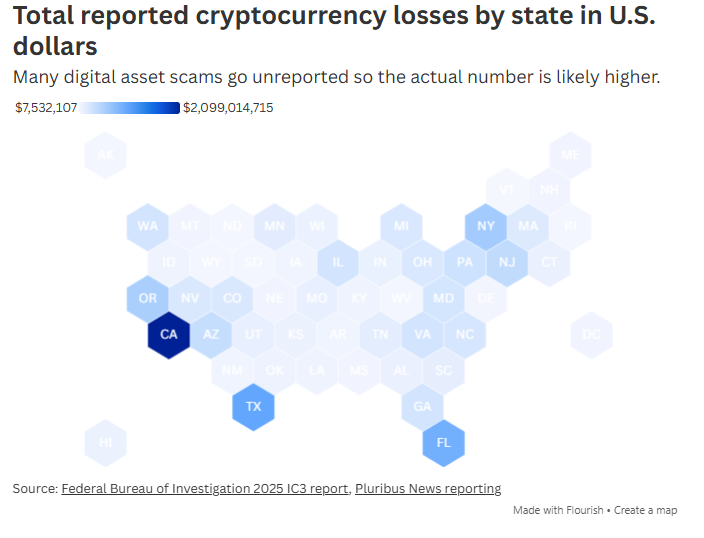
  • California reported the most crypto crimes and dollars lost
  • Twenty-three states have enacted crypto ATM regulation laws to curb fraud

Americans reported losing more than $11 billion in cryptocurrency-related crimes between 2024 and 2025, according to a new report from the Federal Bureau of Investigation that found complaints rising 21%.

California by far reported the most cryptocurrency-related crimes and dollars lost to digital asset scams last year, nearly double that of runner-up Texas in both categories, according to new data the FBI released its annual Internet Crime Report for 2025. Residents in the largest states – California, Texas, Florida and New York – reported the most complaints and overall losses. But after those mega-states, the correlation between population and the number and scale of scams becomes less clear: Oregon, which ranks 27th by population, reported the fifth largest losses due to cryptocurrency-related crime: $545,938,510. The FBI data shows cryptocurrency scams resulting in a total of a reported $11.366 billion in losses. Seniors were the hardest hit of any age group: Americans over the age of 60 reported the most complaints and the largest amount lost — more than $4.4 billion from that group alone last year.

Twenty-three states have enacted crypto ATM regulation laws in total, with 10 states passing laws in 2025. At least 22 bills have been introduced this year. Indiana in March became the first to outlaw the kiosks with the enactment of House Bill 1116.

In the last month lawmakers have passed bills to do so in Alabama (HB 303), Florida (HB 505), Wisconsin (AB 968) and Kansas (HB 2515 and HB 2591), Mississippi (HB 1625) and Kentucky (SB 189).

Emma Kinery is a State Affairs national reporter covering state politics and policy out of our Washington, D.C. office. Contact Emma Kinery at ekinery@stateaffairs.com or on X @EmmaKinery.

RELATED

Beshear signs cryptocurrency kiosk regulation bill, joining slew of other states

Mississippi Gov signs law tamping down on elder fraud from crypto ATMs

Alabama latest state to regulate cryptocurrency ATMs, seeking to curb fraud

Kansas passes crypto ATM bill; third state to do so in a month

Indiana becomes first state to ban cryptocurrency ATMs

Florida passes crypto ATM bill to curb scams targeting seniors

Wisconsin passes stringent crypto ATM regulation bill

Lawmakers in New Jersey aim to outlaw crypto ATMs, citing ‘rampant’ scams

Arizona implements law to regulate Bitcoin ATMs and prevent fraud

States move to rein in crypto ATMs as scams surge

Only 900 children to benefit from Arizona’s child care subsidy

Key Points:
  • Arizona parents eligible for subsidized child care can apply again
  • $125.9 million allocated will only help 900 children in 530 families
  • Eligibility for assistance based on income, preference for most needy families

Arizona parents who are eligible for subsidized child care can once again get in line. However, be warned — the $125.9 million allocated won’t be nearly enough.

In fact, initial estimates indicate that the recent allocation will assist only 900 children in 530 families. There are currently around 6,100 youngsters from nearly 3,700 families on the list.

And Stacey Reinstein, deputy assistant director of the Department of Economic Security, stated on July 21 that the system is designed so that those at or below the federal poverty level — $26,650 per year for a family of three — will be the first to qualify. She said there are about 2,200 children on the list who fit that category.

Reinstein said, however, that there’s a chance there will be enough money to help even some who are not yet on the list, particularly if they fall into that poverty level category.

They would have to wait their turn, but if they are among the most needy, they still would have a better chance of getting help than those who may have been on the list longer but have higher incomes.

This will be the first major dent in a waiting list that has been in place for years.

Arizona didn’t have a wait list until lawmakers cut state funding under the administration of Gov. Jan Brewer. The list shrank in 2018 when the state got a federal grant.

Then, when COVID-19 hit, Arizona received $1.2 billion in federal COVID-19 funds for child care.

Barbie Prinster, executive director of the Arizona Early Childhood Education Association, said what also happened is the state finally updated its reimbursement rate for child care centers, the first time since 2000. That was no problem with those federal dollars coming in.

But then the federal funds dried up.

Last year, lawmakers provided $12 million in state funds — the first state dollars in a dozen years.

“However, that wasn’t enough money to fund the system,” Prinster said, not only because of the number of applicants, but also because of the higher reimbursement rate. “So that’s why the wait list had to start.” 

Eligibility starts with income.

Strictly speaking, the program provides subsidized child care for families making less than 165% of the federal poverty level, about $43,972 for a family of three.

But the chances of anyone above the federal poverty level getting aid depend on how far those dollars stretch.

Reinstein said the system set up by DES will first use the funds to help the neediest of families. Only when — and if — there is money left will DES start funding those at 110% of the federal poverty level.

And, as dollars remain available, those in subsequent higher income categories will get help, up to that 165% limit. She said this “phased release” means that, in the end, there could be more than 900 children who get care from the funds lawmakers have made available.

There is, however, a catch.

Some children get to skip the line entirely.

That includes those who receive cash from DES, such as recipients of Temporary Assistance for Needy Families who are employed, and those in a grant diversion program who are seeking employment. They are considered categorically eligible.

The same applies to children referred from the Department of Child Safety.

But there’s something else.

Except for those who automatically qualify, a parent has to work at least 20 hours a week. What that means, Prinster said, is there’s no help for those who want to go out and search for a job.

“The people that want to go to work are screwed,” she said.

Reinstein acknowledged that gap.

“If they don’t meet the current DES child care eligibility requirements, we are limited with that,” she said. “I think there are multiple ways that people can seek assistance, whether it’s through their child care provider or through their community to help support that.”

None of what DES provides is free of charge.

“The federal government requires families to share in the cost of care through a copayment,” Reinstein said, with that linked to family income. But even those at or below the federal poverty line are supposed to pay $1 per day for each child.

Prinster, whose organization represents private licensed child care centers, said that kind of copay is important for parents “having some skin in the game and having a little bit of responsibility.”

She said, though, that there’s another factor, based on the rates providers charge, which can vary depending on the child’s age.

“So let’s say DES is reimbursing me $300 a week for an infant, but I charge $350,” Prinster said.

“The business can choose whether or not they want to charge that difference,” she said. “Nine times out of 10 they’re not going to be able to afford it,” what with many parents possibly making only the minimum wage of $14.70 an hour.

The state is currently sending letters and text messages to those on the wait list who are the most in need. That provides a way to connect them with DES caseworkers.

However, not everyone who received the messages may be in line for care, as a family’s situation may have changed since they first went on the wait list a year ago, whether due to a higher income or a child now being older and no longer needing daycare.

And that, in turn, raises the question of whether additional slots will be available.

How to apply:

Anyone already on the waitlist need not submit a new application, although they must respond to any letter or message they receive from DES to ensure they remain eligible and still require care.

Anyone else can apply online at “atozarizona.gov,” which provides links for child care assistance and other state services, including food stamps, unemployment benefits, and help with utility bills.

Paper applications also can be submitted at any DES office. There is a link at “des.az.gov/find-your-local-office” to search.

DES says eligibility determination is not based on the method of application.

Arizona budget faces potential hit from federal tax changes

Key Points:
  • State budget faces potential revenue loss due to conformity with federal tax code changes
  • Non-conforming could result in $381 million revenue loss in fiscal year
  • Sen. Kavanagh believes conformity is necessary to avoid an “accounting nightmare”

The newly enacted so-called Big Beautiful Bill could blow a not-so-beautiful hole in the just-enacted $17.6 billion state budget.

New figures from legislative budget analysts say that having state income tax laws conform with the changes made by Congress and signed by President Trump would reduce revenues this fiscal year by $381 million. And that’s without considering another $57 million in possible effects.

Strictly speaking, none of that has to happen. The losses would occur only if state lawmakers and Gov. Katie Hobbs agree that what the state considers taxable should mirror federal law.

Senate Majority Leader John Kavanagh said not conforming is not a realistic option.

The Fountain Hills Republican pointed out that the starting point for Arizonans to compute their state income taxes is the federally adjusted gross income. That simplifies the process for filers.

By contrast, he said that any decision not to conform would be “an accounting nightmare,” requiring Arizonans to make additional calculations and add back income into the state form that the federal government has decided is no longer taxable. And Kavanagh said there is little appetite to create new hassles for taxpayers.

Senate Minority Leader Priya Sundareshan agreed with a lot of that.

“The taxpayer burden is absolutely real,” said the Tucson Democrat.

That, however, still leaves the question of whether, given the number of dollars involved, lawmakers believe the state can afford to lose those revenues.

Kavanagh, who helped craft the newly enacted budget, said he believes that the reduction in revenues is “do-able.”

“The economy seems to be picking up, so I don’t really see a problem with that,” he said. Anyway, Kavanagh noted that the loss of revenues amounts to less than 3% of the total $17.6 billion state budget.

Sundareshan, however, said that Arizona’s $17.6 billion budget covers, just barely, the state’s needs.

She also believes that trimming that much in state revenues will simply provide an excuse for Republicans who, during negotiations, were interested in deeper cuts. That includes a proposal by some GOP lawmakers — ultimately defeated and not made part of the final budget — to take more than $100 million out of the Arizona Health Care Cost Containment System, the state’s Medicaid program.

“I guess they’re salivating at the mouth, really, to be in a position to cut more programs and to start kicking people off of AHCCCS and other things, services that we all rely on,” she said.

Even Sen. J.D. Mesnard, who chairs the Senate Finance Committee that crafts tax policy for Arizona, questions whether the state can handle such a large hit.

What may have to happen, the Chandler Republican said, is that he and his colleagues may be forced to pick and choose among which changes to the federal tax code to make their own and which income should remain taxable in Arizona.

Central to all this are the series of changes made by Congress to the federal tax code.

One of the biggest is allowing individuals to deduct — and not pay taxes on — overtime.

There is also a limit of $12,500 in such income for individuals and twice that for couples. And only the extra pay is exempt.

So, someone who earns typically $20 an hour but gets $30 in overtime can deduct only that $10 difference.

Even with those restrictions, legislative budget staffers figure that a change in federal law alone, if adopted by the state, would reduce Arizona revenues by $76.5 million.

Federal lawmakers also sought to make social security income tax free. But finding that too complicated, they substituted language to create an additional $6,000 standard deduction for taxpayers over 65, though there are some income limits.

This deduction is available whether taxpayers itemize deductions or not.

While social security is not taxed at the state level, there’s still a cost of $53.7 million to Arizona.

Further complicating matters, federal law allows that deduction for only three years, meaning it goes away in 2029 unless renewed.

There’s also a reduced tax on tips — also for only three years — with a $25,000 limit. And it applies only to those occupations the Treasury Secretary certifies “customarily and regularly” received tips before 2025.

The cost to Arizona? $23.6 million.

And then there are a series of changes to allow businesses to write off the cost of new equipment faster, reducing their taxable income. If lawmakers here follow suit, Arizona would incur total losses exceeding $110 million.

But can the state afford the losses?

The last time members of the state Finance Advisory Committee met, they predicted there would be a dip in tax collections. At the same time, the economists on the panel said state expenses in providing health care for people experiencing poverty could jump.

Kavanagh said he isn’t buying those predictions.

“Most of the dire warnings were based on a belief that Trump was going to put tariffs on everybody,” he said. “But, instead, he’s making tariff deals.”

And Kavanagh said predictions that the price of oil would spike were based on the possibility of war in the Middle East, “which Trump has calmed down.”

Sundareshan does not read the economic indicators that way, saying that tariffs are, in fact, being increased, meaning higher costs for businesses in Arizona.

“And so prices are going to increase for consumers,” she said. “But I don’t see that resulting in positive gains for the economy and, therefore, by translation, to revenue for the state.”

She acknowledged there was a boost in state income tax collections in the past few months. But Sundareshan said that is attributable to people paying taxes on the capital gains on their stocks — something she said was occurring because people were selling off their holdings “in anticipation of a negative downturn in the economy.”

House Minority Leader Oscar De Los Santos has his own views about the federal package, including the tax benefits for businesses.

“What we know is this: Massive tax cuts for corporations and the ultra wealthy never trickle down to the working class,” said the Laveen Democrat.

Kavanagh said he expects lawmakers to take up the issue of conformity when the Legislature reconvenes in January.

Hobbs, for her part, was noncommittal about whether to have state tax laws conform with the changes in the federal package.

“The administration is going through every provision with a fine-tooth comb to understand the full implications of this legislation and how to best protect Arizonans,” said gubernatorial press aide Christian Slater.

While Arizona lawmakers have historically tried to conform the state tax code to its federal counterpart, that is not a hard and fast rule. 

2026 ballot measure would ban tax or fee on vehicle miles traveled

Key Points:
  • The shift to all-electric cars could undermine the state’s ability to build and maintain roads
  • ADOT study to determine how the shift to electric vehicles will affect fuel use tax receipts
  • More fuel-efficient vehicles also complicate the fuel tax revenue

He’s describing the measure as a “freedom to travel” issue.

But a proposal Sen. Jake Hoffman got colleagues to include on the 2026 ballot would remove one option lawmakers have to ensure that electric vehicle owners in Arizona pay their fair share in taxes for road construction and repair. 

SCR 1004 would put a provision in the Arizona Constitution barring state and local government from imposing a tax or fee “based on the vehicle miles traveled.”

This comes as lawmakers continue to struggle with the fact that there are more and more vehicles on the road that use no gasoline at all. And that means they don’t pay the 18-cent-a-gallon gasoline tax that goes into the Highway User Revenue Fund.

Under the current system, the shift to all-electric cars could undermine the state’s ability to build new roads and, more importantly, upgrade and repair the ones we already have. But approval of the ballot measure would remove the option of charging electric vehicle owners who escape those gas taxes a fee based on their usage of Arizona roads.

Hoffman said it’s not a question of protecting those who use electric vehicles — as the driver of a Tesla cybertruck, that includes him — from the taxes generated on the sale of fossil fuels. Instead, the Queen Creek Republican said this is about protecting everyone from government overreach, regardless of the fuel they use.

“This is a measure that I’m confident that the voters will approve because it stands on the very simple principle that government should not be tracking or taxing your miles,” he said. “Regardless of what type of vehicle you own, regardless of how our roads are funded, freedom to move is a fundamental liberty that has a long-standing track record in America.”

And Hoffman said it’s more basic than that.

“The ability to tax is the ability to control by force,” he said.

Still, that leaves the question of how to pay for roads as consumers move away from fossil-based fuels.

There are more than 108,000 all-electric vehicles registered in Arizona. And while that’s a small percentage of the total fleet of more than 8.1 million cars and trucks, their use is growing exponentially, having more than tripled since 2020.

That trend so worries ADOT that it has contracted for a study to put a number on how many electric vehicles are driven in the state, and how that figure might change in the future. The agency is noting the placement of new fast-charging stations as part of the National Electric Vehicle Infrastructure program, which is “expected to increase the use of EVs both in Arizona and nationally.”

What the $74,835 study also intends to do is help ADOT determine how this shift will affect fuel use tax receipts. An agency spokesman stated that the report should be completed by the end of this year or early in 2026.

In the meantime, Sen. David Farnsworth is the latest in a series of lawmakers who have crafted legislation designed to provide some equity.

His SB 1471 would have allowed ADOT to establish a tax on electric vehicles and any other motor vehicles using something other than fossil-based fuels.

It provided two methods for the agency to compute the levy, and was designed to be comparable to the fuel tax that would have been paid by a similarly equipped vehicle using gasoline or diesel.

The Mesa Republican even included a provision to ensure everyone knew what he was trying to do and what was going on. It included language saying the intent is to ensure all alternative fuel vehicles are “paying an amount that is proportionally equal to their use of highways in the state” and, more to the point, that vehicles powered by petroleum-based fuels “are not paying for all of the costs relating to highway use and maintenance.”

However, Farnsworth, who chairs the Senate Committee on Education and Transportation, didn’t push it beyond an informational hearing in March, after receiving resistance from some of his colleagues.

“There’s the fear of government control and the camel’s nose under the tent, and before long they’re telling us where we can and can’t go,” he said.

“Is that paranoia or reality?” Farnsworth asked. “But the concern is real.”

So the measure never advanced. Still, Farnsworth said he will continue to try, saying, “We need to make things more fair.”

However, the failure of his bill also paved the way for Hoffman to line up the votes for his SCR 1004, which asks voters to permanently eliminate one option: imposing a tax based on miles traveled.

Hoffman said that doesn’t eliminate all options to tax electric cars.

For example, he said he has no problem with “consumption taxes” based on usage.

“That’s a very different thing,” Hoffman said. In fact, that’s the basis for the gasoline tax: Motorists pay based on the number of gallons of fuel purchased.

In this case, he said, electric vehicle owners are already paying fees and taxes to the electric company based on usage. And there may be more electrons used by someone who is charging a vehicle.

However, Hoffman said that all of this ignores the real solution: don’t tax gasoline, diesel or electricity.

“I believe it is the Legislature’s job to fund the core responsibilities, public safety and infrastructure being the most fundamental of those things,” he said.

That, however, doesn’t mean Hoffman supports higher overall state taxes to make up for the more than $1.8 billion that goes into the Highway User Revenue Fund each year —— $800 million of which is the levy on fossil fuels used to power motor vehicles. He figures there’s enough in the state’s $17.6 billion budget to pick up the cost.

His position is not a surprise: Hoffman has voted against virtually every spending plan since he was first elected to the Legislature in 2020. And he insists that there is no company — and no government — that cannot find a way to cut 4.5% from its spending.

That, however, is likely to get a fight from a majority of lawmakers who just approved the new budget and have priorities they want funded, whether it’s health care, prisons, social services or even pet projects.

Still, there is some precedent for the idea of the state using its income and sales tax revenues to fund road construction.

In fact, the new budget actually has millions of dollars in carve-outs for specific road projects, such as widening a stretch of Interstate 10 west of Phoenix and making improvements to State Route 347, which runs between the edge of Phoenix and Maricopa.

And it’s not just big projects. General fund dollars — the money collected mainly through sales and income taxes — are also being earmarked for projects such as adding a second right-turn lane to State Route 87 in Payson and installing traffic control systems in Colorado City.

There’s also the precedent of voters approving local sales taxes for specific transportation projects, including not just road construction and maintenance but also mass transit.

Gov. Katie Hobbs inquired about the issue, stating that the state needs a “creative solution” to find a way to ensure that everyone who uses state roads pays a fair share.

“The way that the gas tax works right now is not fair,” she said. The governor, however, said she had no answer.

But will she vote for the ballot measure?

“I have not thought that far ahead,” she said.

The issue of how to fund road construction and repair transcends alternate fuel vehicles and predates their current increasing popularity.

A decade ago, Noel Campbell, then a Republican state representative from Prescott, proposed a dime-a-gallon increase in the gas tax.

He pointed out that the rate was set in 1991— and hasn’t been adjusted since 1991. Had it kept pace with inflation, the levy in 2025 would be about 45 cents a gallon. Conversely, the buying power of the current 18-cent levy is worth only about a third.

Complicating matters — beyond the increasing popularity of electric vehicles — is that newer cars and trucks are generally more efficient than older ones. That means a typical vehicle travels more miles on a gallon of gas, resulting in less need to purchase fuel, even as the number of miles people travel — and the wear and tear — on state roads is not decreasing.

Campbell, however, found little appetite among fellow lawmakers for a tax hike, even if it were referred to voters. And successive lawmakers have had no more luck.

 

Gov. Hobbs likely to sign bill for Chase Field despite opposition

Gov. Katie Hobbs may not sign a budget this week, but she will likely sign a negotiated measure to use sales tax revenue and state income tax revenue for stadium renovations at Chase Field. 

The House passed House Bill 2704 (tax; distribution; county stadium district) 35-20, with the Freedom Caucus joining some Democrats in opposition.

The bill is intended to keep the Diamondbacks in downtown Phoenix, with the team’s lease at the stadium ending in 2027. 

Other Democrats who were previously hesitant about the bill voted for it because of the jobs it will bring to Arizonans. 

“This morning, I wasn’t ready to vote yes on this bill,” said Rep. Mariana Sandoval. “But because I’ve learned that unions have signed contracts to get work from this bill, I am going to support it.”

The city of Phoenix now supports the bill after fighting against it all legislative session. Before the Senate voted on the bill last week, an amendment was added to bring the city in support of the bill, which caps Phoenix’s annual contribution to the stadium at $3.5 million, adjusted at 3% for inflation. 

Stadium renovations are expected to use $500 million collected from sales tax revenue at the stadium district and from income taxes of Diamondbacks players and staff over the next 30 years.

“I just want to remind the Arizona Diamondbacks that this is public money that should be used for public good,” said Rep. Cesar Aguilar. 

The bill now also restricts the use of tax dollars provided to the Maricopa County Stadium District from being used for luxury amenities such as club seating or pool suites. The Legislature intends for the team to contribute $250 million for the stadium and the bill now has a provision which would put the team on the hook for stadium repairs if the Legislature repeals the tax distributions before 2056. 

Dear IRS, Arizona wants its $20 million back.

Key Points:
  • Arizona filed a lawsuit to recover $20 million taken from Arizona taxpayers by the IRS
  • State lawyers say the IRS improperly taxed one-time rebate checks from 2023 
  • 21 other states who passed similar rebates were not taxed

State lawyers are asking a federal appellate court to allow them the opportunity to recover more than $20 million they claim was illegally taken from approximately 750,000 Arizona taxpayers.

In legal briefs, members of the Attorney General’s Office contend that U.S. District Court Judge Murray Snow erred in upholding the Internal Revenue Service’s decision that $260 million in one-time rebates in 2023 were subject to federal taxes.

Murray did not dispute that the IRS reached a contrary decision regarding the one-time payments to residents in 21 other states. But he said what Arizona did was factually different — including the fact that the “rebates” in some cases exceeded the amount of state taxes that some residents paid.

And there’s something else.

Snow stated that only individuals who claim to have been injured by the IRS decision have the right to sue. And none are named as plaintiffs.

But Assistant Attorney General Josh Bendor is telling the 9th Circuit Court of Appeals that the state does have standing to sue.

His proof?

Bendor stated that the IRS collected approximately $20.8 million from state residents. Had they spent that money, he figures the state would have collected about $480,000 in sales tax.

Snow dismissed any injury to the state as “derivative and speculative.” In fact, he said, even the state, in its lawsuit, admitted that the only certainty was that if Arizonans had retained the money they would have been free “to spend it as they saw fit.”

But Bendor is telling the appellate judges that Snow’s conclusion was “premature,” arguing that the state is entitled to its day in court, something it did not receive when Snow dismissed the case without hearing evidence.

All this stems from a provision in the 2023 budget — when the state had a surplus — to provide a rebate to families of $250 for every child younger than 17 and $100 for older dependents, up to a maximum of $750 per family. That generated about $260 million for 750,000 Arizona families, with an average rebate of about $370.

What wasn’t known at the time was that the IRS would later tell the state Department of Revenue it considers such payments subject to federal income taxes.

Based on that, state revenue officials said they had no choice but to issue a 1099-MISC form to each rebate recipient. That form covers certain types of miscellaneous compensation, including prizes, that are not covered by other documents federal law requires to be issued.

More to the point, a copy of those forms went to the IRS, just like a W-2 for wages, making the federal government aware of who received the payments — and making the taxpayers liable to report it and pay taxes on it.

A key to Bendor’s argument to the appellate judges is that the IRS, in effect, is discriminating against Arizona and its taxpayers. That’s based on his argument that the federal agency allowed residents of other states to keep their full rebates without having to pay federal taxes.

“The IRS treated 21 states favorably and then, without a reasoned basis, treated Arizona unfairly — an action that was arbitrary and capricious in violation of the Administrative Procedures Act and that derived Arizona of equal sovereignty under the U.S. Constitution,” Bendor wrote.

“The IRS cannot dispute its disparate treatment of Arizona,” he continued. “It can only attempt to justify it.”

Bendor also hit back at Snow’s conclusion that any loss to Arizona in sales taxes was speculative. He said the state supported that conclusion with declarations from an economist from the Arizona Department of Revenue.

Bendor said it’s irrelevant if the amount of lost dollars does not equal the state claims.

“The IRS cannot plausibly dispute that taking over $20 million out of Arizona caused the state to suffer at least some tax-loss injury, even if the quantum differs from what Arizona has alleged,” he said.

Strictly speaking, the 9th Circuit cannot order the IRS to refund the money. Instead, all the appellate court can do — if they agree with Bendor — is order Snow to take another look.

But even if the 9th Circuit sides with the state, and even if Bendor can convince Snow to change his mind, that doesn’t mean the Arizonans who had an extra bite taken by the IRS will automatically get a check.

“That would be our preferred relief,” said Richie Taylor, a spokesman for the Attorney General’s Office.

“But the IRS has said that it cannot reliably identify individual taxpayers who paid tax on the tax rebate,” he told Capitol Media Services. “If accurate, taxpayers may need to request refunds from the IRS in the event we ultimately prevail.”

This would mean filing amended tax returns for the 2023 tax year.

As it turns out, the state, while using its $480,000 claimed loss as the basis for being able to sue, isn’t actually asking the federal government for the money. Richie said the presumption is that if Arizona wins and taxpayers do get their $20 million back, they will spend it, and the state treasury will eventually receive its sales taxes that way.

Arizona’s leaders must do what is necessary to restore our schools

William David Nichols

We must acknowledge that there are Arizona schools where excellent teachers inspire students to perform at high achievement levels. The Arizona Department of Education (ADE) provides cutting-edge academic standards and teaching strategies. Unfortunately, the overall picture of schools is bleak, and there is no silver bullet remedy to a crisis of neglect by policymakers. However, a bipartisan consensus for sufficient funding that supports a broad-based commitment to strategies for every student is required to break free from a cycle of crisis.

In the September 2024 edition of The Arizona Republic, a Consumer Affairs study found that Arizona schools were ranked at the bottom of all 50 states in all issues of quality in education.

Since the ADE’s initiative to adopt the Empowerment Scholarship Account (ESA) in 2022, participation has expanded exponentially. This statewide funding strategy allows students to use state-funded vouchers to apply to their school of choice. 

Consequently, thousands of students either left public schools or never attended one, using vouchers at charter or private schools. This otherwise positive school choice program reduced the ADE’s funding plan for public schools. Consequently, along with other factors, more than 20 public schools have closed, creating a dire predicament.

According to a 2023 report by the Grand Canyon Institute, the ESA will cost Arizona’s 2024 General Fund $700 million. There is an ongoing controversy over the voucher program and its costs among some elected officials, the governor, and the superintendent of public instruction, all the while Arizona’s children struggle.

Despite the bad news, we can devote our resources to improving reading, children’s most important academic skill. Learners who struggle with reading will not do well in other subjects. In his book, “The Educated Child” (1999), former U.S. Secretary of Education Bill Bennett made a resounding statement: “If a child cannot read on grade level (proficient) by the end of the third grade, there is an 80% chance that he will not graduate from high school.”

Scientific, reliable data prove that reading is the primary skill in student success. Most reading assessments, state and national, closely align with other credible measurements. The National Assessment of Educational Progress (NAEP), the gold standard in evaluating academic progress, conducts a bi-annual assessment for every state. Crucial are the subjects of reading and math in 4th and 8th grade. NAEP uses an algorithmic method for randomly selected schools. The most recent NAEP (2024) for Arizona’s average reading score for 4th graders ranked sixth from the bottom of all 50 states in America.

The state’s 2020 legislative mandate requires all certified teachers in grades 1 – 5 to obtain an endorsement. It is a course known as the “Science of Reading.” Other states have adopted the requirement.

The ADE outcomes from reading assessments mirror national test scores and validate state achievement measures. Yet, Arizona public school students lag in the success rates of 44 other states. This failure lies at the feet of decision-makers who appear to be complacent and unwilling to prioritize the education budget, ignoring that future opportunities will be limited for more than an estimated 2 million Arizona children.

The regressive tax laws in Arizona create another stumbling block to better school funding. Low to middle income families pay more property and sales taxes than higher-income families. Students from these lower socioeconomic communities are also at several disadvantages, including a lack of technology in the home, parents who may be unable to assist them, and a community culture that often creates low academic expectations, a precursor to higher dropout rates and low high school graduation rates.

According to the Arizona Department of Revenue (FY 2023), Arizona’s corporate tax rate liability, once 7%, is now only 4.9%. Also, unlike most states, the federal government pays the highest percentage of Arizona’s funding. If federal dollars for education are reduced as expected, Arizona will face the need to increase state and local funding sources.

Parents, teachers, education administrators, state legislators and the public want good schools. It will benefit the state’s economy, businesses and families considering moving to Arizona. Taxpayers must insist that our elected officials do the right thing. The school voucher program should be revisited to seek methods to cap the funds and/or re-align procedures to stop the bleeding.

As the 2025 state budget is developed, preferably in a bipartisan effort, strategies and permanent solutions must be made for the sake of our children.

William David Nichols, Ed.D. has been a teacher, education consultant, author and a school board member in both public and private institutions.

Lawmakers negotiate funding in face of looming DCS budget shortfall

Lawmakers on the Joint Legislative Budget Committee approved a $16 million funding transfer within the Department of Child Safety on Thursday after Republicans sounded the alarm that funding for foster group homes would run out on March 24.

The final approval came amidst growing partisan frustration with Democratic Gov. Katie Hobbs over state spending.

That meant Republicans and Democrats on the committee spent most of the meeting arguing over who was responsible for DCS’s funding issue after feuding erupted earlier in the week prompting a press event and ad hoc committee by the GOP on March 17 to address Hobbs’ management of the executive budget.

House Appropriations Chairman David Livingston, R-Peoria, said he received a letter from DCS on March 11 informing him that the department needed a line item transfer by March 24. The letter, dated March 5, was delayed in getting to Livingston because it was sent to the nonpartisan Joint Legislative Budget Committee staff rather than Livingston’s House office.

“This financial mismanagement threatens the most vulnerable children in our state and House Republicans will not let this stand,” said Speaker Steve Montenegro, R-Goodyear. “Once again, we are being told that we have to clean up Governor Hobbs’ mess.”

DCS initially proposed pulling $6.5 million from kinship care services and foster home placements to cover the shortfall in its letter, but Livingston said he was concerned that wouldn’t be enough to cover the rest of the fiscal year.

“The agency has already spent its fourth quarter allotment even though we’re in the fourth quarter,” said House Majority Leader Michael Carbone, R-Buckeye. “They tell us that even if we move funds for DCS today, congregate care will still go broke in April. Perhaps one of these problems alone would be excusable, but we’re seeing a pattern of financial malfeasance.”

When Livingston said he asked DCS to re-examine funding sources the department could pull from and to make sure the supplemental request would cover the rest of the fiscal year, the department came back with a proposal of transferring another $10 million from adoption services, out-of-home support services and in-home mitigation to cover the shortfall through June 30.

The request also includes a $2.2 million transfer to extended foster care from adoption services. JLBC approved the total transfer of $16.5 million during its March 20 meeting.

Hobbs’ spokesman Christian Slater said in a written response March 17 that the DCS funding request is a standard budget procedure that Republicans have known about since department staff attended a Jan. 29 House Appropriations Committee to discuss the state of the agency.

“The majority should do their jobs and pay attention in committee hearings rather than weaponize routine budgeting processes to hold Arizonans hostage for their own political gain,” Slater said.

Richard Stavneak, the director of JLBC’s staff, said while JLBC knew about DCS’ funding issue, his staff could not have known when exactly the department would run out of money.

“There are any number of different funding sources that exist with any large department so I think my perspective is, yes, there was going to be a problem,” Stavneak said. “Would it occur on March 24? That is something that only the agency is sufficient to be able to make that call.”

Republicans say their frustration stems from the executive branch’s management of the budget as a whole and what they view as miscommunication from the governor’s office and DCS. Livingston said he felt that the letter that DCS sent on March 5 was “unprofessional” and “politicized” when it mentioned that children would be removed from group home placements and likely be forced to sleep in DCS offices or runaway as a result of inaction.

“It is normal when (JLBC) meets and we do line item transfers,” Livingston said. “If (DCS) would have asked for these monies to be transferred in our December meeting, that would have been a normal process.”

Alex Ong, the deputy director of administration for DCS, said during the JLBC’s meeting that DCS knew about the shortfall that congregate care services would face since the current year’s budget was signed last legislative session, but waited until March to ask for the appropriations transfer to see how the department’s expenditures were shaping.

Ong said while the department didn’t make the specific request for a line item transfer in January, he felt the department had made the legislature aware that it would need a supplemental well before the March 5 letter was sent.

Although the legislature has addressed DCS’s funding issues, the governor’s office has been critical of Republicans choosing not to vote on a $122 million supplemental funding bill that would provide emergency funding for Arizonans with developmental disabilities.

House Democrats on March 18 attempted to bypass procedural rules and bring forward the supplemental bill that would provide supplemental funding to keep these services running, but Republican lawmakers and the governor’s office came to a standstill over how to resolve a budget crisis rapidly becoming political.

“The governor has made promises to them that she can’t keep. She hasn’t appropriated the money to pay them what she says she will pay them and then we’re left cleaning it up and being the adults in the room,” Livingston said.

House Republicans rejected the offer from Democrats to vote on HB2816 — the supplemental funding bill. Livingston said after Tuesday’s floor session that Republicans were unwilling to pass a supplemental funding bill on its own without “substantial” adjustment on disability policies. He said the governor’s office hasn’t been willing to discuss those policy adjustment ideas.

“It makes it very difficult to pass a supplemental when they won’t meet with us to talk about what we need in that, besides the money,” Livingston said. “There’s no way in hell that we’re passing a supplemental with just the money and no reforms because the mismanagement caused it.”

Slater said that Republicans have proposed cutting 25% to 50% of the DDD’s budget.

He also accused Republicans of not being willing to negotiate and lying about the budget process.

Line item budget transfers have historically been a common occurrence from various state departments during JLBC meetings; DCS itself has approved over 20 since September 2016 when former Republican Gov. Doug Ducey was in office. That fact was not missed by House Minority Leader Oscar De Los Santos, D-Laveen, who said that Republicans are only now speaking about it because a Democrat occupies the Ninth Floor.

“Now, suddenly, when it’s not (Empowerment Scholarship Accounts) asking for a supplemental request, and its children with disabilities asking for a supplemental request, suddenly it’s a problem. Outrageous,” De Los Santos said. “Stop the games. Pass the supplemental.”

In a March 5 letter to Livingston and Sen. John Kavanagh, R-Fountain Hills, Hobbs’ office informed the appropriations chairmen that the ESA program would need a $44.8 million supplemental to cover increased costs in the 2025 budget.

Both Livingston and House Assistant Minority Leader Nancy Gutierrez, D-Tucson, told the Arizona Capitol Times they’re confident DDD’s funding issue can be resolved by the end of April, but Republicans and the governor’s office have called on one another to step up to the negotiating table.

House passes D-Backs funding bill 35-25, tosses it to Senate

A legislative proposal intended to keep the Arizona Diamondbacks in Phoenix for the long-term future cleared the Arizona House of Representatives on Feb. 26 as the team officials consider the end of their stadium lease in 2027.

House members passed HB2704 by a vote of 35-25 to get one step closer to stability for where the team will play after the current lease at Chase Field in downtown Phoenix ends. 

Diamondbacks ownership is seeking a funding mechanism for maintenance and repairs at the ballpark, which has been the team’s only home since 1998. 

Rep. Jeff Weninger, R-Chandler, the bill’s sponsor, said, “Let’s make sure we hold onto this economic juggernaut that is the Arizona Diamondbacks. Let’s make sure we hold onto a source of pride for the entire state and let’s make sure the Arizona Diamondbacks are here for years to come and we celebrate many more World Series titles.” 

Lawmakers are working with the Diamondbacks to split future stadium repair costs between the team and sales tax revenue without creating a new tax. 

The bill adopts the model of how the Arizona Cardinals pay for stadium maintenance at State Farm Stadium in Glendale by using income tax revenue from team staff and players combined with sales tax collected from stadium-related purchases.

“This is a proven way to maintain a sports facility and the smartest way to create a partnership between the city, county and state that all benefit from a world-class baseball team,” Weninger said. 

A fiscal note on the bill from the Joint Legislative Budget Committee estimates HB2704 would reduce the state’s general fund revenue by more than $9.2 million annually. Nonpartisan budget analysts also estimate the city of Phoenix would lose $3.5 million annually and Maricopa County would lose $1.1 million annually. 

The Diamondbacks estimate more than $500 million of repair costs for essential stadium projects, including HVAC, plumbing and roof repairs. Diamondbacks leadership has verbally committed to paying for more than half the costs needed for stadium repairs and has projected to contribute between $250 million to $300 million. 

The Diamondbacks don’t own Chase Field. Maricopa County owns the stadium, and a 2018 agreement between the county and the team states that the team is responsible for stadium operations and maintenance as its facility manager. 

“When you own a house and your air conditioning goes out, it’s on you to pay for it,” said Rep. Justin Wilmeth, R-Phoenix. “Much is the case in my opinion on this measure with the D-backs and Chase Field.”

Phoenix Mayor Kate Gallego said in a post on X that the bill subsidizes public taxes and would negatively impact the city’s ability to pay for police and fire services. City officials are estimating the city will lose $200 million over a 30-year period from the deal. 

“Two-thirds of Phoenix’s general fund supports public safety. Phoenix’s tax dollars are best spent supporting our firefighters who respond to emergencies, helping police fight crime, and combating homelessness — not used to pay for subsidies for those at the very top,” Gallego wrote in her post.

The House amended the bill on Feb. 24 to include some transparency measures, including requiring the team’s board of directors to report to the Legislature and Governor’s Office for all reconstruction, repair and maintenance projects at Chase Field.

The amendment also would end the stadium’s tax revenue method after 30 years, leaving future lawmakers to decide on the team’s location. 

Gov. Katie Hobbs said on Feb. 26 that she supports a bill keeping the Diamondbacks in Phoenix and would not veto it just because the city of Phoenix opposes it. 

“I am really hopeful that the points of disagreement between the city, the county and the state can get worked out so that we can get a deal done,” Hobbs said.

Republican political consultant Barrett Marson said he thinks it would be wise for Hobbs to sign the measure in whatever fashion it’s presented to her. 

“Hobbs doesn’t want to be the governor that loses the Diamondbacks,” Marson said. 

The House vote was bipartisan with a handful of Republicans and Democrats voting against the measure. House Democratic leadership and members of the Arizona Freedom Caucus voted against the bill. 

“I am old enough to remember when Democrats opposed taking money from regular taxpayers and giving it to rich corporations,” Rep. Alexander Kolodin, R-Scottsdale, said as he voted against the bill. 

The bill must now pass the Senate before it can reach Hobbs’ desk, where she will decide its fate. 

First they came for the auto parts store…

I am president of RockAuto, an online auto parts store in Madison, Wisconsin.  My family and I started the business in 1999, offering “all the parts your car will ever need” to everyone from novice “DIYers” to professional mechanics worldwide.  

Jim Taylor

Since 2019, when a new law taxing out-of-state businesses based on “economic nexus” took effect, RockAuto has paid Arizona sales taxes even though we never have had an Arizona store.  

Unsatisfied, the Arizona Department of Revenue (ADoR) recently convinced the Court of Appeals we were physically present in Arizona before 2019 without knowing it and owed tax under the old law.  Somehow, every Arizona factory and wholesaler selling parts to us became our branch office when we asked them to ship directly to our customers.  Address labels became stores, refrigerator magnets became salespeople and, magically, RockAuto was in Arizona. 

No previous court case (including ours in the Arizona Tax Court) found a retailer “physically present” without employees or assets or someone making in-state contact with customers.  ADoR’s own publications say “drop-shipping” from Arizona suppliers does not create tax liability.  But ADoR persists in demanding six years of taxes (which we didn’t collect from customers) plus interest and penalties — far more money than we earned in 20 years selling auto parts to Arizonans! 

We’ve petitioned the Arizona Supreme Court to review the case.  The Arizona Tech Council and State Representative Michael Carbone have written letters pointing out tax laws come from the legislature, not ADoR’s imagination.  Since Governor Hobbs did not create this situation (it began before she took office), thousands of our Arizona customers have appealed to her to move the state in a more positive direction by restraining ADoR.  Some of them said:

“I live in a rural area of Arizona and quite often RockAuto is the only
source of automobile parts available within a reasonable time frame.”

“As an accountant by trade who has experience in sales tax law, this is blatantly incorrect.” 

“I drive a 1998 auto and I need parts quite often due to the mileage and year. Competition helps keep the parts business competitive and prices lower. Don’t reduce the numbers of parts businesses in Arizona for all of us retired people.”

“The state’s tax case is absurd and unfair. It could easily affect other online retailers we depend on.”

Empowered by the appeals court, ADoR has not responded.

To protect the livelihoods of our families from future attack, we’ve stopped buying from Arizona suppliers.  We may be forced to stop selling to customers in Arizona.  Dismantling relationships which took decades to build is heartrending.  But we can’t work for free or live in fear of the next random, retroactive ruling.  

Other online retailers that bought from Arizona suppliers in past decades or today  (even if they don’t meet the “economic nexus” threshold) could be next on ADoR’s hit list.  Do you or your business depend on any of them?

You don't have credit card details available. You will be redirected to update payment method page. Click OK to continue.