Sign In
 Free Newsletter

When state rhetoric collides with federal law, public safety suffers
Brandon Burley, Guest Commentary//January 27, 2026//

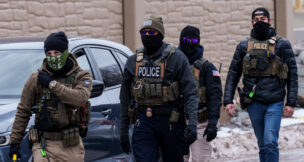
Maple Grove police officers stand during a protest outside SpringHill Suites and Residence Inn by Marriott hotels on Monday, Jan. 26, 2026, in Maple Grove, Minn. (AP Photo/Adam Gray)
When state rhetoric collides with federal law, public safety suffers
Brandon Burley, Guest Commentary//January 27, 2026//


Arizona has a long history of tension between state leaders and federal immigration enforcement. Disagreement over policy is nothing new — and in a constitutional system, it is expected.
What is new, and deeply concerning, is the growing willingness of state officials to frame legal realities in ways that risk real-world violence by blurring settled constitutional boundaries.
During a televised interview with 12News reporter Brahm Resnik, Arizona Attorney General Kris Mayes raised concerns about how Arizona’s expansive “stand your ground” law could intersect with federal immigration enforcement. Citing the state’s gun culture and self-defense statutes, Mayes warned that Arizona was “kind of a recipe for disaster” because of the presence of “masked federal officers with very little identification — sometimes no identification”— combined with a law that allows lethal force if someone reasonably believes their life is in danger while in their home, vehicle, or on their property.
When Resnik cautioned that such remarks could be interpreted as endorsing violence, Mayes rejected that characterization, stating, “I’m not [giving a license] to an individual…to shoot a peace officer. No, absolutely not.” She then emphasized the uncertainty she believes arises when officers are not clearly identifiable, asking, “How do you know they’re a peace officer?” and noting that in a stand-your-ground state, legal scrutiny could turn on whether someone “reasonably knew that they were a peace officer.”
Even with those disclaimers, the legal problem remains.
Federal law enforcement authority is not ambiguous. Under the Supremacy Clause of the U.S. Constitution, federal officers acting within the scope of their duties are enforcing federal law that states cannot veto through opposition, implication, or rhetoric. Whether one supports or opposes immigration enforcement, that legal reality is settled.
States may criticize federal policy. They may challenge it in court. They may protest it politically. What they may not do — legally or responsibly — is frame violence against federal officers as potentially justified under state law. This distinction matters because it shapes public behavior.
The First Amendment robustly protects peaceful protest. Arizonans have the right to assemble, to speak, and to condemn federal policies they oppose. That protection does not evaporate because enforcement is unpopular or controversial. But the First Amendment does not protect obstruction of lawful law enforcement. It does not protect interference with officers executing warrants. It does not protect threats or violence. Courts have drawn that boundary clearly for decades.
When senior legal officials blur that line — especially by publicly emphasizing ambiguity around the lawful status of federal officers — they do not empower protest. They place civilians in legal jeopardy and increase the likelihood of violent confrontation. Some public concern driving these tensions is legitimate. Questions have been raised nationally about federal officer training standards, particularly reports that formal academy training for new immigration officers was shortened to roughly eight weeks. Independent fact-checking has found these claims largely accurate, even as agencies note supplemental training.
Training standards matter. Scrutiny is appropriate. Transparency builds trust. But concerns about training do not alter the legal framework. They justify oversight and reform — not rhetoric that risks normalizing confrontation. Raising preparedness concerns while emphasizing hypothetical justification for lethal force is a dangerous mix.
Arizona’s leaders occupy a unique position. Unlike national officials, they live with the consequences of their words. Their statements land on the same streets where protests unfold and tensions escalate. Careless rhetoric here does not remain symbolic — it becomes operational. The federal government also bears responsibility. When federal agencies retreat into silence following use-of-force incidents, they fuel suspicion and rumor. Transparency after serious encounters is not a concession; it is a stabilizing force.
But federal opacity does not excuse state irresponsibility. The off-ramp from escalation is not control — it is clarity. State leaders should affirm protest rights while stating plainly that obstruction, threats, and violence are unlawful. They should criticize federal policy without mischaracterizing constitutional limits. And they should remember that legal precision is not weakness; it is public safety.
Arizona does not need louder statements. It needs more accurate ones.
Policy disagreement is healthy. Reckless rhetoric is not.
Brandon Burley, MPA, is a retired detective who now works as a criminal justice educator and public policy writer based in Tennessee.