Sign In


Upcoming Event
 Free Newsletter

Don’t gut Arizona’s middle housing law
Tyler Denham, Guest Commentary//March 20, 2026//
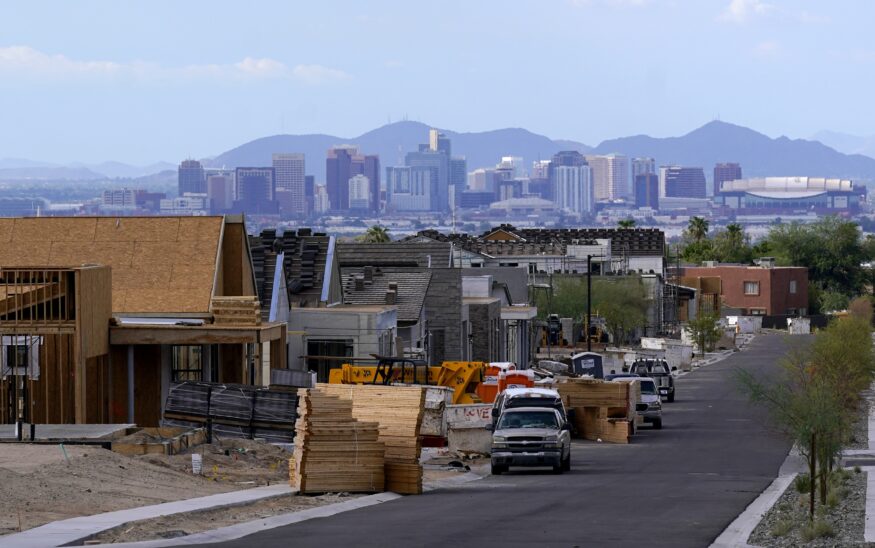
With the downtown skyline in the background, a new housing development adds to the expansive urban sprawl continuing to grow, Thursday, Aug. 12, 2021, in Phoenix.(AP Photo/Ross D. Franklin)
Don’t gut Arizona’s middle housing law
Tyler Denham, Guest Commentary//March 20, 2026//


Arizona’s middle housing law took effect on Jan. 1, 2026, requiring large cities to legalize duplexes, triplexes, fourplexes and townhomes within one mile of their downtown cores. Its goal was simple: to expand housing options near jobs, shops, services and existing infrastructure. When the law passed, it was praised by the League of Arizona Cities and Towns, the Governor’s Office and legislators from both parties as a common-sense, bipartisan response to rising housing costs.
Just three months later, legislators are considering rolling much of that back.
HB2375, a bill moving through the Legislature, would let cities exempt areas they designate as historic from the middle housing law. That may sound modest on paper, but in Phoenix alone it would immediately exempt 38% of the area where middle housing was recently legalized, sharply limiting the number of homes the law will produce.
The frustrating part is that HB 375 is unnecessary for historic preservation. The middle housing law does not override historic property protections or demolition restrictions. It still allows cities to regulate the scale and form of new housing, just as they do for single-family homes, to ensure compatibility with neighborhood character. Cities can still enforce ordinary zoning rules such as density, setbacks, lot coverage, and height limits.
So what is really behind this bill?
It’s a classic case of Not In My Backyard (NIMBY) politics. In a bid to block new housing, wealthy neighborhoods have hired lobbyists to push HB2375. Historic preservation is the only sympathetic cudgel they could find, and they are happy to mislead residents and legislators about all the ways genuinely historic properties remain protected.
The irony is that middle housing is itself a historic building form. Duplexes, triplexes and fourplexes were common in American cities in the early 20th century, before zoning laws made them widely illegal. That is why they are often called “missing middle” housing. The groups pushing HB2375 claim to value history, yet they are fighting a law that restores a traditional pattern of neighborhood development.
The passage of HB2375 would set a terrible precedent. Full exemptions would almost certainly become a fixture of future housing bills, creating a powerful incentive for well-connected neighborhoods across Arizona to lobby their cities for special protection from change. State law does not require objective criteria or independent review boards to ensure cities are creating historic districts in good faith.
Instead of gutting the middle housing law, legislators should consider expanding the area it covers. To avoid concentrating development in just a few neighborhoods, Flagstaff and Tucson legalized duplexes, triplexes, fourplexes and townhomes citywide. Several historic districts in other cities asked for the same approach, but were shot down in favor of doing the bare minimum to comply with the law.
The ordinances in Flagstaff and Tucson were notably less controversial than those in other cities. The idea that every neighborhood needs to chip in to help address the regional housing shortage is a unifying message, but the idea that favored neighborhoods get to push their share of development onto everyone else is a divisive one.
Ultimately, HB2375 is a test of whether Arizona lawmakers are serious about lowering housing costs. If we won’t allow even the most basic forms of incremental housing reform in the urban cores of large cities, what hope do we have?
Tyler Denham is a resident of Flagstaff and executive director of a local housing advocacy nonprofit.