Sign In




 Free Newsletter
Arizona ICE warehouse conversion halted over environmental impact study
Howard Fischer, Capitol Media Services//July 2, 2026//
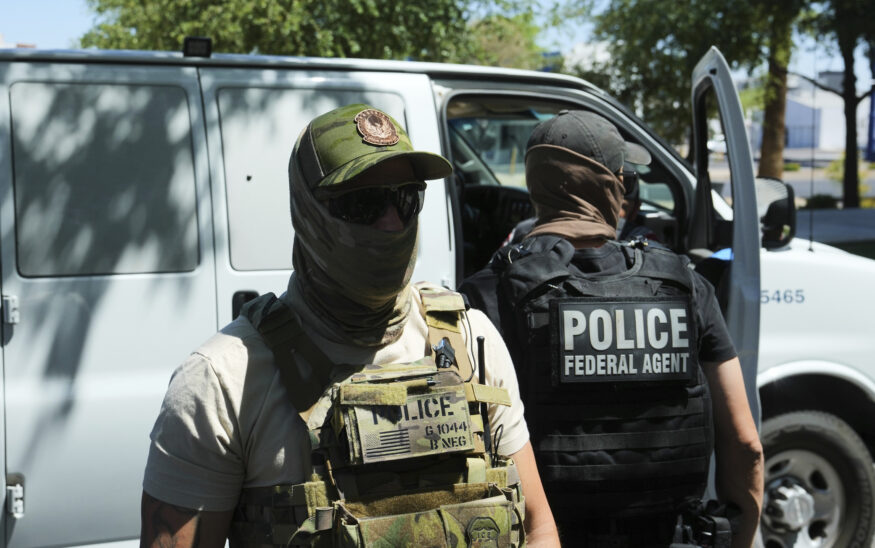
ICE and HSI police protect a van after taking into custody a person outside an immigration court Wednesday, May 21, 2025, in Phoenix. (AP Photo/Ross D. Franklin)
Arizona ICE warehouse conversion halted over environmental impact study
Howard Fischer, Capitol Media Services//July 2, 2026//


Key Points:
-
Federal officials delay converting Surprise warehouse to detention facility
-
Environmental assessment will be conducted to determine suitability of facility
-
Federal officials will conduct “ordinary maintenance” on the warehouse property
Federal officials have agreed to delay — but not forgo — their plans to convert a warehouse in Surprise, Arizona, to a detention facility for illegal migrants.
In a proposed federal court order, attorneys for the Department of Homeland Security and Immigration and Customs Enforcement said they will conduct an “environmental assessment” of the facility on West Sweetwater Avenue to determine whether it is suitable to house up to 1,500 people detained on immigration violations. More to the point, they will not begin remodeling the 418,400 square foot industrial warehouse to make it suitable for a detention center until that study is complete.
That agreement satisfies one complaint made by state Attorney General Kris Mayes in April when she asked U.S. District Court Judge Susan Brnovich to block the conversion, saying such a study is legally required any time federal dollars are spent on construction projects.
In this case, the questions concern the environmental issues raised by converting a warehouse to a detention center. That includes questions like whether there is sufficient water to support the expected population, whether there would be a strain on the local sewer system, and if there will be an increase in local air emissions from facility operations.
But nothing in the agreement says that Mayes will drop her opposition once the study is completed.
“We just need to see how adequate their review is and if they decide to rush this,” said press aide Richie Taylor.
“Usually, these things take, on average, about 9 1/2 months,” he said. “If they rush it through and do something that doesn’t meet the requirements, we would challenge that, too.”
More to the point, the objections that Mayes has raised in her federal court lawsuit go beyond the failure to complete the environmental assessment. Taylor said there are other legal issues.
One is the Immigration and Naturalization Act, a federal law that Mayes says requires federal agencies to arrange for “appropriate” places for immigration detention.
Her case starts with the fact that the proposed detention site is directly across the street from a chemical storage facility. That, she said, creates additional safety issues if there are leaks or explosions.
Mayes has acknowledged that the area is already the home of residents who would also be affected by such a hazard, but she argued that detention added new complications to the scenario.
“The major distinction is the sheer number of people who will be housed in this facility and can’t get out,” the attorney general said when she announced her lawsuit. “If this thing blows up, they will be locked in that facility with no way of getting out.”
All that, Mayes contends, would put additional pressure on local fire departments and emergency responders. She said if Immigration and Customs Enforcement is allowed to use a warehouse to house detainees, firefighters could be forced to use so much water to protect the facility that there might not be enough to also battle a blaze at the chemical facility.
Mayes also said the facility is about a mile from both Dysart High School and Dysart Middle School.
“Our position would still be that this close to schools and neighborhoods and chemical plants is not an appropriate place — and won’t be,” Taylor said.
The new agreement halts all construction, demolition or retrofitting work that would be necessary to convert the warehouse into a detention center. Mayes said when she filed suit in April that federal agencies already had issued more than $300 million in contracts to oversee the necessary and extensive construction and renovation efforts.
But the federal government remains free to do other work not specifically aimed at conversion, things like repair or replace fencing, lighting, building security alarm systems, and other “ordinary maintenance” of things like the roof, windows, electrical systems and plumbing.
Part of what makes the new agreement significant is that Immigration and Customs Enforcement had said in April, when Mayes first filed suit, that there was no need for any formal environmental studies.
“Prior to purchasing this site, ICE carefully evaluated the use of existing facilities to help minimize environmental impacts,” the agency said in its statement.
But the question of whether ICE is prepared to scrap its plans for the facility it had purchased for $70 million remains unclear.
In that April statement, the agency derided the efforts by Mayes to halt the conversion.
“Let’s be honest about what is happening,” the statement read.”This isn’t about the environment … It’s about trying to stop President Trump from making America safe.”
There was no immediate response on July 1 from ICE to questions about its new decision to conduct the environmental assessment — and whether there were any second thoughts about the site.
Mayes has never made it a secret that her objections to a new ICE facility — regardless of where it is located — go beyond what the law requires. She has said those already being detained are being mistreated and even dying unnecessarily.
One example, she said, is Emmanuel Damas of Haiti, who died in ICE custody at a facility in Florence after federal agents ignored his complaint about a toothache and instead gave him ibuprofen. In another case, Arbella Rodriguez Marquez, who was being treated for leukemia, had not received necessary medication.
“A report by DHS’s own Office of Inspector General detailed a pattern of abuse of detainees by ICE staff,” Mayes said in April when she filed suit, with those who complained being segregated from others and then denied access to clean bedding and clothing and were denied legal materials.