Sign In


 Free Newsletter

Arizona’s largest egg producer agrees to $1M settlement over price fixing
Howard Fischer, Capitol Media Services//June 30, 2026//
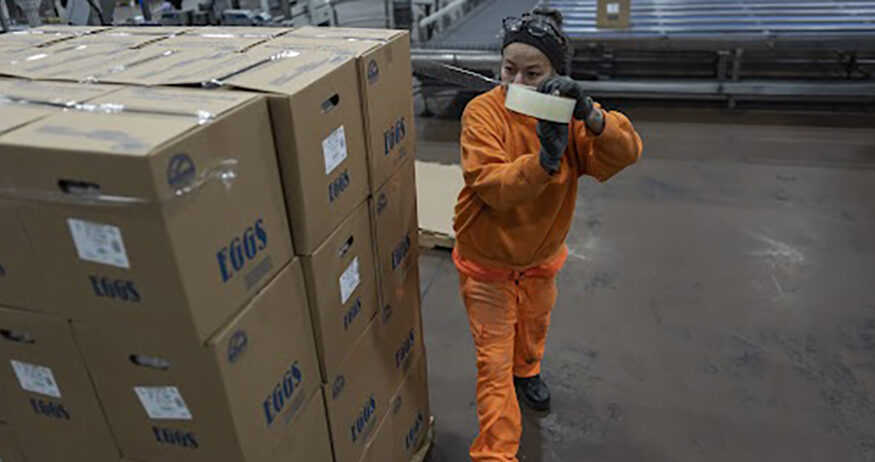
An incarcerated worker secures boxes of eggs with tape at Hickman's Family Farm egg-packaging operation where she operates a palletizer in Tonopah, Ariz., (AP Photo/Carolyn Kaster)
Arizona’s largest egg producer agrees to $1M settlement over price fixing
Howard Fischer, Capitol Media Services//June 30, 2026//


Key Points:
-
Hickman’s Egg Ranch settles price-fixing complaints with $1 million fine and 3.25 million egg donation
-
Federal court lawsuit says Hickman’s and others manipulated egg prices through information sharing on Urner Barry
-
Hickman’s and other companies will donate 53 million eggs to food banks
Hickman’s Egg Ranch, Arizona’s largest egg producer, has agreed to a $1 million civil penalty and a 3.25 million egg donation under a proposed federal and multi-state settlement over complaints that it conspired to keep prices artificially high.
The civil lawsuit filed by the U.S. Department of Justice and attorneys general from 17 states says Hickman’s Egg Ranch exchanged information with other companies through coordinated bids, calls and text messages that allowed them not only to coordinate egg prices but to drive them up through “manipulation.”
Prosecutors say Hickman’s and two other major producers, Cal-Maine Foods and Versova Holdings, used Urner Barry Publications — a market-reporting company whose daily egg price quotations are widely used in supply contracts — to influence the benchmark prices that grocery stores, restaurants and other buyers pay for eggs nationwide.
And the U.S. Department of Justice says egg price quotations fell from record highs after Hickman’s and the other companies learned of the investigation and were instructed to preserve the documents, following a period in which coordinated bidding had helped push those benchmark prices up.
A representative of MTQ USA said everything in the federal complaint occurred before the international company acquired the family-owned operation last year.
“This settlement fully resolves the allegations against Hickman’s Egg Ranch related to that period,” said Nikki Richardson. “We are committed to complying with all applicable laws and regulations and to conducting business with the highest standards of integrity.”
What enabled the alleged price-fixing scheme for egg producers, according to the federal court complaint, was Urner Barry Publications, a firm that reports market pricing for eggs. Hickman’s and the other companies have contracts with retailers that set prices based on those Urner Barry quotations.
But federal prosecutors said Hickman’s and others coordinated as far back as 2022 to “hold” prices, “meaning they worked together to stop prices from declining.” And an executive from Cal-Maine Foods Inc., the nation’s largest egg producer and another defendant in the case, texted Glenn Hickman, who is the CEO, stating, “we are bidding up. Let’s hold it today.”
There also were regularly scheduled calls among Hickman’s and other companies where they discussed Urner Barry’s price quotations.
There was another instance where federal prosecutors said the companies submitted dozens of bids to Urner Barry, resulting in that operation increasing its price data for white, large shell eggs across all regions of the country. That resulted in Hickman’s and the others submitting data showing there were higher bid prices, resulting in Urner Barry, relying on that information, reporting that egg prices were “hitting records.”
Under the terms of the proposed settlement signed by an attorney for Hickman’s, the company agrees not to communicate, discuss or negotiate, whether directly or indirectly, with any competitors about the prices or bids it is or will make and the timing of those bids. It also must designate an antitrust compliance officer and adopt an antitrust compliance program to monitor and report any potential violations. The company has also agreed to produce twice-a-year reports for the next five years certifying it has not engaged in prohibited communications.
Then there’s the agreement to provide 3.25 million eggs to food banks or related nonprofit organizations in states where Hickman’s currently does business over the next 18 months. And the deal makes it clear that these can’t just be eggs the company cannot sell.
“Eggs provided in the egg donation must be unspoiled, non-expired, and non-damaged medium or large white Grade A eggs, with at least 20 days of shelf life,” the agreement says. It also says the eggs “must be at least of a quality identical to that of eggs sold by Hickman’s to its grocery store or food service customers.”
Those deliveries are required to be at Hickman’s expense, with the company forbidden to charge any fee for shipping, freight, handling or service fees associated with the donations.
Arizona Attorney General Kris Mayes said the settlement will help Arizonans who have already been hit with higher prices for household staples by inflation and illegal tariffs, noting that some of the egg price increases were the result of illegal price-fixing by major producers.
And the deal says that eggs that Hickman’s had previously donated or promised to food banks will not count toward the total “and Hickman’s will make any such previously planned donations as planned.”
Overall, all the defendants will donate about 53 million eggs, with 30 million from Cal-Maine and 20 million from Versova Holdings, on top of the 3.25 million Hickman’s has agreed to provide.
The $1 million payment from Hickman’s — $3.3 million from all the affected egg producers — will be divided among the 17 states that joined with the federal government in filing suit, with the decision about how to divide up the cash left by those states.
Hickman’s, founded in 1944, was sold last year to MTQ USA in the wake of the avian flu that resulted in the company having to destroy six million laying eggs at two farms west of Phoenix and lay off hundreds of workers.
In a prepared statement, Arizona Attorney General Kris Mayes, who joined in the federal and multi-state lawsuit, said residents have already been beset by higher prices for household supplies because of inflation and illegal tariffs and rising inflation.
“But now we know that some price increases, like those affecting eggs, were the result of illegal price-fixing by major egg producers,” she said. “This settlement holds these companies accountable, ends their illegal conduct, and helps Arizonans who need it most.”
The Department of Justice, in its own statement, said the deal will prevent the companies from engaging in “coordinated manipulation” in the future.
“No product more quintessentially represents affordability than the price Americans pay for eggs,” said Associate Attorney General Stanley Woodward. “These actions prove this department’s continued commitment to protecting competition and providing real relief for everyday Americans’ pocketbooks.”
The agreement with Hickman’s and others is not a done deal.
While the attorneys for the companies have agreed, by law it is only a proposed settlement and must be published and opened to written public comments for 60 days. After that, a federal judge in Iowa, where the case was filed, can enter a final judgment if the court finds the settlement is in the public interest under federal antitrust law.