Sign In



 Free Newsletter


Judicial retention elections receive more partisan attention
Kiera Riley, Capitol Media Services//October 27, 2026//

Deposit Photos
Judicial retention elections receive more partisan attention
Kiera Riley, Capitol Media Services//October 27, 2026//


Key Points:
-
Arizona voters gets to decide whether or not to retain appointed judges
-
The races are non-partisan, but political groups have become more involved
-
Judges hope voters are making decisions based on the merits, not politics
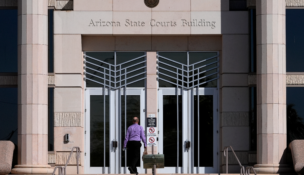
Partisan election guides have infiltrated the nonpartisan judicial retention elections, with both sides airing long lists of judges they feel are unfit to remain in their positions.
In recent years, political groups have gradually ramped up efforts to cast the judicial section of the ballot in a partisan light, focusing on judges’ appointment details, high-profile rulings, prior career paths, and alleged ideological slants.
Booting a judge from the bench could backfire on Republicans and Democrats alike, though, if the opposing party wins the governor’s race. Any vacancy created by voters this election cycle gives the future governor, whether incumbent Katie Hobbs or Republican Andy Biggs, the opportunity to choose replacements.
Hobbs maintains that she has appointed judges throughout her term without regard to political party, and a spokesperson for her campaign added that she had not taken any position on the judicial retention races.
“Governor Hobbs has always put politics to the side and selected the most qualified candidates for the bench,” Christian Slater, Hobbs’s spokesman, said in a statement. “The governor is a social worker who is laser-focused on putting Arizona first and prioritizing nominees that demonstrate a commitment to public service, the rule of law and to building a judiciary that serves everyday Arizonans fairly.”
Biggs spokesman Drew Sexton declined to say whether Biggs opposes retaining certain judges this cycle. But he gave some insight into his philosophy on the judiciary.
“As Governor, Andy Biggs will put a priority on selecting judges who adhere to and uphold the Constitution as it’s written, not imagined,” Sexton said. “He’ll take a hands-on approach in identifying judicial prospects who will be unafraid to carry out this approach from the bench.”
Interest in judicial retention elections has grown over the past two election cycles, climbing from near silence to a dull roar, then to a cacophony.
In 2022, voters removed three judges from the Maricopa County Superior Court, a first since 2014.
Then, in 2024, the Arizona Supreme Court ruled to keep Arizona’s pre-statehood abortion ban in place. As a result, judicial retention races received a groundswell of attention from political action committees and voters as campaigns sought to oust or protect Justices Clint Bolick and Kathryn King.
Efforts to remove the two justices failed. But political interest in the judiciary kept momentum in 2026.
Now, PACs, grassroots organizations, and political parties have released long lists of judges they think voters should fire.
Republicans generally remained consistent in opposing Hobbs’ nominees but were otherwise scattered on which judges to keep or remove.
The Freedom Club PAC, a conservative “Mega PAC” attached to the Arizona Free Enterprise Club, opposed the retention of three judges appointed by former Gov. Doug Ducey and one appointed by former Gov. Jan Brewer, both Republicans.
The Maricopa County Republican Committee also advised voters to vote no on nine Republican-appointed judges. Some legislative district committees took it further. Legislative District 3 listed 14 Ducey- or Brewer-appointed judges no longer in its good graces.
The groups did not lay out their rationale for opposing the judges, though legislative action and losses in high-profile cases grant some insight.
One judge, for example, became the subject of a legislative inquiry into family court.
A handful returned adverse rulings on election issues, striking down Republican-led lawsuits against election procedures and policies, past election challenges, and attempts to access voter information.
Other judges allowed measures Republicans opposed on the ballot, or struck Republican-backed measures or ballot language from consideration.
Democratic- and progressive-leaning voter guides explained their reasons for opposing each judge in much more detail, but they were similarly split on which judges to oppose or retain.
Unlike Republican voter guides, Democratic groups declined to list a judge on the reject list solely because of the governor’s political affiliation when making the initial appointment.
Gavel Watch, the original judicial voting guide from Civic Engagement Beyond Voting, advised against retaining seven judges and expressed reservations about a dozen more.
Arizona Judge Watch, a group formed in response to the “conservative capture” of state courts, opposed 37 judges, citing specific civil and criminal cases, backgrounds as corporate litigators or prosecutors, alleged political donations, and ties to conservative groups.
State + Local Election Alliance, which bills itself as a national pro-democracy group, opposed 13 judges along similar lines, though it also considered a judge’s rulings on election issues.
The group is also supporting Hobbs’ reelection.
“SLEA supports judges who won’t play games with elections,” Kim Rogers, the alliance’s president, said in a statement. “Andy Biggs has been lying about the 2020 election for six years. We’re not trusting that guy with judges.”
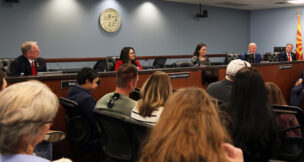
Arizona Supreme Court Justice Ann Timmer said voters certainly have the First Amendment right to campaign for and against judges. But she told Capitol Media Services that the state’s system for choosing and voting on judges was designed to keep judges out of partisan politics.
“I would urge people, that if they’re a great member of a group and they’re a big supporter and their group says, ‘Oh, don’t vote for this person’ (that they would) make a further inquiry of ‘well, why?’ ” the chief justice said.
“Is it because of a single decision?” she continued. “Is it because you don’t like the governor who appointed them? Is it because you don’t like something they did as an attorney?”
Overall, Timmer urged voters to fill out the entire ballot as the judiciary continues to contend with lackluster down-ballot voter participation.
In 2024, Arizona voters cast about 3.4 million ballots, but only about 2.6 million made it down to the retention races for Bolick and King. In Maricopa County, 2 million voters weighed in on the presidential race, while about 1.5 million voted on the justices and 1.2 million on Superior Court judges.
Former Arizona Supreme Court Justice Scott Bales echoed Timmer’s call for voter participation and again noted that judges appointed to the bench are highly qualified in the first place.
“We need to keep those people in office,” Bales said.
He recalls facing a “minor” partisan effort to remove himself and other judges appointed by former Democratic Gov. Janet Napolitano. But Bales, a Democrat, noted that opposition efforts have become a little more organized.
Bales urged voters to move away from partisan voting guides and approach any recommendation with skepticism.
“I wouldn’t want a judge that’s going to be gauging whether (they) share my political affiliation or my demographic background,” he said.
“I wouldn’t want the judge to be influenced by whether he thought or she thought ruling one way or the other might be popular or not,” Bales said. “I want them to do the right thing in my case.”
Stay ahead of Arizona politics.
Get essential reporting on political developments, campaign finance, elections and the people shaping state government. Subscribe or sign up for our free Morning Report.