State treasurer manages Arizona’s $32B in investments
Outgoing Treasurer Kimberly Yere endorses Katherine Haley
Elijah Norton touts backing of Turning Point
State treasurer hopeful Elijah Norton is charging that his Republican primary foe is totally unqualified to manage the state’s $32 billion in investments.
During a televised debate May 19, Norton cited his experience as founder and CEO of what is now known as Veritas Global Protection, a company which sells extended warranties on vehicles. And that, he said, means he has to invest premiums in a way to ensure that the funds will be there when claims are made.
By contrast, Katherine Haley cites her experience as owner of Oak Rose Group, an investment advisory firm.
“We maintain balance sheets,” she said.
“We have to make sure we balance our checkbook every day,” Haley said. “We have to make sure we pay our bills.”
Norton sniffed at that.
“I think my opponent’s a lovely person,” he said.
“But this is about experience,” Norton said. “She’s not qualified frankly — and I mean this with all due respect — to be the bookkeeper at a pizza parlor.”
Haley responded that the job goes beyond deciding where to invest the dollars that come into the Treasurer’s Office. She said it also requires leadership and planning, both skills she says she has.
Beyond that, Haley said much of what treasurers can do with the dollars under their control is not on whim of the person heading the office but constrained by statutory restrictions as well as oversight by the State Board of Investment.
“At the end of the day, you are following state statute and also what is defined in the Constitution,” she said. And Haley chided Norton, saying he has said the state should manage its investments like Texas and Florida.
“They’re very different states,” she said.
What Haley said she does have is broader experience, including working as a policy adviser in Washington for Republicans John Boehner and Paul Ryan when they were speakers of the U.S. House. Norton dismissed both as “swamp rats,” a derisive term that had been used against both by some hardline conservatives to criticize more establishment politicians.
Haley’s view of the role of the office is also much closer to that of Republican Kimberly Yee, the current treasurer, who after serving two four-year terms, is now running for state superintendent of public instruction. And Yee told Capitol Media Services after the debate that whoever is in that office should not be making individual decisions on investments.
“The treasurer should be the manager of the agency and hire the best individuals qualified,” said Yee.
Haley made it a point during the debate to say she has been endorsed by Yee. Norton clapped back with his endorsements by the Free Enterprise Club, Turning Point and Senate President Warren Petersen.
Norton also dismissed the argument that it is the job of the treasurer to run the office and ensure it is staffed by the people who are the actual experts in their fields.
“We’re not trying to hire a glorified HR manager to manage unelected bureaucrats,” he said. “We’re electing the chief banking and investment officer of our state.”
Haley said all that is true, but that doesn’t mean Arizona should have a treasurer who has overly broad ideas of how to earn more money with the cash that the state needs to pay its bills.
“We cannot make risky bets,” she said. And Haley said what Norton wants is to “sell our portfolio to the highest bidder with the goal of, oh, perhaps, we’ll get higher yields.”
Norton makes no secret of his belief that the state could make more on the money it has invested.
He poked fun at Yee who, in press releases, said that the assets her office is managing nearly doubled from $15.4 billion in 2019 when she was first elected.
He said during that time there was growth in state population and property value, state lands were sold off and the proceeds put into the trust, and cities, who can invest through the Treasurer’s Office have gained the ability to tax internet sales.
“If you take our portfolio to somebody who actually understands investments, they’re going to say we should have about $3 billion to $5 billion more than we actually do,” Norton said.
“I’m not saying we should take risky bets,” he said. “I want to go to the office every day, do my job, and apply my experience to getting better returns for the taxpayers.”
One place where the treasurer has played a role — or at least has had some input — has been on the question of how much extra money can be withdrawn from the special education trust account.
Arizona received about 10 million acres of land from the federal government when it became a state in 1912, with the restriction that the land be held for the benefit of certain entities, primarily public schools. About 9.2 million acres remain, along with more than $10 billion the trust invested from sales and leases of the land.
A former formula in place for years gave schools 2.5% of the value of the trust annually, a figure that was designed to ensure level distributions without endangering the principal.
In 2016, however, voters narrowly approved Proposition 123, a measure to boost that annual distribution to 6.9%, generating an extra $300 million.
But that authorization has since expired. And lawmakers along with Gov. Katie Hobbs are now debating whether to ask voters to renew that rate — and at what level.
That’s where the views of the treasurer can come in.
The governor at one point proposed boosting the distribution to 8.9%, with GOP lawmakers proposing to keep it at 6.9%.
Yee has already weighed in, rejecting both proposals as unwise and saying the prudent figure would be more in the neighborhood of between 4% and 5%.
“We do have to protect the principal,” Haley said when asked her views on renewal. “It’s an endowment,” she said, having to last not just through today but well into the future.
“On average, an endowment distributes about 5%,” Haley said, saying she would consider that a safe figure going forward.
Norton blasted the numbers originally proposed by Hobbs as “absolutely ridiculous,” though the governor, in her proposed budget released in January, is not on the same page as the Republicans at 6.9%. But Norton refused to say, both during the TV appearance and when asked afterward, whether he agrees with that GOP figure — or what he believes would be the proper level of withdrawal going forward to both protect the trust and yet still provide more dollars for K-12 education.
What history has shown is the difficulty of making predictions of a return on investment on a long-term basis.
When Proposition 123 went to the ballot in 2016 it was opposed by Jeff DeWit, the state treasurer at the time. He predicted that the higher withdrawal would cut into the principal of the trust and ultimately leaves public schools with less money.
As it turned out, the economy — and the rate of return on investments — remained strong enough so that the principal actually increased even with the higher withdrawals.
Whoever wins the July 21 primary will face off against Democrat Nick Mansour.
Republicans face divisive primaries amid shifting political dynamics, voter makeup
Turning Point influence tested against independent voters’ growing electoral hold
Conservative incumbents battle fellow Republicans across multiple statewide races
Thirteen Republicans are vying for statewide office this year, but before they can take on their Democratic opponents, they’ll have to navigate increasingly contentious and fragmented primary challenges.
There isn’t a single Republican running unopposed in a statewide primary this year, while most of the Democrats hoping to keep or flip those same seats will not face any meaningful competition within their own party. Even Republican incumbents have not been spared; three officeholders with proven conservative chops are facing challenges from the right.
“That’s a Turning Point thing,” said Chuck Coughlin, a Republican-turned-independent consultant. “Are they going to be able to marshal Republican voters in opposition to fairly conservative candidates?”
Hanging over it all is diminished public support for President Donald Trump, his policies and the Republican Party as a whole. Each candidate is walking a delicate tight rope between supporting the president enough to win over an engaged GOP primary voter and keeping enough distance so as to not alienate Arizona’s growing bloc of independent voters.
Some Republicans argue even Turning Point, the conservative youth organization founded in Arizona, might be losing its influence in the state after less than resounding results for TP-backed candidates in April’s Salt River Project Board elections.
“Turning Point puts their money behind people, and that machine rolls, but it turns off the independent voters,” said Lisa Everett, the former chair of Legislative District 29 Republicans. “Since they are the ones that decide the elections in Arizona, we need to figure out how to court them.”
With the exception of the Republican primary for governor, GOP voters seem largely undecided about primary candidates in down-ballot statewide contests. Polling suggests that some of those candidates are unknown to the Republican electorate, even though most have held some form of elected office in Arizona.
Governor
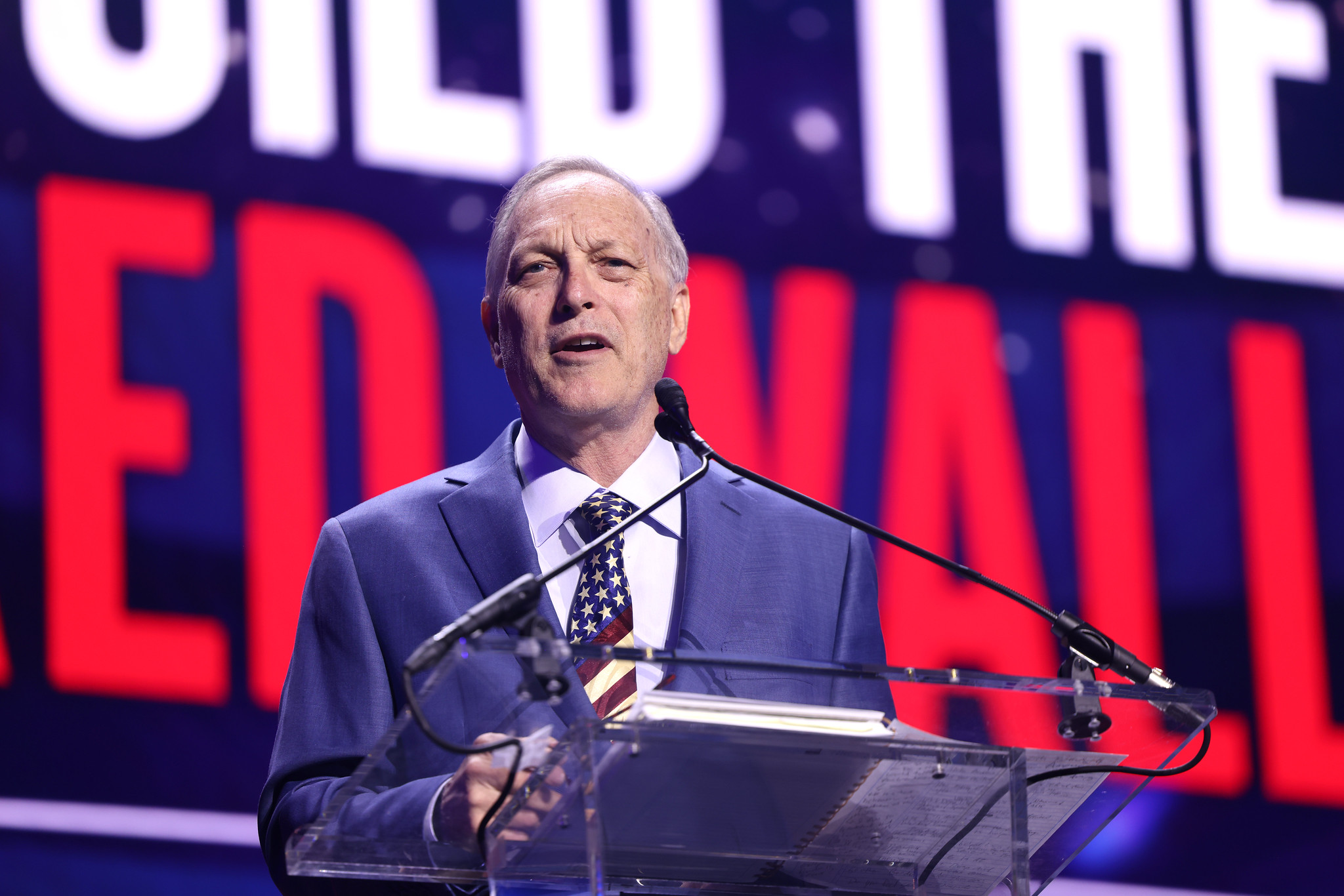
U.S. Congressman Andy Biggs speaking with attendees at the April 2026 “Build the Red Wall” rally at Dream City Church in Phoenix. (Gage Skidmore / Flickr)
Congressman Andy Biggs is widely viewed as the frontrunner in the GOP gubernatorial primary. His closest rival — fellow Congressman David Schweikert — is still behind by double-digits according to most polls and by several hundreds of thousands of dollars in fundraising.
“I’m trying to unify the Republican Party right now to win this governor’s race,” Biggs told reporters when asked about Schweikert on May 5. “I don’t talk about my primary opponent, because the reality is, I’m staying focused on Governor (Katie) Hobbs, what she’s not doing and what she is doing, and I’m trying to bring that message out.”
Schweikert has maintained since he entered the race in October 2025 that Biggs cannot defeat Hobbs in the general election.
U.S. Congressman David Schweikert speaking with attendees at the 2022 Legislative Forecast Luncheon hosted by the Arizona Chamber of Commerce & Industry at Chase Field in Phoenix. (Gage Skidmore / Flickr)
“The left is so giddy (and) wanting him to be the nominee because you see the polling, he can’t come within 10, 11 points of Katie Hobbs,” Schweikert told KTAR on May 7.
Everett endorsed Schweikert on social media for precisely that reason, though she knows her opinion is not widely shared among the conservative grassroots.
“I attend lots of meetings, LD meetings, club meetings, council board meetings, etc. and what I am seeing is Republicans are coming up to me, and they’re whispering, ‘I’m supporting David Schweikert,’” Everett said. “They’re afraid to say it out loud, because the other candidates that are supported by these larger organizations are taking up all the oxygen in the room.”
One slight wrinkle in Schweikert’s election theory is that polling numbers actually show he’s doing worse than Biggs in the matchup against Hobbs. According to a February survey from local pollster Noble Predictive Insights, Biggs trailed Hobbs by five points among registered voters, while Schweikert trailed the governor by nine points.
Biggs, the only candidate in the race with a Trump endorsement after Karrin Taylor Robson dropped out in February, doesn’t see the president’s support as a deterrent for voters.
“If I had an issue, I would just call (Trump) up and say, ‘Hey, what’s going on here?,’” Biggs told reporters on May 5. “… I think you need to have somebody in office as the governor here who can actually call up the president … I think those relationships are important, and I think they benefit the state.”
Secretary of State
State Rep. Alexander Kolodin, R-Scottsdale, speaking with attendees at a campaign rally for Andy Biggs for Governor at the Arizona Biltmore in Phoenix. (Gage Skidmore / Flickr)
Rep. Alex Kolodin, a state lawmaker and election attorney, was the first candidate to cut into the secretary of state’s race. But, he did so as rumors of a run by Gina Swoboda, chair of the Republican Party of Arizona and the Legislature’s election policy lead, started to swirl around the political sphere.
Swoboda initially launched a campaign for the 1st Congressional District, but, in early February, she filed her statement of interest for the Secretary of State’s Office and pivoted her run.
“I love the office so much, and I love the people in it, and I love the work,” Swoboda said. “And I’m sad by how politicized it’s become, and I’m sad at where I think it will go if this continues for another four years.”
Kolodin, with the endorsement of Turning Point Action, is angling his campaign at some election nerves frayed among his base. Along the campaign trail, Kolodin has focused on alleged noncitizen voting, championed the SAVE Act and pledged to cooperate with the federal government in granting access to state voter rolls.
“When I’m elected the very first thing that we need to do is partner up with our friends in the federal government who have graciously offered to allow us to use their SAVE Act database to ensure that we don’t have noncitizens on our voter rolls,” Kolodin said in an interview with former U.S. Congressman Matt Gaetz.
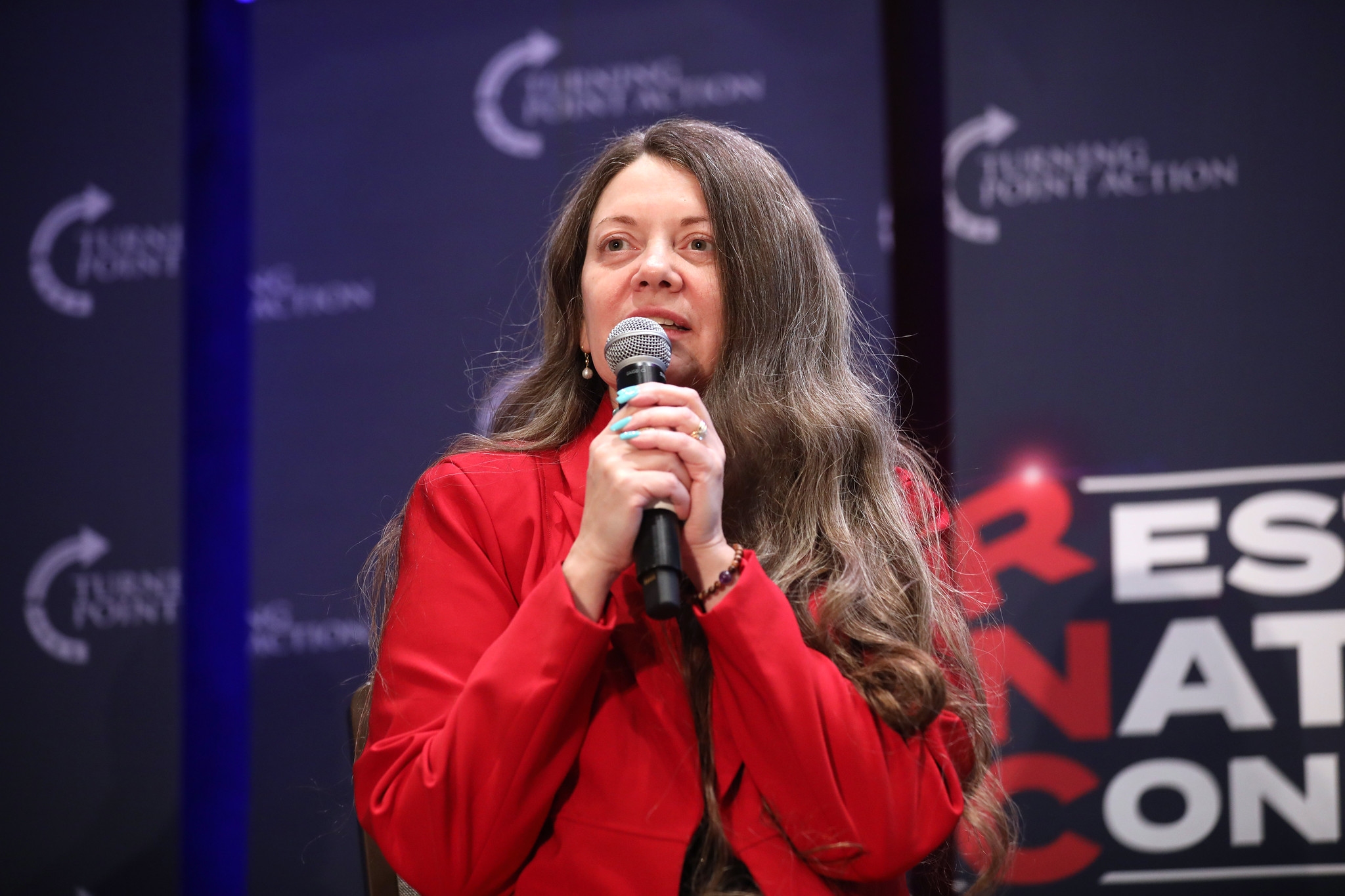
Gina Swoboda speaking with attendees at the Restoring National Confidence Summit at Planet Hollywood in Las Vegas, Nevada. (Gage Skidmore / Flickr)
Swoboda, meanwhile, aims to capture the growing sect of Arizona’s independent voters through a focus on policy and operations.
“What I want to run on is transparency, accountability and competence. That’s all I want. And that’s what I think the voters want. I think that they are exhausted,” Swoboda said. “The last thing (people) need to worry about is what did the secretary of state do today? Why do people have to think about that?”
She expressed some doubt that Kolodin could win over the third of the state’s voters who have no declared party affiliation. And Swoboda stressed the need to work well across the state with officials in every corner on election administration, a skill she claimed her opponent lacked.
Swoboda referenced the ongoing legal dispute between the Maricopa County Recorder and the Board of Supervisors as one example.
“It’s a disaster. I got into the race because I don’t want that to happen on a statewide level,” Swoboda said. “It will dissolve into dysfunction and infighting, and the voters will not have confidence in the process. Nobody needs that.”
Attorney General
Senate President Warren Petersen and Rodney Glassman framed campaigns for the Attorney General’s Office as a matter of legal experience.
Rodney Glassman speaking with attendees at a campaign rally for Andy Biggs for Governor at the Arizona Biltmore in Phoenix. (Gage Skidmore / Flickr)
Glassman, a lieutenant colonel in the U.S. JAG Corps Reserve, former Tucson City Councilmember and longtime candidate for office — with past runs for the Arizona Corporation Commission, Maricopa County assessor and the U.S. Senate, as a Democrat — claims he is the only candidate who has ever practiced law, taken on a client or prosecuted someone in court.
“My primary opponent is a termed-out career politician, a part time Realtor, and received his law license less than 28 months ago,” Glassman said. “He’s never had a client. He’s never prosecuted a criminal, and he doesn’t even carry professional liability insurance, aka, he doesn’t practice law. He’s never practiced law.”
Petersen was licensed to practice law in 2023, though he passed the bar in 2020. And he corrected Glassman, noting he is not yet termed out from the Senate.
State Senate President Warren Petersen speaking with attendees at a campaign rally for Andy Biggs for Governor at the Arizona Biltmore in Phoenix. (Gage Skidmore / Flickr)
Petersen claimed he is the most experienced person in the race, pointing to his part in a swell of litigation from the Legislature to defend public laws Attorney General Kris Mayes left by the wayside.
“We basically set up a mini Solicitor General’s Office here at the Senate,” Petersen said.
More significantly, Petersen pointed to Glassman’s past history of switching parties and continuing to pursue election as a downside.
“The people, they’re tired of him running for office. If you run twice and lose twice, normal people quit,” Petersen said. “If you run more than twice and you keep running, I think you’re achieving sociopath level.”
Support and endorsement is currently split among both candidates.
Glassman has courted support from Congressman Paul Gosar, Superintendent of Public Instruction Tom Horne, Maricopa County Sheriff Jerry Sheridan, and former Senate President Karen Fann.
Petersen meanwhile has shored up support withCongressman Biggs, a slate of Republican state lawmakers and Idaho and West Virginia’s attorneys general.
During Trump’s recent visit to the state, he declined to dole out any formal endorsement, but he did give Petersen a shoutout from the stage. And when Gosar voiced his support for Glassman, it drew a mixed reaction from the crowd.
Superintendent of Public Instruction
The Arizona Freedom Caucus and Turning Point Action placed veteran incumbent Superintendent of Public Instruction Tom Horne in its crosshairs early on, recruiting outgoing Treasurer Kimberly Yee to oust him from office.
Arizona Superintendent of Public Instruction Tom Horne speaking with attendees at the 2024 Legislative Forecast Luncheon hosted by the Arizona Chamber of Commerce & Industry at Chase Field in Phoenix. (Gage Skidmore / Flickr)
Horne is keeping his messaging on improving academics across education and is hoping voters will keep him around for another four years to finish what he set out to do at the start of his term.
He pointed to the department’s Project Momentum, which lifted 80% of schools in the bottom 5% for academic performance to a higher bar.
“That’s an eight-year job, not a four-year job,” Horne said. “I want to finish the job. If the voters were to switch horses after four years, somebody else would start all over again and it would never get done.”
Horne is continuing his crusade against critical race theory, diversity, equity and inclusion and “woke ideology” as well. And in that vein, he did not have much to say about his opponent, other than claiming she had served on a Diversity, Equity and Inclusion Committee for the National Association of State Treasurers.
Yee denies serving on any DEI committee and went so far as to send a cease and desist letter.
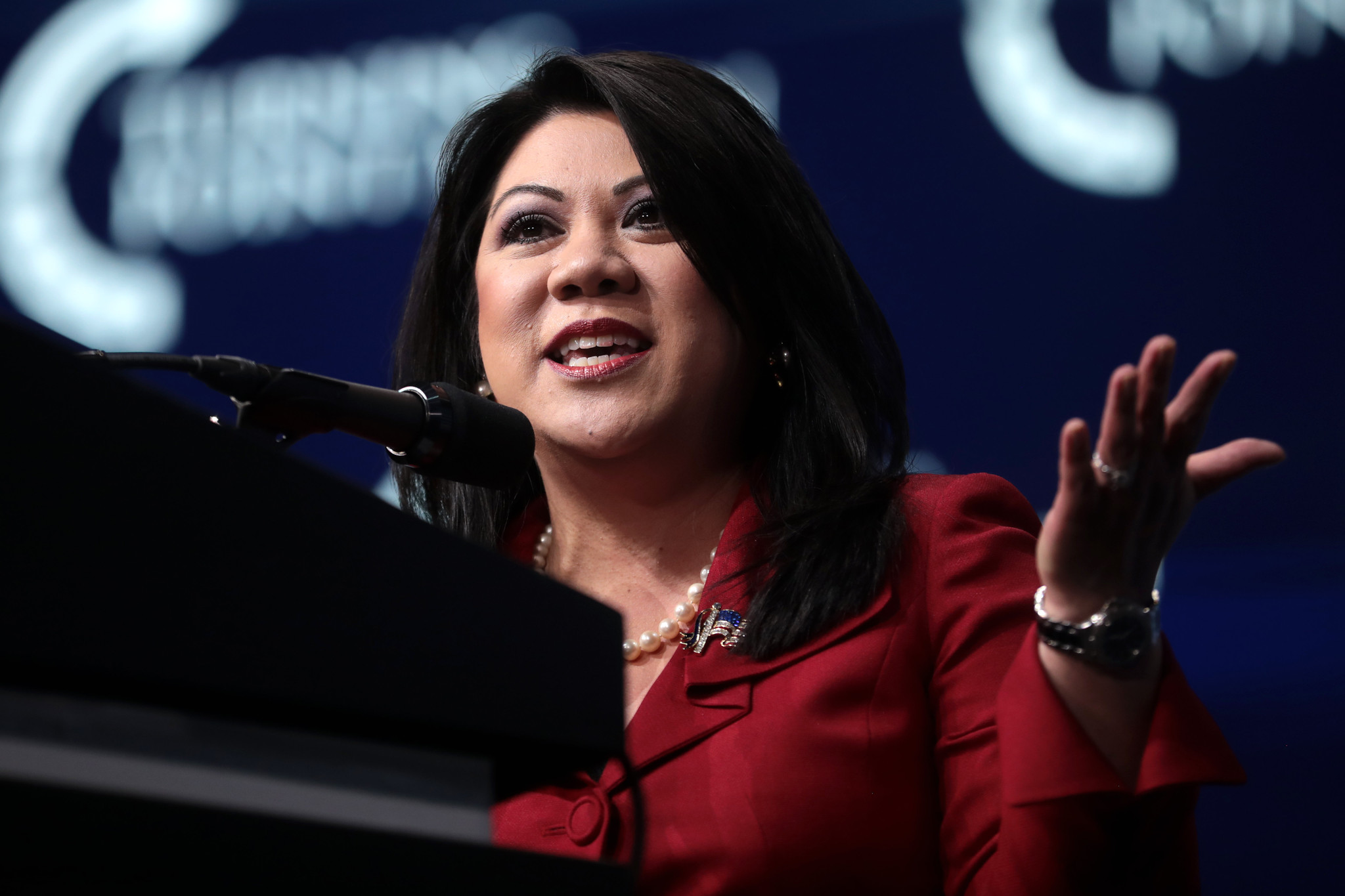
State Treasurer Kimberly Yee speaking with attendees at the “Rally to Protect Our Elections” hosted by Turning Point Action at Arizona Federal Theatre in Phoenix. (Gage Skidmore / The Star News Network)
In her own campaign, Yee claims academic performance has not improved significantly under Horne.
“He’s had four years, and those numbers have not changed,” Yee said. “I see complete chaos in the Department of Education when it comes to management. I also see a real non-presence of this current superintendent with respect to his role as a statewide official.”
The two must also contend with the Empowerment Scholarship Account program, a live wire for Republicans staunch on supporting school choice, which has formed significant party lines surrounding the issue of ensuring there’s no misspending, fraud or abuse in the program.
Horne maintains the department is continuing to finetune its oversight of the program.
Meanwhile, Yee, in her role as state treasurer, recently put out a request for information to assess the field of financial vendors. She stopped short of wading into any policy questions for the program, though, claiming the specifics are better left to the Legislature.
“We have a superintendent of public instruction who has exceeded that authority and has gone beyond what an administrator is required to do by the law,” Yee said. “And if there ever is a question of administration or properties of educational definitions, those really need to be brought back to the Legislature.”
Corporation Commission
Corporation Commissioners Nick Myers and Kevin Thompson are not exactly known as moderate Republicans. But that did not stop the Arizona Free Enterprise Club and the state’s Freedom Caucus from recruiting two state lawmakers to run against them in the Republican primary.
That challenge lost a bit of steam recently, with former Rep. David Marshall ending his bid for the commission to accept a new role as Navajo County recorder. Marshall’s exit leaves Rep. Ralph Heap, R-Mesa, to fend for himself against the two incumbents.
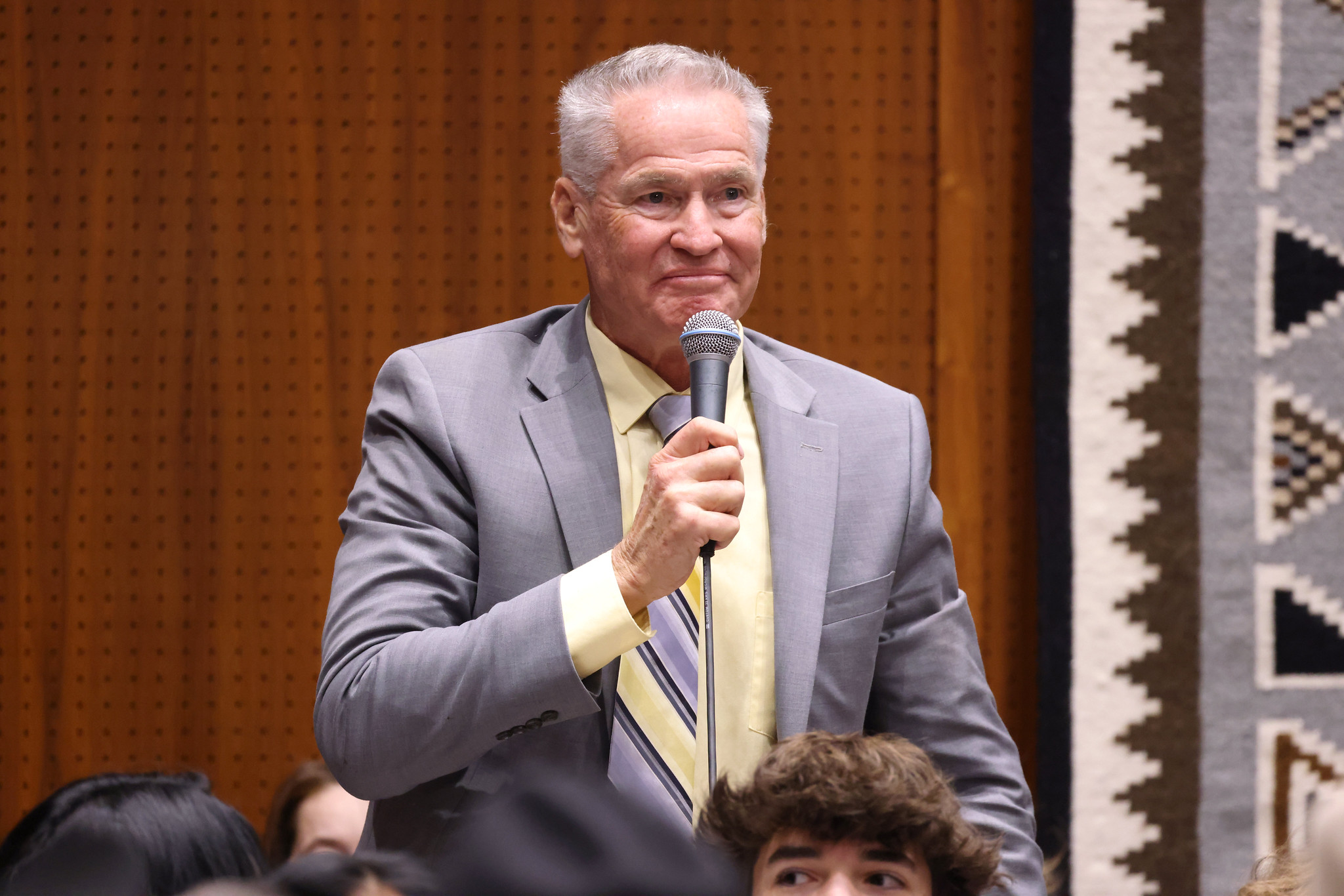
State Rep. Ralph Heap, R-Mesa, speaking with attendees on the floor of the Arizona House of Representatives on opening day of the 57th legislature in Phoenix. (Gage Skidmore / Flickr)
“If you have two people on the commission that have similar ideas in terms of how to produce energy and what we need to do, that’s a stronger position,” Heap said. “So that does weaken the message I have and that’s frustrating.”
Heap’s main message is that Myers and Thompson have not done enough to end “Green New Deal” policies at the state’s utility companies, nor have they done enough to support Trump’s coal-centric energy priorities.
“We need to immediately adopt the principles that are in the Trump energy agenda, which are continuing with reliable, affordable fossil fuels, and then move towards nuclear energy as fast as we possibly can.” Heap said.
This combination photo features Arizona Corporation Commissioners Kevin Thompson (left) and Nick Myers. (Photos by Gage Skidmore)
Myers and Thompson say they have done exactly what they set out to do, pointing to their votes to repeal the energy efficiency and renewable energy requirements past commissions imposed on utilities.
“We’ve delivered the promises that we campaigned on the first time, which was to eliminate the Green New Deal, eliminate mandates and subsidies,” Thompson said.
Myers noted that the pair is in favor of an “all of the above” approach to energy generation, though they believe natural gas is far more affordable and reliable than solar or wind. The two also said they have done everything in their power to cut the fat out of utility budgets in rate cases, though they know customers are still struggling with high bills.
“We’ve been saving as much money as we possibly can and trying to keep those rate increases as low as we can, but we’re fighting an uphill battle when it comes to the weather and the things that we don’t have control over,” Myers said.
The duo said they are more focused on the general election than defeating Heap in the primary.
“We’re just going to continue focusing on things that got us here, and talk about the great things the commission has done over the last three years and hope that the people of Arizona see that and decide they want to keep us in place,” Thompson said. Treasurer
Katherine Haley, president of the State Board of Education, lodged her challenge against Elijah Norton, former treasurer for the AZGOP, late in the game, with an endorsement from sitting Treasurer Kimberly Yee in tow.
Norton has painted himself as the candidate with the most relevant experience. Besides guarding the AZGOP coffers, he founded and currently serves as president of Veritas Global Protection Services, an international vehicle insurance company.
“I don’t just have business experience. I also have experience investing money,” Norton said. “And that’s literally the treasurer’s job, the chief Banking and Investment Officer of Arizona.”
He said Haley was a “nice person” but doubted her ability to manage the state’s $32 billion in assets.
“I always use the example of the Treasurer’s Office being like an airplane. Do you want someone flying a $32 billion airplane from Phoenix to Australia who’s never set foot in a cockpit before?” Norton said. “Or do you want a veteran person that has proven experience piloting that flight?”
Haley is leaning on her background in public service to make her case to voters and pointed to her experience on the State Board of Education overseeing district budgets and the Empowerment Scholarship Account program.
“It’s about the mentality of service. It’s focused on Arizona taxpayers and what they need, rather than personal interest,” Haley said. “My opponent has a life career in sales, and I think that is just a different skillset than one that is focused on Arizona taxpayers.”
Norton noted, though, as the two have convened at legislative district meetings that straw polls have swung in his favor.
At the Legislative District 27 meeting on May 12, Norton said a straw poll yielded 68 votes for him and four votes for Haley.
“When people actually get into the weeds, and they listen to us talk about policy. There’s an obvious dichotomy, that she does not have the experience,” Norton said.
A clean energy slate of candidates will control the Salt River Project board
Turning Point-backed candidates fell short despite massive investments
The results could foreshadow the outcome of November contests in the state
Turning Point fell short of preventing a “clean energy” majority on the Salt River Project power board, signaling a rebuke of the conservative group and an increase in voter interest in energy issues.
The clean energy contingent now has an eight to six majority on SRP’s Agricultural Improvement and Power District board, which oversees energy policy and customer rates. Turning Point Action launched an unprecedented localized campaign to prevent a clean energy majority on the board, but only managed to hold on to the board’s president and vice president seats and two of the seven other board seats up for grabs this year.
In posts on X, Turning Point executives declared victory despite falling short of their original goal.
“Democrats had told donors this was the inevitable year they would win President and Vice President of SRP and control the agenda. They failed massively with a huge turnout,” Tyler Bowyer stated. “Ballot chasing works!”
But political consultants and energy experts say the results show voters are becoming disillusioned with both the Turning Point brand and the federal government’s energy policy agenda.
“Turning Point made this election about them,” said independent consultant Chuck Coughlin. “It is a very poor time to be associated with the president with his poll numbers where they are, and they became the turnout mechanism.”
The normally-quiet utility race was dominated by Turning Point’s get-out-the-vote efforts, which began in the summer of 2025, and its seemingly endless resources. A political action committee formed by local construction executive Jimmy Lindblom to support conservative energy candidates even admitted defeat.
“First, we congratulate Chris Dobson and Barry Paceley on their victories for President and Vice President,” Lindblom said in a statement. “While we are encouraged by their leadership, we are disappointed by the results in several other board races.”
As president, Dobson will set the board’s agenda, but his vote will still be part of the minority. Paceley will be a non-voting member as vice president and will primarily serve to fill in for Dobson in the case of any absences.
Autumn Johnson, the executive director of the Arizona Solar Energy Industries Association, noted that Dobson isn’t exactly known in the energy space as an anti-Green New Deal extremist.
“(Turning Point is) acting like a Donald Trump person won … (Dobson) is a moderate, he has developed wind projects on his own land, he spoke at my solar conference two years ago,” Johnson said. “The guy is not like a fringe, right-wing guy.”
Johnson said Turning Point spent too much time and energy on the president, vice president and at-large board seats, while the clean candidates devoted their efforts to the acreage seats in voting areas 4, 6 and 8. Coughlin said that the Turning Point candidates had the right messaging, but it was overshadowed by their association with the group.
“Parts of the SRP campaign were super good, affordability, reliability, cost of power. They had solid messaging all around the deck,” Coughlin said. “But it didn’t matter, because Turning Point became the issue, and that turned out gobs of people who have never voted in an SRP election ever.”
SRP is a nonprofit subdivision of the state that provides water and power to more than 2 million people throughout the Valley, from Chandler and Scottsdale to Goodyear and Peoria. While the state’s other major utilities are regulated by the Arizona Corporation Commission, SRP is regulated by a board made up of landowners within its service territory — many of whom are descendants of the farmers and ranchers who put up their land as collateral to ensure the construction of the Roosevelt Dam in the 1900s.
SRP elections are uniquely arcane, thanks to a voting system created before Arizona was granted statehood, meaning only around 40,000 of the utility’s 2 million customers can weigh in on its leadership. The utility is regulated by two organizations, the Salt River Valley Water Users’ Association and the Salt River Project Agricultural Improvement and Power District.
Only landowners can vote in SRP elections and only some of those eligible voters can vote in both association and district elections. Landowners are entitled to a certain number of votes based on acreage, except in the case of the district’s at-large board members who are elected under a one-landowner, one vote system.
Voters elect a president and vice president to oversee both the association and district. Ten board members and 30 council members are elected to oversee the association from SRP’s 10 voting areas, while 14 board members and 30 council members are elected to oversee the district.
Johnson said the April 8 results were “nothing short of miraculous,” as it marks the first time the SRP board has had a pro-renewable energy majority in its over 120 year history. She attributes it to a growing concern over soaring utility bills.
“This is probably the first election in my lifetime when energy would probably make somebody’s ranking list of the things that they care about,” Johnson said.
Two seats on the state’s other utility oversight board, the ACC, are also up for grabs this year. Johnson said the SRP results should put those candidates — four on the Republican side, including two incumbents, and two on the Democratic side — on notice.
But it should also serve as a reflection of “pent-up angst” that voters seem especially willing to take out on Republican candidates, not just in Arizona but across the country, Coughlin said.
The SRP results could foreshadow the results of contests set to take place in November.
“People waiting two and a half hours in line to vote for a utility governance board should make people pretty concerned about the amount of fervor that’s going to be around the November election,” Johnson said.
Arizona’s electricity system is entering a period of rapid change, and the decisions made in the next few years will determine whether the state can maintain affordable, reliable power while continuing to grow. Demand is rising from both population growth and large new industrial users, including data centers. Meeting that demand will require significant investment in generation, transmission and grid infrastructure, all of which will ultimately be paid for by customers.
At the same time, the range of practical resource options is narrowing. Water constraints continue to limit traditional thermal generation. Air quality requirements are tightening in Maricopa County. Natural gas infrastructure is facing delays, including constraints on pipeline capacity and long lead times for turbines. New nuclear generation is not a near-term solution, with development timelines extending well beyond a decade. These constraints mean that decisions about what to build, how quickly to build it, and who pays for it are becoming more complex and more consequential.
Clean energy resources, particularly solar paired with storage, are increasingly central to navigating these realities. They can be deployed more quickly than many alternatives, do not rely on water for cooling, and avoid many of the fuel supply challenges affecting other generation types. They also offer a path to managing long-term cost exposure in a system that will require substantial new infrastructure to meet demand.
One of the entities responsible for making these decisions is the Salt River Project (SRP). As one of Arizona’s largest utilities, SRP determines how new demand is met, how infrastructure is built, and how costs are allocated among customers. Its board makes decisions about resource planning, capital investments and rates without oversight from the Arizona Corporation Commission. Those decisions directly affect affordability, reliability and Arizona’s ability to support continued economic development.
The composition of that board is being decided through the upcoming SRP election. The structure of the election is unusual, with voting limited to landowners within the district and participation requiring voters to request a ballot by March 27 ahead of the April 7 election. Turnout is historically low, which means relatively small shifts in participation can influence outcomes in ways that would not occur in a typical election.
This year, the election has also attracted attention from outside political and financial interests. Turning Point is running a slate of candidates for the SRP board, backed by Arizonans for Responsible Growth, a political committee that has indicated it plans to spend approximately $500,000 in the race. The group has identified corporate backers tied to large commercial energy users, including data center interests that will rely on how SRP chooses to meet growing demand.
Turning Point’s involvement is not occurring in a vacuum. The organization has been explicit about expanding its political footprint in Arizona, and this election presents an opportunity to test messaging, build infrastructure, and engage voters ahead of future statewide races, including the gubernatorial election. That raises an additional concern about whether this election is being used as a proving ground for political ambitions rather than a forum for thoughtful utility governance.
The question for voters and policymakers is whether the individuals making decisions about Arizona’s energy system are prepared to navigate the constraints and tradeoffs ahead. Resource planning now requires an understanding of deployment timelines, permitting realities, system reliability and long-term cost impacts. It also requires balancing the needs of large commercial users with the interests of residential customers who ultimately bear many of the costs.
There is a clear contrast in this election. A slate of candidates focused on clean energy, affordability, and responsible long-term planning is also running. These candidates are prioritizing cost-effective resource deployment, managing growth in a way that protects residential customers from unnecessary cost shifting, and aligning investment decisions with what can realistically be built in Arizona in the near term. Voters can review these candidates and their positions at https://srpcleanenergy.org, and those priorities are well aligned with the challenges the state is facing.
Affordability, reliability and economic development are closely linked at this moment. If infrastructure does not keep pace with demand, reliability risks increase. If investments are poorly planned or delayed, costs rise. If resource choices do not reflect real-world constraints, both households and businesses will feel the impact.
Autumn Johnson is the CEO of Tierra Strategy and an energy attorney and consultant, focused on Arizona energy policy. She can be reached at autumn@tierrastrategy.com.
Sergio Arellano elected chair of Republican Party of Arizona
Sitting chair Gina Swoboda left seat to pursue congressional run
Eligibility questions and hand count prolonged meeting
Sergio Arellano was elected as the next chair of the Republican Party of Arizona at the annual mandatory meeting on Jan. 24, following a run-off with Pam Kirby.
Despite rumors that sitting chair Gina Swoboda would secure a nomination from the floor and stay at the helm, the meeting went by without any major upsets.
“Enough of the division, enough of the fighting, let’s focus on winning and kicking butt in November,” Arellano said.
Nominations started with four candidates – Arellano, Kirby, Kathleen Winn and Robert Branch.
The initial round of voting put Arellano and Kirby in a runoff, with Arellano taking 655 votes and Kirby taking 603, and dropped Branch, with 200 votes, and Winn, with 196 votes.
A brief last-ditch effort to keep Swoboda resulted in drawn-out procedural tension and a run-off vote between Sergio Arellano and Pam Kirby, stretching the meeting until late evening.
Sergio Arellano, newly elected chair of the Republican Party of Arizona, celebrates his swearing in alongside first vice chair Shiry Sapir (left), secretary Sherra Kissee and sergeant-at-arms Carie Hughes (right) at a meeting on Jan. 24 in Prescott. Arellano won in a runoff election by 140 votes. (Kiera Riley / Arizona Capitol Times)
In the final round, Arellano prevailed, with 761 votes to Kirby’s 621.
Before any votes were cast, Saturday’s meeting kicked off with a debate over whether to allow a “fractional” appointed state committeemen to vote, and for Arellano, to run for a leadership position.
Under state law and bylaws, the party elects one state committeeman for every three precinct committeemen, ensuring a proportionate share for each legislative district.
But the math required rarely yields a clean round number and often leaves decimals, or “fractional” appointments, in an awkward gray area. In past chair practice, remaining fractions were typically rounded up, giving way to the appointment of additional committeemen.
Swoboda said under her leadership that, instead of rounding up each decimal to a state committeeman, the party would add all the remaining decimals, creating a total of 16 “fractional” state committeemen.
Ahead of the meeting, legal threats challenged the practice altogether.
The party maintained fractional reserve appointments as a reasonable interpretation of the law, but decided to vacate state committeemen status for the 16 “fractional” members, Arellano among them, citing potential damage to party unity and finances.
The decision made Arellano, a fractional member, no longer eligible for the chair or the committee. But after a back-and-forth on points of order and information, and ultimately a motion, the party voted to allow the 16 members to vote, clearing the way for Arellano.
The field stuck to the four candidates despite ultimately unsuccessful motions to first request Swoboda reconsider her resignation and then to throw her name in the chair race.
Amid a run for Congressional District 1, Swoboda said she would resign upon election of a new chair. Though there was some speculation that Swoboda would try to stay, she told the party today it was time for her to step aside and thus shut down a motion to nominate her.
“Don’t try to keep me, let’s just go. It’s been an honor,” Swoboda said. “Just continue to work together.”
Swoboda’s time at the helm oversaw the return of big-dollar donors, increased voter contact spending, and coordinated campaigns, reaping wins for the Republican party up and down the ballot in 2024.
Her work inspired the ire of Turning Point, though, culminating in an ultimately unsuccessful effort to oust Swoboda at the 2025 organizational meeting.
Criticism of Swoboda continued, but in a departure, Turning Point did not charge into the chair race at the same tenor this year, offering no single endorsement.
Arellano now takes the mantle, bringing with him his experience as a son of immigrants, a veteran, president and CEO of Tipping Point, LLC, a political consulting firm, and as a founding member of the AZGOP Latino Coalition.
He attributed his success to his work to expand party membership and donors during his campaign.
“We can address and expand the umbrella a little bit more to welcome individuals who are tired of one side or the other as far as rhetoric goes,” Arellano said. “We lead with conservatism and family values.”
As for day one business, Arellano hopes to start dialing for dollars, a task won with a plan, an outline of what it takes to win the state.
And as for party unity, Arellano wants to lead with communication.
“People are in this party because they believe in what we have to offer,” Arellano said. “But also, they deserve recognition, they deserve a shout out for running for office, they deserve data, they deserve support.”
Arellano prevailed over Kirby, former first vice chair and executive director of the AZGOP.
Her time in party leadership, though featured in her run for chair, was marked with controversy, as pointed out in attack ad played at the top of the meeting.
Kirby, as second in command to then-chair Kelli Ward, spent big on a campaign bus and an election party rather than on voter contact in the lead-up to 2022, leaving the party in difficult financial straits in the aftermath.
She now works as the founder and president of the Arizona Coalition of School Board members. In her campaign video, Kirby championed her efforts to elect conservative school board members and noted her efforts with Latinos for Trump and Women for Trump.
And in her remarks to the party, she hit hard on election integrity, going so far as to call for a “one day, one vote, required ID, no machines” approach to elections.
Branch, former candidate for Maricopa County Supervisor District 4 and Superintendent of Public Instruction, called for a steadier fundraising mechanism, with increased reliance on the precinct committeemen to keep party momentum going down the ballot.
Winn, chair of the Pima County Republican Party and former congressional candidate, called for bringing Independents into the party and strengthening fundraising.
In her final remarks, Swoboda urged the party to find common ground in 2026.
“I just want you to work together and go win,” Swoboda said.
Julie Spilsbury, a councilwoman in Mesa, was recalled on Nov. 4
Her recall is in large part due to her support of Kamala Harris, despite Spilsbury being Republican
Turning Point Action funded the recall campaign promoting their own candidate, Dorean Taylor
A Mesa City Council election may have set a precedent for the future of nonpartisan politics, as a Republican councilwoman was recalled for endorsing Democrat Kamala Harris for president in the 2024 election.
Julie Spilsbury, a Mormon mother of six, was removed from her District 2 seat on Nov. 4. She was replaced by Republican candidate Dorean Taylor, whose campaign was partially funded and heavily promoted by Turning Point Action.
Chuck Coughlin, president of HighGround Inc., said, “(Turning Point) singled (Spilsbury) out and drove a narrative on a recall campaign, which can be done if you nationalize local politics, and that’s exactly what they did here. It’s a lesson for anybody who’s thinking about jumping outside of their party … to not do that.”
Turning Point Action is a conservative activist organization founded by Charlie Kirk. According to The New York Times, the recall was originally spearheaded by Kirk. Now, after Kirk’s assassination in September, Turning Point has found renewed motivation to continue in his honor.
According to Spilsbury, the organization was clearly involved in the city council election, specifically because of her support for Harris. She said just from driving around District 2, the Turning Point’s presence was overwhelming.
“The text messages are all from Turning Point, the emails from Turning Point. The signs have Turning Point logos on them,” Spilsbury said. “They’re very much involved in this and trying to support my opponent.”
A total of 3,858 people signed a petition to recall Spilsbury, exceeding the required number by about 800 signatures.
In the recall, Taylor won by about five points and about 900 votes.
Spilsbury was initially elected to represent District 2 in Mesa in 2020 and reelected in 2024, winning about 65% of the vote. If she had won the recall election — which cost the city over $100,000 — she would have continued to serve until her term ended in 2029.
Spilsbury said that Mesa will be worse off as a result of this election, since voters had already decided what they wanted a year earlier.
“It’s extremely worrisome that we’ve let a far right political ideology take over a nonpartisan city council election,” Spilsbury wrote in a statement to the Arizona Capitol Times. “Especially one that doesn’t let people have different views or opinions.”
Tyler Bowyer, Chief Operating Officer of Turning Point Action, made multiple public statements against Spilsbury and in favor of her recall.
“One of the biggest wins in America tonight, RECALLING the leader of ‘Republicans for Harris’ Julie Spilsbury,” Bowyerposted on X following the election results.
Coughlin said the result will affect nonpartisan politics, as people may now be fearful of stepping outside their party lines. He said that this was part of Turning Point’s larger agenda, to eliminate nonpartisan politics and promote only far-right principles.
“It’s a continuation of their agenda to activate constituencies, young people, younger voters, unaffiliated people who are disenchanted Republican voters to listen and pay attention to the drift in the Democratic Party,” Coughlin said. “And to try and anchor them in more what they would call traditional Republican values.”
Spilsbury said she believes the campaign was a litmus test for Turning Point’s ability to impact local politics.
“They’re just trying it out. They’re going to see how much muscle they can flex in a city council election that should be nonpartisan,” Spilsbury said. “If they’re successful, they’re just going to keep going to other city councils and school boards that should be nonpartisan.”
Spilsbury said that making local politics more polarized could harm the work done by city councils. She said if all members of the city council had the same political views, it wouldn’t be productive or healthy for the city.
“We come up with better solutions to really complex issues. When we have diverse opinions, when we have people with different backgrounds, different political backgrounds, different life backgrounds, that’s what helps you learn,” Spilsbury said. “It’s so crucial to a functioning community and society to have those voices and those different opinions.”
Tyler Montague, a Republican activist, said that while the organization was successful in recalling Spilsbury, the win did not mean much, given that Taylor won by only five points in an area that is already relatively conservative.
According to Maricopa County election records, there are nearly 21,000 registered Republicans in Mesa District 2 and about 11,000 registered Democrats.
“It actually wasn’t that impressive of a win given the amount of resources they dumped into it,” Montague said. “Dumping that amount, they underperformed, compared to what you would think that they should be able to do.”
Montague said he believes the main motivation for the organization’s hyper-focus on the recall was “vengeance” and to keep the momentum of their movement going. Montague said that Turning Point tends to hyperbolize minor societal issues, such as Spilsbury’s support for Harris, using that to mobilize people.
Similar to Coughlin, Montague said he saw the recall as a Mafia-style play by Turning Point, threatening anyone who was considering crossing them. While Montague said Turning Point may be trying to use this campaign to grow their movement, he said without Kirk, he expects the group to eventually become obsolete.
“Turning Point will lose more relevance, and as they try to survive without the unique charisma of Charlie Kirk, they will also lose relevance and funding,” Montague said. “They may not go all the way away, but they’ll certainly become a much smaller presence.”
Ultimately, Spilsbury said she was disappointed in the recall results but proud of the progress she made while serving as a councilwoman. She said she remains optimistic about Mesa’s future.
“I do not think we should see people who think differently than we do as our enemies or as evil. I’m all about bridge building, working with the other side,” Spilsbury said. “I want to see every single person as a human being who should be treated with respect. So when we dehumanize people and we vilify people, and we make the other side evil … that’s very concerning to me.”
OREM, Utah (AP) — Charlie Kirk, a conservative activist and close ally of President Donald Trump, died Wednesday after being shot at a college event, Trump said.
The co-founder and CEO of the youth organization Turning Point USA, the 31-year-old Kirk is the latest victim in a spasm of political violence across the United States.
Authorities are still searching for suspect in the shooting death of Charlie Kirk, according to the mayor of Orem, Utah.
Charlie Kirk hands out hats before speaking at Utah Valley University in Orem, Utah, Wednesday, Sept. 10, 2025. (Tess Crowley/The Deseret News via AP)
Videos posted to social media from Utah Valley University show Kirk speaking into a handheld microphone while sitting under a white tent emblazoned with the slogans “The American Comeback” and “Prove Me Wrong.” A single shot rings out and Kirk can be seen reaching up with his right hand as a large volume of blood gushes from the left side of his neck. Stunned spectators are heard gasping and screaming before people start to run away. The AP was able to confirm the videos were taken at Sorensen Center courtyard on the Utah Valley University campus, where Kirk was scheduled to speak on Wednesday.
Kirk was speaking at a debate hosted by his nonprofit political organization. The event had been met with divided opinions on campus. An online petition calling for university administrators to bar Kirk from appearing received nearly 1,000 signatures. The university issued a statement last week citing First Amendment rights and affirming its “commitment to free speech, intellectual inquiry, and constructive dialogue.”
The crowd reacts after Charlie Kirk, the CEO and co-founder of the conservative youth organization Turning Point USA, is shot at the Utah Valley University Wednesday, Sept. 10, 2025, in Orem, Utah. (Tess Crowley/The Deseret News via AP)
Last week, Kirk posted on X images of news clips showing his visit to Utah colleges was sparking controversy. He wrote, “What’s going on in Utah?”
President Donald Trump and a host of Republican elected officials offered prayers for Kirk on social media.
“We must all pray for Charlie Kirk, who has been shot. A great guy from top to bottom. GOD BLESS HIM!” Trump posted on Truth Social.
The shooting comes amid a spike in political violence in the United States across all parts of the ideological spectrum. The attacks include the assassination of a Minnesota state lawmaker and her husband at their house in June, the firebombing of a Colorado parade to demand Hamas release hostages, and a fire set at the house of Pennsylvania’s governor, who is Jewish, in April. The most notorious of these events is the shooting of Trump during a campaign rally last year.
Former Utah congressman Jason Chaffetz, a Republican who was at the event, said in an interview on Fox News Channel that he heard one shot and saw Kirk go back.
“It seemed like it was a close shot,” Chaffetz said, who seemed shaken as he spoke.
He said there was a light police presence at the event and Kirk had some security but not enough.
“Utah is one of the safest places on the planet,” he said. “And so we just don’t have these types of things.”
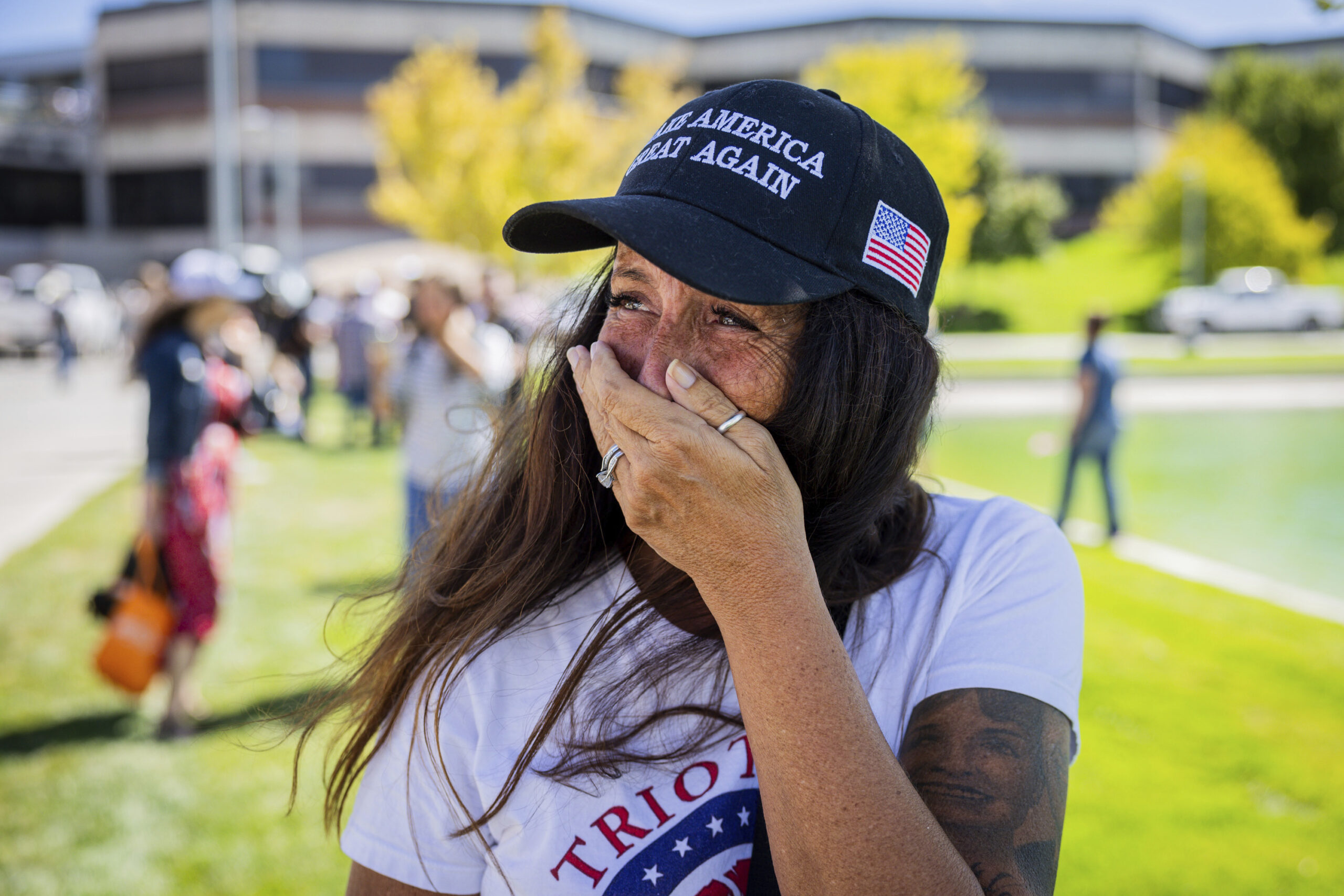
Allison Hemingway-Witty cries after Charlie Kirk is shot during Turning Point’s visit to Utah Valley University in Orem, Utah, Wednesday, Sept. 10, 2025. (Tess Crowley/The Deseret News via AP)
Gabby Giffords, a former U.S. representative for Arizona who suffered a serious brain injury when she was shot in 2011, posted on X about the attack on Kirk.
“I’m horrified to hear that Charlie Kirk was shot at an event in Utah,” she wrote Wednesday. “Democratic societies will always have political disagreements, but we must never allow America to become a country that confronts those disagreements with violence.”
Turning Point was founded in suburban Chicago in 2012 by Kirk, then 18, and William Montgomery, a tea party activist, to proselytize on college campuses for low taxes and limited government. It was not an immediate success.
But Kirk’s zeal for confronting liberals in academia eventually won over an influential set of conservative financiers.
Law enforcement tapes off an area after Charlie Kirk, the CEO and co-founder of the conservative youth organization Turning Point USA, was shot at the Utah Valley University, Wednesday, Sept. 10, 2025, in Orem, Utah. (Tess Croewley/The Deseret News via AP)
Despite early misgivings, Turning Point enthusiastically backed Trump after he clinched the GOP nomination in 2016. Kirk served as a personal aide to Donald Trump Jr., the president’s eldest son, during the general election campaign.
Soon, Kirk was a regular presence on cable TV, where he leaned into the culture wars and heaped praise on the then-president. Trump and his son were equally effusive and often spoke at Turning Point conferences.
Turning Point’s representatives have made two things clear in meetings with state and local Republican leaders – Donald Trump has blessed their conservative organization to help lead his get-out-the-vote effort, and local party officials ought to use the group’s new voter mobilization app.
Both prospects terrify fellow Republicans.
Soaring to prominence after Trump’s unexpected 2016 win, Turning Point earned a reputation for hosting glitzy events, cultivating hard-right influencers and raising prodigious sums of money while enriching the group’s leaders. They’ve had far less success helping Republicans win, especially in their adopted home state of Arizona.
Now the organization has leveraged its ties to Trump to expand its influence in a way that could be potentially lucrative. Turning Point has sought to lead an effort to remake the GOP’s get-out-the-vote effort based on the theory that there are thousands of Trump supporters who rarely vote but could be persuaded to in this year’s election. And they are pitching their new mobile app as vital to this effort’s success.
The Associated Press obtained an unvarnished look at how Turning Point is promoting its strategy by obtaining several recordings of presentations made by its representatives to state and local Republican officials. In those presentations, Turning Point operatives honed in on churchgoers and hunters, citing statistics that purport to show how few of each group cast ballots in 2020. Their argument, which is widely questioned by critics, is if groups like Turning Point target such groups, Republicans will likely sweep the swing states for Trump, the recordings show.
The decision by Trump to rely on untested groups such as Turning Point could have sweeping implications for November’s election. Turning Point says it’s operating statewide in Arizona and Wisconsin, two must-win states for Trump. It’s also working two competitive House districts, one in Michigan and another in Nevada, that could also help tip the balance in the presidential race.
“Their strategy is bad. They know how to talk MAGA, they know how to message the base,” said Tyler Montague, a Republican strategist from Arizona and a longtime Trump critic. “But they literally don’t know what to say to a swing voter.”
A Turning Point spokesman rebuffed such criticism, saying the group is performing an important role for conservative candidates. “We did this because we knew conservatives need” a way to identify and turn out voters, said spokesman Andrew Kolvet.
A straightforward, if questionable, strategy
Turning Point’s operatives believe there is a well of untapped conservative voters who have not backed Trump in recent elections. To get Trump back to the White House, they believe the best path is to activate those voters. The strategy appears to mostly ignore independents — or less hardened Republicans — because Turning Point’s brand of hard-right politics is less likely to appeal to them.
In the recordings obtained by AP, Turning Point’s representatives fully embraced that strategy and believe it would have helped them win past elections and ensure victory in November.
“If we just have an ounce of ballot chasing, just in Arizona,” Republicans would have won all their races, Matthew Martinez, a Turning Point official, said at a June event in Detroit, referring to the practice of convincing people to vote early while reaching out to those who haven’t cast ballots
Experts are skeptical
Experts in voting patterns are doubtful Turning Point’s efforts to mobilize infrequent Trump-inclined voters will do much to affect the election. Turnout in the past two presidential elections has already drawn a record number of voters to the polls, the experts noted, meaning the pool of voters they are seeking to turn out is small and particularly unlikely to vote.
“You had the highest turnout in Michigan in those presidential election years than you’ve ever had before. It’s doubtful they’re going to get any more,” said Bernie Porn, a nonpartisan pollster who’s worked in the state for more than 30 years.
‘Just download the app’
For over a year, Turning Point has aggressively pitched its new voter mobilization app — a potentially lucrative venture that, if successful, critics believe could strengthen its grasp on the Republican Party machinery. In meetings with state and local Republican leaders, Turning Point operatives lean heavily into their close affiliation with Trump, who is a regular speaker at Turning Point conferences, according to the recordings obtained by the AP.
“We now are an official arm of the Trump campaign,” Turning Point operative Luke Malace told the members of the Monroe County Republican Party in Michigan earlier this year while urging the group to become a paying “client.”
The app was designed by Superfeed, a company with direct ties to Turning Point’s leaders. Tyler Bowyer, Turning Point’s chief operating officer, sits on the company’s board and was formerly the company’s chairman, business filings show. Kirk’s mother-in-law also serves on Superfeed’s board.
“It’s all in-house,” Malace told the county party in Michigan.
Malace did not respond to a request for comment. Superfeed officials also did not respond to a request for comment.
Kolvet, the Turning Point spokesman, said that Malace mischaracterized the organization’s relationship with the app maker. Turning Point does not receive any money earned by Superfeed, and the conservative group isn’t “financially involved” with the app maker, Kolvet said.
The app and Turning Point’s data plans draw criticism
Some Republicans told the AP that there are major issues with Turning Point’s app, which has minimal protections to secure voters’ personal information.
Others said they liked the app and praised Turning Point’s new focus.
Turning Point is “doing the work that no one else wants to do and the party is not doing it,” said Matt Brown, chair of the Yakima County Republican Party in Washington. He said he learned about Superfeed at a Turning Point event in December 2023, and his county party became a Superfeed client.
The app is seen by Republican strategists as the latest example of Turning Point becoming more focused on using data as a way to strengthen its own role in the future of the party, not help the party now.
More than 35 of the 46 faculty at Arizona State University’s Barrett, The Honors College signed a letter condemning an upcoming speaking engagement featuring Dennis Prager...
Get 24/7 political news coverage and access to events honoring top political professionals
Sen. Michelle Ugenti-Rita, R-Scottsdale, tries to speak above the heckling crowd at “Rally to Protect Our Elections” hosted by Turning Point Action at Arizona Federal Theatre...
Get 24/7 political news coverage and access to events honoring top political professionals
Facebook and Twitter are investigating the accounts of several Arizona teens after reports that pro-Trump groups may have paid the teens to post specific political messages...
Get 24/7 political news coverage and access to events honoring top political professionals

 Sign In
 Free Newsletter