fbpx

Horne sues feds to end Voting Rights Act preclearance

Jeremy Duda//August 25, 2011//

Horne sues feds to end Voting Rights Act preclearance

Jeremy Duda//August 25, 2011//

Listen to this article
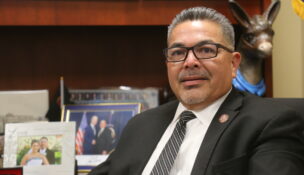
Attorney General Tom Horne (Photo by Evan Wyloge/Arizona Capitol Times)

Attorney General Tom Horne filed a federal lawsuit aimed at overturning a provision in the Voting Rights Act requiring Arizona and several other states to get all election changes approved by the U.S. Department of Justice before they can be implemented.

In the lawsuit, which was filed Thursday in the U.S. District Court for Washington, D.C., Horne argued that the preclearance requirement in Sections 4 and 5 of the Voting Rights Act is unconstitutional because it exceeds Congress’s authority under the 14th and 15th Amendments to the U.S. Constitution and treats some states differently than others.

Horne also said the formula for determining which states should be covered by the preclearance requirement is archaic and punishes the state for problems that were corrected decades ago.

Horne said the preclearance requirement was unfairly applied to Arizona in the first place. Congress included Arizona as a preclearance state in a 1975 amendment to the Voting Rights Act due a prior lack of bilingual ballots. The state began using bilingual ballots in 1974, the same year it elected a Latino governor, Horne noted, but Congress used 1972 as the benchmark for discriminatory voting practices.

“The situation is patently absurd. We’re being punished 40 years after the fact for the fact that we implemented bilingual ballots in 1974 rather than 1972, under an amendment to an act that was passed in 1975,” Horne said.

Horne said he began working on the lawsuit shortly after he took office in January. “It’s something we’ve been thinking about pretty much since I took office. But we took a long time to develop it. We wanted to make sure it was thoroughly researched and presented in a correct way,” he said.

Several Democratic legislators quickly took Horne to task for the lawsuit. Sen. Leah Landrum Taylor, D-Phoenix, said it was “very premature” for Arizona to be taken off the preclearance list, while Sen. Steve Gallardo, D-Phoenix, and Rep. Richard Miranda, D-Tolleson, said they get calls from DOJ every year regarding election laws passed by the Legislature.

“It’s because of the history here in the state of Arizona—the history of discrimination, the history of unfairness. That’s the reason we are on that list, and until we eliminate those reasons, there is no reason why we should not be under the Voting Rights Act and having stuff pre-cleared,” Gallardo said.

U.S. Attorney General Eric Holder, who was named as the defendant in the suit, vowed to defend the preclearance provision. He noted that Congress approved a 25-year reauthorization for the Voting Rights Act, along with the preclearance provision, with bipartisan support in 2006.

“The Voting Rights Act plays a vital role in our society by ensuring that every American has the right to vote and have that vote counted. The Department of Justice will vigorously defend the constitutionality of the Voting Rights Act in this case, as it has done successfully in the past,” Holder said in a press statement.

Horne argued that preclearance is unconstitutional because the classification system used to determine which states are covered is “flawed, arbitrary and irrational.” Arizona was included because at least 5 percent of its voting-age population was deemed to be of “Spanish heritage” and therefore a member of a language minority.

But Horne said the system used to determine whether a state should be covered to protect language minorities uses three different sets of criteria which are arbitrarily and unequally applied to different states.

The lawsuit also argued that the law placed an unnecessary burden on Arizona without any actual need to do so. States and jurisdictions on the preclearance list must get DOJ approval for any election law change, no matter how innocuous. Horne cited several recently passed Arizona laws that he said needed preclearance, despite the lack of impact on minority voting, such as the 2010 special election for Proposition 100 and a 2011 law allowing the dissolution of school districts that don’t have any students.
Other laws must go through the time-consuming process, he said, even if circumstances require immediate enforcement, such as 2010 bill creating new reporting requirements for independent expenditures.


States and local jurisdictions can apply for an exemption from the preclearance requirement, known as a bailout, if they have not had an infraction in at least 10 years. Gila and Yavapai counties are actively seeking bailouts, and several others are considering it. The state has not had any preclearance issues since DOJ rejected the first draft of Arizona’s redistricting maps in 2002, but some counties and local jurisdictions have had more recent problems.

Concerns over resetting that 10-year clock actually led the state to withdraw a preclearance request on one 2011 bill, and officials at the Attorney General’s Office and Secretary of State’s Office are considering doing the same to another. DOJ precleared most of SB 1412, which imposes new requirements on people who collect and deliver other voters’ early ballots.

But DOJ said it did not enough information to give preclearance to a provision that required anyone who delivers more than 10 early ballots must show photo identification, and required the Secretary of State’s Office to compile the information. Rather than submit more information and risk a preclearance rejection, officials asked the sponsor for permission to withdraw the preclearance request.

Sen. Ron Gould, whose bill prohibiting people from assisting others with voting if they have been employed by or volunteered for a candidate, campaign, political organization or political party may be withdrawn from its preclearance request as well, said he doesn’t think the federal government should be able to dictate how states run their elections, and supported Horne’s lawsuit.

“I don’t really see in the Constitution where the Justice Department has the authority to do that,” said Gould, R-Lake Havasu City. “If he’s willing to take the case on, I’m game.”

Arizona is not alone in challenging the constitutionality of Section 5 of the Voting Rights Act. Shelby County, Ala., is awaiting a district court ruling on a similar lawsuit in filed in 2010. The North Carolina town of Kinston is also challenging the preclearance provision.