Sign In


Upcoming Event
 Free Newsletter

Ben Henderson: Surveying the chessboard of Arizona’s budget
Reagan Priest, Arizona Capitol Times//July 17, 2026//
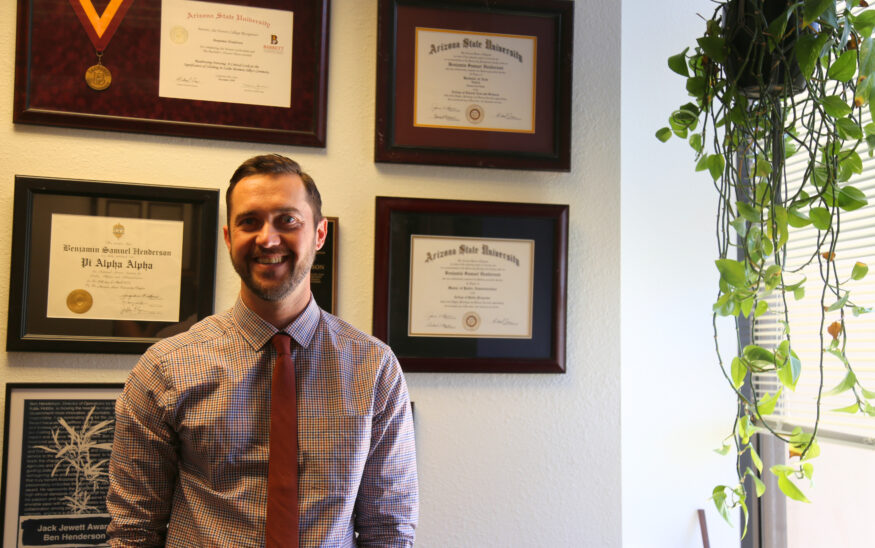
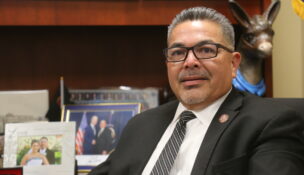
Ben Henderson poses for a photo in his office at the Capitol Executive Tower on July 9, 2026 (Reagan Priest / Arizona Capitol Times)
Ben Henderson: Surveying the chessboard of Arizona’s budget
Reagan Priest, Arizona Capitol Times//July 17, 2026//


For Ben Henderson, the state budget process is like a game of chess — that is, if you replace the board with a pile of spreadsheets and the pieces with lawmakers, state agency directors and the governor.
As the director of Gov. Katie Hobbs’ Office of Strategic Planning and Budgeting, Henderson is tasked with allocating funding to the governor’s policy priorities and agency initiatives while navigating budget negotiations with the Republican-controlled Legislature.
He sat down with the Arizona Capitol Times to talk about his long career in public service and his approach to budgeting in an era of divided government.
Questions and answers have been lightly edited for style and clarity.
Can you tell me about your career trajectory so far?
I got my bachelor’s degree in 2009, and it was a literature degree, in the middle of the Great Recession. I could not get a job for the life of me, so I did a whole bunch of internships, mostly unpaid. I was really interested in why a whole bunch of spreadsheets all around the world suddenly changed slightly, and everyone’s lives got worse. Why does the economy work this way? I got really interested in economics and public administration. I did the City of Phoenix, the League of Arizona Cities and Towns, and the Arizona School Boards Association. And the bug bit me. I applied to work at (the Joint Legislative Budget Committee). The rest is kind of history. I got a call from (former Gov. Doug Ducey’s) administration after I did the Flinn Brown Fellowship, and they said, “Hey, do you want to be a project manager on a newly forming operations team?” At the time, we were a leader; Arizona was one of the first states in the country to have an operations team in the Governor’s Office. It was all about how you get stuff done when people don’t agree, when you run into bureaucratic obstacles.
You’ve worn a lot of hats since you joined the Hobbs administration. What has that been like?
They’re all different. And they’re all challenging in their unique ways. Sometimes I view the operations job as like the fast-moving disasters, and the budget job as like the slow-moving disasters. The governor is in charge of 35,000 people. Every time the freeway shuts down, every time there is an emergency, every time there’s a fire, she is leading the charge. She relies on a lot of really smart people who don’t sleep to make sure that that work gets done. But it was nice to transfer from a job that you used to get phone calls at 2 a.m. about terrible, horrible things happening. Now the phone calls I get are during the daytime, but the challenge is to figure out solutions that just require different kinds of work. Getting everyone to agree on how to spend $18 billion in divided government in 2026 is not an easy task, but the governor is phenomenal, and I think she leads the state in a great way, and it helped (us) come to a budget that had the most consensus of any budget in 20 years.
How have your previous roles prepared you to step into this position?
I’m learning new stuff all the time. It’s one of the cool things about state government. I’m learning new acronyms all the time, I’m learning new nooks and crannies of state government where there are dedicated staff working all the time. You only learn that small stuff by being an analyst. So being at JLBC, learning from Richard (Stavneak), who is an incredible leader and a mentor of mine, taught me a lot about how the budget works, but it’s like learning the tools. So you get the hammer and you get the saw and you get the measuring tape and now what do we want to build? The cool part about this job is now we get to build things, like investing in childcare and K-12.
This was a particularly challenging budget year; how did you prepare?
If you rewind to last year, everyone was fighting tooth and nail to get (the 2025) budget done. We were running up against the deadline. We were trying to get everyone to agree that shutting down the state is not good for anybody. It’s not good for our public employees. It’s not good for the people of Arizona. It’s not good for leadership. So on June 28 we finally get the deal done, and on July 4, they pass the “One Big Beautiful Bill” that changes everything. It changes how we think about our safety net. It changes how we think about our revenues. It changes how we think about resiliency and energy grants. I mean, it literally changes just about everything you can imagine in terms of federal funding. So like three days after we finished our marathon of getting the fiscal (year) 26 budget done, I said, “Hey, guess what? Everything just changed, and we got to start understanding what this means.” So my team started doing some pretty in-depth analysis about what this could mean. The “One Big Beautiful Bill” actually didn’t provide much direction. We had to make a bunch of guesses about whether or not we were going to get border reimbursement funds, whether or not we were going to get investments from the federal government in the way that they said the “One Big Beautiful Bill” would help our state. It did help in a couple places, but it also made it very hard and very difficult to do our work and very hard to keep Arizonans healthy and fed and safe.
What is most fascinating about this role and what is most challenging?
I’ve never found another job where I could have more impact. It really does feel like you’re playing this giant year-long chess game, and if you play it just right at the end of it, you get to invest tens of millions of dollars in homelessness prevention. The parts that are challenging are oftentimes these rules that we set for ourselves that just don’t change. So we budget this way because that’s how we budgeted in 1975, and we’ll never change because this is the right way to do things. Sometimes we had the right answer in 1975, and we don’t have to rethink it. But not very often anymore. The world around us has changed and changed radically. So you look at like the aggregate expenditure limit, which is this cap on K-12 spending that never took into account computers in our K-12 funding because it was the 1980s. So how do you have the conversation that it’s time to rethink our rules? It is hard, especially when the people you’re talking to wrote the rules.
What do you wish more people knew about your role or the Governor’s Office?
The system is working as it was designed. I don’t know if it’s working in the way that we want it to today, but it’s not like it was brought here by accident, by happenstance. Every piece was intentionally designed by somebody. Now, everyone has their own perspective, and so we don’t design those things in a way that’s truly interoperable and works together. There aren’t, like, mustache-twisting villains in the corner; it’s not like someone is out there to tank the whole system. As much as a lot of people on both sides think that’s what’s going on. Everyone is coming at it from a very strong position and is trying to accomplish different things. Someone might be trying to invest more in public safety, and someone else might be trying to invest more in K-12. If there’s only $1, when you’re trying to decide where that $1 goes, does it go to K-12? Does it go to public safety? How do you decide? How do you split it? That’s the vitriol and the animosity and all the political stuff that everyone gets. We are a bunch of people trying to do good, trying to make people’s lives better in a bunch of different ways with different opinions, and the best thing that humanity has come up with so far is this thing called democracy. So we’re just making it work.
How does one get to know the state budget as well as you know it?
I just want everyone to understand this because it doesn’t need to be as complicated as we make it, and there’s a whole industry of people who want it to stay obscure because it’s how they control and manage the message. If economists are the only ones who know the right answer, then we can’t contribute, and that’s not how democracy is. It’s not how the state budget should be done. If you can only access this one spreadsheet in this one format in this one way, then the budget’s not that transparent. We need to do a lot of work as a state to make our documents more accessible and easily readable. We just updated the OSPB’s website to try to do some of that, and we’re working really hard to try to tell the story better. But a lot of it is just memorizing it from many, many years of doing this over and over again.