Sign In


 Free Newsletter

A tribute to Jimmy Carter
By Alison Bethel, State Affairs//December 29, 2024//
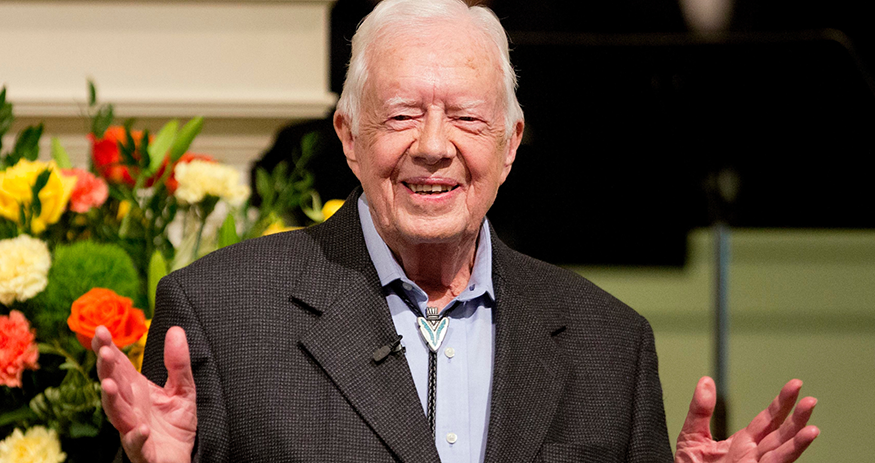
at Maranatha Baptist Church in his hometown in Plains. (Credit: David Goldman)
A tribute to Jimmy Carter
By Alison Bethel, State Affairs//December 29, 2024//


Editor’s note: On this day, State Affairs offers a tribute to one of Georgia’s most famous modern sons. While not intended to be an exhaustive recollection of his political career, it is an homage to who he was to Georgia and its people.
James Earl “Jimmy” Carter was many things.
A Christian. A patriot. A humanitarian, and a builder of homes. A politician. A devoted husband, father and grandfather of 12. A naturalist. A painter and a poet.
But maybe above all, he was a patchwork of unbelievable strength and humility forged from the fields of a southwest Georgia farm where faith, family and hard work prevailed.
“I have one life and one chance to make it count for something. … My faith demands that I do whatever I can, wherever I am, whenever I can, for as long as I can with whatever I have to try to make a difference,” Carter once said.
And what a difference he made for his small town of Plains, Georgia, and for many around the world — even until his death on Dec. 29 at the age of 100.
“Marty, the girls, and I join all Georgians and the entire nation in mourning the loss of former President Jimmy Carter,” said Gov. Brian Kemp. “As the only American president thus far to come from Georgia, he showed the world the impact our state and its people have on the country.
“Their family continues to be in our prayers,” Kemp added, “as President Carter is reunited with his beloved wife and the world mourns this native Georgian, former state and national leader, and proud peanut farmer from Plains.”
Born in Plains in 1924, Carter grew up in the Depression era among Black sharecroppers and their children, with whom he worked and played on the family farm, and for whom he developed an affection and respect that shaped the rest of his life.
“The bond of our common humanity is stronger than the divisiveness of our fears and prejudices,” Carter said in his Nobel Peace Prize lecture in 2002.
The so-called “Peanut Farmer,” known in childhood as “Hot Shot,” would accept the Nobel Peace Prize 21 years after leaving the White House as the nation’s 39th president. He is the only president ever to hail from the Peach State and was the country’s oldest living president.
Over the course of his political career — which began when he joined the Sumter County School Board in 1955 at the age of 36 — he would serve as a Georgia state senator and governor before heading to Washington.
But Carter might say that among his greatest accomplishments was marrying his childhood sweetheart — Eleanor Rosalynn Carter. The two were inseparable, married for 77 years until her death in Plains in November 2023 at age 96.
“I can’t really quantify it or describe it in words,” Jimmy Carter told talk show host Oprah Winfrey in 2015. “But I knew that she was quiet. She was extremely intelligent. She was very timid, by the way, beautiful, and there was just something about her that was irresistible.”
Many wondered whether the man who had survived metastatic brain cancer, liver cancer and brain surgery could survive the loss of his beloved companion. But he did; her funeral in November 2023 would be the last time he would be seen in public. The solemn occasion drew every living former first lady, seated in order: Melania Trump, Michelle Obama, Laura Bush and Hillary Clinton. First lady Jill Biden was seated with President Joe Biden.
‘Gotta let your soul shine’
What many people may not remember about Carter was his love of music — from gospel to rock-and-roll to folk. Former U.S. Ambassador to the United Nations Andrew Young once said Carter would attend gospel music concerts at all-Black churches and wouldn’t need to pick up a hymnal because he knew every word.
“Music is the best proof that people have one thing in common no matter where they live, no matter what language they speak,” a 95-year-old Carter said in the 2020 documentary “Jimmy Carter: Rock & Roll President.”
With the help of the Allman Brothers Band, Bob Dylan and pal Willie Nelson, Carter would use music to propel him from the Georgia governor’s mansion to the White House.
“Anybody who wants a president who doesn’t like music like this, and who doesn’t like people who make music like this, should just simply vote for another man,” Carter told a crowd at a 1975 Allman Brothers benefit concert.
A glorious start
Carter was elected president in 1976, as the nation was recovering from the Vietnam War and Watergate hearings.
“His tenacity and intensity on the campaign trail in 1976 served as a model for many upstart campaigns decades later,” Indiana Democratic Chairman Mike Schmuhl remembers. “After Vietnam and Watergate, Americans were hungry for someone entirely different, and his down-home retail efforts, particularly as the first president to find success in the Iowa caucuses, proved that there’s no substitute for direct conversations between a candidate and the voters,” Schmuhl told State Affairs/Howey Politics Indiana.
Rufus Edmisten, former North Carolina secretary of state and attorney general, told State Affairs North Carolina Pro that in 1976 President Carter “invited all of the nation’s attorneys general to the White House for a meeting. As North Carolina’s attorney general, I was in attendance, and I beamed when President Carter remarked, ‘Attorney General Edmisten played a big role in the Watergate investigation.’”
Carter was that kind of man — always ready to praise, or at least take the higher road.
“I believe that anyone can be successful in life, regardless of natural talent or the environment within which we live,” he wrote in “Our Endangered Values: America’s Moral Crisis,” published in 2006. “This is not based on measuring success by human competitiveness for wealth, possessions, influence, and fame, but adhering to God’s standards of truth, justice, humility, service, compassion, forgiveness, and love.”
Carter’s presidency began triumphantly with celebrations of the country’s bicentennial, but an ongoing energy crisis in the Middle East soon sent gas prices and inflation soaring, provoking anger and anxiety among Americans throughout his term.
What many consider the crowning achievement of his presidency occurred in 1978, when he brokered the Camp David Accords between Israel and Egypt.
“There are a lot of things the Carter presidency set in motion: awareness around energy conservation, Black political empowerment,” said Andrea Young, executive director of the American Civil Liberties Union and the daughter of Andrew Young.
After losing the 1980 election to Republican Ronald Reagan, Carter returned quietly to Plains. It was from that humble setting that his influence would reach new heights.
“President Jimmy Carter showed America that a former president can do great things after the presidency, with dignity and grace,” said Edmisten.
Carter became a fixture of community life, teaching Sunday school at Maranatha Baptist Church. His lessons drew thousands of visitors. He taught Sunday school until he entered hospice in 2022.
The Carter legacy
Stone Mountain resident Sheila Jasper attended one of Carter’s Sunday school classes about eight years ago. The lesson the former president taught that Sunday was so profound that it has stuck with her to this day.
“To me, his legacy is his Sunday school teachings,” Jasper told State Affairs during a visit last fall to The Carter Center, which hosted a 99th birthday party for the former president. “I still hold very close to his definition of love when he taught that Sunday school lesson. And it is ‘Love is stretching one’s heart for the benefit of others.’”
“President Jimmy Carter was a principled leader, a brilliant mind with a servant’s heart, who rewrote Georgia’s Democratic Party, making it more sensitive to the needs and challenges of all people, no matter their status in life,” said state Sen. Freddie Powell Sims, whose district includes Plains and Sumter counties.
Carter led an overhaul of Georgia’s state government, reducing its 65 agencies to 22. At the same time, he increased the number of Black appointees to state boards and agencies to 53 from three, appointed the state’s first Black county judge and raised the number of Black state employees by 25%.
In 1974, Carter commissioned a portrait of the Rev. Dr. Martin Luther King Jr. to be painted and hung inside the state capitol, which before that had featured only the likenesses of white leaders.
As governor, Carter also was a champion of Georgia’s natural spaces. He lobbied Congress to pass a bill to protect the state’s rivers and wetlands, and canoed down the Flint River in south Georgia to protest a federally funded dam.
In 1982, the Carters co-founded The Carter Center, located on a 35-acre campus in Atlanta that includes the Jimmy Carter Presidential Library & Museum.
One of the center’s most successful initiatives is its program to eradicate Guinea worm disease, a parasitic infection that’s contracted when people consume water from stagnant sources.
“What I remember and recall vividly, it’s just the compassion that he had,” said Adam Weiss, who began working with Guinea worm eradication as a Peace Corps volunteer in Ghana and now directs the program at The Carter Center. Weiss said that during a visit in Savelugu in north Ghana in 2008, Carter “would console somebody, whether it was a little kid crying with Guinea worm, or their mother, and he’d be holding their hand and comforting them.”
Carter and The Carter Center staff mediated a peace agreement between Sudan and Uganda in 1999 and oversaw the historic referendum on independence for South Sudan in 2011, when 99% of voters elected to form their own country.
Humanity at its best
Since the early 1980s, Carter also poured his energy and conviction into volunteering with his wife to build homes alongside the economically disadvantaged people destined to live in them, through Habitat for Humanity.
“When we left the White House, we could have done anything,” Carter once said. “But our choice was to volunteer as Habitat workers, and that’s been a life-changing experience for us.” And for many, many others.
Devoting a week each year to the project from 1984 to 2019, the Carters worked alongside more than 104,000 volunteers in 14 countries to build, renovate and repair 4,390 homes. Their involvement helped turn Habitat for Humanity into a globally renowned organization.
“We have the ambition to share some of our good fortune with others,” Carter once said. “That’s one of the most difficult things in life: to cross that chasm between well-off people and families that don’t have a decent home. That’s one of the things Habitat has given us — an ability to share, side by side, building a home with families that have never had a decent place to live.”
Said DeKalb County CEO Michael Thurmond: “I don’t want to mythologize people, but you have to consider him almost in the vein of a Mother Teresa or Gandhi in terms of his persona and his commitment to helping the less fortunate.
“He accomplished more out of office than most presidents can say they accomplished in office.”
State Affairs senior investigative reporter Tammy Joyner, State Affairs chief of staff Joy Walstrum and Jill Jordan Sieder contributed to this report.