Sign In


Upcoming Event
 Free Newsletter

Marisol Garcia: a passionate educator and organizer
Kiera Riley, Arizona Capitol Times//August 3, 2025//
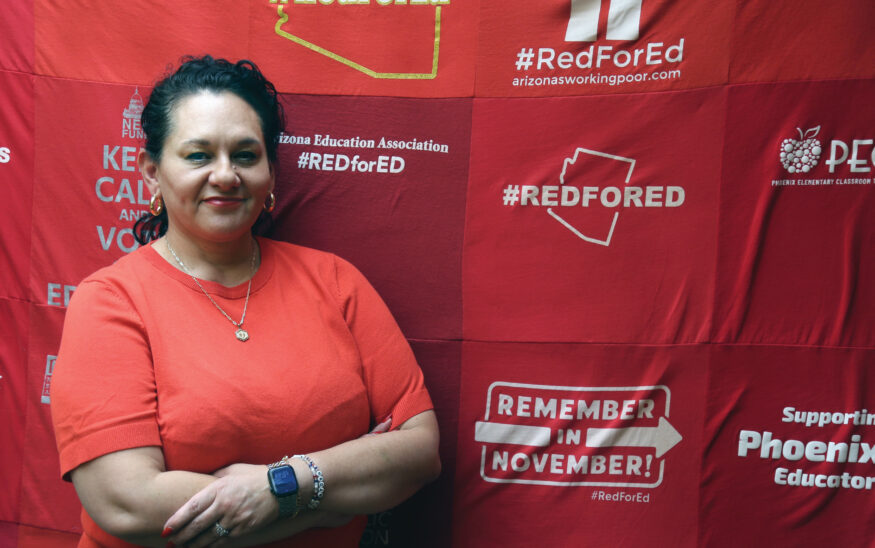
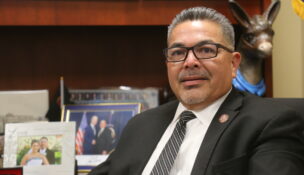
Marisol Garcia poses for a photo against a backdrop of #RedforED slogans. (Kiera Riley / Arizona Capitol Times)
Marisol Garcia: a passionate educator and organizer
Kiera Riley, Arizona Capitol Times//August 3, 2025//


Marisol Garcia did not set out to be an educator, but an organizer. After working in the political world, she found her way to the classroom and then to the head of the state’s teacher’s union. There she discovered her past experience helped her and her union use collective action to move forward and meet the challenges of educators in Arizona.
Responses have been edited slightly for clarity.
What was your path to education? And to your current leadership role?
My mom is a first grade teacher, she was for 40 years and my dad is in higher education. He was a professor and a dean, and a lot of his work was done in cognitive science and bilingual education. And my mom was a bilingual educator — I had no interest in getting involved in education.
I was fairly politically active in high school, with school board stuff. I really wanted to get involved. And I ended up doing an internship in 1992. I was a White House intern. I was an undergrad intern, which is very odd. My job was like making photocopies and getting Caesar salads and Diet Cokes and running all over the place. And after I graduated, I decided to get involved, and I did a lot of training to become an organizer and did a lot more electoral organizing. Then I worked for a couple of elected officials.
I decided I don’t want to continue to be the person with the clipboard behind the elected official forever. I needed to find a path or an issue that I was closest to. And so a couple of mentors were like, what is the issue that you care most about? And it was education. So I went back to school to get my certification. And I ended up teaching middle school in the Mission District in San Francisco.
How did working as an educator in California differ from working in Arizona?
I became very aware of the things that I was given in California, health care for me and my son, the ability to walk into a classroom that had resources, a really strong union. There wasn’t any of it here.
My first day on campus, they handed me one of these plastic bags that cover the little small garbage cans filled with all the supplies I was going to get. And it was a couple of yellow Post-it notes, some pencils, a stapler, just very basic supplies.
I was also walking into a school and a school district that served probably the most vulnerable community in the state, in the area. These kids were fighting to have food on the table. Their parents were working three jobs. It was extreme, extreme poverty. In my first year, I was a member of the student council. I coached softball. I had a six month old baby. I threw myself 100% into it, and I fell in love with it, but it became very clear regarding the strains on that system, and there were things to be fixed.
When did you get involved with the teacher’s union?
We were having a lot of violent fights at lunch and breakfast. There were issues with duty. There weren’t enough teachers, or the wrong teachers were there at that time, meaning, teachers that were in special education classrooms were expected to do before school monitoring, with the big field of seventh and eighth graders that were literally going to war over a girl, text or a MySpace post.
So our seventh-grade team went to (our principal), saying, ‘Hey, could we think about realign?’ No, no no, no, no, no. And I thought, ‘Oh, OK. Well, I know how to deal with a person like that. I can organize.’ I put an anonymous survey into everyone’s teacher box, and then I said, ‘Return to room 227.’ I was organizing, but sticking my butt out. I put them in everyone’s box, because I knew we weren’t the only ones feeling it.
Then I get a call to go meet with the superintendent. And he just pulled me aside and said, “Look, if you’re going to organize like that, you probably want to do it under the umbrella of the union. Otherwise, you’re just this lone wolf.”
When did you get pulled to the state level?
I saw myself wanting to do more in 2010 when SB 1070 was passed. That directly impacted my students, my families, and I didn’t see AEA anywhere in that fight. In fact, the day it was signed, we were at our annual meeting — we were just operating like it’s anything, and this is the worst immigration policy that we’d ever seen, and it wasn’t being talked about. There wasn’t any pushback. I just didn’t see the union moving in that space.
How would you describe your leadership style at AEA?
I am more of a unionist at heart than my predecessors. There is so much power in collective action. There is so much, so powerful in being selfless when it comes to the fight. And so when I first took over, my priorities were really to become an organizing and fighting union, and that was very uncomfortable for a lot of our members, a lot of our leaders, and our staff. But I was elected in 2022, right when we were entering this big gubernatorial race, statewide offices, and again, just eliciting my background, knowing how important a governor could be to disrupt a lot of the policies that we’d seen passed in the past.
We know that we have to get involved in political battles. We cannot be afraid of them.
What has that change looked like internally?
We had to restructure, so we’ve trained close to 200 members. We retrained our entire staff. I think what that has allowed us to do is see ourselves as part of the working families community, of the majority of workers, whether they are at a meat plant or they’re in the fields, or if they are in classrooms, we all have this ability to work in coalition.
It allowed me to see workplace organizing as this powerful tool to disrupt the division that has really destroyed a lot of it. For instance, the teacher across the hall from me, when I think of the last year, is like in the classroom. The teacher across the hall from me, who graduated from UofA, had always lived in Tucson his whole life. Another teacher across from me was a TFA (Teach for America), who is from Virginia, and the teacher next to me grew up on the Gila reservation. We all have different backgrounds, but we had one thing in common: our workplace.
We wanted dignity in our workplace. We wanted to be able to take a water break or use the restroom, and have a say in our schedule and resources. And so if we could make that coalition at the workplace, it would allow us to work within and outside of it, right? We saw each other as very similar. The humanity came back to it, and it wasn’t who did you vote for or whatever? It was more, what was your day like, and how can we make it better? Everyone I worked with was very different, and they had very different backgrounds, but we had one singular experience.
What do you make of the overlap between education and politics now?
We fight for three main things: working conditions, safety issues and resources. So working conditions, wages, benefits and respect, those are non-partisan issues.
We do not do anything overtly partisan as you are a union member. What we will do is ensure that we elect policymakers who will do what’s best to keep you safe, pay better wages, and respect you. We really bring it right back to everybody who’s entered this profession, everyone who works in that building, at core is there to do what’s best for kids, yeah, in every way possible. And we want to make sure that they are treated with dignity and paid a professional salary. Bottom line and respect comes in ensuring those happen, but respect also ensures that the union has a seat at the table. If not, it will fail. It was destined to fail, just as any policy imposed on people without their participation would fail.
How important is it to be at the table now, with the current education climate at both the state and federal levels?
We’re all thinking we should all get shirts that say, “No more unfunded mandates.” I understand the desire to fix something, but I think the issue is that you don’t understand the problem, much like the butterfly effect.
All of these legislators went through a K 12 experience. They have that experience. They probably have some experience as parents, godparents, or grandparents. But there are three now who have actual classroom experience.
Some of the positions we may need to take or try to fit into are because we aim to help you make your idea, whether it’s something a constituent shared with you or a dream you had, a success. We’re not throwing speed bumps to stop it, but we’re trying to get you to use the yellow cones to reach the right place to ensure whatever you’ve dreamed of is possible.