Sign In


Upcoming Event
 Free Newsletter

Shift happens: When Colorado River cuts hit home
Rusty Childress, Guest Commentary//March 13, 2026//
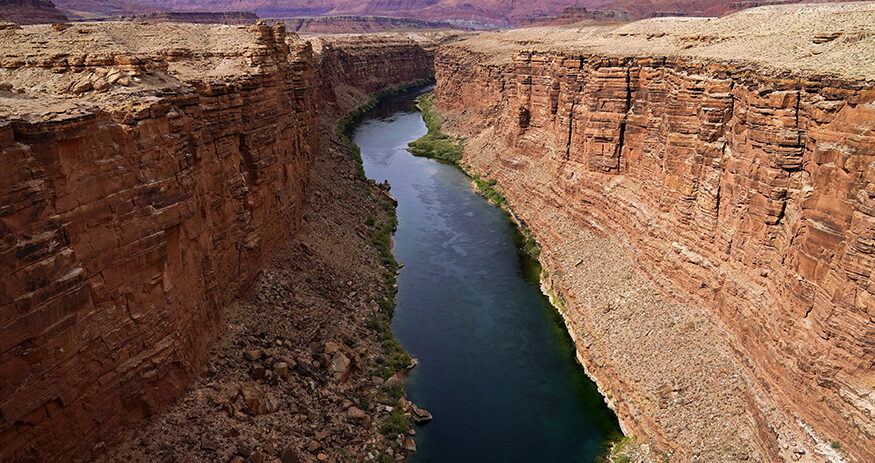
The Colorado River in the upper River Basin is seen, May 29, 2021, in Lees Ferry, Ariz. (AP Photo/Ross D. Franklin, File)
Shift happens: When Colorado River cuts hit home
Rusty Childress, Guest Commentary//March 13, 2026//


This is no longer someone else’s problem.
If Arizona loses a significant share of its Colorado River supply, you won’t feel it standing on the shore of Lake Mead. You’ll feel it in your water bill, in the cost of keeping a lawn alive, and eventually in what your home is worth. That’s the shift, from abstract resource crisis to something unmistakably personal.
For years, the conversation has circled around structural deficits, aridification trends, and post-2026 operating guidelines. Eyes glaze over. But when shortage conditions led to Rio Verde Foothills losing its hauled water access, none of that technical language was necessary. Real estate listings stalled. Buyers hesitated. And agents started hearing a question they hadn’t heard before: Does Arizona actually have enough water?
That question travels faster than any policy memo.
It’s not only Arizona’s question, either. Seven states, tribal nations, and Mexico all draw from the same river — a single connected system of reservoirs, turbines, and canals that doesn’t recognize “Upper Basin” or “Lower Basin” as meaningful distinctions. When inflows decline, pressure builds everywhere. Framing the problem as three states against four has produced predictable gridlock. Framing it as seven states tied to one shrinking supply clarifies what’s actually at stake.
When buyers grow uneasy, markets respond. When markets respond, politicians pay attention. Water insecurity isn’t just an environmental concern — it’s an economic signal.
Consider what a serious priority-based reduction would actually look like on the ground in central Arizona. Water rates in higher-use tiers would rise sharply. Outdoor irrigation would become genuinely expensive. Nonfunctional turf would disappear from new developments, and HOA rules demanding lush green aesthetics would become difficult to defend in court and in conversation alike. Subdivision approvals would require proof of actual, deliverable water rather than paper allocations. Agricultural districts would face compensated fallowing, crop shifts, or permanent water transfers. Industrial users, including data centers, would be required to disclose and reduce their consumption.
None of that resembles turning off kitchen sinks. It resembles reshaping growth and lifestyle expectations — which is uncomfortable, but it’s a different kind of problem.
Fairness, though, cannot be an afterthought. If homeowners are fined for overwatering while large agricultural operations continue flood-irrigating low-value crops, resentment builds fast. If builders keep breaking ground while existing neighborhoods are told to conserve, trust erodes. If industrial users receive quiet carve-outs while residents face scrutiny, the politics turn volatile. Scarcity that demands sacrifice from some but not others isn’t just inequitable — it’s combustible.
Rio Verde was not a large story in acre-feet. Perceptually, it was enormous, because it showed how quickly long-held assumptions about water can unravel and how rapidly markets internalize risk when confidence falters.
Backyard pools are more than amenities — they’re part of the lifestyle Arizona has always sold and that families expect to keep: sunlight, open patios, grandkids swimming in January. If scarcity deepens, even those expectations may face new limits or rising costs. Not overnight, but gradually, through pricing signals, restrictions, and shifting cultural norms about what’s reasonable to expect in a desert.
Structural shortages, in the end, require structural responses. Turf removal at meaningful scale saves tens of thousands of acre-feet; agricultural transitions save hundreds of thousands. Slowing new development until supply is demonstrably reliable prevents deficits from compounding. Advanced municipal reuse increases reliability within existing urban systems. None of these are glamorous, but they save real water.
The uncomfortable reality is that people don’t respond to acre-feet. They respond to invoices and aesthetics. When a water bill rises 25 percent, behavior changes. When lawns vanish from new subdivisions, conversations follow. When buyers hesitate because long-term supply feels uncertain, developers take notice.
Change accelerates when cost aligns with scarcity.
As long as water feels cheap and abstract, deadlock holds. When it becomes personal and visible, adjustment follows. The river itself doesn’t negotiate — it reflects supply and demand, and post-2000 flows are measurably lower than the 20th-century assumptions that built the modern Southwest. Seven states depend on one declining inflow, and no single state can stabilize the system alone.
Ignoring reservoir charts is easy. Ignoring mortgage values and monthly bills is not.
The sooner price, growth, and policy align with hydrologic reality, the more orderly the transition can be. The shift is coming either way. The question is whether it shows up gradually in policy — or suddenly in property values.
Rusty Childress is an Arizona native and nature photographer.