Sign In


 Free Newsletter

Budget stalemate: House Republicans send Hobbs their first proposal
Howard Fischer, Capitol Media Services//April 29, 2026//

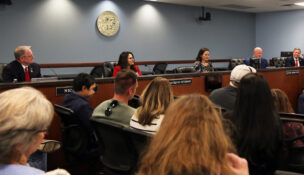
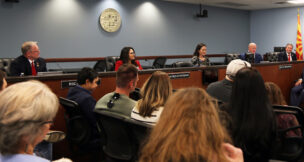
House Speaker Steve Montenegro, right, chats with Rep. David Livingston on June 24, 2025, as the House prepares to vote on last year's $17 billion "continuation budget." (Howard Fischer / Capitol Media Services)
Budget stalemate: House Republicans send Hobbs their first proposal
Howard Fischer, Capitol Media Services//April 29, 2026//


Key Points
-
Aide says lawmakers should come to Hobbs to negotiate
-
GOP plan cuts agency budgets, but includes some of Hobbs’ priorities
-
Senate expected to evaluate the GOP proposal next week
House Speaker Steve Montenegro says it’s up to Gov. Katie Hobbs to reach for the phone if she wants a deal on the budget.
The Goodyear Republican told Capitol Media Services that GOP lawmakers have prepared their own plan for balancing the budget. He said that’s exactly what Hobbs demanded when she walked away from talks a month ago.
And he said it even includes some of what the Democratic governor proposed before she broke off talks, like money for child care.
“We’ve got a majority of this chamber agreeing on a budget,” Montenegro said. “We’re waiting for her to pick up the phone, email us, text us… She’s welcome to show up here.”
Gubernatorial press aide Christian Slater said the speaker shouldn’t sit by his phone — at least not now.
“The Governor’s Office received that budget two days ago,” he said.
In the meantime, Slater said, aides to the governor are “examining the budget in detail.”
He added that there’s more involved in what Hobbs does next than just the numbers — particularly in how Republican lawmakers proceed from this point forward.
“We are … monitoring their actions to determine if they are serious about engaging in good-faith, bipartisan negotiations rather than playing political games,” Slater said.
And Rep. Nancy Gutierrez, the assistant House minority leader, questioned why it should be up to Hobbs to make the next move and reach out to Montenegro.
“The last time I looked, she’s the governor,” the Tucson Democrat said.
“He’s the speaker of the House that took over 100 days to have a budget,” she said, referring to the time between when Hobbs released her $18.7 billion plan and the $17.9 billion plan that Republicans unveiled earlier this week. “Maybe he needs to call her.”
Montenegro, however, said that’s not the way he reads the situation.
“She was the one that walked away five weeks ago,” he said.
“She could have called me yesterday,” Montenegro continued. “We’re here. We’re waiting. It’s incumbent upon her to show some leadership.”
With no communication from the governor since the plan’s April 27 unveiling, House Republicans moved ahead on April 29, voting to adopt their budget — with Democrats objecting to multiple provisions after arguing they short-change critical services and programs.
Much of the budgetary dispute is over the fact that Republicans, unwilling to accept the tax hikes and other proposals by Hobbs to boost state revenues, are proposing major cuts. That includes $99 million in across-the-board cuts of 5% for most state agencies, with state universities among the hardest hit.
Part of the reason Republicans have less to spend is they have built in some tax breaks for business that mirror the changes made by Congress last year in H.R. 1, including allowing them to write off the costs of certain expenses.
But the dispute over what and who to tax — and whether there is money for other programs — is more complex than that.
Hobbs, in her own budget proposal, said there’s a simple way to save more than $38 million a year to use for other priorities: end the tax breaks now provided for new data centers. And she also asked lawmakers to impose new water use fees on the growing industry.
“It’s time we make the booming data center industry work for the people of our state, rather than the other way around,” the governor said in January.
But while the GOP plan does eliminate various tax breaks for things they call the “Green New Deal,” like installing solar energy devices, it leaves the data center breaks untouched.
“Data centers first, affordable colleges last,” complained said House Minority Leader Oscar De Los Santos, a Laveen Democrat.
Rep. Matt Gress, who was instrumental in crafting the GOP plan, said if the governor wants to eliminate those tax breaks for data centers she “should come back to the table and start negotiating with us.” And he argued that if House Democrats were really interested they should have proposed amendments to the budget when it was being debated on April 29.
Gutierrez, for her part, said that proposing amendments to the Republican plan would have been a waste of time.
“This is not a real budget,” she said.
“It wasn’t negotiated with us or the governor,” Gutierrez continued. “If they want to use this as a starting point for real negotiations, we will bring those things back.”
The Senate is not expected to take up the GOP plan until next week.