Sign In




 Free Newsletter
House Republicans pass budget plan — Hobbs is ready to negotiate
Reagan Priest & Jakob Thorington, Arizona Capitol Times//April 30, 2026//
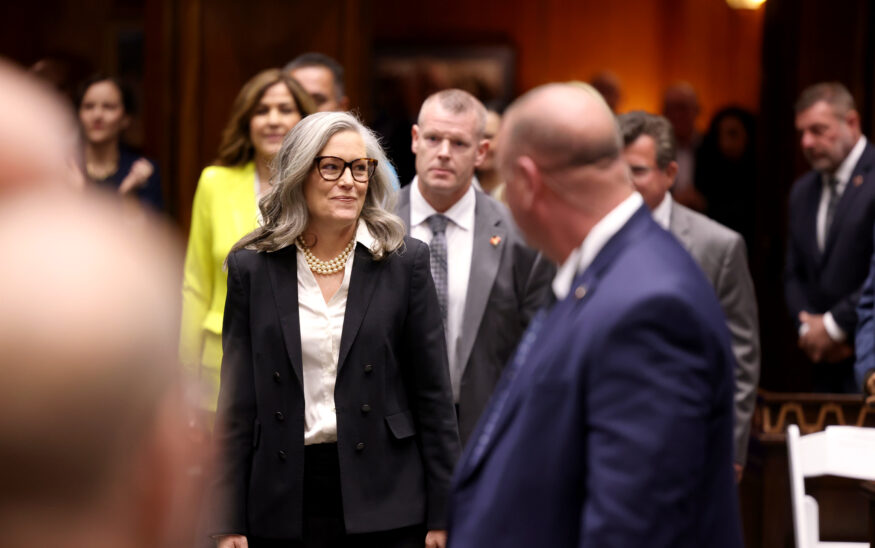
Gov. Katie Hobbs arriving at the 2025 State of the State Address on the floor of the Arizona House of Representatives at the Arizona State Capitol in Phoenix. (Gage Skidmore / Flickr)
House Republicans pass budget plan — Hobbs is ready to negotiate
Reagan Priest & Jakob Thorington, Arizona Capitol Times//April 30, 2026//


Key Points:
-
House GOP pass $17.9B budget using agency cuts to fund tax conformity
-
Governor supports some provisions, opposes Medicaid and SNAP eligibility changes
-
Both sides say they’re ready to negotiate, but Hobbs hasn’t lifted bill-signing moratorium
Republican lawmakers are close to sending Gov. Katie Hobbs a budget, although several GOP members and the governor have signaled they’re already waiting for the next set of negotiations given the plan’s lack of Democratic support.
House Republicans passed a $17.9 billion budget package April 29 on a party-line vote. And while the Senate did not gavel in on April 29 to move that package, Senate Republicans did share their support for the GOP proposal in a Joint Appropriations Committee earlier in the week.
Senate Majority Director of Communications Kim Quintero told the Arizona Capitol Times that the Senate is planning on moving the budget Monday morning and voting on the package later in the day.
The budget is largely a continuation of last year with the inclusion of new broad cuts to state government designed to help the state pay for full federal tax conformity — which the governor has vetoed twice this session.
Still, Hobbs said there are parts of the GOP budget that she can support, like $66 million in funding for public schools, $23 million to backfill federal funding for the Victims of Crime Act and full funding for the state’s Division of Developmental Disabilities. However, she also criticized the plan for prioritizing “special interests and billionaires over everyday Arizonans.”
House and Senate Republicans said in an April 27 news release that their plan is about $800 million less than Hobbs’ executive proposal that was introduced in January. It’s also a goal for the caucus to be the only state in the nation that is fully conforming state tax code to federal policy.

“Republicans have crafted a budget that’s thoughtful, that’s serious and has Arizona families in mind,” said House Speaker Steve Montenegro, R-Goodyear. “The government should take less of your earned money. This budget is about that mission. This is the third time we’re going to send this governor tax relief for families.”
Governor’s Office staff say the state can afford full tax conformity, but Hobbs isn’t willing to impose the funding cuts required to make the math work — especially if the Legislature refuses to extend Proposition 123.
Additionally, Hobbs said she is not in favor of the “across the board” cuts at state agencies that Republicans have proposed to help pay for tax conformity. The GOP plan would reduce all agency budgets by 5% — excluding the Department of Child Safety, Department of Public Safety and Department of Corrections, Rehabilitation and Reentry — to save the state around $99 million.

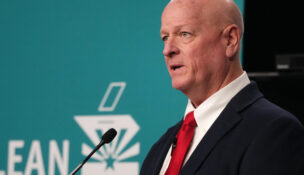
House Appropriations Chairman David Livingston, R-Peoria, said he preferred a budget that gave agencies discretion with what’s cut instead of lawmakers making those decisions. He said this was also the preferred approach for the Governor’s Office when state agencies faced cuts in a previous budget.
“I hope my members don’t take this the wrong way, but (agency directors) know more about what’s happening in that agency than my guys do,” Livingston said.
Hobbs also criticized the plan for attempting to implement eligibility changes to Medicaid and the Supplemental Nutrition Assistance Program, saying the budget will pay for large tax cuts by “kicking Arizonans off their health care and taking food off their tables.”
The GOP budget includes several provisions that Hobbs has already vetoed this session, like expanded work requirements for SNAP and increased eligibility checks for the Arizona Health Care Cost Containment System.
The budget would also require the Department of Economic Security to reduce the state’s SNAP payment error rate to 3% or lower, going beyond the 6% payment error rate mandated by H.R. 1. DES Director Michael Wisehart told reporters that the department’s SNAP distribution has already been strained by the federal changes and the 2025 federal government shutdown, a strain that has led to more SNAP recipients being kicked off the program in Arizona than in any other state.
“All of that led to a situation where we had to leverage the resources that were available to us to do some tremendously challenging work,” Wisehart said. “We are also utilizing an eligibility IT system — this isn’t an exaggeration — that was built more than 45 years ago. And so when you add all of these things together, it becomes extremely challenging to navigate through all of the changes that are happening simultaneously.”
The Governor’s Office noted that Republicans are not offering any additional funding to DES or AHCCCS to implement the eligibility changes required by both H.R.1 and the GOP’s proposed budget.
Both legislative Democrats and Hobbs have also called for a repeal of the state’s data center tax exemption, a proposal not included in the GOP plan which Hobbs estimates could generate $38 million in new revenue for the state.
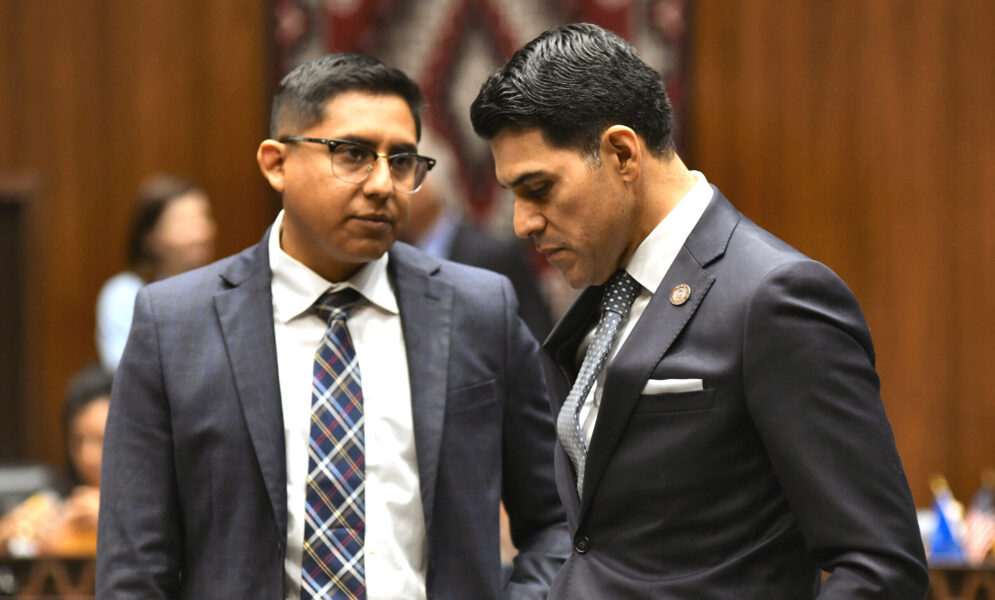
“This Republican budget protects tax breaks for large corporations, including data centers, while cutting support for working families. That is corporations first, Arizonans last,” said House Minority Leader Oscar De Los Santos, D-Laveen.
Democrats have also raised alarm over a proposed increase to state employee health insurance premiums. Under the plan, state employees would see their premiums increase by 10% this year, 5% the next year and another 5% the following year. State employees currently pay about 7% of health insurance costs.
“It’s a hell of a deal,” Livingston said. “I think most of us would agree that our state employees are not paying their fair share.”
Hobbs has not yet signaled publicly if she will veto the budget, but without Democratic support and with Republicans already saying they’re ready to resume negotiations, the proposal, as currently written, is unlikely to be signed.
Hovering over negotiations is Hobbs’ yet-unlifted bill moratorium — an April 13 promise she made to veto any measure that makes it to her desk before a Republican proposal.
“When we issued the bill moratorium, it was about seeing their budget and getting back to the negotiating table in good faith,” Hobbs told reporters April 28. “I’m hopeful that we can get back to the table and start having real conversations about a budget that works for Arizona.”
The bill signing moratorium came about three weeks after Hobbs announced she was pausing budget negotiations because Republicans were unwilling to consider potential revenue from a Prop. 123 renewal in budget discussions.
And while a Prop. 123 renewal would free up about $300 million for the budget, the measure still remains dependent on voter approval.
“I invite the governor to come back to the negotiation table,” said Rep. Matt Gress, R-Phoenix. “This is the budget package and there will be some modifications made, but at the end of the day, we’re going to respect Arizona taxpayers.”