Sign In


 Free Newsletter

Arizona’s story is America’s story — before and after statehood
Kiera Riley, Arizona Capitol Times//July 2, 2026//
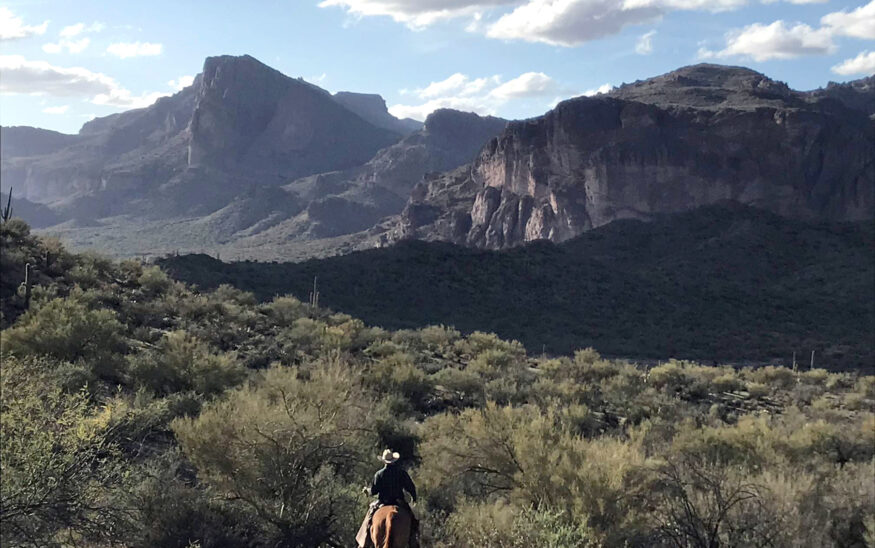
Chuck Backus, former owner of Quarter Circle U Ranch, rides into Arizona’s Superstition mountains. (Courtesy of Amy Doyl)
Arizona’s story is America’s story — before and after statehood
Kiera Riley, Arizona Capitol Times//July 2, 2026//


Key Points:
-
Arizona’s history reflects American history beyond date of statehood
-
Historians urge reflection beyond the nation’s 250th celebration
-
Individual stories shape and inform state and nation’s history
 Cattle roamed the rocks and bluffs around Quarter Circle U Ranch long before the U.S. president’s signature cemented Arizona’s statehood.
Through verdant springs and unflinching heat each summer, a string of families have reared and herded cows in the shadows of the Superstition Mountains since 1876 – with the buck now passed to Amy Doyle from her parents, Chuck and Judy Backus, who ran the ranch for more than 40 years.
“We’re hoping to be here in 50 years,” Doyle said.
The ranch’s settlement and struggles came well before Arizona joined the United States proper, but the history of Quarter Circle U ranch is American history — a history still living with the Doyle family.
Arizona became a state 132 years after the signing of the Declaration of Independence. But as the United States celebrates its 250th birthday, historians work to thread the lives, stories and ethos of Arizona before and after statehood into the history of the country.
“Arizona history is American history,” Jaynie Adams, history engagement manager for the Arizona Historical Society, said. “Every event, every choice that happens is informed by a larger context where people are taking their own values and their own understandings of what it means to be an American.”
On Valentine’s Day in 1912, Arizona became the 48th state to join the Union. But before the presidential signature, Arizona had already laid bare a vast history spanning indigenous stewardship, Spanish missions, Mexican frontiers, lawless Wild West settlements and budding economic output as an American territory.
“Arizonans, in particular, have this really strong sense of independence and have this really strong sense of personal freedoms,” Adams said. “Historically speaking, I think that comes from an assertion of belonging to a larger American experiment.”
Marshall Trimble, the Arizona state historian, noted that before statehood, Arizona provided opportunities in land ownership where there was none before.
“You could own your property. You could be your own boss,” Trimble said. “That’s one of the things that’s so great about America is people could rise. You could rise up.”
He told the story of Ed Schieffelin, a man who arrived in Arizona broke and later struck riches in silver, prompting the founding of Tombstone.
“This was a guy who was in rags,” Trimble said. “This story played out many times.”
Trimble himself grew up in Arizona as the son of a farmer and waitress. He lived in a two room trailer house with his family. He was the first to go to college and paid his way earning $1-an-hour at Encanto Park.
He went on to become a teacher, then a professor, then a published author, chronicling the countless stories woven into Arizona’s history.
“Only in America could that have happened,” Trimble said.
Though promise existed in the West, Adams acknowledged the fraught foundation — manifest destiny, settler colonialism and the mass displacement of Indigenous people who had stewarded land for generations.
“It’s complicated to look at histories like Arizona and go ‘Well, this doesn’t necessarily align with life, liberty, and the pursuit of happiness writ large,’ ” Adams said. “It’s complicated to think about our values as Americans versus our actions as Americans, and the gap between the two.”
Governor of the Gila River Indian Community Stephen Roe Lewis expressed similar sentiment, acknowledging both the promise and reality of America and the tribal nations’ history reaching far beyond the 250-year mark.
“I see this anniversary as a moment for reflection, not just celebration. It should be a time to honor what is best in America, but also to tell the truth about where the country has fallen short and where it still has work to do,” Lewis said.
He noted the tension between the ideals of “liberty and equality” and the history lived by Indigenous people.
“At the same time the United States was declaring that all people are created equal, Native people were being displaced from our lands, denied basic rights and often excluded from the promises being made. That conflict is part of the American story, and it cannot be ignored,” Lewis said. “But I also believe those words still matter. The question is whether America is willing to make them real for everyone, including tribal nations.”
Gov. Katie Hobbs deemed it a “pivotal moment” in the state and looked to the work in the state now to move the country forward.
“Arizona’s part of the West, the new frontier, and we are doing so much here that is advancing our national security and our economy. Whoever’s in the White House, (no matter) what their agenda is, Arizona is a key component,” Hobbs said. “I just think our story is like the story of what America is about.”
Adams centered the anniversary as an opportunity for reflection.
“This is more about – where are we? What has happened? Where are we going, right? That’s why we study history, generally. It’s not to have fun facts for a cocktail party,” Adams said. “It’s to use the knowledge of the past to help us make informed choices about where to go in the future.”
The Arizona Historical Society partnered with the Arizona America250, a coalition encompassing major state industries, the Arizona Secretary of State’s office and civic and education groups, to celebrate the U.S. milestone.
To mark the occasion, Arizona America 250 created a guide of significant historical landmarks, destinations and natural wonders. It hosted a traveling museum touting the state’s replica Liberty Bell around all 15 counties, put on an art installation and it forged a commemorative copper ingot.
For its part, the Arizona Historical Society published a “Journal of Arizona History.”
One chapter chronicled the concurrent histories in the Southwest and on the East Coast during the Revolutionary War. Historians delved into images, food traditions and documents marking the state’s history.
Adams put together a collection of artifacts to tell the stories of the people past and present.
Entries include a tus — a water-carrying basket crafted by the Yavapai people, a beaver trap, a rifle owned by Geronimo, a revolver owned by Wyatt Earp, a mounted head of a mountain lion, a cattle branding iron, an iron lung, a hockey helmet and a quilt crafted in memory of migrants who died while attempting to cross into the United States.
The items will be on display at the Arizona History Museum in Tucson for the next year, starting on July 4. Adams hopes it brings all Arizonans, in every corner of the state and in every walk of life, into the fold.
“Centering Arizona in this story and helping people see that their history, the history of their family, their neighbors, their community, that history matters, and that all history is local history, I think that’s really powerful,” Adams said. “I hope that it will encourage people to think about their own history as being something that’s integral to the national story.”
More for America’s 250th:
Paying for the party: 250th celebrations requiring everyone to dig deep
Is Massachusetts still leading, or resting on its laurels?
250 years in, Pennsylvania is still fighting over the rules of democracy
From courtrooms to coal country: Pennsylvania’s unlikely road to America’s 250th
The Hoosiers who helped forge America’s more perfect union