Sign In


 Free Newsletter

The Protect Education Act harms Arizona’s disabled students and school choice
Jack Reany, Guest Commentary//June 12, 2026//

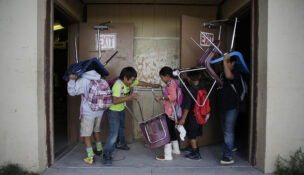
Students work on their computers during the last week of classes at Frye Elementary School in Chandler on May 23, 2023. (AP Photo/Darryl Webb)
The Protect Education Act harms Arizona’s disabled students and school choice
Jack Reany, Guest Commentary//June 12, 2026//


Editor’s note: This article is a direct response to: https://azcapitoltimes.com/news/2026/06/09/arizona-esa-moms-demand-voucher-reforms-to-protect-education-for-students-with-disabilities/

A recent opinion article urging Arizonans to support the Protect Education Act was written by two self-described “ESA moms,” Dr. Kathy Boltz and Amy Pedotto. Readers deserve an important piece of context this article left out: these aren’t ordinary parents offering a grassroots testimony from the ESA community. Both are board members of Save Our Schools Arizona, the anti-school-choice organization backing this ballot initiative. This is an opposition campaign promoting its own product, dressed in the language of concerned parenthood.
So, let’s talk about the product they’re selling, and what it would actually do.
First, understand what the ESA program is. It allows any K-12 student to opt out of public school and direct roughly half the cost of their public education toward an alternative of their family’s choice: private school, microschool, homeschool, tutoring or specialized services. This opens doors to premium educational opportunities once reserved for a privileged minority. Most new ESA students come directly from public schools, saving roughly $7,000 each, since ESA funding is about half of what is spent per public school student. That’s a rare policy win-win: lower costs for taxpayers and an education tailored to unlock each student’s potential.
So why reform a program that’s working? The authors invoke “fraud, waste, and luxury purchases” to justify the Act. But here’s what they don’t tell you: luxury items are already banned under current ESA rules. Jewelry, cell phones, televisions and vacations — all prohibited. ESA spending is restricted to educational uses, and parents must submit receipts, itemized invoices, and educational justification for expenses, all backed by state audits and enforcement. A recent Arizona Department of Education report found only 1.9% of ESA funds were misspent on unauthorized items, with just 0.3% tied to egregious fraud. By government standards, ESA is already one of Arizona’s most accountable programs.
The ESA fraud narrative is the Trojan horse; the act’s real agenda is hidden inside. Consider what it does to the disabled students it claims to protect.
The authors say the act “preserves access to ESA for all students with disabilities.” Read the fine print. Buried in the eligibility rules (sections 5.3 and 4.10.b) is a serious concern: some disabled students who entered the program after 2022 could be forced to complete a 45-day public school attendance requirement to keep their ESA. For a child currently thriving in a private placement — a child with severe autism, anxiety or sensory needs — being sent back into a public school classroom for 45 days to “re-qualify” would be the exact ordeal these families fled, and could trigger developmental regression.
They celebrate that the act allows disabled students “a full year of ESA rollover.” But that’s a cap where none exists today. Many families of disabled children have saved patiently across multiple years for expensive, episodic needs like an assistive communication device, an intensive therapy program, or vocational training. That money is already allocated and sits in the child’s individual ESA account. The act would reach into those accounts every July and seize every dollar more than a year old. Families who have saved responsibly for their child’s future are the ones the act punishes.
And the harms don’t stop with disabled students. The act strips existing legal protections from private schools, grants sweeping new regulatory authority to a state Board of Education that the governor has already reshaped against school-choice, and hands a politically motivated attorney general independent power to investigate and sue families and providers. These aren’t guardrails against waste: they’re levers of control, handed to officials who have made no secret of their hostility to the ESA program.
Worse, the Protect Education Act is engineered as a one-way ratchet: the Legislature can pile on new restrictions with a simple majority, but loosening them requires another ballot initiative and statewide vote. Even the $150,000 income cap is designed to tighten, quietly excluding more families as inflation erodes its real value over time. This isn’t a program being reformed. It’s a program being slowly strangled.
Here’s the part that should give every family pause. This initiative is bankrolled almost entirely by the national teachers union in Washington, D.C. — an organization whose core interest is keeping students and dollars inside the public system. The group that benefits most from shrinking ESA is funding the campaign to shrink it, then sending its own board members to write op-eds promising “this protects students.” Consider the source.
ESA already has real accountability, but I’d welcome more. I’d vote tomorrow for a clean bill that sped up fraud prosecution, modernized audits with AI-assisted review, and increased ESA oversight staffing at the Department of Education. But the Protect Education Act isn’t that bill, nor is it really about “protecting education.” It is a power grab designed to build a permanent legal framework that will choke educational opportunity in our state. For disabled families especially, the gap between its promises and its provisions is stark. Real protection would preserve eligibility without traps, savings without raids, and schools and providers without hostile oversight. The Protect Education Act delivers the opposite. I urge voters to decline to sign this ballot petition and vote “no” in November.
Dr. Jack Reany is an ESA dad and Mechanical Engineer in Sahuarita, Arizona.