Sign In


 Free Newsletter

Phoenix can’t afford political theater with a police department in crisis
Anne Matlock Ender, Guest Commentary//June 19, 2026//
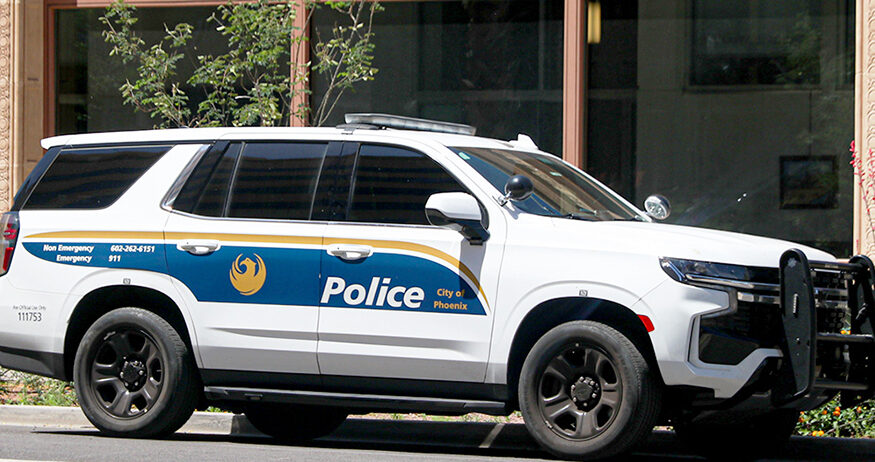
A Phoenix police vehicle is parked on a city street. (Photo by Gianna Abdallah/Cronkite News)
Phoenix can’t afford political theater with a police department in crisis
Anne Matlock Ender, Guest Commentary//June 19, 2026//



Phoenix is facing a public safety crisis that city leaders can no longer afford to ignore.
The Phoenix Police Department is currently operating hundreds of officers below authorized staffing levels. While the department is authorized for more than 3,100 officers, only 2,461 sworn officers are currently available to serve a city of 1.7 million residents spread across 515 square miles. To put that into perspective, Phoenix had 2,534 officers in 1996 when the city was smaller, less populated and still expanding through annexation.
This staffing shortage is not merely a statistic — it is a growing threat to public safety. Fewer officers mean reduced patrol coverage, longer response times to emergency calls, heavier caseloads for detectives, and increased burnout among the officers who remain.
Yet instead of focusing on recruitment, retention, and support for law enforcement, the Phoenix City Council has chosen to devote significant time and taxpayer resources to the so-called Community Transparency Initiative (CTI) — a proposal that is legally questionable, a drain on city resources, and disconnected from the realities facing public safety in Phoenix.
Let’s start with the law. Arizona Revised Statutes 11-1051(A) clearly states that no city or political subdivision may “limit or restrict the enforcement of federal immigration laws to less than the full extent permitted by federal law.” Any attempt by the city of Phoenix to create policies that discourage or interfere with cooperation between local and federal law enforcement places the city on uncertain legal ground and invites unnecessary litigation risk at the taxpayers’ expense.
Then there is the cost. A multilingual “Know Your Rights” campaign would require substantial taxpayer funding for translation services, media purchases, digital outreach, printed materials and ongoing updates. Additional costs include training city employees on new protocols, implementing compliance procedures across departments, and maintaining the administrative infrastructure necessary to support the initiative. None of these expenditures address the city’s most pressing challenge: rebuilding the ranks of the Phoenix Police Department.
At a time when every available resource should be focused on strengthening public safety, CTI represents a solution in search of a problem. It diverts attention, money, and energy away from the urgent task of recruiting and retaining the officers Phoenix desperately needs.
Unfortunately, the misplaced priorities do not stop there.
Rhetoric from certain members of the Phoenix City Council has reflected a troubling direction. During the February 18th City Council meeting, one councilmember described funding for training pilots in the department’s aviation unit as “war-like tactical aviation” and criticized what they characterized as the “continuation to militarize Phoenix police.”
A few weeks later, Phoenix police helicopters were shot at on two separate occasions within a two-week period. In the second incident, officers were forced to make an emergency landing in a Walmart parking lot while responding to reports of gunfire.
This is an alarming escalation that underscores the very real dangers involved in protecting this city. Sadly, apart from Maricopa County Attorney Rachel Mitchell, there have been no other local leaders that addressed or condemned these egregious actions. What message do you think that sends to our officers? Operation Blue Ribbon and other public safety advocates greatly appreciate the county attorney and her office’s leadership on this.
Leadership matters. Tone matters. And when elected officials publicly downplay or recklessly mock the tools and personnel responsible for public safety, it sends a message — not just to officers — but also to those who seek to harm them.
The message coming from City Hall should be clear: Phoenix supports the men and women who risk their lives to protect our neighborhoods. The city needs to focus on improving officer morale, increasing the number of recruiters, reversing retention trends, and ensuring officers have the resources necessary to keep residents safe.
Instead, too often, officers hear partisanship while facing mounting workloads, increasing dangers and shrinking ranks.
This is the real crisis. This is the real emergency. And it demands the attention of city leaders.
Anne Matlock Ender is president of Operation Blue Ribbon, a law enforcement advocacy group.