Sign In
Upcoming Event
 Free Newsletter

Maricopa County bans insider betting by employees
Jakob Thorington, Arizona Capitol Times//July 16, 2026//
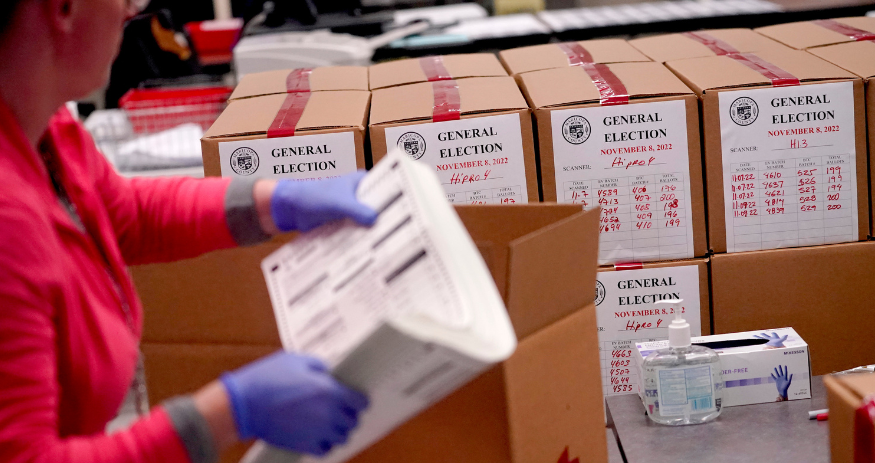
An election worker boxes tabulated ballots inside the Maricopa County Recorder's Office on Nov. 9, 2022, in Phoenix.(AP Photo/Matt York, File)
Maricopa County bans insider betting by employees
Jakob Thorington, Arizona Capitol Times//July 16, 2026//


Key Points:
-
The Maricopa County Board of Supervisors adopted a resolution that prohibits county employees from insider trading in prediction marketplaces.
-
The policy follows an executive order signed by Gov. Katie Hobbs banning state-level employees from doing the same thing.
-
Other government agencies are considering similar measures, including the Arizona Legislature, the Attorney General’s office and the Secretary of State’s office.
The Maricopa County Board of Supervisors unanimously voted this week to adopt a policy prohibiting county employees from using insider government information in prediction markets such as Kalshi and Polymarket.
This comes as a growing number of government agencies adopt similar policies to prevent employees from cashing in by using nonpublic data.
County Supervisor Thomas Galvin, a Republican, helped draft the resolution with the board’s Republican Chair, Kate Brophy McGee.
Galvin said in an interview with the Arizona Capitol Times that he wanted to ensure the policy was enacted before the state’s primary election to let Arizonans know the county was being proactive in implementing election integrity measures.
The prohibition is primarily intended to prevent county employees from betting on elections, given that election-night data is available to them before election results are publicly posted.
Galvin said there is a brief window in which county workers could place a bet on their cell phones before results are posted, but he emphasized the window is so short that he’s not sure anyone could realistically do it without getting caught.
“You’re probably too busy at that moment, and if you have a prediction market app open on your other phone, then you’ve got a lot of bigger problems,” Galvin said.
County officials said during the board’s Wednesday meeting that they’re not aware of any employees who have profited off prediction markets with insider information. Any employee determined to engage in such conduct following the resolution will likely be fired, Galvin said.
“This is to give our residents and constituents peace of mind that not only is it very unlikely to occur, but we want to make sure that people know we’re preventing our employees from doing it,” Galvin said.
Employees could place bets in other areas related to county government. Court outcomes or emergency weather activations have potential for inside information to be misused. There are about 13,000 employees working for Maricopa County, but the board’s resolution doesn’t apply to employees in other elected offices, since personnel decisions are vested in the officeholder.
The Maricopa County Recorder’s office did not respond to a request for comment from the Arizona Capitol Times before Thursday afternoon.
Gov. Katie Hobbs signed an executive order on July 9 that keeps executive branch employees from using nonpublic information to profit on prediction markets.
She urged other agencies to follow her example after the federal indictment of U.S. Army soldier Gannon Van Dyke, who allegedly made more than $400,000 trading on Polymarket using classified information about military operations.
“Arizonans deserve a state government that works for them, not one where insiders exploit public service for their own gain,” Hobbs said in a statement. “I’m proud to set clear, commonsense ethical standards on prediction markets to hold our government accountable. Public service is a privilege, and we will not tolerate anybody abusing that privilege to line their own pockets.”
Some state agencies, such as the Secretary of State and Attorney General’s offices, are now reviewing the executive order and considering issuing guidance akin to the governor’s. Others point to existing internal ethics policies that already address the issue.
Arizona Supreme Court Chief Justice Ann Timmer recently confirmed that ethical standards and policies prevent judicial officers and employees from participating in prediction markets.
As a general rule under the Code of Judicial Administration, anyone working for state courts must “uphold and promote the independence, integrity, and impartiality of the judiciary and shall avoid impropriety and the appearance of impropriety.”
But in more specific terms, judicial officers and employees are barred from using their position for personal gain, special privileges or exemptions, with a clear provision prohibiting the sharing or use of information that’s unavailable to the public for “personal gain or advantage or for any purpose unrelated to court duties.”
Galvin said Maricopa County is the first major county in the nation to adopt a policy like the governor’s executive order. He drafted the resolution after learning that several private companies prohibit their employees from using insider information in prediction marketplaces, including Kalshi itself.
“Kalshi already bans insider trading and imposes penalties for violations,” said Kalshi spokeswoman Jacki McGavick in a statement to the Arizona Capitol Times. “Formalizing this and making it an industry standard across all prediction markets is a welcome measure.
Senate President Warren Petersen, R-Gilbert, said legislative leaders are also interested in adopting a similar policy next session.
Arizona Capitol Times Education and Courts Reporter Kiera Riley contributed reporting to this article.