Sign In


 Free Newsletter

Arizona is building a future the Colorado River cannot supply
Rusty Childress, Guest Commentary//February 6, 2026//
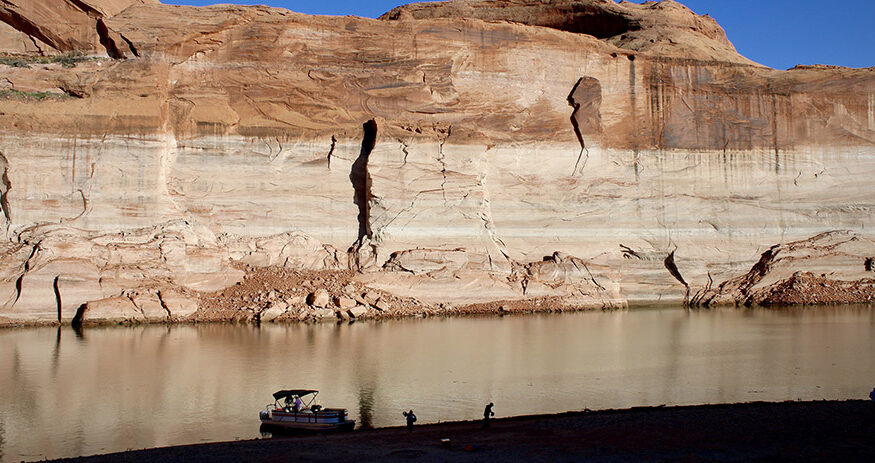
People unload a boat on the shores of Lake Powell on April 10, 2023. (Photo by Alex Hager/KUNC)
Arizona is building a future the Colorado River cannot supply
Rusty Childress, Guest Commentary//February 6, 2026//


The potential collapse of the Colorado River system is not a distant theory or an abstract climate warning. It is a direct threat to the water supply of roughly 40 million people across seven U.S. states and Mexico. Yet growth across the basin continues as if risk itself were imaginary. More homes are approved. More long-term water obligations are created. More faith is placed in future solutions that do not yet exist.
This behavior mirrors another crisis unfolding in plain sight. In artificial intelligence, leading researchers and industry executives now acknowledge that credible estimates place the risk of catastrophic failure at up to 25%, with some warning that loss of control could pose an existential threat to humanity. Despite this, AI development continues at full speed because no company or nation wants to slow down first. This is not optimism. It is a dismissive response to known risk, driven by competition and short-term incentives.
The same logic now governs Western water policy.
The Colorado River is already over-allocated. This is not opinion. It is math. Average flows are declining. Variability is increasing. Aridification has permanently shifted the basin into a hotter and drier regime. Engineers and hydrologists have repeatedly stated that Lake Powell and Lake Mead are unlikely to ever return to full pool under modern conditions. These reservoirs were designed for a climate that no longer exists.
Yet demand continues to grow.
What makes the situation more dangerous is that artificial intelligence and water scarcity are not separate challenges. They are now directly linked. Modern AI systems require enormous amounts of electricity, and electricity generation requires water. Power plants need cooling. Data centers consume water directly and indirectly through energy production. In arid regions, this means AI expansion increases pressure on the same limited water supplies already stretched to the breaking point. What appears to be a digital problem quickly becomes a physical one.
This creates a compounding risk. AI accelerates energy demand. Energy demand accelerates water demand. Water scarcity then feeds back into economic and political instability. Treating these pressures as separate allows each to worsen the other without meaningful oversight. Together, they push the system faster toward failure.
New subdivisions, industrial facilities, and speculative development are still being approved as if water were guaranteed simply because pipes and contracts exist. Conservation is discussed, but limits are deferred. The result is a system that looks adaptive while quietly becoming more fragile.
This pattern is not new. In Collapse, Jared Diamond showed that societies rarely fail because they lack knowledge or warning. They fail because they understand the risks and continue anyway. Leaders acknowledge limits, then choose short-term stability and growth over long-term survival. Decline becomes normalized, responsibility is deferred, and action is delayed until real choices are gone.
Experts are now warning that under plausible conditions, Lake Mead or Lake Powell could approach dead pool status or lose power generation as early as this year. If that were to occur, the consequences would be immediate and severe. Water deliveries would be curtailed. Hydropower generation would cease. Major infrastructure such as the Central Arizona Project could lose its primary supply entirely. This would not be a temporary disruption. It would trigger cascading impacts across agriculture, housing and financial markets, energy systems, and public trust. Continuing business as usual under deep uncertainty is irrational.
What makes this moment so dangerous is not ignorance. We know the risks. We have known them for years. The danger lies in a dismissive response to that knowledge, one that acknowledges limits in words while continuing business as usual because saying no is politically and economically inconvenient.
That is why a moratorium on new growth tied to Colorado River water is not extreme. It is responsible. Just as many now argue that AI development should pause until risks are better understood and controlled, water policy must adopt the same precautionary principle. No new long-term water commitments should be approved unless there is a verifiable and physically reliable supply to support them. If that supply never materializes, then growth must permanently adjust to reality.
This is not an argument against progress. It is an argument for survival. The river does not negotiate. Physics does not compromise. Optimism does not create water. Everything is not under control, but we still have the ability to stop pretending that it is.
Rusty Childress is an Arizona native and nature photographer.