Sign In




 Free Newsletter
A Capitol moment: Y2K and Gov. Jane Hull’s veto prowess
Brock Blasdell, Arizona Capitol Times//April 17, 2026//
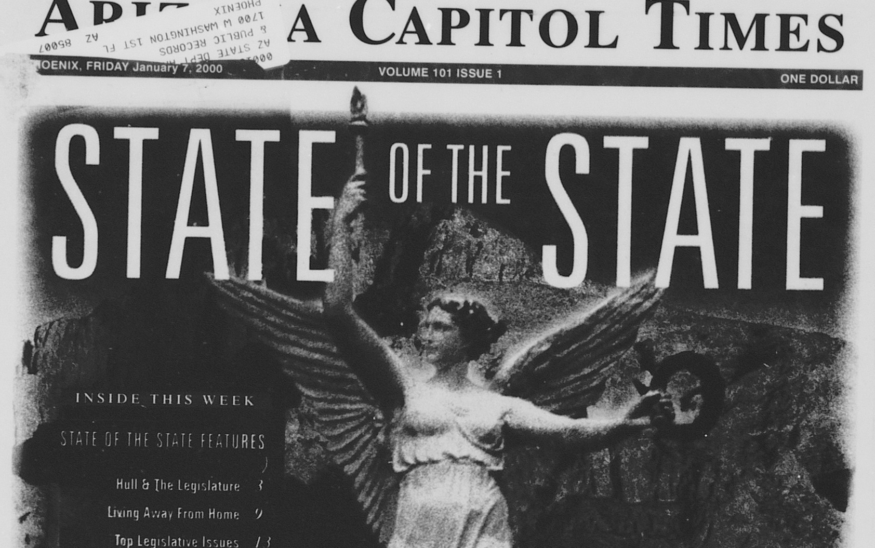
The Arizona Capitol Times special State of the State edition, dated January 7, 2000, commemorates the first Arizona legislative session of the new millennium. (Credit: Arizona Capitol Times Archive)
A Capitol moment: Y2K and Gov. Jane Hull’s veto prowess
Brock Blasdell, Arizona Capitol Times//April 17, 2026//


 “The year 2000 computer bug inconvenienced a customer at the Motor Vehicle Division. And that was about it.”
While that diagnosis may be a bit glib, that’s what former Arizona Capitol Times reporters deemed appropriate to lead one of the three top stories for the publication’s first issue of the new millennium.
The article, “Y2K Bug’s Bark Proves Worse Than Its Byte,” is a personable and fun write-up of some of the scant ways the impending digital catastrophe — as many saw it — impacted Arizona.
But it wasn’t the only issue at hand that week, and the minor glitch at the MVD and backup security measures at the Yavapai County Courthouse that were reported were far from center stage for our former editors. They also shared the front page with Rep. John Verkamp’s resignation and drunk driving scandal, a write-up of Clean Elections’ latest appointment, David McKay, and even a joke from Henry David Thoreau about governors.
“I went to the store the other day to buy a bolt for our front door, for as I told the storekeeper, the Governor was coming here. ‘Aye,’ said he, ‘And the Legislature too.’ ‘Then I will take two bolts,’ said I. He said there had been a steady demand for bolts and locks of late, for our protectors were coming.”
— Henry David Thoreau
More prominently, and far beyond the Y2K scare, the January 7 issue also featured a familiar January Capitol event — the governor’s State of the State address. And along with it? An old perspective on a fresh issue: veto power.
To be delivered by then-Gov. Jane Dee Hull, a Republican who served in the state’s highest office between 1997 and 2003, the article focuses on her biography, her rise to power and the variety of issues she thought critical to her upcoming term.
Even now, 26 years later, the echoes of her most prominent concerns can still be heard in the Legislature. So, too, does her use of the veto and the reaction from long-gone legislators reveal a striking similarity to modern debates, proving the truth of an old adage: Some things just don’t change.
A Black Widow
Hull had a reputation for slashing budgets. According to reporting from former Arizona Capitol Times staffer Tom Collins, she was first elected to the Legislature in 1979 under the banner of a fierce anti-tax conservative. Her penchant for slashing budgets had earned her the title of “Black Widow,” an honor she shared among a group of other likeminded conservatives.
It makes sense then that her primary issues for the session included K-12 funding, charter school reform, the construction of state hospitals, and what to do with the state’s new windfall of cash earned from recently enacted tobacco litigation.
More significantly, and perhaps more relatably, Arizona’s Y2K session appears to have been marred by a tense and veto-scarred Legislature. According to Collins, Hull had vetoed 21 bills during the 1999 session, bringing her average to 17 bills per session, an alarming record for the period.
That expression of gubernatorial power set off a tense summer of silence, with state officials, including Hull, criticizing the lack of communication among elected officials.
“I don’t think anybody tried very hard this summer,” Hull said, referring to the months leading up to Y2K.
So what exactly was Hull opposed to? Several appropriations bills, or proposals to fund projects, made the cut — literally. Most notably, she declined to provide extra funding for Arizona’s community colleges and for home development on the Navajo reservation.
But not all of her ink was spent slashing bills directly related to the state budget. The fiscally-focused governor also had a sore spot for legislation she believed infringed on her executive power.
S1143, sponsored by then-Sen. Tom Freestone, who served between 1997 and 2001, also met with Hull’s red ink. The proposal would have expanded open meeting laws to also apply to the state’s executive branch — an idea Hull blasted as hypocritical, given her contention that the Legislature was itself operating without adequate transparency.
“We felt blindsided on that,” Freestone said.
That blindside prompted a tense return to the GOP’s first caucus of the Y2K session, with Freestone joining forces with then-Sens. Dave Petersen and John Huppenthal on Nov. 29, 1999, to push for a “veto recess” to review Governor Hull’s rejection of their proposals.
Huppenthal, who hopped back and forth between the Legislature’s chambers between 1992 and 2010 before finally serving as the secretary of state, had joined the cause, according to Collins, because he believed Hull had vetoed his own proposal to recreate a Symington-era Administrative Rules Oversight Committee as a matter of political revenge.
“Having suffered what I feel was a retaliation veto, I would be in support,” Huppenthal said before the meeting of fellow conservatives.
Petersen, by contrast, joined the push against Hull on principle. His S1303 had passed both houses by wide margins before it met its end by the governor. He was told, like Huppenthal, that the veto was retaliation — this time for Petersen’s refusal to tighten charter school accountability.
“We made changes and still got vetoed and that was kind of disconcerting,” Petersen said. “I guess you have to come to (the) conclusion that there has to be another reason.”
Senior legislator and then-Senate Minority Leader Jack Brown, a Democrat born in St. Johns, Arizona, in 1929, had his own bill, H2600, which would have increased aviation funding by $2.7 million, also vetoed by Hull.
“Its hard to understand,” Brown said. “… I think she was using her vetoes to tell people that she was the boss.”
For her part, Hull said she was surprised legislators had taken ire with her vetoes.
“I would just remind them that the phone works both ways,” Hull said.
The tension leading up to the first session of the new millennium may have been high, but despite the silent summer and allegations of political retaliation, there remained a resounding message of comradery and communication that boiled through.
Freestone himself, who led the GOP caucus criticism against Hull, may have said it best when asked his thoughts about the controversial figure, a woman he had known for nearly 30 years at that point.
“The basic character of a person doesn’t change,” Freestone said. “You have to understand that when a person gets in a difficult position like that, there’s going to be pressure that sometimes might sort of alter your relationship.”
“(It’s important) it doesn’t,” he continued. “It’s just a momentary thing.”
In the end, despite the “Black Widow’s” strict conservative stance and penchant for power dynamics, the year 2000 brought a host of significant changes to Arizona.
In total, 1,373 bills, memorials and resolutions were introduced. Of those, 420 made it to the governor, and 402 were given Hull’s approval. By the end of the session, Hull had vetoed a total of 15 bills — a pittance compared to current figures.
Notable pieces of legislation passed during the Y2K session include Proposition 301, championed by Hull herself and met with voter approval, which increased the state sales tax to provide long-term funding for Arizona’s schools, teacher salaries, community colleges and research — essentially establishing the financial foundation of Arizona’s modern state schools. Hull also signed a bill to encourage the use of alternative fuels through tax incentives for natural gas and propane fueled vehicles, those commonly used on worksites across the state today.
Hull died in 2020, at the age of 84, on the same day as her husband. And while her legacy in Arizona is far from forgotten, her efforts and attitude during Arizona’s first session of the millennium highlight just how little has changed in the past quarter-century of Arizona politics — and the reason why the Arizona Capitol Times has always loved covering the state Legislature.
Editor’s Note: This article is part of an ongoing series highlighting the Arizona Capitol Times’ 120th Anniversary. Read our other anniversary pieces below.
A century of service — Arizona News Service covers the Capitol, and always has