Sign In
Upcoming Event
 Free Newsletter

Kalshi faces criminal charges in Arizona as judge denies injunction
Howard Fischer, Capitol Media Services//April 9, 2026//
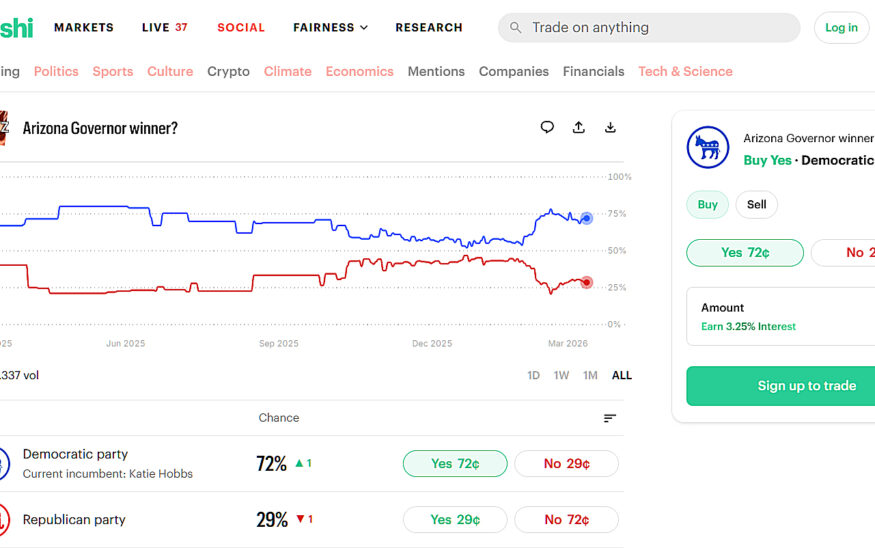
A Kalshi prediction on the 2026 Arizona gubernatorial race. (Howard Fischer / Capitol Media Services)
Kalshi faces criminal charges in Arizona as judge denies injunction
Howard Fischer, Capitol Media Services//April 9, 2026//


Key Points:
-
Federal judge allows Arizona to prosecute online gambling site Kalshi
-
Kalshi claims its activities are regulated by the Commodity Futures Trading Commission
-
Kalshi faces 20 criminal charges, including 16 sports-related counts
A federal judge is refusing to block the state of Arizona from prosecuting an online gambling site for violating state gaming laws.
In an opinion late April 8, U.S. District Court Judge Michael Liburdi acknowledged a legal conflict between Kalshi and the state over which laws take precedence. But he said that, for the moment, he would allow Attorney General Kris Mayes to continue pressing charges.
Kalshi contends that its activities, like letting people bet on everything from political and social events to sports and weather, are regulated by the federal Commodity Futures Trading Commission.
That, the company’s attorneys told the judge, trumps arguments by Mayes, who says state laws allow only regulated entities to take wagers — and only on sporting events. So they asked Liburdi to issue an injunction barring the state from pursuing the 20 criminal charges it has brought against Kalshi.
Tied up in all of this is whether the various events that Kalshi customers can wager on fall under the definition of “swaps” within the federal Commodity Futures Act. That involves transactions in which people can agree to bet money on a future contingent event.
So, for example, Arizonans logging into the Kalshi website today can put money down on what they think will be the rate of the U.S. tariff on China on July 1, how high the unemployment numbers will go, and even whether Dune Part Three will win an Oscar next year. The price of buying a swap fluctuates depending on how many people bet on an individual outcome.
Liburdi, in a detailed 15-page ruling, said it is “premature” for him to rule on that question of what is a “swap” just yet. But what he did conclude is that while the case is pending in his court, he won’t block the state case from pursuing its criminal charges.
The key, the judge explained, is something called the Anti-Injunction Act.
It says that federal courts can’t block proceedings in state court except in narrow exceptions. More to the point, Liburdi said that act applies as long as there is a case in state court, which is the case here.
What could complicate all that is that this is no longer just a legal dispute between Kalshi and the Attorney General’s Office.
The Community Futures Trading Commission has filed its own suit in federal court. In that case, now consolidated with Kalshi’s original lawsuit, the agency is siding with the company and urging Liburdi to rule that any action by the Attorney General’s Office is preempted.
Liburdi, however, said that, for the moment, the intervention of the Trump administration does not change his belief that Mayes is free to pursue Kalshi in state court. But he did agree to hear arguments from attorneys for the CFTC that they are entitled to block Mayes’ case, even if Kalshi is not.
The company faces its first hearing April 13 in Maricopa County Superior Court.
Mayes has charged Kalshi with four counts of illegal wagering on elections, all based on bets filed by an investigator from her office between December 2025 and February 2026. One of those, for example, is whether Andy Biggs would win the Republican Party primary in his bid for governor.
A spokesman for Mayes declined to say which way the investigator bet. But he said each of those election wagers carries a maximum penalty of $10,000.
The remaining 16 counts involved sports bets, ranging from the outcome of a women’s basketball game between Arizona State University and the University of Arizona to whether Devin Booker would score more than 25 points in a specific game between the Phoenix Suns and the Indiana Pacers. Each carries $20,000 penalties.
A spokesman for Mayes said late April 8 that the office’s lawyers were analyzing the ruling.
“But we believe the court made the right decision,” he said.
There was no immediate response from Kalshi.